


Absolute Navetta 53 Buyer’s Guide
Semi-Displacement YachtRefined semi-displacement design with enhanced livability and 24+ knot top speed. Absolute is a growing brand that delivers exceptional value in the Italian yacht market with the Navetta's innovative use of space and natural light.
Show 5 key features
Updated 10 June 2026 · By Hulls.io Editorial
The Absolute Navetta 53: A Complete Guide
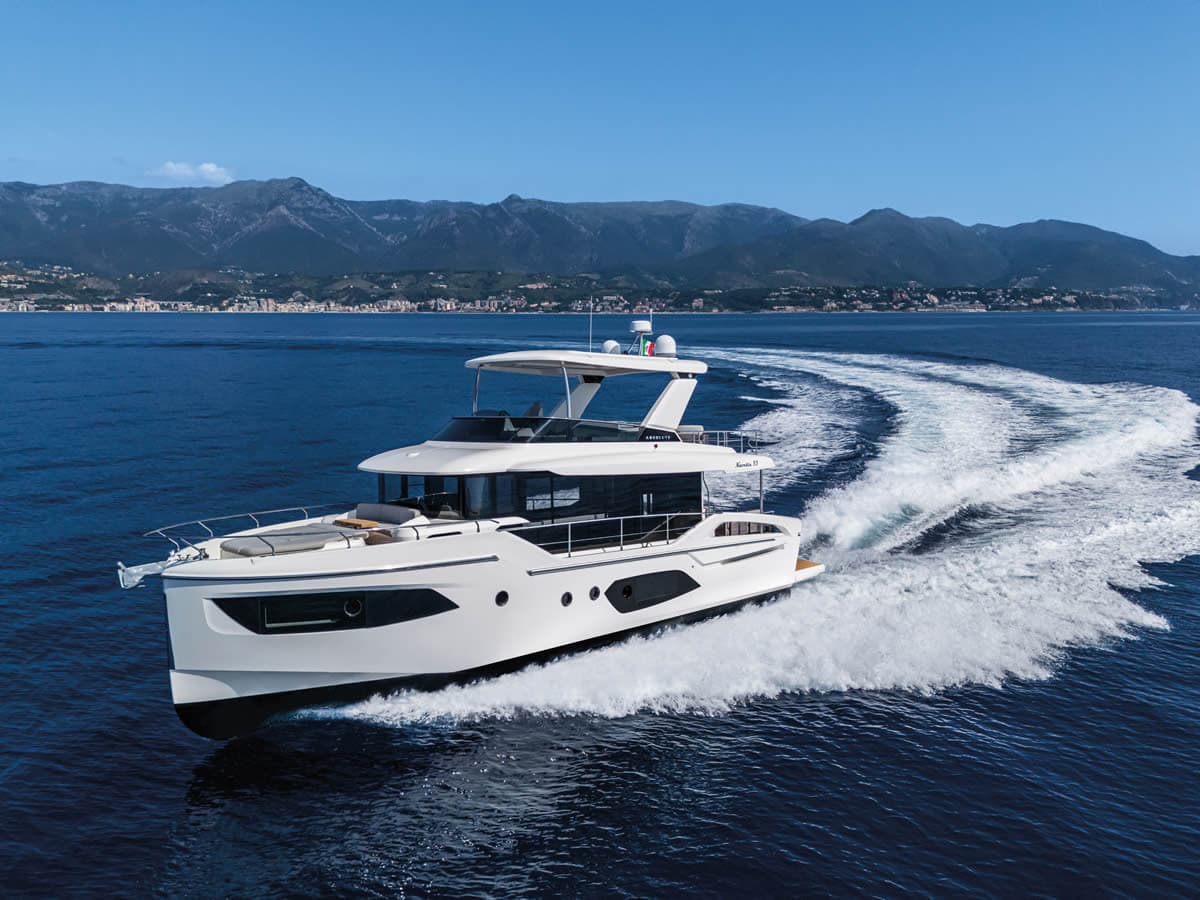
The Absolute Navetta 53 is a 52-foot Italian-built crossover flybridge motor yacht that redefines what a semi-displacement cruiser can offer in the 50–55-foot segment. Unveiled at the 2024 Cannes Yachting Festival by Absolute, it replaces the Navetta 52 — a model that established Absolute’s Navetta line as a serious contender in the long-range flybridge market, with approximately 110 hulls built between 2015 and 2024. The 53 carries forward the Navetta philosophy — quiet, comfortable, fuel-efficient passage-making with genuine liveaboard capability — whilst addressing every meaningful criticism of its predecessor through a comprehensively redesigned cockpit, updated interior volumes, and enhanced energy management via integrated solar panels.
Absolute is one of the few builders in the European motor yacht market that designs and engineers everything in-house. Hull form, exterior styling, interior layout, structural engineering, and systems integration are all handled by the Absolute team at their facility in Podenzano, near Piacenza in Italy’s Emilia-Romagna region. This vertical integration — unusual in an industry where most builders rely on external design studios — gives Absolute unusually tight control over how each element of the yacht interacts with every other. The Navetta 53’s tri-zone main deck layout, for example, was developed as a single architectural concept rather than a compromise between separate hull and interior design teams. The result is a level of spatial coherence that reviewers and owners consistently remark upon.
The “Navetta” designation within the Absolute range signals a specific mission: long-range, semi-displacement cruising with an emphasis on comfort over outright speed. Where Absolute’s Fly line delivers more aggressive performance on a planing hull, the Navetta line pairs a semi-displacement hull form with IPS pod drives to achieve a distinctive balance — capable of 24–25 knots at full power yet genuinely efficient at 9-knot displacement speeds, where the 2,000-litre fuel capacity delivers a range of approximately 475 nautical miles. This dual personality — the ability to cruise economically at trawler speeds or sprint between ports when the schedule demands — is the core Navetta proposition, and the 53 executes it better than any previous model in the line.
Industry recognition has been swift. The Navetta 53 was named a finalist at the World Yachts Trophies 2024, received a Yacht Style Award in 2025, and earned a Best of Boats award in 2025 — a trio of accolades that reflects the breadth of its appeal across European, Asian, and international markets. For buyers evaluating the 50–55-foot flybridge segment, the Navetta 53 represents a genuinely distinctive alternative to the established French, Italian, and British options — a yacht designed from the keel up as an integrated system rather than a collection of separately sourced components.
Hulls.io currently tracks 0 active listings for the Absolute Navetta 53, drawn from brokerages worldwide.
Absolute Navetta 53 Specifications
| Specification | Detail |
|---|---|
| LOA | 15.98 m (52 ft 5 in) |
| Beam | 4.65 m (15 ft 3 in) |
| Draft | 1.50 m (4 ft 11 in) |
| Displacement | 26,190 kg (57,738 lbs) |
| Hull material | GRP (ISS construction) |
| CE category | B (Offshore, up to 200 nm) |
| Fuel capacity | 2,000 litres (528 US gal) |
| Water capacity | 600 litres (158 US gal) |
| Standard engines | 2× Volvo Penta D6-IPS650 (2× 480 HP, 960 HP total) |
| Drive system | Volvo Penta IPS pod drives with counter-rotating propellers |
| Top speed | 24–25 knots |
| Cruising speed | ≈20 knots |
| Economy speed | ≈9 knots |
| Range at economy | ≈475 nm at 9 knots |
| Cabins | 3 (owner’s stateroom + VIP + twin guest) |
| Optional crew cabin | 1 (in lazarette, separate access) |
| Heads | 2 |
| Solar panels | 1.35 kW integrated into hardtop |
| Flybridge | Full hardtop with dining, outdoor galley, helm station |
| Design | Absolute in-house (hull, exterior, interior) |
| Builder | Absolute Yachts, Podenzano, Italy |
| Predecessor | Absolute Navetta 52 (≈2015–2024, ≈110 hulls) |
| Production | 2024–present |
The headline figure is the 2,000-litre fuel capacity — substantially larger than most competitors in the 50–55-foot flybridge segment and a clear signal of the Navetta’s long-range intent. Combined with the semi-displacement hull form and IPS pod drive efficiency, this tankage delivers a genuine 475-nautical-mile range at economy speed — enough to cross the western Mediterranean without refuelling, or to island-hop through the Aegean for weeks without concern for fuel dock availability. By comparison, the Prestige 520 Fly carries 1,100 litres, and the Galeon 500 Fly carries approximately 1,400 litres — the Navetta 53’s 2,000-litre capacity provides a meaningful autonomy advantage over both.
The twin Volvo Penta D6-IPS650 engines each produce 480 horsepower from a 5.5-litre inline-six diesel, driving the yacht through forward-facing counter-rotating propellers mounted on steerable pods. The IPS system delivers Volvo’s joystick docking capability — intuitive lateral, rotational, and fore-aft control through a single hand-held controller — that has fundamentally changed how owner-operators handle yachts in this size range. For a 26-tonne vessel, the manoeuvring precision is remarkable; solo docking in a crosswind is genuinely practical.
Absolute’s ISS (Integrated Structural System) construction uses GRP with a hull geometry optimised specifically for the IPS pod configuration. The 1.35 kW solar array integrated into the flybridge hardtop is a notable addition — providing enough energy to maintain battery charge and run domestic loads at anchor without running the generator, a meaningful quality-of-life improvement for owners who prefer quiet anchorages over marina berths.
Performance & Handling
Speed and efficiency: The Navetta 53 is not a performance yacht — it is a passage-maker that happens to carry enough power for spirited cruising when the occasion demands. The 24–25-knot top speed is achieved at wide-open throttle with the twin D6-IPS650 engines producing their full 960 combined horsepower. The practical cruising speed of approximately 20 knots delivers comfortable point-to-point progress at a fuel burn that remains manageable for a yacht of this displacement. However, the Navetta 53’s true character emerges at economy speed — approximately 9 knots, where the semi-displacement hull settles into its most efficient regime and the 2,000-litre fuel tanks provide a range that most competitors simply cannot match. This is the speed at which the Navetta concept makes its strongest argument: quiet, fuel-efficient, comfortable passage-making with genuine long-range autonomy.
IPS docking and manoeuvring: The Volvo IPS joystick system is, for many Navetta buyers, the decisive feature that separates the yacht from conventional shaft-driven alternatives. The joystick integrates control of both pods and the bow thruster, allowing the helmsman to position a 26-tonne yacht with remarkable precision. Dynamic positioning mode holds the yacht’s GPS coordinates and heading automatically — useful when waiting for a berth or hovering alongside a fuel dock. For couples cruising without crew, the IPS system removes the single greatest source of anxiety in motor yacht ownership: close-quarters manoeuvring in unfamiliar marinas with a crosswind.
Sea-keeping: The semi-displacement hull form provides a softer, more comfortable motion in a seaway than a pure planing hull at displacement speeds. The 4.65-metre beam is moderate for the class — narrower than the Sirena 48’s 4.95-metre beam but adequate for stability at anchor and a predictable ride in beam seas. At economy cruise in moderate sea states, the Navetta 53 delivers a comfortable, controlled motion that allows passengers to move about the interior without bracing. In rougher conditions, the hull handles head seas competently, though buyers accustomed to deep-V planing hulls will notice a different, slower pitching rhythm characteristic of the semi-displacement form.
Noise levels: The IPS pod system is inherently quieter than conventional shaft drives, and Absolute has invested significantly in acoustic insulation throughout the Navetta 53. The absence of long propeller shafts and struts beneath the hull eliminates several vibration sources that conventional installations transmit into accommodation spaces. At 9-knot economy cruise, the saloon is remarkably quiet — a genuine advantage for owners who spend extended periods aboard and value the ability to hold a conversation at normal volume whilst underway. The real wood interior panels also contribute to acoustic damping, absorbing sound more effectively than the laminate or vinyl surfaces used by some competitors.
Interior Layout & Living Aboard
The Navetta 53’s interior is defined by its tri-zone main deck layout — a design approach that divides the main living level into three distinct functional areas: the galley aft, the lounge amidships, and the helm station forward. This arrangement is the result of Absolute’s in-house design team working without the constraints of a separate exterior designer’s hull form, and it produces a flow through the main deck that feels both logical and spacious. The galley-aft positioning places the cooking and preparation area directly adjacent to the cockpit, creating a natural indoor-outdoor entertaining zone — the cook remains connected to guests in the cockpit whilst also being part of the saloon conversation.
Lower deck: The accommodation layout comprises three cabins and two heads. The full-beam owner’s stateroom is positioned amidships — the widest, most stable section of the hull — with a centreline island bed, generous wardrobe storage, and hull-side windows that flood the cabin with natural light. The VIP cabin forward features a double berth and a walk-in wardrobe — a notable inclusion at this size that elevates the guest experience beyond what most 52-foot competitors offer. A twin guest cabin provides flexible accommodation for children or additional guests. Both heads are well-appointed, with real wood cabinetry and solid surface countertops consistent with the yacht’s overall interior specification.
Crew accommodation: The optional crew cabin in the lazarette is accessed separately from the cockpit, providing genuine independence between crew and guest spaces. This is an important feature for owners who employ a captain or deckhand for extended cruising seasons — the separate access ensures crew movements do not disturb guests, and the lazarette location keeps crew accommodation clear of the main living areas. Not all competitors in this size range offer a true crew cabin with independent access; the Prestige 520 Fly, for example, integrates its crew space less distinctly.
Flybridge: The flybridge is the Navetta 53’s social centre — a full hardtop with integrated solar panels sheltering a dining area, outdoor galley, and dedicated helm station. The 1.35 kW solar array on the hardtop is functionally invisible, maintaining clean lines whilst providing practical energy generation. The outdoor galley allows complete meal preparation on the flybridge, reducing traffic through the main deck galley and creating a self-contained outdoor living and dining space that is the default location for most owners in fair weather.
Material quality: Absolute uses real wood throughout the interior — a deliberate choice that distinguishes the Navetta 53 from competitors relying on printed laminates or vinyl-wrapped panels. The warmth and tactile quality of genuine timber is immediately apparent, and it ages with a character that synthetic materials cannot replicate. The overall fit and finish reflects Absolute’s Italian heritage: careful attention to joinery tolerances, well-chosen hardware, and a design sensibility that balances contemporary aesthetics with the warmth of natural materials. The redesigned cockpit — a key improvement over the Navetta 52 — provides a more versatile outdoor living space with better integration between the aft galley and the cockpit seating.
Ownership & Running Costs
The Absolute Navetta 53 sits at a price point that places it in direct competition with the established European flybridge builders. New pricing starts at approximately EUR 1,600,000 (base specification), with US dealers listing well-equipped examples at USD 2,000,000–2,299,000 including import duties, commissioning, and dealer preparation. This positions the Navetta 53 competitively against the Prestige 520 Fly and below the Azimut Magellano 53 — whilst offering the 2,000-litre fuel capacity and semi-displacement efficiency that neither French nor Italian competitor can match.
- Used Navetta 52 (2016–2019): Asking prices of approximately USD 920,000–1,300,000 depending on hours, specification, and condition. These earlier models offer the Navetta concept at a substantially lower entry price, with the trade-off of the older cockpit design and absence of solar panel integration.
- Used Navetta 52 (2020–2024): Later examples list at approximately USD 1,500,000–2,000,000. Low-hour, well-maintained examples from this period represent strong value against a new Navetta 53, particularly for buyers who do not require the redesigned cockpit.
- Annual operating costs: Budget 10–15% of hull value annually as a realistic total. On a yacht valued at EUR 1,600,000, this translates to EUR 160,000–240,000 per year encompassing insurance (1.0–1.5% of hull value), marina berth (EUR 10,000–30,000 depending on location), twin IPS service (EUR 6,000–10,000), hull maintenance and antifouling (EUR 4,000–7,000), fuel at 100 cruising hours, generator servicing, winter storage and recommissioning, and miscellaneous repairs.
- IPS maintenance: The Volvo IPS system requires scheduled service at 200 and 400-hour intervals, including anode replacement, propeller inspection, steering actuator service, and oil changes. Parts availability through Volvo’s global dealer network is excellent, but IPS service is the single largest recurring maintenance expense and must be performed by qualified Volvo technicians. Neglected IPS maintenance leads to pod corrosion and costly component replacement — always request complete Volvo service records when evaluating a used Navetta.
- Solar offset: The 1.35 kW hardtop solar array reduces generator running time at anchor, lowering both fuel consumption and generator maintenance costs. In a typical Mediterranean cruising season, owners report meaningful reductions in generator hours — a quality-of-life and cost benefit that compounds over years of ownership.
The Navetta 53’s fuel efficiency at economy speed is a genuine ownership cost advantage. At 9 knots, fuel consumption drops dramatically compared to the 20-knot cruise, and the 2,000-litre capacity means fewer fuel stops and lower per-mile costs than faster, thirstier competitors. For owners who cruise at displacement speeds — the intended Navetta use case — the annual fuel bill will be substantially lower than for a planing-hull flybridge driven at 25–30 knots. This efficiency advantage should be factored into any total-cost-of-ownership comparison with competitors like the Galeon 500 Fly, which is faster but less efficient at comparable displacement speeds.
How to Buy an Absolute Navetta 53
New vs used Navetta 52: The Navetta 53 is a new model, so the used market currently consists of its predecessor, the Navetta 52. With approximately 110 hulls built between 2015 and 2024, the Navetta 52 provides a reasonable pool of pre-owned options. The key differences between the 52 and the 53 are the redesigned cockpit, integrated solar panels, updated interior detailing, and refinements to the hull form. For buyers who prioritise value over having the latest model, a well-maintained late-production Navetta 52 (2022–2024) offers the core Navetta experience at a meaningful discount to new 53 pricing. For buyers who want the improved cockpit layout and solar integration, the 53 is the clear choice.
Key Considerations for Buyers
- IPS service records: This is the single most important document to request. Volvo IPS pods are reliable when properly maintained, but neglected service leads to corrosion, seal failure, and component degradation that can cost tens of thousands of euros to rectify. Verify that all scheduled 200-hour and 400-hour services have been performed by a Volvo-authorised dealer, with documentation.
- Engine hours and usage pattern: A Navetta used primarily at economy speed (9 knots) will accumulate hours more gently than one regularly driven at 20–25 knots. Context matters as much as the raw hour count. A 500-hour Navetta used for leisurely coastal cruising is likely in better mechanical condition than a 300-hour example that has been driven hard.
- Crew cabin specification: The crew cabin in the lazarette is an option, not standard. Yachts without this option have additional storage in the lazarette instead. For owners planning to employ crew, the crew cabin variant is strongly preferred; retrofitting is not straightforward.
- Generator sizing: As with all flybridge yachts in this segment, verify the generator capacity relative to the air conditioning and domestic electrical loads. In Mediterranean and tropical climates, undersized generators create constant compromise between air conditioning and other systems. Check which generator is fitted and confirm it is adequate for the buyer’s intended cruising ground.
- Gel coat and hull condition: GRP hulls in this class should be inspected for osmotic blistering, gel coat crazing, and any impact damage. Commission moisture readings during haulout, particularly on Navetta 52 examples older than five years. Absolute’s ISS construction is well-regarded, but no GRP hull is immune to osmosis in warm-water cruising grounds.
- Solar panel condition (Navetta 53): The integrated hardtop solar array is a defining feature of the 53. On used examples, verify panel output against the rated 1.35 kW specification and inspect wiring connections and charge controller function. Solar panel degradation reduces the practical benefit of generator-free anchoring.
The Absolute Navetta 53 is ideally suited to the owner-operator market. The IPS joystick docking, manageable 52-foot LOA, and well-integrated systems make it a yacht that a competent owner can handle without professional crew — though the optional crew cabin provides flexibility for longer cruising seasons where hired help is desirable. The semi-displacement hull and economy cruise mode also extend the comfortable operating envelope for less experienced helms; at 9 knots, the yacht is forgiving and predictable in a way that high-speed planing hulls are not.
Absolute Navetta 53 vs Competitors & Alternatives
The 50–55-foot flybridge segment is one of the most competitive in the European motor yacht market, with Italian, French, Polish, Turkish, and British builders offering distinct approaches to the same brief: a comfortable, capable cruising yacht for owner-operators and small crews. The Navetta 53’s semi-displacement hull, generous fuel capacity, and integrated solar panels give it a specific positioning within this crowded field — the long-range, efficiency-focused alternative to faster but thirstier planing-hull competitors.
Navetta 53 vs Azimut Magellano 53
The Magellano 53 is the most direct competitor — a semi-displacement long-range cruiser from Italy’s largest yacht builder, designed specifically for extended coastal and offshore passages. The Magellano’s headline advantage is its extraordinary range: approximately 1,300 nautical miles at economy speed, nearly three times the Navetta 53’s 475 nm, achieved through larger fuel tanks and an even more efficiency-focused hull design. The Magellano also carries a CE Category A (Ocean) rating versus the Navetta’s Category B (Offshore), reflecting its greater range capability for open-water passages. However, the Magellano 53 has been discontinued, meaning new examples are no longer available — buyers must source from the used market. The Navetta 53 counters with current production, the solar panel integration, the redesigned cockpit, and a lower new price point. For buyers whose cruising plans demand Category A range, the used Magellano remains compelling. For buyers operating within the western Mediterranean or Caribbean basin where 475 nm of range is more than adequate, the Navetta 53’s current production status and modern specification make it the stronger choice.
Navetta 53 vs Prestige 520 Fly
The Prestige 520 Fly is the most commercially successful production flybridge in the 50–60-foot segment, built in volume by Groupe Beneteau at their French facility. It shares the same Volvo Penta IPS propulsion philosophy and targets a similar owner-operator demographic. The Prestige offers a narrower beam (4.50 m vs 4.65 m) and correspondingly easier berthing in tight Mediterranean marinas, along with Groupe Beneteau’s formidable global service network. However, the Navetta 53 carries significantly more fuel (2,000 litres vs 1,100 litres), providing a decisive range advantage for extended cruising. The Navetta also offers the semi-displacement hull character, real wood interiors, and integrated solar panels that the Prestige does not match. The Prestige wins on price (typically 10–20% less for comparable specification), parts and service accessibility, and resale liquidity due to higher production volumes. The Navetta wins on range, material quality, and the refinement of its passage-making character. Cross-shoppers should compare fuel costs over a five-year ownership period — the Navetta’s efficiency at displacement speeds narrows the acquisition price gap significantly.
Navetta 53 vs Galeon 500 Fly
The Galeon 500 Fly is the Polish alternative — a planing-hull flybridge yacht that brings innovation through features such as folding balconies that extend the cockpit living space over the water. The Galeon is typically faster than the Navetta at wide-open throttle but less efficient at displacement speeds, reflecting its planing hull design optimised for higher-speed cruising. The folding balconies are a genuinely distinctive feature with no equivalent on the Navetta 53, creating an at-anchor experience that is difficult to replicate on a conventional hull. The Galeon also offers competitive pricing from its Polish production base. The Navetta counters with superior fuel efficiency at economy speed, greater range from the 2,000-litre tanks, the semi-displacement hull’s more comfortable motion in a seaway at lower speeds, and the refinement of Absolute’s real wood interiors. For buyers who value speed and innovative deck features, the Galeon merits serious consideration. For buyers who prioritise range, efficiency, and the Navetta’s passage-making character, the Absolute is the stronger proposition.
Navetta 53 vs Sirena 48
The Sirena 48 from the Turkish builder Sirena Yachts brings the widest beam in the class — 4.95 metres — to a slightly smaller overall length. The wider beam translates directly into more interior volume, particularly in the saloon and owner’s cabin, and provides excellent stability at anchor. Sirena’s build quality is well-regarded, with construction standards that reflect Turkey’s strong tradition of semi-custom yacht building. The Navetta 53 counters with greater length (52 ft 5 in vs 48 ft), more fuel capacity, the integrated solar panels, and the optional crew cabin with independent access. The Sirena is the natural choice for buyers who prioritise interior volume per foot of LOA and value Turkish build quality. The Navetta suits buyers who need more range, a longer waterline for sea-keeping, and the flexibility of crew accommodation.
Navetta 53 vs Princess F50
The Princess F50 is the British alternative — a flybridge motor yacht built to Princess’s exacting standards in Plymouth, England. Princess offers superior build quality and interior craftsmanship, with hand-laid teak decking, hand-stitched upholstery, and the meticulous joinery that defines the Princess brand. The deep-V hull provides excellent rough-water handling and confident high-speed performance. However, the Princess commands a significant price premium over the Navetta 53 and carries less fuel, limiting its range at economy speed. The Princess is the right choice for buyers who value British engineering heritage, ultimate fit and finish, and aggressive sea-keeping in rough water. The Navetta is the right choice for buyers who prioritise range, fuel efficiency, real wood Italian interiors, and the quiet comfort of semi-displacement cruising.
For a full interactive depreciation comparison between the Absolute Navetta 53 and competing models, visit the Hulls.io Market Intelligence tool.