

Allures 51.9 Buyer’s Guide
Expedition / BluewaterSAIL Top 10 Best Boats 2025 with aluminium construction for the serious offshore expedition market. The Allures 51.9 is built for circumnavigation, offering the strength and durability of metal construction with modern comforts and reliable systems.
Show 1 award
Show 5 key features
Updated 10 June 2026 · By Hulls.io Editorial
The Allures 51.9: A Complete Guide
The Allures 51.9 is a 54’8″ aluminium-hulled bluewater expedition sailing yacht — the third generation of Allures Yachting’s flagship 50-footer, following the original Allures 51 (launched 2009) and the Allures 52 (2016). Hull no. 1 was launched in May 2021, and approximately 15–20 hulls had been completed by early 2026 — a production rate consistent with the semi-custom nature of the build and the painstaking aluminium fabrication process at the Cherbourg shipyard. Where the previous generation refined the concept, the 51.9 represents a more fundamental rethink: a full-beam aft master cabin, a redesigned deck layout by Franck Darnet, and a hull drawn by Berret-Racoupeau that improves on the already proven underwater lines of the 52.
Allures Yachting was founded in 2003 in Cherbourg, Normandy, by a team with deep roots in aluminium boatbuilding. The yard is part of the Grand Large Yachting group — the same family that owns Garcia Yachts, Outremer catamarans, and Gunboat — and shares its Cherbourg production facility with Garcia. This is significant for buyers: the aluminium welding expertise, supply chain, and quality control culture are shared across two of France’s most respected expedition yacht builders. Grand Large Yachting’s scale also provides better parts availability and long-term support than a standalone niche yard could offer.
The 51.9’s credentials were recognised early. It received a unanimous Cruising World Boat of the Year award in 2025 — a rare distinction — and was named to SAIL Magazine’s Top 10 Best Boats for the same year. These awards reflect what experienced bluewater sailors have long understood: an aluminium centreboard yacht offers a combination of shallow draft, structural resilience, and go-anywhere capability that no GRP production boat can match. The 51.9 packages that capability in a more refined, more liveable platform than any previous Allures.
Hulls.io currently tracks 0 active listings for the Allures 51.9, drawn from brokerages worldwide.
Allures 51.9 Specifications
| Specification | Detail |
|---|---|
| LOA | 16.67 m (54 ft 8 in) |
| Hull length | 15.57 m (51 ft 1 in) |
| Beam | 4.82 m (15 ft 10 in) |
| Draft (board up) | 1.34 m (4 ft 5 in) |
| Draft (board down) | 2.92 m (9 ft 7 in) |
| Displacement | 18,400 kg (40,565 lbs) |
| Ballast | 5,900 kg (13,007 lbs) — 32% |
| Sail area (total) | 118.6 m² (1,277 sq ft) |
| SA/D ratio | 17.30 |
| Fuel capacity | 700–730 litres (185–193 US gal) |
| Water capacity | 600–620 litres (159–164 US gal) |
| Engine | Volvo Penta D3-110, 110 HP |
| Hull construction | 5083 marine aluminium (80% recycled) |
| Deck construction | GRP composite |
| Appendages | Lifting centreboard (manual), twin spade rudders, protective skeg |
| Rig | Sloop/cutter with in-mast furling |
| Naval architecture | Berret-Racoupeau |
| Interior design | Franck Darnet |
| Builder | Allures Yachting SAS (Grand Large Yachting group) |
| Build location | Cherbourg, Normandy, France |
| CE category | A (Ocean) |
| Production years | 2021–present |
The specification sheet tells the story of a yacht designed for serious offshore work. The 5083 marine aluminium hull — fabricated from 80% recycled material — provides the structural resilience that aluminium is prized for: resistance to impact damage, fatigue tolerance over decades of ocean use, and the ability to make emergency repairs in remote locations with basic welding equipment. The GRP composite deck and superstructure save weight where strength-to-weight ratio matters most, keeping the centre of gravity low whilst providing a modern, low-maintenance topsides finish.
At 18,400 kg displacement with 5,900 kg of ballast (a 32% ballast ratio), the 51.9 carries enough weight low down for a confident, planted feel in ocean swells. The SA/D ratio of 17.30 is moderate — this is not a racing yacht — but it provides enough canvas to keep the boat moving in light to moderate conditions without excessive heel. The 700–730-litre fuel capacity and 600–620-litre water tanks give genuine autonomy for extended passages, and the single Volvo Penta D3-110 (110 HP) is well-proven, widely serviceable, and powerful enough to drive the hull at 7–8 knots under power.
How Does the Allures 51.9 Sail?
Upwind: With the centreboard fully deployed to 2.92 m, the 51.9 achieves genuine windward performance that separates it from flat-plate centreboard designs such as the Ovni 495. Hard on the breeze with the staysail set in the cutter configuration, the boat delivers over 6 knots in moderate conditions. The foil-shaped centreboard generates meaningful lift to windward — a fundamental advantage over the swing-plate approach used by Ovni and some older Garcia models. Tacking angles are tighter, leeway is reduced, and the overall upwind experience is closer to that of a fixed-keel yacht than most centreboard cruisers can manage.
Reaching: This is where the 51.9 comes alive. On a beam reach with a code zero in 14–16 knots of true wind, the boat comfortably exceeds 8 knots — a speed that translates to daily offshore averages of 180–200 nautical miles. The in-mast furling mainsail sacrifices some aerodynamic efficiency compared to a fully battened slab-reefing sail, but the trade-off is worth it for shorthanded offshore sailing: the ability to reduce sail area from the cockpit in seconds, without going on deck in deteriorating conditions, is a genuine safety advantage on a yacht designed to be sailed by a couple.
Heavy weather: The aluminium hull’s inherent toughness provides a psychological advantage that GRP cannot match when conditions deteriorate. The twin spade rudders maintain positive steering feel even in steep following seas, and the long protective skeg ahead of the rudders shields the propeller and shaft from debris and lobster pot lines. The watertight forward bulkhead — a feature borrowed from commercial vessel design — adds a layer of survivability in the event of a bow collision with a submerged object. In genuinely severe weather, the centreboard can be partially or fully retracted to reduce draft and wetted surface, allowing the yacht to run before the seas with minimal appendage drag.
Under power: The single Volvo Penta D3-110 pushes the 18.4-tonne hull to a comfortable cruising speed of 7–8 knots. The walk-in engine room — a proper standalone compartment with standing headroom and 360-degree access to the engine — makes routine servicing straightforward and encourages the kind of regular maintenance that keeps a diesel reliable for decades. Fuel consumption at cruising speed sits at approximately 6–8 litres per hour, giving a theoretical range of over 90 hours from the 700-litre tanks. Close-quarters manoeuvring under power is aided by the twin rudders and the option of a bow thruster, though the relatively narrow 4.82 m beam makes marina handling considerably easier than on wider bluewater designs.
Interior Layout & Living Aboard
The interior, designed by Franck Darnet, represents the most significant evolution from the previous Allures 52. The centrepiece is a full-beam aft master cabin — new for this generation — that exploits the hull’s maximum beam of 4.82 m to create a genuinely spacious owner’s retreat with standing headroom exceeding 2 metres throughout. Light oak joinery gives the interior a warm, Scandinavian quality that resists the dark, heavy aesthetic common in older expedition yachts. Two layout options are offered: a 3-cabin, 3-head version (3C-3T) and a 3-cabin, 2-head version (3C-2T) that trades the third head for additional storage or a dedicated workshop space — a pragmatic choice for long-distance cruisers who value repair capability over guest accommodation.
The U-shaped galley to port is designed for cooking at sea: deep fiddles, a gimballed cooker position, and easy bracing points for the cook in a seaway. The dedicated navigation station offers a 270-degree view — a feature that reflects the yacht’s expedition DNA, where the navigator needs to monitor sea state, weather, and sail trim without leaving the chart table. A separate technical area provides organised access to the yacht’s electrical systems, including the standard 800 Ah lithium battery bank, inverter/chargers, and distribution panels. This is not an afterthought or a locker behind a settee — it is a purpose-built compartment that acknowledges the reality of managing complex electrical systems on a modern offshore yacht.
MarineCork deck surfaces are used throughout the interior, providing thermal insulation, vibration dampening, and a warm, non-slip surface underfoot — a practical alternative to teak that avoids the weight, maintenance, and environmental concerns associated with tropical hardwood. The overall impression below decks is one of purposeful comfort: every element is designed for a crew of two to live aboard indefinitely, with enough guest accommodation to welcome visitors but without the wasted space of a charter-oriented layout.
For liveaboard owners, the 51.9 addresses the fundamental challenge of long-term cruising storage. Locker space is generous and intelligently distributed throughout the boat. The 600–620-litre water tanks, combined with a watermaker (fitted as standard or as an option depending on specification), provide genuine water autonomy. Ventilation is handled through opening hatches and dorade vents — effective in temperate and tropical climates without the power draw and maintenance burden of air conditioning, though the latter is available as an option for owners who require it.
Aluminium Construction & Ownership Considerations
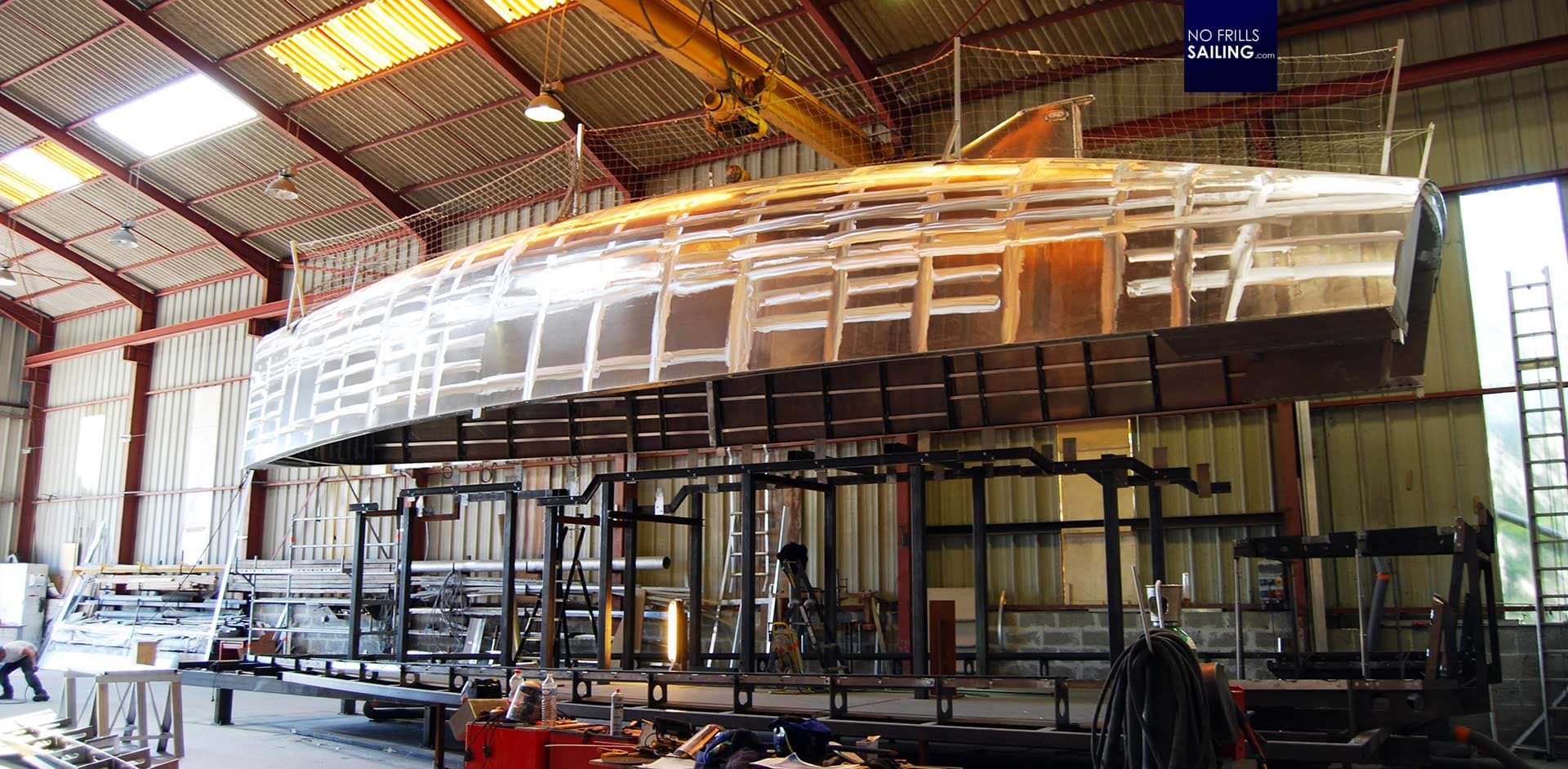
The 5083 marine aluminium hull is the defining feature of the Allures 51.9 and the primary reason buyers choose this yacht over GRP alternatives. Aluminium offers unmatched impact resistance — a grounding or collision with a submerged object that would hole a GRP hull will typically result in a dent or deformation in aluminium, keeping the boat watertight. For expedition sailing in poorly charted waters, coral atolls, high-latitude ice, or developing-world coastlines with submerged hazards, this resilience is not a theoretical advantage but a practical necessity.
Aluminium ownership does, however, demand specific knowledge and vigilance. Galvanic corrosion is the primary concern: the aluminium hull must be electrically isolated from dissimilar metals (bronze, stainless steel, copper) in the underwater area. The electrical system must be scrupulously clean, with no earth leaks that could create stray currents accelerating corrosion. Zinc or aluminium sacrificial anodes must be inspected and replaced on a regular schedule — typically annually, or more frequently in warm, high-salinity waters. Only copper-free antifouling paint may be used; standard copper-based antifouling will cause rapid and catastrophic galvanic attack on the hull.
Pricing: The Allures 51.9 lists at approximately EUR 706,860 ex VAT for the base specification. A well-equipped boat — with lithium batteries, watermaker, upgraded electronics, solar panels, and the cutter rig option — runs to approximately EUR 978,420 ex VAT. Turnkey pricing, including VAT, commissioning, and owner-specified additions, typically falls in the EUR 900,000–1,100,000+ range. On the used market, the small number of hulls built means listings are rare; early examples have appeared at approximately USD 1,500,000, reflecting strong demand and limited supply.
- Insurance: 1.0–1.5% of hull value. Aluminium construction is generally viewed favourably by bluewater insurers due to its structural resilience, though specialist underwriters with aluminium experience are recommended.
- Annual maintenance: EUR 8,000–15,000 covering engine servicing, anode replacement, rigging inspection, and consumables. The aluminium hull itself requires minimal structural maintenance beyond antifouling and anode management.
- Haul-out and antifouling: EUR 4,000–7,000. Copper-free antifouling products are more expensive than standard alternatives and may require more frequent reapplication in tropical waters.
- Centreboard maintenance: The manual (non-hydraulic) centreboard mechanism is mechanically simple and reliable, but the board trunk and pennant should be inspected annually. The absence of hydraulics eliminates a common failure point found on more complex lifting-keel systems.
The total cost of ownership is comparable to a well-maintained GRP bluewater yacht of similar size, with the additional discipline of corrosion management offset by the near-elimination of osmosis concerns, gel coat degradation, and the structural fatigue issues that affect ageing GRP hulls. An aluminium yacht that is properly maintained will outlast its GRP equivalent by decades.
How to Buy an Allures 51.9: What to Look For
New build vs used: With only 15–20 hulls completed by early 2026, the used market for the 51.9 is extremely thin. Most buyers will be ordering new, with a build time of approximately 12–18 months depending on yard scheduling and specification complexity. The semi-custom nature of the build allows significant owner input on interior layout, systems specification, and equipment choices. For buyers seeking a used example, the earlier Allures 52 (2016–2020) and Allures 51 (2009–2015) offer the same core concept at lower price points, with the 52 being the most directly comparable.
Key Inspection Points
- Hull corrosion: Inspect the entire underwater hull for signs of galvanic corrosion, pitting, or weld degradation. Pay particular attention to areas around through-hulls, the centreboard trunk, and any locations where dissimilar metals are in proximity to the aluminium.
- Anode condition: Sacrificial anodes should show normal, even wastage. Anodes that are consumed rapidly or unevenly may indicate stray current issues in the electrical system — a potentially serious problem that requires professional investigation.
- Electrical system integrity: Request an earth leakage test. Any current leaking from the boat’s electrical system into the water will accelerate galvanic corrosion. The entire DC system should be isolated from the hull.
- Centreboard and trunk: Inspect the centreboard pennant, pivot pin, and trunk for wear, corrosion, or calcium buildup. The manual lifting mechanism should operate smoothly without excessive friction.
- Antifouling history: Confirm that only copper-free antifouling has been used throughout the boat’s life. Evidence of copper-based antifouling application is a serious red flag that warrants thorough corrosion investigation.
- Rig and in-mast furling: The in-mast furling system should be inspected for smooth operation, sail condition within the mast, and any signs of jamming or wear. The standing rigging should be assessed for age and fatigue.
Equipment That Adds Value
When assessing an Allures 51.9, the following additions represent genuine added value: watermaker, solar panel array (400W+ for offshore autonomy), lithium battery upgrade beyond the standard 800 Ah bank, SSB/satellite communications, upgraded ground tackle (oversized anchor and additional chain), AIS transponder, radar, windvane self-steering (in addition to the autopilot), dinghy davits, and a properly installed heating system for high-latitude cruising. A boat fitted with serious offshore equipment commands a significant premium over a base-specification example — and rightly so, as the cost of retrofitting these systems is substantial.
Surveying an Aluminium Yacht
A pre-purchase survey of any aluminium yacht must be conducted by a surveyor with specific aluminium experience. Standard GRP survey techniques are insufficient — the failure modes, inspection methods, and critical areas differ fundamentally. Ultrasonic thickness testing of the hull plating is essential to verify that no localised thinning has occurred due to corrosion. The surveyor should also inspect all welds for cracking or fatigue, particularly around high-stress areas such as chainplate attachments, the mast step, and the centreboard trunk.
Allures 51.9 vs Competitors
The aluminium centreboard bluewater yacht is a niche within a niche — a small number of French builders dominate the segment, each offering a distinct interpretation of the same core concept. The competitive landscape also includes one notable GRP alternative for buyers who prioritise comfort and systems integration over hull material.
Allures 51.9 vs Garcia Exploration 52
The Garcia Exploration 52 is the most direct competitor — and, uniquely, a stablemate within the Grand Large Yachting group. Both are built in the same Cherbourg shipyard by overlapping teams of aluminium welders. The Garcia is an all-aluminium design (hull and deck), heavier and more expedition-focused, with a stronger emphasis on high-latitude capability and a more utilitarian interior philosophy. The Allures 51.9 uses a GRP composite deck to save weight and improve topsides aesthetics, features a more refined interior by Franck Darnet, and positions itself as the more “liveable” choice for owners who want expedition capability without sacrificing domestic comfort. The Garcia suits the buyer planning Arctic or Antarctic passages who values an all-metal construction above all else. The Allures suits the buyer who wants to sail the world in comfort with the confidence of an aluminium hull beneath their feet.
Allures 51.9 vs Boreal 55
The Boreal 55 is the other major French aluminium centreboard competitor. It is lighter than the Allures, with a distinctive raised pilothouse/doghouse that provides exceptional visibility and a protected helm position for high-latitude sailing. The Boreal uses a lifting centreboard similar in concept to the Allures, and both boats share the foil-shaped board design that provides superior windward performance compared to flat-plate alternatives. The key differences are in the deck layout and interior philosophy: the Boreal’s doghouse creates a unique elevated saloon that some owners adore and others find unusual; the Allures’ more conventional deck layout feels immediately familiar to sailors stepping aboard from a traditional monohull. Build quality on both boats is excellent. The choice between them is largely personal — the Boreal for those who value the pilothouse concept, the Allures for those who prefer a conventional layout with the full-beam aft master cabin.
Allures 51.9 vs Ovni 495
Ovni (built by Alubat) is the most established name in aluminium centreboard yachts, with a heritage stretching back to the 1970s. The Ovni 495 is smaller than the 51.9 and uses a flat-plate swing centreboard rather than a foil-shaped lifting board. This is the fundamental technical distinction: the Allures’ foil-shaped centreboard generates hydrodynamic lift and delivers meaningfully better windward performance, whilst the Ovni’s flat plate is simpler, cheaper, and arguably more robust but sacrifices upwind efficiency. Ovni benefits from a larger owner community, a deeper pool of used boats on the brokerage market, and decades of proven ocean-crossing track record. The Allures 51.9 is the newer, more refined, and more performance-oriented design. For buyers who prioritise simplicity, community, and a proven track record, the Ovni remains compelling. For those who want the latest thinking in aluminium yacht design with better sailing performance, the Allures is the stronger choice.
Allures 51.9 vs Amel 50
The Amel 50 represents an entirely different philosophy. Built in GRP with a fixed keel, the Amel prioritises systems integration, comfort, and ease of handling above all else. The enclosed centre-cockpit helm, legendary self-sufficiency, and Amel’s proprietary integrated systems create a yacht that is arguably the most comfortable long-distance cruiser ever built. However, the Amel cannot dry out on a tidal flat, cannot explore shallow anchorages, and lacks the structural resilience of aluminium in the event of a grounding. The Allures 51.9 offers expedition versatility that the Amel simply cannot match. The Amel offers a level of domestic comfort and systems refinement that the Allures does not attempt. For buyers whose cruising plan involves trade wind circuits and established marinas, the Amel is superb. For those whose plans include high latitudes, remote atolls, drying harbours, or poorly charted coastlines, the Allures is the only rational choice.
For a full interactive depreciation comparison between the Allures 51.9 and competing models, visit the Hulls.io Market Intelligence tool.