


Aquila 44 Power Cat for Sale
Power CatamaranThe Aquila 44 is the most popular model from Aquila Power Catamarans, a joint venture between Sino Eagle (one of Asia's largest composite boatbuilders) and MarineMax (America's largest recreational boat dealer). The 44 brings power catamaran ownership to a mainstream price point, offering the stability, fuel efficiency, and deck space of a catamaran without the complexity of sailing rigs. Designed by Vripack — the Dutch naval architecture firm behind Feadship and Heesen superyacht interiors — the Aquila 44 features a contemporary interior with full standing headroom, three cabins, and an open-plan salon that flows seamlessly to the cockpit.
Show 2 awards
Show 6 key features
Updated 10 June 2026 · By Hulls.io Editorial
The Aquila 44 Power Catamaran: A Complete Guide
The Aquila 44 Power Catamaran is the boat that proved a Chinese-built power catamaran could compete — and win — in North America’s most discerning market segment. Born from a partnership between Sino Eagle Group, a Hangzhou-based composite manufacturer with roots in Olympic rowing shell production, and Aquila (distributed exclusively through MarineMax, the world’s largest recreational boat dealer), the 44 launched in 2014 and went on to become one of the most commercially successful power catamarans of the 2010s. All design work was handled by J&J Design of Slovenia, the naval architecture studio behind numerous production catamarans and performance multihulls.
The Aquila brand timeline is instructive. Sino Eagle first entered the marine market with the Aquila 38 in 2012, a smaller power catamaran developed primarily for the charter fleet. The larger Aquila 48 followed in 2013 as the company’s first true blue-water power catamaran. The 44 arrived in 2014, filling a gap between the two and targeting the private-ownership market with a more accessible price point and a hull length that fits comfortably into standard marina slips. The model won “Best New Multihull 40’–49’” at the 2014 AIM Media Editor’s Choice Awards, an early signal that the marine press took the boat seriously.
Production scaled steadily. The 100th hull was launched in June 2020 — a notable milestone achieved despite a global pandemic — and over 200 units were built across the model’s 11-year production run. That volume matters for used-boat buyers: parts availability is strong, MarineMax service centres across the US are familiar with the platform, and there is a meaningful pool of comparable sales data for accurate pricing. The Aquila 44 was discontinued in 2025 and replaced by the Aquila 46 Yacht, a next-generation design that carries forward many of the 44’s core principles while adding updated styling and systems. The 44 holds a CE Category A (Ocean) rating, confirming its capability for extended offshore passages.
What set the Aquila 44 apart from early competitors was Sino Eagle’s composite expertise. The company manufactured carbon fibre rowing shells for Olympic programmes before entering the marine market — bringing a level of laminate quality control unusual for a first-generation production powerboat. The hulls use resin-infused vinylester construction with NPG gelcoat, a specification more commonly found on semi-custom builds. The wave-piercing bow design, drawn by J&J Design, reduces slamming in a head sea and contributes to a remarkably smooth ride for a sub-45 ft power catamaran.
Hulls.io currently tracks 1 active listings for the Aquila 44 Power Catamaran, drawn from brokerages worldwide.
Showing 1–1 of 1 results
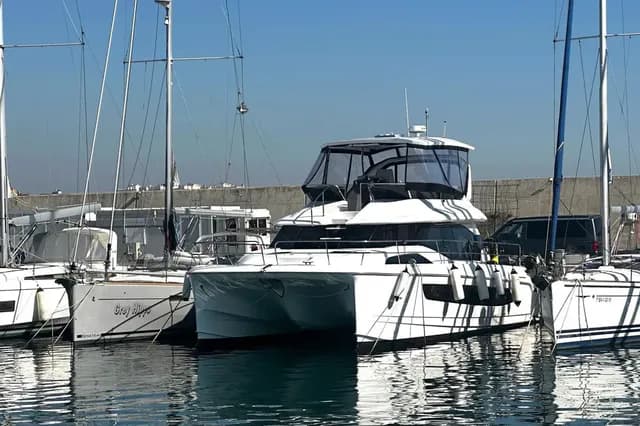
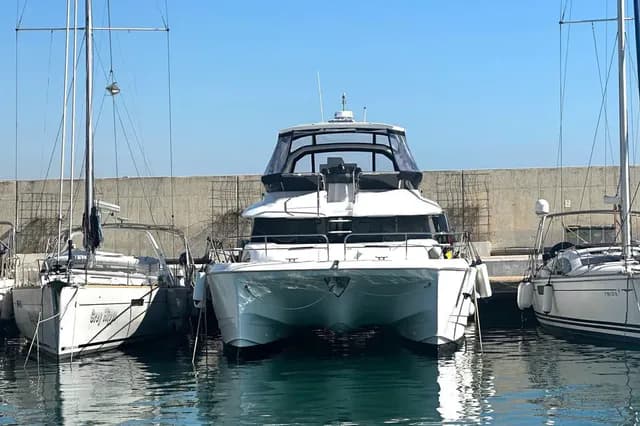
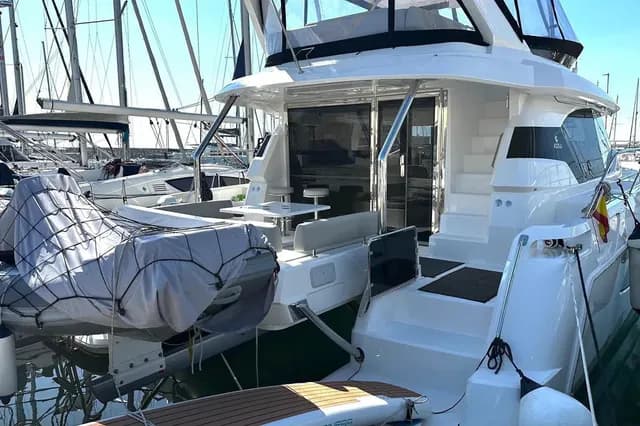
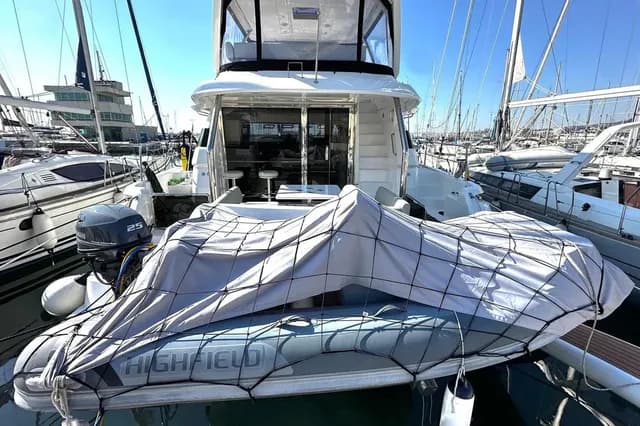
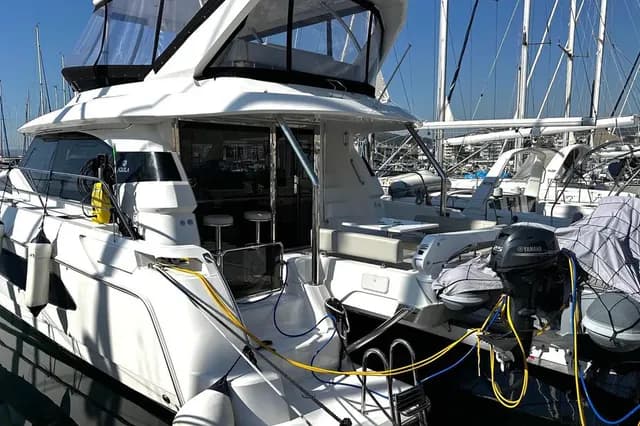
2026 Aquila 44 Power Cat - Innovative Entertaining Platform
Aquila 44 Power Catamaran Specifications
| Specification | Detail |
|---|---|
| LOA (inc. swim platform) | 44 ft 11 in (13.44 m) |
| Beam | 21 ft 6 in (6.56 m) |
| Draft | 3 ft 10 in (1.16 m) |
| Light displacement | 35,053 lbs (15,900 kg) |
| Loaded displacement | 48,500 lbs (22,000 kg) |
| Hull material | Fiberglass (resin-infused, vinylester, NPG gelcoat) |
| Hull type | Twin-hull catamaran with wave-piercing bows |
| Engines (standard) | 2× Volvo Penta D4-225, 225 hp each |
| Engines (mid) | 2× Volvo Penta D4-300, 300 hp each |
| Engines (top) | 2× Volvo Penta D4-320, 320 hp each |
| Drive | V-drive inboard (shaft drive) |
| Top speed | 20–24 knots (varies by engine) |
| Cruising speed | 17–18 knots at 2,800 RPM |
| Fuel capacity | 1,100 litres (290 US gal) standard |
| Fuel capacity (Passage Maker) | 2,180 litres |
| Water capacity | 680 litres (180 US gal) |
| Cabins | 3 staterooms (all en-suite) |
| Heads | 3 |
| Naval architect | J&J Design (Slovenia) |
| Builder | Sino Eagle Group, Hangzhou, China |
| Distributor | MarineMax (exclusive) |
| CE category | A (Ocean) |
| Production years | 2014–2025 |
| Successor | Aquila 46 Yacht (2025) |
| Units built | ~200+ |
The specification sheet reveals a boat engineered for stability, range, and comfort rather than outright speed. The 21’6” beam — generous for a 44 ft power catamaran — delivers the platform stability that makes catamarans so appealing for cruising couples and families. All three engine options use Volvo Penta’s proven D4 inline-4 diesel, a marinised version of the well-regarded automotive block, paired with conventional V-drive shaft propulsion rather than sterndrives or pods. The Passage Maker option nearly doubles the standard fuel capacity to 2,180 litres, pushing theoretical range beyond 1,000 nautical miles at displacement speed — genuine transoceanic capability from a 44 ft power catamaran. The shallow 3’10” draft opens up the Bahamas, the Keys, and other thin-water cruising grounds that deep-vee monohulls cannot access.
Performance & Handling
Speed: With the popular D4-300 engine option, the Aquila 44 reaches a top speed of approximately 21.2 knots at 3,600 RPM (wide-open throttle). This is brisk for a 22-tonne loaded-displacement catamaran, though few owners run at WOT regularly. The cruising sweet spot sits at 17–18 knots at 2,800 RPM, where the twin D4-300s consume approximately 76 litres per hour (20 GPH) combined. With the standard 1,100-litre fuel capacity, this gives a cruising range of roughly 220–260 nautical miles — adequate for most coastal passages and island-hopping but not generous for extended offshore work at speed.
Economy cruise: Back the throttles to 1,500 RPM and the character changes entirely. At 7–8 knots — essentially displacement speed — fuel consumption drops to just 12.5 litres per hour (3.3 GPH) combined. This delivers a range of approximately 592 nautical miles on standard tanks. The best fuel economy figure is approximately 2.9 nautical miles per gallon at around 7 knots, making the Aquila 44 genuinely economical for owners willing to slow down. With the Passage Maker fuel option (2,180 litres), range at displacement speed exceeds 1,000 nautical miles — enough for a Bahamas-to-New-England delivery or a Caribbean island chain cruise without a fuel stop.
Ride quality: The catamaran hull form delivers its most significant advantage in beam seas and at anchor. Where a comparable monohull would roll uncomfortably, the Aquila 44 sits level and stable. The wave-piercing bow design reduces slamming in a head sea — a common complaint with earlier power catamaran designs — though some hobby-horsing (pitching fore and aft) is present in steep, short-period waves, as with any catamaran. In following seas, the wide beam and twin-hull stability make for a comfortable, predictable ride.
Handling: The twin-engine, twin-rudder configuration gives the Aquila 44 excellent close-quarters manoeuvrability. Differential thrust — one engine forward, one in reverse — allows the boat to spin nearly in its own length, a significant advantage in tight marinas. The V-drive shaft arrangement is mechanically simple and robust, avoiding the maintenance complexity and expense of pod drives. Bow thrusters are available as an option and recommended for regular marina use, particularly for single-handed operators.
Interior Layout & Living Aboard
The Aquila 44 accommodates three spacious staterooms distributed across both hulls, each with its own en-suite head — a configuration that gives every cabin genuine privacy and avoids the compromised shared-head arrangements found on some competitors. The full 6.56 m beam is carried well forward, maximising cabin volume in every stateroom. The master suite in the starboard hull features a generous island bed, a full-height hanging locker, and an en-suite that feels more residential than maritime. The two port-hull cabins mirror each other in layout, with double berths and individual heads that share no compromises with adjacent spaces.
The main deck is where the Aquila 44 distinguishes itself from monohull competitors. The salon features 360-degree panoramic windows that flood the interior with natural light and provide unobstructed views at anchor. An L-shaped settee converts the salon into a comfortable entertainment space, with a hidden television that deploys when needed. The galley occupies a clever transitional space between the cockpit and salon, featuring a fold-out bar counter that serves both areas. A lift-up window partition between the aft deck and galley erases the boundary between interior and exterior living — a feature that transforms the main deck into a single open-plan entertaining space in fair weather.
The flybridge is oversized for a 44 ft boat. It accommodates a full helm station with excellent forward and lateral visibility, dedicated sunpads for lounging, and optional grill and wet bar for al fresco dining. Access is via a staircase from the cockpit rather than a ladder — a detail that matters for less agile crew members and in rough conditions.
One feature that genuinely sets the Aquila 44 apart is the Portuguese-style walkaround decks. These dedicated side decks allow crew to move from the flybridge to the bow without descending through the salon — a practical safety feature for anchoring and line handling, and one that few power catamarans in this size range offer. The bow itself features a large sunpad and seating area, accessible from both the walkaround decks and through the forward salon windows.
The large aft cockpit connects directly to twin swim platforms at the stern, creating a natural flow from the water to the living spaces. The platforms are substantial enough for a sit-down rinse after a dive or snorkel, and the cockpit provides shaded seating for a full crew. For liveaboard use, the Aquila 44’s combination of three private staterooms, generous tankage (680 litres of water), and a galley that can be opened to the cockpit makes extended cruising genuinely comfortable rather than merely tolerable.
Aquila 44 Ownership: What to Expect
The Aquila 44 occupied a competitive price point within the power catamaran market. New base pricing was approximately $1.2 million USD in the model’s later production years, with fully specified boats reaching $1.4–1.5 million. Used examples currently range from approximately $535,000 for older, higher-hour boats to $1.25 million for late-model, low-hour examples. Annual depreciation runs at approximately 10–12%, broadly in line with other production power catamarans in this segment.
- Insurance: 1.0–1.5% of hull value. On a boat insured at $800,000, this equates to approximately $8,000–$12,000 per year. Hurricane-zone and offshore coverage commands the upper end of the range.
- Marina berth: The 21’6” beam requires a catamaran-width slip. US East Coast marinas typically charge $1,800–$3,000 per month for a 45 ft catamaran berth. Florida marinas range from $1,200–$2,500 per month depending on location. Caribbean marinas charge $1,500–$2,200 per month.
- Engine maintenance: The Volvo Penta D4 is a well-supported engine with a broad dealer network. Annual service costs (oil, filters, impellers, belts) run approximately $2,000–$3,500 for the twin installation. Major service intervals at 1,000 hours add $3,000–$5,000 per engine.
- Haul-out and antifouling: $4,000–$7,000 depending on the yard and bottom paint specification. The catamaran’s twin hulls increase the bottom surface area compared to a monohull of similar length.
- Fuel at cruise: At 17–18 knots cruise, the twin D4-300s consume approximately 20 GPH. At current US diesel prices, this translates to roughly $50–$80 per hour underway — a significant running cost for regular weekend use.
- Approximate total: $35,000–$65,000 per year depending on location, usage pattern, and cruising ground.
One cost advantage of the Aquila 44 over sailing catamarans of similar size is the absence of rig maintenance. There are no shrouds to replace, no standing rigging to inspect, and no sails to repair or re-cut. This eliminates a significant recurring expense that sailing catamaran owners face every 8–12 years. The trade-off, of course, is that every mile is powered by diesel rather than wind.
How to Buy an Aquila 44: What to Look For
Model years: Production ran from 2014 to 2025, so the market spans a wide range of age and condition. Early 2014–2016 boats are now a decade old and may show signs of age in the cabinetry and soft furnishings. Mid-production 2017–2020 boats represent the sweet spot for value: old enough for meaningful depreciation, new enough for modern systems and refinements. Late-model 2021–2025 examples carry premium pricing but benefit from the most refined specification. The model is now discontinued with the arrival of the Aquila 46 Yacht in 2025 — a factor that may put downward pressure on used 44 prices as buyers weigh the newer alternative.
Known Issues to Inspect
- Formaldehyde odour from cabinetry: Some early-production boats exhibited a persistent formaldehyde smell from the interior woodwork, a known issue with certain adhesives used in Chinese-manufactured cabinetry. Later production runs addressed this with alternative materials. Inspect closed lockers and enclosed spaces with particular attention to odour.
- SureShade water ingress: Boats equipped with the SureShade retractable sunshade have reported water ingress around the track mechanism. Check the flybridge deck and headliner below the shade track for signs of moisture or staining.
- Flybridge door sealing: The flybridge access door seal has been a recurring complaint. Water can track down the staircase in heavy rain or following seas. Inspect the seal condition and look for water damage on the cockpit sole and headliner below.
- Salon floor step (trip hazard): The transition between the cockpit and salon features a step that is poorly illuminated on some boats, creating a trip hazard particularly at night. Check whether courtesy lighting has been added or upgraded.
- Engine selection matters: The D4-320 is the most desirable engine option, offering the best power-to-weight ratio and strongest resale. The base D4-225 is adequate for displacement cruising but feels underpowered when trying to maintain hull speed in a head sea. The D4-300 represents the best balance of performance and economy for most buyers.
Configuration Variants
The standard Aquila 44 was offered in a 3-cabin layout with all en-suite heads. A 4-cabin variant existed, developed primarily for the charter market, which added a fourth stateroom at the expense of storage and crew comfort. For private-use buyers, the 3-cabin version is overwhelmingly preferred and commands stronger resale. Charter provenance is not inherently negative — these boats typically have comprehensive service records — but engine hours, cosmetic condition, and maintenance history should be scrutinised carefully.
Passage Maker Option
The Passage Maker package roughly doubles the fuel capacity to 2,180 litres. Boats fitted with this option carry a meaningful premium on the used market and are particularly desirable for owners planning extended coastal cruising or offshore passages. Verify the additional tankage installation and plumbing during the survey, and confirm that the boat’s displacement with full tanks falls within the design envelope.
Aquila 44 vs Competitors
The 40–50 ft power catamaran segment grew rapidly during the Aquila 44’s production life, with several manufacturers offering compelling alternatives. Each takes a distinct approach to the fundamental question: what should a mid-size power catamaran prioritise?
Aquila 44 vs Leopard 43 Powercat
Built by Robertson & Caine in South Africa, the Leopard 43 Powercat comes from a builder with deep catamaran pedigree and a strong reputation for structural quality. The Leopard is typically priced lower than the Aquila, making it attractive to budget-conscious buyers. It benefits from an enormous charter fleet, which means parts availability is excellent and surveyors know the boat intimately. The Aquila 44 counters with a more refined interior finish, a larger flybridge, the Portuguese-style walkaround decks, and the Volvo Penta D4 engines (the Leopard typically runs Yanmar). The Leopard’s charter heritage means 4-cabin ex-fleet boats dominate the used market — the Aquila offers more privately owned, lower-hour examples.
Aquila 44 vs Fountaine Pajot MY 44
The French-built Fountaine Pajot MY 44 (now superseded by the MY4.S, MY5, and MY6 range) occupies a higher luxury tier. Fountaine Pajot brings decades of catamaran building experience and a reputation for build quality that commands a price premium. The interior design and fit-and-finish are generally considered a step above the Aquila, with more sophisticated joinery and material choices. The Aquila 44 responds with competitive pricing, the Passage Maker long-range option, and MarineMax’s extensive US service network. For European buyers, the Fountaine Pajot benefits from proximity to the builder and a denser dealer network in the Mediterranean. For US-based buyers, the Aquila’s MarineMax distribution provides a practical service advantage.
Aquila 44 vs Bali 4.3 MY
The Bali 4.3 MY (Motor Yacht) from the Catana Group is a lighter, more affordable alternative. The Bali design philosophy — solid foredeck, innovative indoor-outdoor integration, and lower displacement — creates a different on-water experience. The Bali is narrower in beam, which reduces berthing costs and improves access to space-constrained marinas. However, it offers less interior volume than the Aquila 44 and lacks the full walkaround deck access that makes the Aquila practical for shorthanded cruising. The Bali is the value play in this segment; the Aquila is the more complete cruising platform.
Aquila 44 vs Horizon PC52
The Taiwan-built Horizon PC52 occupies a different price bracket entirely — typically $1.5–2.5 million — but serves as a useful comparison for buyers considering a step up. The Horizon offers more interior volume, higher-quality fit-and-finish, and a level of customisation that the production Aquila cannot match. The PC52 is a semi-custom yacht where the Aquila 44 is a production boat, and the price reflects that distinction. For buyers who have outgrown the Aquila 44 or who want a more refined long-range power catamaran, the Horizon represents the next tier — but at roughly double the acquisition cost.
For a full interactive depreciation comparison between the Aquila 44 Power Catamaran and competing models, visit the Hulls.io Market Intelligence tool.