


Bertram 36 SF for Sale
Sportfishing YachtThe Bertram 36 is a legendary sportfishing yacht that defined the category from the 1960s through the 2000s. Designed by the pioneering naval architect Ray Hunt, the original Bertram 31 (1960) proved that a deep-V hull could handle blue-water seas while maintaining the speed needed for offshore fishing. The 36-foot variant — known as the Bertram 36 SF (Sportfish) — carried that legacy forward with a wider beam, larger cockpit, and improved tournament-grade fishability. The 36 SF remains one of the most sought-after sportfishing platforms on the pre-owned market, prized for its bulletproof construction and legendary rough-water handling.
Show 2 awards
Show 5 key features
Related models
Updated 10 June 2026 · By Hulls.io Editorial
The Bertram 36 SF: A Complete Guide
The Bertram 36 SF (Sport Fisherman) is a boat that carries one of the most storied names in offshore fishing. Since Dick Bertram won the 1960 Miami–Nassau race in Moppie — a Ray Hunt–designed deep-V hull that changed marine architecture forever — Bertram has been synonymous with serious offshore capability. The 36 SF was built on the same hull platform as the 36 Convertible (1996–1997) and the 36 Moppie express (1996–2001), sharing a solid fiberglass bottom, cored hullsides, and the company’s signature deep-V hull form with reverse chines. The SF variant added a flybridge and an enclosed helm deck to the Moppie’s express layout, creating a versatile platform that could fish hard offshore on Saturday and cruise comfortably with the family on Sunday.
Built in Miami, Florida, the 36 SF was produced in deliberately small numbers — approximately 30–40 units across the Convertible, Moppie, and SF variants combined. This low production volume reflected both the yacht’s premium price point (approximately $350,000–$450,000 when new in the late 1990s) and Bertram’s position as a quality-over-quantity builder. Marine surveyor David Pascoe, in his detailed review of the 36 platform, found no weakness in the decks after pounding, hammering, and even jumping on them — the boat was “all-over solid, from the very wide cockpit gunwales to the trunk cabin top.” This is the Bertram reputation in practice: built heavier, finished to a higher standard, and engineered to survive conditions that would break lesser boats.
The cockpit is the centrepiece. At approximately 100 square feet, it is one of the largest in the 36-foot class — big enough for a serious tournament crew and the kind of fish that justify owning a Bertram. The deep-V hull, descended directly from Ray Hunt’s original design philosophy, delivers a ride through rough water that remains the benchmark against which other sportfishing hulls are measured. The trade-off is well documented: the deep-V rolls at anchor in a beam sea, a characteristic inherent to the hull form and shared by every Bertram ever built.
Hulls.io currently tracks 1 active listing for the Bertram 36 SF, drawn from brokerages worldwide.
Showing 1–1 of 1 results
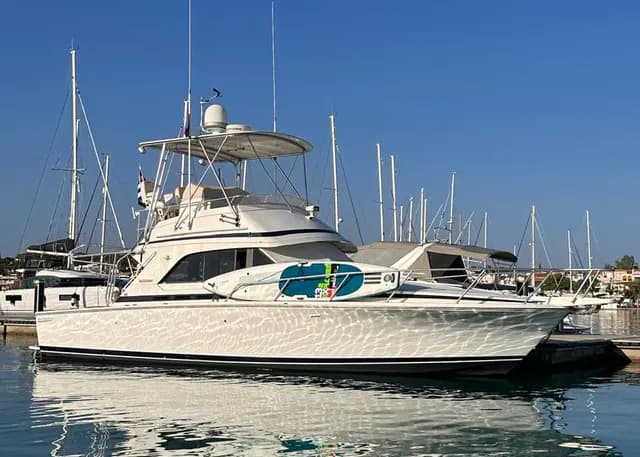
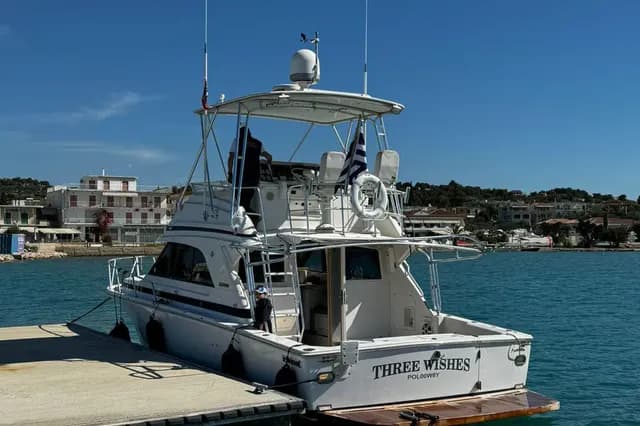
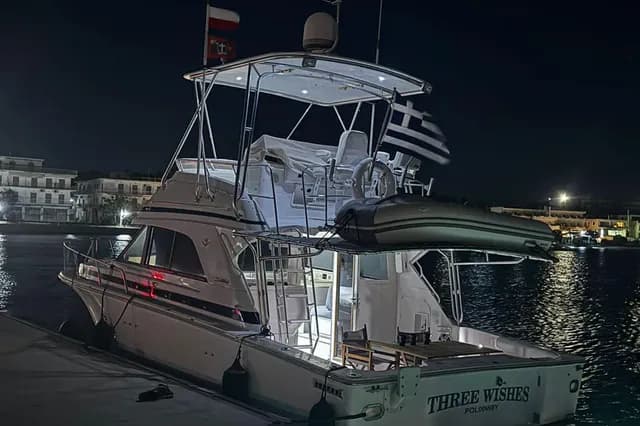
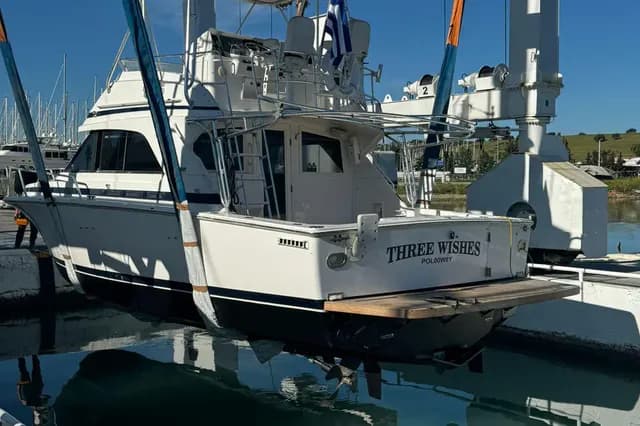
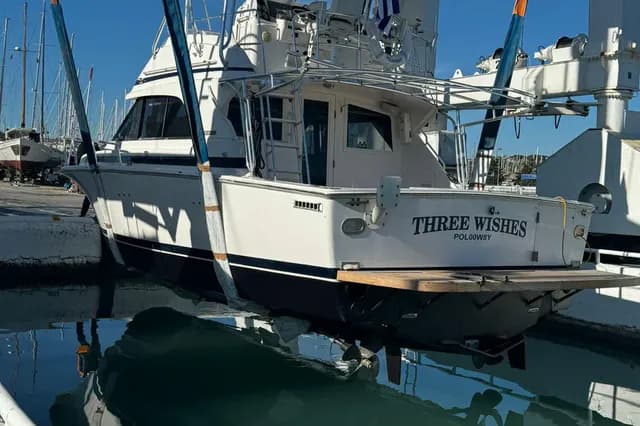
2000 Bertram 36 SF - Legendary Sportfish Performance & Comfort
Bertram 36 SF Specifications
| Specification | Detail |
|---|---|
| LOA (inc. pulpit) | 39 ft 4 in (12.0 m) |
| Hull length | 35 ft 10 in (10.9 m) |
| Beam | 13 ft 6 in (4.11 m) |
| Draft | 3 ft 9 in (1.14 m) |
| Dry displacement | ≈22,500 lbs (10,200 kg) |
| Hull material | Solid fiberglass bottom, cored hullsides |
| Hull type | Deep-V with reverse chines |
| Engines (option 1) | 2× Cat 3126, 420 hp each (840 hp combined) |
| Engines (option 2) | 2× Cummins 6BTA 5.9, 370–450 hp each |
| Drive | Straight shaft, inboard |
| Top speed | ≈30 knots |
| Cruising speed | 24–26 knots |
| Fuel capacity | 450 US gal (1,703 litres) |
| Water capacity | 75 US gal (284 litres) |
| Cabins | 2 staterooms |
| Heads | 1 |
| Cockpit area | ≈100 sq ft (9.3 m²) |
| Builder | Bertram, Miami, Florida |
| Production years | 1997–2002 |
| Units built | ≈30–40 |
The specification sheet reveals a boat built for a single purpose: getting offshore safely, fishing seriously, and coming home in one piece. The 450-gallon fuel capacity is generous for a 36-footer, providing the range to reach distant fishing grounds without anxiety. The solid fiberglass bottom — not cored — is a deliberate choice that adds weight but eliminates the risk of core saturation that plagues many production sportfish boats as they age. The cored hullsides above the waterline reduce topside weight where it matters most for stability. Every hose is double-clamped, every fuel tank is custom-moulded of fire-retardant resin, and every cleat is anchored to a metal backup plate moulded into the fiberglass — details that distinguish Bertram construction from the competition.
Performance & Handling
At speed: With twin Cat 3126 engines producing 420 hp each (840 hp combined), the 36 SF achieves a top speed of approximately 30 knots. The Cummins 6BTA 5.9 option, available in 370–450 hp ratings, delivers similar performance depending on the horsepower variant. Some owners have noted that the 420 hp Cat option is somewhat over-spec for the hull — the boat runs well at lower horsepower ratings, and the additional power primarily buys a few extra knots at wide-open throttle rather than a meaningful improvement in cruising comfort.
Cruising speed: The practical cruising band sits at 24–26 knots, where fuel consumption runs approximately 36 gallons per hour combined. With the 450-gallon fuel capacity and a 10% reserve, this gives a cruising range of approximately 270–300 nautical miles — comfortably sufficient for a Bahamas run from South Florida, a canyon trip from the Mid-Atlantic coast, or a day of tournament fishing with margins.
Rough water: This is where the Bertram 36 earns its reputation. The deep-V hull, descended from Ray Hunt’s original design, slices through head seas rather than pounding over them. The reverse chines add stability at cruise without compromising the V-shape that makes the ride so effective in a seaway. In the kind of conditions that send lesser sportfish boats back to the dock — 6–8 foot seas, a stiff head wind, a Gulf Stream crossing on a bad day — the Bertram 36 keeps going. This is not marketing hyperbole; it is the reason commercial fishermen and tournament captains have chosen Bertrams for over six decades.
At anchor: The same deep-V that excels at speed rolls at displacement speeds and at anchor in a beam sea. This is the physics of the hull form: a sharp entry with minimal flat sections means less resistance to rolling. Owners who anchor overnight routinely deploy flopper-stoppers or paravanes, and many have retrofitted aftermarket stabiliser systems. At the dock, the boat sits comfortably and predictably.
Interior Layout & Cockpit
The Bertram 36 SF uses a galley-up layout with two staterooms and a single head. The interior is finished in traditional teak throughout — a hallmark of Bertram interiors of this era. The galley-up arrangement places the kitchen on the main deck to port, opposite a settee and dining area to starboard. This creates a practical flow from the cockpit through the salon to the galley, and means the cook stays connected to the action rather than being buried below.
A distinctive feature of the 36 platform is the half dinette positioned aft of the galley. This arrangement is dictated by the engine boxes, which extend into the cabin to accommodate the twin diesels. The result is a compact but functional dining space that doubles as a navigation station. The forward stateroom features a V-berth with hanging storage, while the aft stateroom provides a double berth accessible from the salon. A single head serves both cabins.
The cockpit is the reason this boat exists. At approximately 100 square feet, it provides the working space that serious offshore fishing demands. The gunwales are wide enough to sit on comfortably, the scuppers drain efficiently, and the transom provides access to a swim platform. Rod holders, bait prep stations, and fish boxes are standard or easily fitted. The cockpit sole is raised in the forward section to accommodate the engine room below — a compromise that provides better engine access but creates a step in the cockpit.
The flybridge on the SF variant provides a second helm station with 360-degree visibility — essential for spotting birds, weed lines, and surface activity while running to the fishing grounds. The elevated driving position also makes close-quarters manoeuvring easier, with clear sightlines to all four corners of the boat.
Bertram 36 SF Ownership: What to Expect
The Bertram 36 SF is now 23–28 years old, which means ownership economics are dominated by maintenance and refit costs rather than depreciation. Purchase prices are attractive — typically $80,000–$180,000 depending on engine hours, condition, and location — but the boat’s premium construction quality means it deserves (and demands) premium maintenance.
- Purchase price: $80,000–$180,000 for well-maintained examples. Project boats that need engine work or significant cosmetic attention can be found below $70,000, but refit costs will quickly exceed the purchase price.
- Insurance: 1.5–2.5% of hull value. On a boat insured at $120,000, this translates to approximately $1,800–$3,000 per year. Tournament and offshore coverage commands the upper end.
- Berthing: A 39-foot sportfish requires a standard marina slip. US East Coast marinas range from $600–$1,500 per month depending on location. Florida marinas run $500–$1,200 per month.
- Engine servicing: Twin Cat 3126 engines require annual servicing including oil changes, impeller replacement, belt inspection, and coolant system checks. Budget $3,000–$6,000 per year for routine service. The 3126 is a well-proven marine engine, but at 20+ years old, injector rebuilds, turbocharger servicing, and heat exchanger replacement become increasingly likely. A full engine overhaul runs $15,000–$25,000 per engine.
- Haul-out and antifouling: $2,500–$4,500 including hull preparation, antifouling application, running gear inspection, and zinc replacement.
- Fuel at cruise: At 24–26 knots, the twin diesels consume approximately 36 GPH. At current US diesel prices, this translates to roughly $130–$180 per hour underway.
- Approximate total: $20,000–$45,000 per year depending on location, usage pattern, and engine condition.
Depreciation: The 36 SF has essentially reached the bottom of its depreciation curve. Well-maintained examples with fresh engine work hold their value year over year, and exceptional boats with low hours and documented maintenance histories can appreciate modestly. The Bertram name carries a significant resale premium over comparable sportfish boats from less prestigious builders — a factor that partly offsets the higher purchase price.
How to Buy a Bertram 36 SF: What to Look For
Variants: The Bertram 36 platform was built in three configurations: the Convertible (flybridge, enclosed helm, 1996–1997), the Moppie (express/open, 1996–2001), and the SF (sport fisherman with flybridge, 1997–2002). The model name used in listings varies — some brokers list the boat as a “36 Convertible,” others as a “36 SF,” and the Moppie variant carries its own distinct designation. All share the same hull. Buyers should search for all three designations to avoid missing listings.
Key Inspection Areas
- Engine hours and service records: At 20+ years old, engine condition is the primary value driver. Low hours (under 2,000) with documented service records are ideal. High hours (4,000+) on a Cat 3126 are not necessarily disqualifying if the engine has been properly maintained, but budget for injector rebuilds and turbo servicing. Oil analysis reports provide the best insight into internal engine condition.
- Cored hullsides: While the bottom is solid fiberglass, the hullsides are cored. Moisture meter readings out of the water are essential to identify any areas of core saturation. Pay particular attention to areas around hardware penetrations, rub rail fasteners, and anywhere the gelcoat shows cracking or crazing.
- Teak interior condition: The teak interior was finished to a high standard, but 25 years of use, UV exposure, and humidity take their toll. Refinishing teak cabinetry is labour-intensive and expensive. Assess the condition of all teak surfaces and factor refinishing costs into your offer if needed.
- Electrical systems: Original wiring on a 25-year-old boat may need updating. Inspect all electrical panels, connections, and wiring for corrosion, chafe, and outdated components. A complete electrical refit is a five-figure expense.
- Cockpit and deck hardware: Check all deck hardware fasteners for corrosion and backing plate integrity. The cockpit sole should be tapped for delamination, particularly in the raised forward section above the engine room.
- Running gear: Inspect shafts, struts, cutlass bearings, and rudder posts. At this age, cutlass bearing replacement and shaft realignment are common requirements. Budget $3,000–$6,000 if the running gear needs attention.
Cat 3126 vs Cummins 6BTA
Both engine options are well-proven marine powerplants with strong aftermarket support. The Cat 3126 is slightly more common in the 36 SF and benefits from Caterpillar’s extensive dealer network. The Cummins 6BTA 5.9 is a simpler, more mechanically straightforward engine that many independent marine mechanics can service without specialist tools. On the used market, there is no meaningful price premium for either engine option — the choice comes down to local service availability and personal preference.
Bertram 36 SF vs Competitors
The 35–38 foot sportfish convertible segment is one of the most competitive in the fishing boat market, populated by builders whose reputations were forged in tournament cockpits and offshore canyons. Each takes a slightly different approach to the same fundamental brief: get offshore safely, fish effectively, and come home.
Bertram 36 SF vs Viking 38
The Viking 38 Convertible is the most direct competitor — a New Jersey–built sportfish from the other great American sportfishing dynasty. The Viking offers a slightly larger interior, more refined cabin finishes, and the cold-moulded hull construction that Viking is known for. The Bertram 36 counters with its legendary deep-V ride quality, a larger cockpit relative to overall length, and the construction ruggedness that David Pascoe described as “all-over solid.” On the used market, Vikings typically command a 15–25% premium over comparable Bertrams, reflecting Viking’s stronger brand positioning in the current market. For buyers who prioritise ride quality in rough water and cockpit space, the Bertram is the better choice.
Bertram 36 SF vs Cabo 35
The Cabo 35 Flybridge (now Hatteras Cabo) is a West Coast alternative that has built a devoted following among Pacific sportfishing crews. The Cabo offers a more modern interior layout, better engine room access, and the benefit of a newer design that addresses some of the compromises inherent in the Bertram’s 1990s platform. The Bertram counters with deeper heritage, superior rough-water performance from the deep-V hull, and the emotional resonance of the Bertram name. The Cabo is the pragmatic choice for buyers on the West Coast; the Bertram is the choice of conviction for East Coast fishermen who value tradition and offshore capability above all else.
Bertram 36 SF vs Tiara 36
The Tiara 36 Open is a different kind of sportfishing boat — more cruiser than pure fishing machine. The Tiara offers a significantly more refined interior, better-appointed cabin, and a smoother ride at displacement speeds. The Bertram 36 SF counters with a substantially larger cockpit, better rough-water performance at speed, and the construction ruggedness that commercial fishermen and tournament captains demand. The Tiara is the choice for owners who fish occasionally and cruise frequently; the Bertram is for owners who fish seriously and cruise when the weather is wrong.
Bertram 36 SF vs Hatteras 36
The Hatteras 36 Convertible is the other great American sportfish in this size range, built in North Carolina with a reputation for heavy-duty construction that rivals Bertram’s own. The Hatteras offers a slightly wider beam, more interior volume, and the company’s own legacy of offshore excellence dating back to the 1960s. The Bertram’s deep-V hull delivers a marginally better ride in a head sea, while the Hatteras’s slightly flatter sections aft provide better stability at rest. Both are excellent boats; the choice often comes down to geography and personal loyalty.
For a full interactive depreciation comparison between the Bertram 36 SF and competing models, visit the Hulls.io Market Intelligence tool, where you can overlay pricing trends, track seasonal demand, and benchmark value retention across the sportfish segment.