


MasterCraft X24 Buyer’s Guide
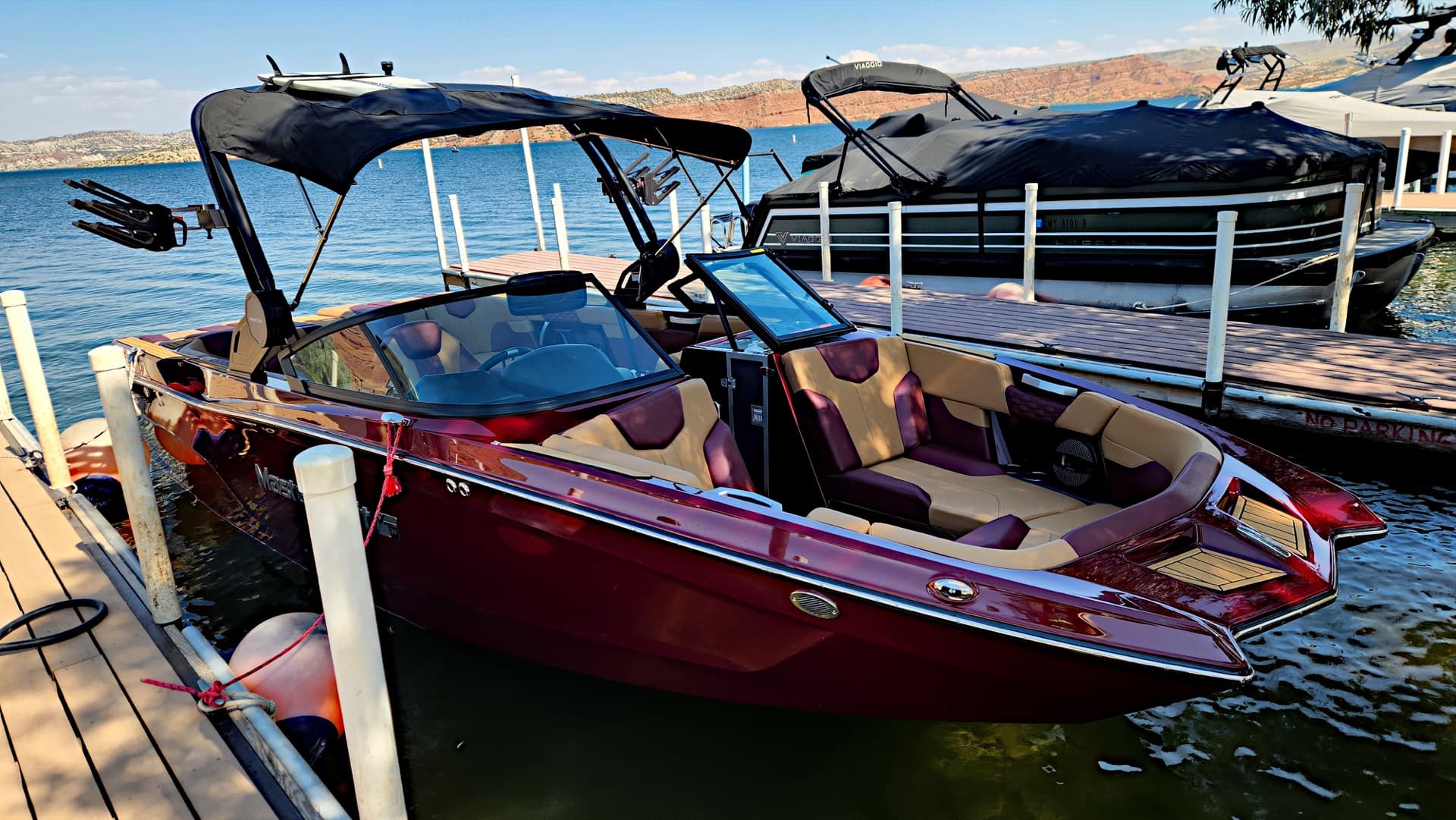
Wake / Tow SportsThe go-to boat for wake sports with high-performance customisation and strong rental/charter demand. The MasterCraft X24 delivers world-class wakes and waves, setting the standard for competitive wakeboarding and wakesurfing performance.
Show 2 awards
Show 5 key features
Updated 10 June 2026 · By Hulls.io Editorial
The MasterCraft X24: A Complete Guide
The MasterCraft X24 is the flagship of MasterCraft’s X-Series — the lineup that has defined competitive wakeboarding and wakesurfing for more than a decade. At 24 feet, the X24 is the largest towboat in the X-Series range and the platform MasterCraft builds for riders who refuse to compromise on wave quality, boat handling, or fit and finish. It is the boat that PWT (Pro Wakeboard Tour) athletes train behind, the boat that dominates the shoreline at Lake Powell and Lake Norman, and the boat that serious watersports families graduate to when they outgrow a 22-footer.
MasterCraft’s heritage runs deeper than most buyers realise. Founded in 1968 in Maryville, Tennessee, the company built its reputation on ski boats — the Stars & Stripes and ProStar lines were the gold standard of competitive waterskiing through the 1970s, 1980s, and 1990s. The shift to wakeboarding in the early 2000s led to the X-Series, and MasterCraft was among the first manufacturers to engineer a hull specifically for wake generation rather than wake suppression. Today, the company trades publicly on NASDAQ as MCFT and manufactures every boat at its vertically integrated facility in Vonore, Tennessee, where hulls, upholstery, towers, and wiring harnesses are all built under one roof. That level of manufacturing control is rare in the marine industry and directly contributes to the consistency and build quality that MasterCraft owners expect.
The X24 represents the culmination of MasterCraft’s wake engineering programme. The Gen 2 SurfStar system — an integrated ballast and wave-shaping platform that carries approximately 4,400 lbs of water — produces a wave that is genuinely world-class on both the port and starboard sides. Unlike aftermarket ballast systems that bolt bags into lockers, the X24’s ballast is engineered into the hull from the design stage, with dedicated hard tanks, optimised plumbing, and Quick-Fill pumps that flood in under 90 seconds. The result is a wave that is clean, consistent, surfable from the moment the boat is on plane, and adjustable from the helm via the SurfStar tabs. For riders who have spent time behind boats with poorly integrated ballast, the difference is immediately apparent.
Hulls.io currently tracks 0 active listings for the MasterCraft X24, drawn from dealers and brokerages across North America. With 26 tracked listings in our market intelligence database, the X24 benefits from robust pricing data — particularly useful given that towboats in this class hold value exceptionally well and accurate comps are essential for buyers and sellers alike.
MasterCraft X24 Specifications
| Specification | Detail |
|---|---|
| LOA | 24 ft 0 in (7.32 m) |
| Beam | 8 ft 6 in (2.59 m) |
| Dry weight | ~5,800 lbs (2,631 kg) |
| Draft (drive down) | ~36 in (0.91 m) |
| Draft (drive up) | ~22 in (0.56 m) |
| Deadrise at transom | 12.5° |
| Engine (standard) | Ilmor 6.2L V8, 430 HP |
| Engine (optional) | Ilmor 6.2L V8, 575 HP / 600 HP |
| Fuel capacity | 68 US gal (257 L) |
| Integrated ballast (Gen 2) | ~4,400 lbs (1,996 kg) |
| Ballast system | Gen 2 SurfStar with Quick-Fill |
| Wave system | SurfStar wave-shaping tabs |
| Seating capacity | 16+ persons (NMMA rated) |
| Freshwater capacity | 4 gal (15 L) |
| Storage | Bow, port/starboard gunwale, in-floor ski locker, transom |
| Tower (standard) | ZFT4 forward-folding tower |
| Tower (optional) | ZFT6 power tower |
| Audio system | Heyday by Wet Sounds (6+ speakers standard) |
| Display | Infinity digital helm display (12 in touchscreen) |
| Hull construction | Hand-laid fibreglass with stringer grid |
| Hull design | MasterCraft proprietary modified-V with wake-shaping running surface |
| Swim platform | Full-width fibreglass with integrated boarding ladder |
| Trailer (recommended) | Tandem-axle custom trailer (~3,500 lbs) |
| Build location | Vonore, Tennessee, USA |
| Builder | MasterCraft Boat Holdings (NASDAQ: MCFT) |
| Production years | 2020–present |
The X24’s spec sheet reveals a boat engineered around one objective: producing the best possible wave and wake while carrying a large crew in comfort. At approximately 5,800 lbs dry — before you add 4,400 lbs of ballast, 68 gallons of fuel, and 16 passengers — the X24 can weigh well over 12,000 lbs in riding configuration. That mass is deliberate: it is what creates the deep, long, powerful wave that advanced surfers and wakeboarders demand. The Ilmor 6.2L V8 at 430 HP standard is well-matched to the hull at this displacement, though most serious riders opt for the 575 HP or 600 HP upgrade to maintain strong acceleration and pulling power when the boat is fully loaded.
The 12.5-degree deadrise at the transom is a critical figure. This is shallower than a typical V-hull runabout, and it is intentional — the flatter running surface generates a larger, more defined wake while still providing enough V to manage chop at speed. The modified-V hull with its proprietary running surface is MasterCraft’s intellectual property and the product of decades of refinement. The 36-inch draft with the drive down keeps the boat accessible to most inland lakes and reservoirs, while the 22-inch drive-up draft makes trailering and loading at shallow ramps practical. The NMMA-rated 16+ person capacity is not mere certification padding — the X24’s cockpit genuinely accommodates a large group, which matters when you are running a full day on the lake with riders, spotters, and spectators.
Performance & Wake Science
The Gen 2 SurfStar system: This is the technology that defines the X24 experience. The Gen 2 SurfStar is an integrated ballast and wave-management platform comprising approximately 4,400 lbs of hard-tank ballast distributed across bow, midship, and stern compartments, combined with SurfStar wave-shaping tabs mounted at the transom. The tabs are adjustable from the helm via the Infinity touchscreen, allowing the driver to dial in wave shape, wave height, and the transition from the port side to the starboard side without stopping the boat. The Quick-Fill system floods all tanks in under 90 seconds — a meaningful advantage over competitors that require 3–5 minutes to fill, which adds up over a long day of riding.
Wave quality: The X24 produces a wave that is genuinely world-class for both wakesurfing and wakeboarding. At surf speed (10–11.5 mph), the wave is tall, steep, and pushable — advanced surfers can generate speed and perform aerial manoeuvres with confidence. The wave face is clean, with minimal lip curl or whitewater intrusion that plagues boats with poorly integrated ballast. The transition from the regular to goofy side is smooth when managed through the SurfStar tabs, avoiding the dead spot that some competing systems exhibit during switchover. At wakeboard speed (19–23 mph), the wake is firm, defined, and consistent from the boat to approximately 75–85 feet back — the range where competitive riders set their rope length. The wake shape holds its integrity even in crosswind conditions that degrade the wake on lighter-displacement boats. This is why PWT and WWA athletes train behind MasterCraft X-Series boats: the wake is repeatable, session after session.
Hull design philosophy: Understanding the X24 requires understanding the fundamental difference between a watersports hull and a traditional runabout. A conventional V-hull is designed to cut through water cleanly, minimise drag, and suppress wake for a smooth ride. A watersports hull does the opposite — it is designed to displace water in a controlled, predictable pattern that creates a rideable wake or wave behind the boat. The X24’s modified-V hull with its 12.5-degree transom deadrise, flat running pads, and proprietary chine design is the product of over two decades of iterative development. Every angle, every strake, every transition in the hull surface is engineered to direct water into the wake zone. The integrated ballast then adds mass at precisely calculated positions to amplify and shape that displacement into a wave. It is hydrodynamics as performance art.
Under way: Top speed with the standard 430 HP Ilmor is approximately 42–45 mph, rising to 48–52 mph with the 575 HP or 600 HP options — though speed is largely irrelevant in a towboat, where you spend the vast majority of your time at 10–24 mph pulling a rider. What matters is torque, acceleration from a dead start with a rider in the water, and the ability to maintain precise speed under varying load conditions. The Ilmor engines deliver on all three counts. The X24 gets on plane quickly even at full ballast, pulls a downed rider out of the water without hesitation, and holds GPS speed within a fraction of a mph via the integrated speed control system. At cruising speed without ballast, the ride is comfortable for a flat-bottom towboat, though the hull form is not designed for rough water — this is a lake boat, and it excels at what it was designed to do.
Competition pedigree: The X-Series is the official towboat of multiple PWT (Pro Wakeboard Tour) and WWA (World Wake Association) events, and the X24 is the platform that professional athletes ride behind at the highest level. This is not merely a sponsorship arrangement — the feedback loop between MasterCraft’s engineering team and professional riders drives continuous refinement of the hull, ballast system, and wave-shaping technology. When you ride behind an X24, you are riding behind the same platform that Harley Clifford, Meagan Ethell, and other world champions use in training and competition.
Layout & Features
Cockpit layout: The X24’s interior is designed around the reality of a watersports day: riders rotating in and out, gear everywhere, wet bodies dropping onto seats, and a driver who needs to see the water behind the boat as clearly as the water ahead. The cockpit runs deep with high gunwales that provide a secure feeling for passengers and keep spray out. The driver’s position features a bolstered bucket seat with flip-up armrest, positioned to give clear sightlines to the rider through the tower mirror and to the Infinity display on the dash. The observer’s seat (required in most states for wakeboard towing) is positioned to provide an unobstructed rear view.
Seating: The X24 accommodates 16+ passengers across a wraparound cockpit layout. The aft bench is convertible — the backrest flips to create rear-facing seating that looks directly at the rider, which is the preferred orientation for spotters and spectators during a surf or wakeboard set. The bow features MasterCraft’s signature “pickle fork” design — a wide, open bow with wrap-around seating, bow filler cushions, and integrated grab handles. The pickle fork bow adds usable deck space and seating capacity that a traditional pointed bow cannot match, and it creates a social space that becomes the gathering point when the boat is anchored in a cove. All upholstery is marine-grade vinyl with UV-resistant treatments — a critical feature in a boat that spends most of its life in direct sunlight.
Tower: The standard ZFT4 forward-folding tower is built from polished or powder-coated aluminium, providing board racks, a tow point at the correct height for wakeboarding, and mounting positions for speakers and lights. The tower folds forward hydraulically for garage clearance and trailering — a practical necessity given that most X24 owners trailer their boats. The optional ZFT6 power tower adds powered adjustment and a more aggressive aesthetic. Tower speakers (typically Wet Sounds REV series) are integrated into the tower arms, and the Heyday by Wet Sounds audio system delivers sound that reaches the rider 75–100 feet behind the boat at riding speed — a genuine engineering challenge that MasterCraft has solved effectively.
Helm and electronics: The Infinity digital display is a 12-inch touchscreen that controls virtually every system on the boat: ballast fill/drain levels, SurfStar tab position, speed control, audio, lighting, and engine data. The interface is clean and responsive — MasterCraft has invested heavily in software, and it shows. GPS speed control is integrated, allowing the driver to set a precise speed and maintain it within a fraction of a mph regardless of load changes. Profiles can be saved for individual riders, storing their preferred speed, ballast configuration, and tab position for instant recall.
Storage: The X24 provides dedicated storage for the equipment a watersports crew carries: the in-floor ski locker runs the length of the cockpit and holds wakeboards, skis, and surfboards; gunwale storage along both sides accommodates ropes, vests, and smaller items; the transom compartment houses the engine access and additional gear storage; and the bow locker provides space for fenders, lines, and anchor. The swim platform is full-width fibreglass with a non-skid surface, integrated boarding ladder, and a low-profile design that makes getting in and out of the water between sets straightforward.
Audio system: The Heyday by Wet Sounds audio package is a core part of the X24 experience. Music on the water is not optional for watersports riders — it sets the rhythm of a session. The standard system includes six or more cockpit speakers, a subwoofer, tower speakers, and a transom speaker aimed at the rider. The system is powered by dedicated marine amplifiers and controlled through the Infinity display or Bluetooth. At full volume, the tower speakers deliver clean, distortion-free audio that carries to the rider at rope length — a feat that requires serious acoustic engineering given the wind, engine noise, and water spray at wakeboard speed.
MasterCraft X24 Ownership & Running Costs
Owning a flagship watersports towboat is a different financial proposition than owning a cruising sailboat or a centre console. The X24 is a high-performance machine with a premium price tag, but the cost structure is more predictable than many marine segments — single inboard engine, no saildrives, no rigging, and no bottom paint if the boat is trailered. The principal ongoing costs are as follows:
- Insurance: Watersports towboats carry a slight premium over general recreational boats due to the towing activity. Expect 1.5–2.5% of hull value annually. On a boat insured at $180,000, that translates to approximately $2,700–$4,500 per year. Agreed-value policies are strongly recommended — the X24 holds value well, and a stated-value policy may underinsure you.
- Engine service (Ilmor): The Ilmor 6.2L V8 is a marinised General Motors LS-based engine — extremely well-proven and supported by a deep aftermarket and dealer network. Annual service (oil change, impeller, belts, fluid check) runs $400–$800 at a dealer, or $200–$400 DIY. The 100-hour service is more comprehensive at $800–$1,500. Ilmor engines are known for reliability and longevity — 1,000+ hours is common with proper maintenance, and many reach 1,500–2,000 hours before requiring major work.
- Winterisation: Essential in northern climates. A professional winterisation including engine fogging, coolant flush, ballast system purge, and fuel stabilisation costs $400–$800. Shrink-wrapping adds $300–$600 depending on boat size and region. Indoor heated storage, where available, costs $1,500–$3,500 for the season but eliminates shrink-wrap and provides superior protection.
- Trailer: Most X24 owners trailer their boats, which eliminates slip fees but introduces towing costs. A purpose-built tandem-axle trailer runs $4,000–$8,000 new. Tow vehicle fuel at today’s prices adds $50–$150 per round trip depending on distance. Bearing service, brake maintenance, and tire replacement add $300–$600 per year. The combined towing weight of X24 plus trailer is approximately 8,500–9,500 lbs, requiring a full-size truck or heavy-duty SUV.
- Marina or dry stack: Owners who do not trailer typically use a marina slip or dry stack. Freshwater marina slips for a 24-foot boat run $2,000–$6,000 per season in the US lake markets (Lake Tahoe, Lake Austin, and other premium locations command the high end). Dry stack storage costs $2,500–$5,000 per season, with launch-on-demand service.
- Ballast system maintenance: The integrated ballast system requires annual attention: pumps should be inspected and tested, hoses and fittings checked for leaks, and the entire system flushed at winterisation to prevent mildew and scale build-up. Budget $200–$500 per year for preventive maintenance, more if a pump requires replacement ($300–$800 per pump).
- Approximate total: $6,000–$14,000 per year for a trailered boat depending on usage, region, and whether you DIY maintenance or use a dealer. Slip-kept boats in premium lake markets trend higher at $10,000–$18,000.
The MasterCraft dealer network provides excellent service coverage across North America. The Ilmor engine platform benefits from GM’s global parts supply chain, so consumables and replacement parts are readily available and competitively priced. MasterCraft’s Vonore facility also maintains a parts department for hull-specific components — upholstery sections, tower components, SurfStar parts, and electronics modules are all available direct from the manufacturer.
One often-overlooked ownership advantage: the X24 holds its value exceptionally well. Premium towboats from MasterCraft and Nautique consistently outperform other recreational boat segments in residual value retention. A well-maintained X24 with moderate hours typically retains 70–80% of its original MSRP after three to four years — a depreciation curve that is significantly flatter than sterndrive runabouts, pontoon boats, or entry-level watersports boats. This strong residual value is a meaningful factor in total cost of ownership.
How to Buy a MasterCraft X24: What to Look For
New pricing: A new MasterCraft X24 starts at approximately $175,000 for a base-specification boat, but very few leave the factory in base trim. Most buyers add the 575 HP or 600 HP engine upgrade ($8,000–$15,000), premium audio ($3,000–$8,000), upgraded upholstery and gel coat colours ($5,000–$15,000), the power tower ($4,000–$7,000), and various convenience packages. A well-specified X24 with the options most watersports buyers consider essential typically lands at $210,000–$250,000 before tax, registration, and trailer. The MasterCraft configurator makes it easy to build a $280,000+ boat if you select every option.
Used pricing: The used X24 market is active but supply-constrained — these boats are in demand and owners tend to keep them. A 2020–2021 X24 with 200–400 hours typically asks $145,000–$175,000 depending on engine option and specification level. A 2022–2023 model with low hours asks $165,000–$200,000. Higher-hour boats (500+) trade at a discount, but engine hours on an Ilmor 6.2L are less concerning than on some platforms — these engines are designed for high-utilisation use. The sweet spot for value is a 2021–2022 model with the 575 HP engine, 200–400 hours, and a full options package — the first owner absorbed the steepest depreciation, and the boat has the majority of its service life ahead of it.
X24 vs X22 vs X26
The X-Series lineup offers three sizes, and the choice matters. The X22 is the entry point — a 22-foot platform that produces an excellent wave for its size but carries less ballast and accommodates fewer passengers. It is the right boat for smaller crews (6–10 people) and tighter budgets, saving $20,000–$40,000 over an equivalently specified X24. The X26 sits above the X24 as the ultimate big-water towboat — 26 feet, more ballast, more seating, and a price tag that starts above $200,000 and climbs past $300,000 fully loaded. The X24 occupies the sweet spot: large enough for a full crew and a world-class wave, but not so large that trailering becomes impractical or lake ramp access becomes a concern. For most families and serious rider groups, the X24 is the right answer.
What to Inspect on a Used X24
- Engine hours and service records: The Ilmor 6.2L is a robust engine, but maintenance history is critical. Confirm regular oil changes (every 50–100 hours), impeller replacement, and coolant service. Ask for dealer service records. A compression test on engines over 500 hours provides peace of mind.
- Ballast system: Run every ballast pump through a full fill-and-drain cycle. Listen for pump strain, check for leaks at fittings and hose connections, and verify that fill times are within specification (under 90 seconds for full fill). Ballast pump failure is the most common mechanical issue on used towboats and is repairable but should be reflected in the price if deficient.
- Tower condition: Inspect the tower base mounts for corrosion, stress cracks, or looseness. Check the folding mechanism for smooth operation. Tower speakers and wiring should be functional. Look for spider cracks in the gel coat around the tower mounting points — a sign of stress that may indicate the tower was overtightened or impacted.
- Upholstery and gel coat: UV damage is the primary cosmetic concern on used towboats. Check all vinyl surfaces for cracking, delamination, and colour fading — particularly the bow and cockpit cushions that receive direct sun exposure. Gel coat should be inspected for spider cracks, chips, and oxidation. A boat that has been covered or stored indoors will show dramatically less wear than one left in an open slip.
- Electronics and Infinity display: Power up the Infinity system and test every function: ballast controls, speed control, audio, lighting, and GPS. Software updates may be available from MasterCraft if the system is running an older firmware version. The touchscreen should be responsive and free of dead spots.
- Trailer condition: If buying with a trailer, inspect wheel bearings (spin the wheels and listen for grinding), brake condition, tire age and tread, frame for rust or structural damage, and bunks or rollers for wear. Trailer issues are inexpensive to fix but should be factored into the negotiation.
Model Year Changes
The X24 has been refined annually since its introduction. Key changes to be aware of: the Gen 2 SurfStar system brought significant wave quality improvements over the original Gen 1 system — look for the Gen 2 designation, which is standard on 2021+ models. Infinity display software has been updated regularly, with later versions offering improved user interface and additional rider profile features. Audio system upgrades have been incremental, with later model years receiving higher-output amplifiers and improved tower speaker positioning. The ZFT6 power tower became a more widely available option from 2022 onwards. For used buyers, a 2021 or later model year is recommended to ensure the Gen 2 SurfStar system, which represents a meaningful step forward in wave quality.
MasterCraft X24 vs Competitors
The 23–25-foot premium towboat segment is a fiercely contested market dominated by a handful of American manufacturers that have spent decades refining their wake and wave platforms. The MasterCraft X24 competes at the top of this segment, where wave quality, build quality, brand heritage, and resale value all factor into the buying decision. Every serious towboat buyer should ride behind each of these boats before committing — wave preference is ultimately personal, and what suits one rider’s style may not suit another’s.
MasterCraft X24 vs Nautique Super Air G23
This is the rivalry that defines the premium towboat market. Nautique, built in Orlando, Florida by Correct Craft, is MasterCraft’s most direct competitor, and the Super Air G23 is the boat that X24 buyers cross-shop most frequently. The G23 features Nautique’s NCRS (Nautique Configurable Running Surface) and NSS (Nautique Surf System) — a competing wave-shaping platform that many riders consider the equal of SurfStar. The G23 carries substantial integrated ballast and produces a wave that is clean, tall, and highly adjustable. Interior fit and finish on the Nautique is exceptional — Correct Craft is a family-owned company with a fanatical commitment to quality, and it shows in the details. The G23 is priced comparably to the X24, and resale values are similarly strong. The choice between these two often comes down to wave preference (ride behind both), brand loyalty, and dealer proximity. Both are world-class towboats. The X24 tends to attract riders who prefer a slightly more aggressive, peaky wave; the G23 appeals to those who favour a longer, more gradual wave face. Neither choice is wrong.
MasterCraft X24 vs Malibu 23 MXZ
The Malibu 23 MXZ is the flagship of Malibu Boats (NASDAQ: MBUU), MasterCraft’s publicly traded rival based in Loudon, Tennessee. The MXZ features Malibu’s Surf Gate system — one of the original wave-shaping technologies, using deployable gates at the transom to redirect the wake. The Malibu produces an excellent surf wave, and the Surf Gate system is proven and well-refined. Where the MasterCraft differentiates is in overall build quality and interior materials — the X24’s fit and finish is a step above the Malibu in most direct comparisons, with tighter panel gaps, richer upholstery, and a more cohesive design language. The Malibu counters with competitive pricing (typically $10,000–$20,000 less than an equivalently specified X24), the industry’s largest dealer network, and a strong aftermarket community. For buyers who are price-sensitive but want a premium watersports experience, the MXZ deserves a serious test ride.
MasterCraft X24 vs Centurion Fi23
Centurion, a subsidiary of Fineline Industries based in Burlington, Washington, has earned a devoted following among riders who prioritise wave quality above all else. The Fi23 (and the larger Fi25) feature the RAMFILL ballast system with industry-leading ballast capacity and the Opti-V hull design that produces a wave many advanced surfers rate as among the best in the industry. The Centurion is the disruptor in this segment — a smaller company that punches well above its weight in wave performance. The trade-off is in brand cachet, resale value, and dealer network density: MasterCraft’s dealer coverage is broader, its resale values are stronger, and the MCFT brand carries more recognition at the marina. The Centurion typically prices $15,000–$30,000 below an equivalently specified X24. For riders who chase the biggest, most powerful wave and are less concerned with brand prestige, the Fi23 is a compelling alternative.
MasterCraft X24 vs Tige 23 RZX
Tige, based in Abilene, Texas, occupies a distinctive position in the towboat market as a company that emphasises customisation and a slightly more aggressive design aesthetic. The 23 RZX features the TAPS 3T (Tige Adjustable Pitch System) surf platform, which provides precise wave tuning from the helm. The Tige produces a strong surf wave and a solid wakeboard wake, and the TAPS system is intuitive and responsive. Interior styling tends toward bolder colours and more aggressive design cues compared to the X24’s more refined aesthetic. Build quality is solid, though most reviewers place Tige a half-step behind MasterCraft and Nautique in fit and finish. Tige typically prices $10,000–$25,000 below an equivalent X24, and the company offers a degree of interior and exterior customisation that appeals to buyers who want a boat that stands apart visually. Resale values are good but do not match MasterCraft or Nautique at the top of the segment.
For a full interactive pricing comparison between the MasterCraft X24 and competing models, visit the Hulls.io Market Intelligence tool.
Value & Market Insight
Based on analysis of 26 tracked listings across 2 model years, the MasterCraft X24 retains around 98% of its value after two years. Two-year retention figures for recent models may reflect proximity to original list prices rather than resale transactions.
The newest qualifying model year in our dataset (2024) has a median asking price of £229K.
Market insight based on asking prices from 26 tracked listings analysed by Hulls.io (April 2026 data). Figures reflect asking prices, not final sale prices.