


McConaghy MC75 for Sale
Performance Sailing CatamaranThe McConaghy MC75 is a high-performance carbon fibre catamaran built by McConaghy Boats — the world's foremost builder of advanced composite racing and superyacht structures. Based in Zhuhai, China, with engineering offices in Sydney, McConaghy has built hulls for America's Cup campaigns, Volvo Ocean Race entries, and some of the fastest sailing yachts ever launched. The MC75 applies that same aerospace-grade carbon fibre technology to a semi-custom performance cruising catamaran, offering blistering speed combined with the systems and comfort required for long-range ocean sailing. The MC75 competes in the ultra-premium segment alongside the HH Catamarans 77 and custom builds from Outremer.
Show 2 awards
Show 6 key features
Updated 10 June 2026 · By Hulls.io Editorial
The McConaghy MC75: A Complete Guide
The McConaghy MC75 is the yacht that happens when a builder with five decades of America’s Cup and Grand Prix racing experience turns its attention to the luxury cruising catamaran market. Built by McConaghy Boats at their Zhuhai, China facility — the same yard that produces AC75 structures, Volvo Ocean Race hulls, and some of the fastest sailing yachts ever launched — the MC75 applies aerospace-grade carbon fibre construction to a 76-foot performance cruising catamaran designed by Jason Ker of Ker Yacht Design. The result is a yacht that weighs roughly half what competing 75-foot catamarans displace, sails effectively in sub-10-knot winds, and is capable of sustained speeds above 20 knots.
The MC75’s credentials were established early. Hull no. 1, JACK, claimed Multihull Line Honours in the 2024 ARC Transatlantic Rally — a 3,135-nautical-mile passage from Gran Canaria to Saint Lucia — crossing the finish line first among all multihulls. That a brand-new design won a transatlantic race on its debut speaks to both the quality of the Ker hull design and McConaghy’s build precision. Hull no. 2 is currently cruising the South Pacific.
McConaghy Boats was founded in 1967 by John “Macca” McConaghy in Sydney, Australia, initially building 12, 16, and 18-foot racing skiffs. By the mid-1970s, McConaghy was among the first yards in the world to apply pre-preg carbon fibre to sailing boat construction. In 1987, the yard built the first pre-preg Nomex-cored maxi yacht — then the largest composite structure in the world. The company went on to build America’s Cup components, Volvo Ocean Race yachts, the legendary Wild Oats XI (seven-time Sydney–Hobart line honours winner), and in 2012 collaborated with James Cameron and Ron Allum to build the DEEPSEA CHALLENGER submersible for Cameron’s record-breaking descent to the bottom of the Mariana Trench. Today, McConaghy is privately owned by Mark Evans and Tiger Group Investments, employing 200–400+ staff across facilities in Australia, China, and Hong Kong.
Hulls.io currently tracks 1 active listing for the McConaghy MC75, drawn from brokerages worldwide.
Showing 1–1 of 1 results
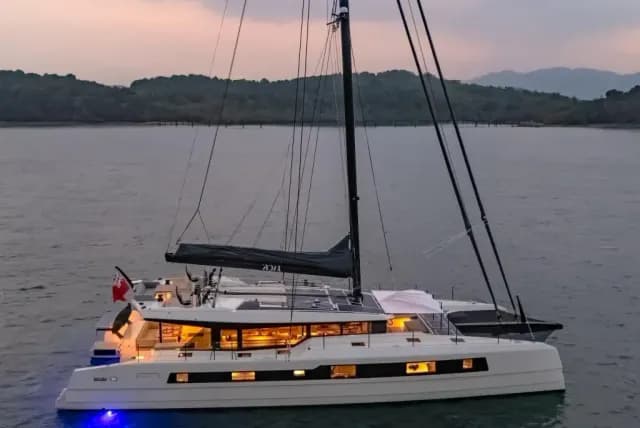
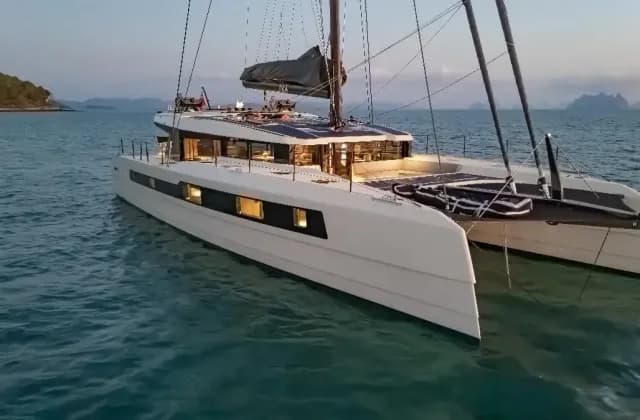
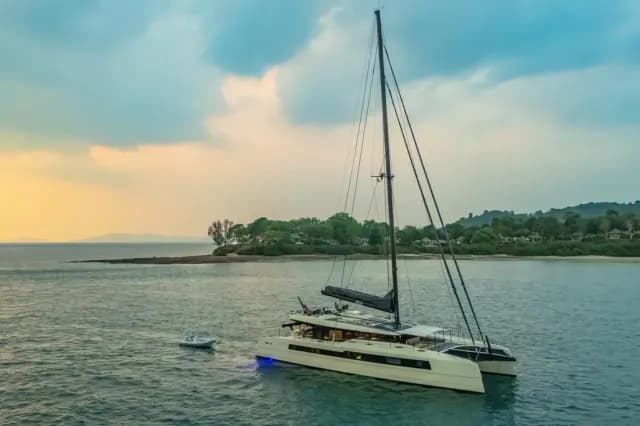
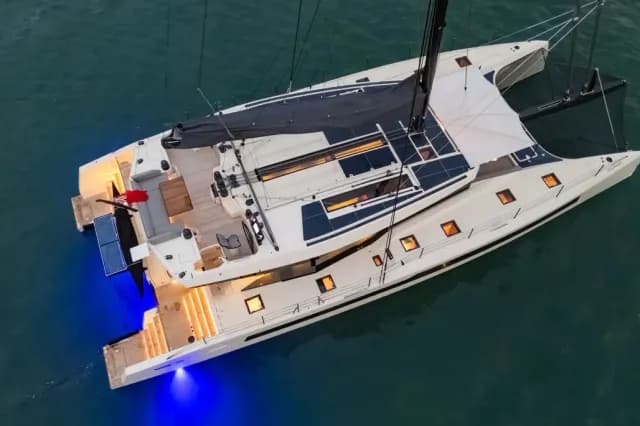
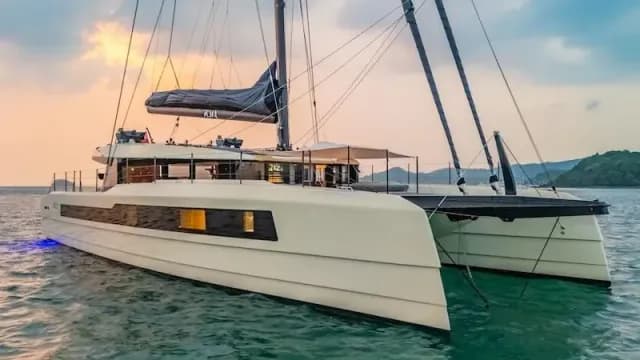
2023 McConaghy MC75 'JACK' - ARC-Winning Performance Catamaran
McConaghy MC75 Specifications
| Specification | Detail |
|---|---|
| LOA | 23.3 m (76 ft 5 in) |
| Beam | 9.8 m (32 ft 2 in) |
| Draft (boards retracted) | 1.68 m (5 ft 6 in) |
| Draft (boards mid-position) | 2.46 m (8 ft 1 in) |
| Draft (boards fully deployed) | 4.5 m (14 ft 9 in) |
| Light displacement | ~25,000 kg (55,116 lbs) |
| Construction | Full pre-preg carbon fibre, Corecell foam core sandwich |
| Structural elements | Carbon fibre with thermoformed Kevlar and Nomex honeycomb cores |
| Mast & boom | Hall Spars — hybrid high-modulus/standard-modulus pre-preg carbon, post-cured at 120°C |
| Mainsail | Square-top, fully battened |
| Headsail | Furling genoa |
| Downwind | Gennaker / Code 0 (optional) |
| Engines | 2× Yanmar 150 HP with V-drive gearbox |
| Generator | Onan 27 kW |
| Fuel capacity | 3,000 litres (792 US gal) |
| Water capacity | 1,200 litres (317 US gal) |
| Solar panels | 3.2 kWp integrated on coachroof, davits, and foredeck |
| Batteries | Mastervolt 24V/6000 lithium × 12 (house bank) |
| Cabin layouts | 3 / 4 / 5-stateroom configurations (all en suite) |
| Crew quarters | 2 cabins (sleeps 4), en suite |
| Naval architecture | Ker Yacht Design (Jason Ker) |
| Interior design | m2atelier (Italy) |
| Builder | McConaghy Boats, Zhuhai, China |
| CE category | A (Ocean) |
The headline number is the displacement. At approximately 25 tonnes light, the MC75 weighs roughly half what conventional 75-foot cruising catamarans displace — the direct consequence of full pre-preg carbon fibre construction using America’s Cup-grade processes. Every component — hulls, deck, structural elements, and rig — is engineered for minimum weight and maximum stiffness. The Hall Spars carbon mast and boom are built from hybrid high-modulus and standard-modulus pre-preg carbon, infused with epoxy, and post-cured at 120°C under 6 bar of pressure. This is racing technology applied to a cruising platform.
The push-button centreboard system is a patented innovation. Rather than conventional daggerboards that risk hull breach on impact with underwater objects, the MC75’s centreboards deploy to three pre-set positions via a push-button control: fully retracted (1.68 m draft for shallow anchorages), mid-position (2.46 m for coastal sailing), and fully deployed (4.5 m for maximum upwind performance). The boards retract automatically on impact — a safety feature borrowed from Grand Prix racing that protects the hull structure.
Performance & Sailing
Speed potential: The MC75 is predicted to achieve 21+ knots of boat speed in 20 knots of true wind at 110 degrees apparent — performance that places it in an entirely different category from production cruising catamarans. The combination of low displacement, a Grand Prix-specification Hall Spars carbon rig, and Ker Yacht Design’s CFD-optimised hull shapes delivers speed that most 75-foot catamarans cannot approach regardless of sail area.
Light-air capability: This is where the weight advantage pays the greatest dividend. While conventional 75-foot catamarans struggle below 12 knots of true wind, the MC75 sails effectively in sub-10-knot conditions — a genuine cruising advantage in light-air sailing grounds such as the Mediterranean in summer, the Caribbean in the doldrums, and the Pacific tropics. The yacht needs less breeze to get moving, spends less time motoring, and covers more distance under sail alone.
Bluewater credentials: The 2024 ARC transatlantic crossing confirmed the MC75’s ocean-going capability over 3,135 nautical miles. Hull no. 1 JACK, skippered by Morgan Hayes, took Multihull Line Honours — demonstrating both outright speed and the structural integrity required for an extended offshore passage. The 3,000-litre fuel capacity and 1,200-litre water tankage support genuinely long-range cruising, supplemented by 3.2 kWp of integrated solar panels and a Mastervolt lithium battery bank.
Under power: Twin Yanmar 150 HP diesels with V-drive gearboxes deliver a cruising speed of 10 knots at 2,500 RPM. The twin-engine configuration provides excellent close-quarters manoeuvrability through differential thrust. McConaghy has also partnered with Integrel Solutions to equip the MC75 with a dual-system Integrel E-Power delivering up to 18 kW of onboard power through an advanced 48V marine electrical system.
Structural innovation: Inspired by the latest America’s Cup foiling catamarans, the MC75 eliminates the conventional front crossbeam found on virtually all other cruising catamarans. Structural rigidity is instead achieved through a full-carbon longeron — reducing weight, improving airflow between the hulls, and further enhancing performance. This is a detail that perfectly encapsulates McConaghy’s approach: racing technology applied to a cruising yacht without compromise.
Interior Layout & Design
The MC75’s interior was designed by Italian studio m2atelier, marking a partnership between McConaghy’s Australian engineering DNA and Italian design sensibility. The design philosophy centres on creating what m2atelier describes as an “apartment-like feel with an architectural personality” — clean lines, natural materials, and a seamless visual connection between interior and sea.
The main saloon is the centrepiece. Described as nearly twice the size of saloons found on 100-foot power yachts, it features no structural bulkheads or partitions — a feat made possible by the carbon fibre construction that carries structural loads through the hull and deck laminate rather than internal framing. Fully retractable windows and floor-to-ceiling glass create seamless indoor-outdoor flow. A walk-around bar, dining area, and lounge seating create multiple social zones within a single open-plan space. Every fitting is bespoke, tailored to individual owner specification.
The MC75 offers three layout configurations: 3, 4, or 5 staterooms, all with en-suite bathrooms. In every configuration, two dedicated crew cabins (sleeping four crew) with their own en-suite head are positioned in the port hull adjacent to the galley — maintaining the separation between guest and crew spaces expected at this level. The starboard hull typically houses the master suite with full-beam owner’s cabin.
The flybridge provides a dual helm station at the forward end with clear sightlines for offshore sailing, a hard-top composite cover with three sail-viewing windows, and a substantial entertaining area aft. The aft cockpit features U-shaped settee seating with outboard cupboards, cushioned sun pads, and direct access to the hydraulic swim platform.
The overall impression is of a yacht that takes the weight-saving discipline of a Grand Prix racer and channels it into creating more space, more light, and more comfort rather than simply more speed. The MC75’s interior volume relative to its displacement is extraordinary — a direct benefit of the carbon fibre construction that most competitors cannot match.
MC75 Ownership: What to Expect
The MC75 sits in the ultra-premium segment of the catamaran market, with ownership costs reflecting the bespoke nature of the build, the carbon fibre construction, and the complexity of the onboard systems:
- New-build pricing: Approximately USD 8–10+ million depending on specification and customisation. A 2027 new-build slot is currently listed at USD 8,800,000 for a 5-stateroom configuration. Each MC75 is semi-custom — the final price depends heavily on interior specification, systems, and equipment choices.
- Used market: Hull no. 1 JACK (launched 2023, ARC 2024 winner) is listed at approximately GBP 5,500,000 / USD 8,000,000. With only two hulls delivered, the used market is effectively non-existent — this is a bespoke platform, not a production yacht with established resale data.
- Annual operating costs: Professional crew (captain + mate/chef minimum), insurance at 1.0–1.5% of hull value, marina berth fees for a 76-foot catamaran (32 ft beam), twin Yanmar engine servicing, generator maintenance, and carbon rig inspection. Expect USD 150,000–300,000+ annually depending on usage, crew, and cruising ground.
- Charter potential: JACK is available for charter in the Mediterranean (summer) and Caribbean (winter), accommodating up to 8 guests. Charter income can meaningfully offset annual operating costs.
The MC75 is not a production catamaran with established depreciation curves or a deep pool of comparable sales. Buyers at this level are purchasing a bespoke yacht from a builder with unmatched composite construction credentials. The investment thesis rests on McConaghy’s racing pedigree, the quality of the carbon construction, and the rarity of the platform.
How to Buy a McConaghy MC75
New build vs used: With only two hulls delivered to date and additional builds in progress, the MC75 market is primarily new-build. McConaghy offers build slots with a lead time that varies depending on yard scheduling and specification complexity. The semi-custom process allows buyers to work with m2atelier on bespoke interior layouts and with Ker Yacht Design on performance optimisation.
The McConaghy range: The MC75 sits within a broader MC Multihull range spanning 55 to 115 feet (MC55, MC62, MC68, MC75, MC86, MC100, MC115) in both power and sail configurations. McConaghy also produces the Panther electric hybrid catamaran series (48, 56, and 68 ft) with integrated composite solar panels generating 12+ kWp. Buyers considering the MC75 should evaluate the full range to identify the right platform for their cruising programme.
Key Considerations for Buyers
- Service network: McConaghy is a specialist builder with facilities in China, Australia, and Hong Kong. Unlike production builders with global dealer networks, service and warranty support require direct engagement with McConaghy. Carbon fibre repair and rig maintenance require specialised technicians — budget for travel to authorised service facilities or for technicians to travel to the yacht.
- Carbon rig maintenance: The Hall Spars carbon mast and boom require annual inspection by qualified riggers experienced with carbon spars. This is not a standard aluminium rig — the inspection protocol, repair procedures, and failure modes differ significantly.
- Insurance: Insuring a carbon fibre yacht of this value requires a specialist marine insurer. Premiums will reflect the replacement cost of the carbon structure, which is significantly higher than conventional GRP construction.
- Survey requirements: A pre-purchase survey must be conducted by a surveyor experienced with advanced composite construction. Standard GRP survey techniques are insufficient. Non-destructive testing (NDT) of critical structural areas — hull-to-deck joints, centreboard trunks, longeron attachment points, and chainplate areas — is essential.
The MC75 is not a yacht for passive ownership. It rewards owners who appreciate the engineering behind the build, who intend to sail actively, and who understand that a bespoke carbon fibre platform requires specialist care. For those buyers, it offers a genuinely unmatched combination of performance, luxury, and construction quality.
McConaghy MC75 vs Competitors
The MC75 competes in the high-performance luxury catamaran segment — a niche occupied by a handful of builders who combine serious sailing capability with superyacht-level comfort. The competitive landscape is defined less by size-class comparisons and more by the buyer’s priority: performance versus luxury, racing pedigree versus production convenience.
MC75 vs Gunboat 72V
The Gunboat is the MC75’s closest philosophical competitor — a performance-first carbon catamaran for sailors who want to go fast. The Gunboat 72V is lighter than production catamarans (approximately 28,400 kg) but heavier than the MC75, which benefits from McConaghy’s America’s Cup-grade carbon construction. The Gunboat has a strong cult following among performance multihull sailors and an established owner community. The MC75 counters with lower displacement, the patented push-button centreboard system, the no-crossbeam longeron design, and McConaghy’s deeper racing pedigree. For buyers who prioritise outright performance with proven racing results, the MC75 has the edge.
MC75 vs Sunreef 80
These yachts serve fundamentally different buyers. The Sunreef 80 is an ultra-luxury catamaran with superyacht-quality bespoke interiors, celebrity cachet (Nadal, Alonso, Rosberg), and the proprietary Eco solar/electric technology. It is significantly heavier, wider, and slower than the MC75. The Sunreef appeals to buyers who prioritise interior luxury, brand prestige, and the Eco sustainability story. The MC75 appeals to buyers who prioritise sailing performance, racing technology, and the engineering achievement of America’s Cup-grade carbon construction. There is minimal cross-shopping between these two platforms.
MC75 vs Lagoon Seventy 7
The Lagoon 77 represents the volume-production end of the 75-foot catamaran market. At approximately 64 tonnes displacement, it weighs more than twice the MC75 — a weight difference that defines every aspect of the sailing experience. The Lagoon offers enormous interior volume, proven production quality, the Groupe Beneteau global service network, and a substantially lower price point. The MC75 counters with transformative performance under sail, carbon fibre construction, and the bespoke nature of each build. The Lagoon is the right choice for buyers who want a floating apartment that sails adequately. The MC75 is for buyers who want a yacht that sails exceptionally and lives comfortably.
MC75 vs Custom One-Off Builds
At the MC75’s price point (USD 8–10+ million), buyers can also commission fully custom one-off catamarans from specialist yards. The MC75’s advantage over a pure custom build is McConaghy’s existing tooling, proven hull shapes, established build process, and the track record of the ARC-winning hull no. 1. A custom one-off carries greater design risk, longer build times, and typically higher costs for equivalent construction quality. The MC75 offers the performance and exclusivity of a custom build with the reduced risk of a proven platform.
For a full interactive comparison between the McConaghy MC75 and other models, visit the Hulls.io Market Intelligence tool.