

Axopar 37 Cross Cabin Buyer’s Guide
Sport CruiserScandinavian design disruptor offering a sporty yet affordable cruiser with massive search growth. The Axopar 37 has redefined what a mid-size boat can be, combining adventure capability with minimalist Nordic design and exceptional build quality.
Show 2 awards
Show 5 key features
Updated 10 June 2026 · By Hulls.io Editorial
The Axopar 37 Cross Cabin: A Complete Guide
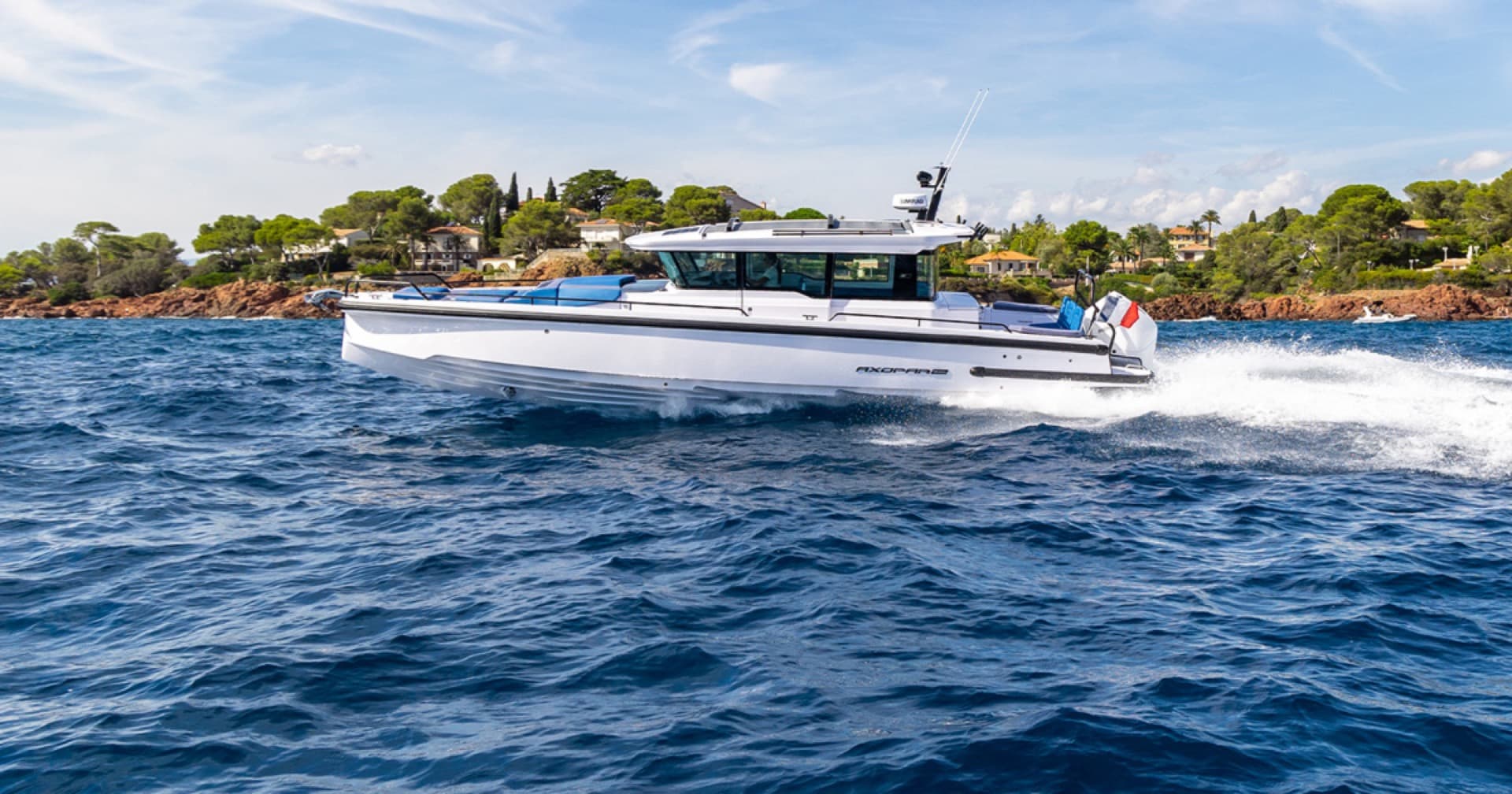
The Axopar 37 XC Cross Cabin is the flagship enclosed-helm variant of the model that defined a new category in recreational boating. When Axopar launched at the Helsinki Boat Show in February 2014, there was no established name for what co-founder Jan-Erik Viitala was building — an outboard-powered, walkaround, multi-purpose platform that could run offshore at 40 knots, anchor in a quiet cove for a swim, tow a wakeboarder, and still serve as a credible weekender. The marine press eventually settled on “adventure boat,” and the category now drives one of the fastest-growing segments in the global leisure marine market. The 37 Cross Cabin sits at the heart of that story: with over 3,000 units of the 37 platform sold worldwide, it has topped US outboard-powered boat sales in the 35–40-foot segment for consecutive years and made Axopar the largest powerboat producer in the Nordic countries.
Naval architect Jarkko Jämsén has drawn every Axopar hull since the brand’s inception, and his twin-stepped, sharp-entry bow design is as central to Axopar’s identity as the Judel/Vrolijk hull is to Hanse. The 37’s hull went through a fundamental evolution in 2020 with the “Revolution” update — a reworked entry angle, refined step geometry, and optimised spray rails that delivered up to 30% better fuel economy across the 20–40-knot cruising range while maintaining the same external dimensions and weight. It was not a facelift; it was a new hull, developed through extensive CFD simulation by Axopar’s design partners at Aivan. The result was a boat that cruises more efficiently at 30 knots than the original did at 25, with a real-world range improvement of approximately 75 nautical miles on the same 730-litre fuel tank.
The Cross Cabin (XC) version distinguishes itself from the Sun Top and Spyder variants by offering a fully enclosed, weatherproofed pilothouse with an optional air-conditioning system. Where the Sun Top provides a full-length roof with open sides and the Spyder is a pure open dayboat, the Cross Cabin wraps the helm station and social seating in glass and a hard roof, creating a genuine all-weather cruising platform. Gullwing doors on either side of the forward cabin open the boat to the elements when conditions allow, and a large sliding canvas roof panel transforms the enclosed cabin into a semi-open experience. This combination — enclosed when you need it, open when you want it — is what has made the Cross Cabin the most popular variant in Northern European and Scandinavian markets, where year-round boating demands real weather protection.
Axopar is a Finnish company founded in 2014 by Jan-Erik Viitala and Sakari Mattila. The name derives from the founders’ collective experience across other distinguished Scandinavian marine brands — Aquador, XO, and Paragon. Production takes place in Poland at Markos Sp. z o.o., in which Axopar acquired a majority stake to secure quality control and production capacity. The operation indexes one position per day at noon on each production line, and the factory can produce six boats every five days. This manufacturing discipline, combined with outboard-only propulsion that eliminates the complexity of inboard shaft lines and stern drives, keeps the Axopar 37 competitively priced against boats with less sophisticated hull designs. Over 7,500 Axopar boats have been delivered since 2014, and the company has appeared on the Financial Times FT 1000 list of fastest-growing European companies in 2020, 2021, and 2022.
Hulls.io currently tracks 0 active listings for the Axopar 37 Cross Cabin, drawn from brokerages worldwide.
Axopar 37 Cross Cabin Specifications
| Specification | Detail |
|---|---|
| LOA (excl. engines) | 11.50 m (37 ft 9 in) |
| LOA (incl. engines) | 12.35 m (40 ft 6 in) |
| Beam | 3.35 m (11 ft 0 in) |
| Draft | 0.85 m (2 ft 9 in) |
| Dry weight (excl. engines) | 3,770 kg (8,311 lbs) |
| Weight as tested (2 × 300 hp) | ~4,900 kg (10,800 lbs) |
| Deadrise at transom | 20° |
| Bow entry angle | 60° |
| Hull type | Twin-stepped deep-V, sharp-entry bow |
| Fuel capacity | 730 litres (193 US gal) |
| Freshwater capacity | 100 litres (26 US gal) |
| Berths | 2 (forward cabin) + 2 (optional aft cabin) |
| Max persons onboard | CE B: 10 / CE C: 12 |
| Engine options | 2 × 225–400 hp outboard (Mercury) |
| Standard engine | 2 × Mercury V8 300 hp FourStroke |
| Maximum power rating | 700 hp (2 × 350 hp standard / 2 × 400 hp BRABUS) |
| Naval architect | Jarkko Jämsén |
| Hull construction | Hand-laminated GRP with vinylester resin |
| Builder | Axopar Boats Oy / Markos Sp. z o.o. |
| Build location | Poland (designed in Finland) |
| CE category | B – Offshore |
| Production years | 2020–present (37 platform from 2017; Revolution hull from 2020) |
| Variants on platform | Spyder, Sun Top, XC Cross Cabin |
| Septic tank | 70 litres |
The numbers tell the story of a boat designed around a single engineering obsession: getting a 37-foot platform to plane quickly, run efficiently at high speed, and handle confidently in rough water — all without the weight and mechanical complexity of inboard propulsion. At 3,770 kg dry (without engines), the Axopar 37 XC is dramatically lighter than most competitors of similar length. This is not an accident. Outboard power, GRP construction with vinylester resin for osmosis resistance, and a carefully optimised superstructure keep displacement low. When you pair that hull weight with twin 300 hp Mercury V8 FourStrokes (adding approximately 272 kg per engine), the power-to-weight ratio is exceptional — and it shows in every aspect of the boat’s on-water behaviour.
The 730-litre fuel capacity is generous for the class and enables a meaningful cruising range at 30 knots — approximately 250–280 nautical miles with the Revolution hull. The 100-litre freshwater tank is adequate for day use and short overnights but will need supplementing from shore for extended weekending. CE Category B (Offshore) certification — the highest attainable for a sub-40-foot vessel — confirms the structural integrity and stability for offshore operation in winds up to Beaufort Force 8 and significant wave heights exceeding 4 metres. The 20-degree deadrise at the transom, combined with the twin-stepped hull geometry and sharp 60-degree bow entry, provides the hydrodynamic foundation for both speed and seakeeping.
Performance & Handling
The stepped hull: Jarkko Jämsén’s twin-stepped hull is the defining technical innovation of the Axopar range. The two transverse steps in the hull bottom introduce air beneath the running surface at speed, reducing wetted area and frictional drag. The sharp-entry bow — with its 60-degree entry angle narrowing to 20 degrees of deadrise at the transom — slices through chop rather than pounding over it. The 2020 Revolution update refined the step geometry and spray rail profiles using computational fluid dynamics, achieving up to 30% better fuel economy across the 20–40-knot range compared to the original 37. This is not marketing hyperbole; it is measurable in fuel flow data. At 30 knots with twin Mercury V8 300 hp engines, the Revolution hull consumes approximately 2.4 litres per nautical mile — a figure that shames many boats ten feet shorter.
Speed: With the standard twin Mercury V8 300 hp configuration, the Axopar 37 XC Cross Cabin reaches a top speed of approximately 48–50 knots and cruises comfortably at 28–30 knots. Stepping up to twin Mercury Verado 350 hp engines pushes the top end beyond 53 knots. The BRABUS Performance Line, equipped with twin Mercury Verado V10 400 hp units, delivers a top speed exceeding 56 knots and a cruise speed of approximately 35 knots. The boat planes in under four seconds from rest — a result of the low displacement, aggressive hull geometry, and the immediate torque response of Mercury’s naturally aspirated V8 or supercharged V10 outboards. This is a boat that gets on plane and stays there in conditions that would force heavier, conventionally hulled competitors to come off the throttle.
Rough water: The combination of 20-degree transom deadrise, sharp bow entry, and twin-stepped hull geometry produces a ride quality that consistently surprises owners and reviewers. Motor Boat & Yachting described cruising at 50 knots as “almost laughable” in its composure. The boat tracks straight in a following sea, grips hard in turns without cavitation or propeller ventilation, and delivers a soft, predictable motion through head seas at cruising speed. The walkaround deck design — with safe passageways, reduced thresholds, and integrated boarding steps on both sides — means crew can move forward safely even at speed in moderate conditions. The self-draining aft deck and quick-drain scuppers handle green water efficiently. In genuinely rough offshore conditions — short, steep North Sea chop or Baltic autumn seas — the 37 XC is a more capable boat than most owners will ever need it to be.
Fuel economy & range: At a comfortable cruise of 28–30 knots, expect fuel consumption of 2.3–2.5 litres per nautical mile with the twin 300 hp configuration, translating to approximately 250–280 nm range on the 730-litre tank with a sensible 10% reserve. Dropping to a displacement cruise of 15–18 knots reduces consumption to approximately 1.4–1.7 l/nm, extending range beyond 380 nm. At wide-open throttle (48+ knots), consumption rises to approximately 4.5–5.0 l/nm — exhilarating but expensive. The sweet spot is 25–32 knots, where the stepped hull is fully ventilated and the engines are operating at peak efficiency. This is where the Revolution hull’s 30% improvement over the original is most pronounced.
Overall assessment: The Axopar 37 XC Cross Cabin drives like a much lighter, much smaller boat than its 37-foot LOA suggests. The helm response is immediate, the boat transitions from displacement to planing speed without the wallowing hump that afflicts heavier designs, and the twin-stepped hull provides a level of grip and control in turns that inspires genuine confidence at speed. It is a boat that rewards experienced drivers with precise, responsive handling while remaining predictable and forgiving enough for less experienced operators. The walkaround layout, excellent visibility from the enclosed helm position, and Mercury’s DTS (Digital Throttle and Shift) electronic controls make close-quarters manoeuvring straightforward despite the twin-engine, twin-outboard configuration.
Layout & Accommodation
The Cross Cabin’s defining feature is its fully enclosed pilothouse. A large wraparound windscreen and side windows provide panoramic visibility from the helm, while the hard roof and enclosed sides create a sheltered, all-weather environment for the driver and passengers. The pilothouse seats up to six: the driver and co-pilot occupy forward-facing seats (rotating and length-adjustable with flip-up bolsters), while a generous L-shaped lounge sofa to port and rear provides social seating around a foldable cockpit table in wenge. When the sliding roof panel is opened and the gullwing side doors are raised, the enclosed cabin transforms into an airy, semi-open space — one of the cleverest transitions in the segment. LED deck lights in the pilothouse floor, recessed LED roof lights, and roof grab rails complete the interior detailing.
The forward cabin is accessed through the gullwing doors or from the pilothouse. It provides a queen-size double berth with soft side bolsters, an L-shaped lounge sofa, and a portlight with an openable hatch for ventilation. With the gullwing doors open, this cabin floods with light and air and feels substantially larger than its footprint. An optional separate toilet compartment can be fitted within the forward cabin. The standard head arrangement positions an electric flush sea toilet beneath a lift-up panel in the L-sofa, connected to a 70-litre septic tank with deck and hull outlets — functional for day use, though owners doing extended weekending will want the enclosed head option.
The modular aft deck is one of Axopar’s signature features. As standard, the 37 XC Cross Cabin ships with a spacious, open aft deck — a flat, self-draining area that serves as a swim platform, tender loading area, and general-purpose social space. From there, the owner can configure the aft deck with any of several factory modules: an aft bench seat, a wet bar module (with refrigerator, electric grill, and sink), a multi-storage compartment designed for watersports equipment, or — critically for the weekender buyer — an aft cabin. The aft cabin option fits beneath a sunpad and provides a double berth for two adults with large windows and opening hatches, bringing the total overnight capacity to four. This modularity is not aftermarket; these are factory-integrated options that maintain the boat’s structural integrity and finish quality.
Galley provisions on the 37 XC are oriented toward day cruising rather than liveaboard cooking. An optional wet bar module on the aft deck provides a refrigerator, electric grill, and sink with faucet — adequate for alfresco entertaining at anchor. Below, a 50-litre refrigerator can be fitted under the co-pilot seat, and a sink/gas hob unit can be integrated into the forward cabin cupboard. This is not a boat designed for preparing three-course meals at sea; it is designed for the cruising reality of most 37-foot outboard owners — cold drinks, grilled food on the aft deck, and restaurants ashore.
Storage is thoughtfully distributed. A large anchor box in the bow accommodates the anchor, fenders, ropes, and gear. The L-sofa in the pilothouse has storage beneath, as does the centre seat and aft sofa. The multi-storage aft deck module adds a dedicated watersports locker. All hardware is 316 stainless steel, and the anti-skid finishing on working deck areas provides confident footing. Eight cleats on the aft, midships, and foredeck provide comprehensive mooring options, and additional hooking points around the side decks accommodate safety harness attachment for offshore work. The overall design language is unmistakably Scandinavian: clean lines, functional detailing, and a material quality that justifies the price point.
Axopar 37 Cross Cabin Ownership & Running Costs
The Axopar 37 XC Cross Cabin remains in production, with new boats configured through Axopar’s extensive dealer network in over 50 countries. A new boat with twin Mercury V8 300 hp engines and a typical cruising specification lands at approximately €260,000–€320,000 in Europe depending on options. The BRABUS Performance Line with twin Verado V10 400 hp engines and premium trim pushes toward €400,000–€450,000+. In the US market, equivalent pricing is approximately $300,000–$450,000. The principal ongoing cost areas are as follows:
- Insurance: 1.0–2.5% of hull value. On a boat insured at €300,000, this translates to approximately €3,000–€7,500 per year. Nordic and Mediterranean coastal coverage sits at the lower end; transatlantic delivery or extended offshore cruising commands a premium.
- Marina berth: A 37-foot outboard boat fits standard berths comfortably. Scandinavian marinas range from €3,000–€8,000 per year; Mediterranean berths from €5,000–€15,000 depending on location. UK south coast marinas charge £5,000–£10,000 per year. The relatively modest beam of 3.35 m avoids the wide-berth surcharges that affect broader pilothouse designs.
- Engine servicing: Mercury outboards require servicing at 100-hour or annual intervals, whichever comes first. Each 100-hour service (oil and filter, gear case fluid, in-line fuel filter) costs approximately €500–€800 per engine at a Mercury dealer. The 300-hour service adds spark plugs, water pump impeller, and the pressurised fuel filter — approximately €800–€1,200 per engine. For twin engines running 100–150 hours per season, budget €1,500–€3,000 annually for professional servicing.
- Winterisation: In Nordic and Northern European climates, winterisation is essential. Professional winterisation for twin Mercury outboards costs approximately €300–€500 per engine, covering fogging, fuel stabilisation, lower unit drainage, and battery conditioning. Many Scandinavian owners haul out in October and relaunch in April/May — the boat’s outboard configuration simplifies this process considerably compared to inboard-powered alternatives.
- Haul-out and antifouling: €1,200–€2,500 for an annual haul-out, hull wash, and antifouling paint. The flat-bottomed, outboard-powered configuration makes this a straightforward job with no running gear to work around.
- Approximate total: €10,000–€25,000 per year depending on location, engine hours, and marina choice. Scandinavian ownership with a seasonal pattern (April–October) sits at the lower end; year-round Mediterranean use at the upper end.
One of the Axopar 37’s strongest ownership propositions is the simplicity and global support of Mercury outboard propulsion. Mercury Marine operates the largest dealer and service network in the marine engine industry, meaning that wherever the boat travels, service capability is close at hand. Outboard engines are mechanically simpler than inboard diesels — no shaft seals, no stern glands, no saildrive diaphragms — and their accessibility on the transom makes routine maintenance faster and less expensive. The engines can be tilted clear of the water when the boat is on a mooring, eliminating growth on the lower units and reducing antifouling requirements.
Parts availability is excellent. Axopar’s dealer network spans 50+ countries, and Mercury’s global distribution ensures that consumables and service parts are available virtually anywhere. The GRP hull requires no special structural maintenance beyond standard antifouling and gel coat care. The vinylester resin used in the hull laminate provides superior osmosis resistance compared to polyester resin, reducing the risk of blistering in warm-water environments. As a current-production model backed by a financially stable, privately owned company, the 37 XC has none of the parts obsolescence concerns that can affect boats from smaller or discontinued builders.
How to Buy an Axopar 37 Cross Cabin: What to Look For
Model years and pricing: The Axopar 37 platform has existed since 2017, but the critical distinction for buyers is between pre-Revolution (2017–2019) and Revolution (2020–present) hulls. The 2020 Revolution brought the redesigned sharp-entry twin-stepped hull with dramatically improved fuel economy, the gullwing door concept, and refined interior detailing. Pre-Revolution examples trade at €150,000–€200,000 depending on engine hours and specification. Revolution-era Cross Cabin models (2020–2022) ask €200,000–€280,000 on the European used market, with 2023–2024 examples commanding €270,000–€380,000. The sweet spot for value is a 2020–2021 Revolution model at €210,000–€260,000 — the major hull improvements are present, two to four years of depreciation have been absorbed, and the boat has the majority of its service life ahead of it.
Known Issues to Inspect
- Engine hours and service history: Mercury outboards are robust, but they must be serviced on schedule. Verify the service history against Mercury’s recommended intervals (100-hour and 300-hour services). Engines with 300+ hours and no documented 300-hour service should raise concerns. Check for corrosion on the lower units, particularly if the boat has been kept in saltwater. Mercury’s VesselView system logs engine data — ask to review it.
- Gel coat and hull condition: Inspect the hull bottom around the stepped sections for any damage, delamination, or repair work. The twin-stepped hull geometry means that any impact damage to the steps can affect the air-ventilation that drives the hull’s efficiency. Check for gel coat crazing along the chines and spray rails — cosmetic in most cases but worth documenting.
- Trim tab and steering system: The boat relies on properly functioning trim tabs (or Mercury Active Trim) and hydraulic steering for its handling characteristics. Test the steering system through its full range at speed during a sea trial. Any stiffness, play, or uneven response warrants investigation.
- Canvas and soft furnishings: The sliding roof canvas, gullwing door seals, and side curtains are high-wear items, particularly on boats used in Nordic climates with UV, salt, and freeze-thaw cycles. Check for stitching deterioration, seal integrity, and canvas tension. Budget €2,000–€5,000 for replacement if worn.
- Electrical system and electronics: The 37 XC carries a significant electrical load (navigation electronics, LED lighting, optional air conditioning, refrigeration). Verify battery condition and charging system function. Check that all navigation electronics, the VesselView display, and accessory circuits operate correctly.
- Aft cabin and wet bar modules: If fitted, inspect the aft cabin for signs of water ingress around the hatches and windows. The wet bar module’s plumbing and refrigeration should be tested for proper function. These modular components are well-integrated from the factory but can develop seal issues over time.
Equipment That Adds Value
When assessing a used Axopar 37 XC Cross Cabin, the following additions represent genuine added value: the aft cabin module (significantly expands weekending capability), BRABUS Line trim and engine upgrade, upgraded navigation electronics (Garmin or Simrad multifunction display, radar, AIS), the wet bar module, air conditioning, bow thruster, Mercury Joystick Piloting for close-quarters manoeuvring, a roof rack for watersports equipment, upgraded audio system, and documented engine service history with low hours. A boat fitted with the aft cabin, quality electronics, and the BRABUS package commands a meaningful premium over a base-specification example on the used market.
The Axopar Community Factor
Axopar has cultivated one of the most active owner communities in recreational boating. The Axopar Owners’ Group on social media is a genuine resource — thousands of owners sharing experiences, technical knowledge, and cruising plans. Axopar-organised events, adventure rallies, and dealer gatherings create a brand community that is unusual in the powerboat market. For buyers, this translates into practical benefits: rapid answers to technical questions, a ready pool of group knowledge about specifications and options, and an active secondary market where well-maintained boats find buyers quickly. The community engagement also supports resale values — the brand loyalty and demand within the owner base create a floor under used pricing that less community-oriented brands lack.
Sea Trial Checklist
A pre-purchase sea trial should include: acceleration to planing speed (should be under four seconds with twin 300 hp), behaviour at cruising speed (28–30 knots) in at least moderate conditions, hard turns at 30+ knots to check hull grip and propeller performance, fuel flow readings at multiple speeds against the Revolution hull benchmarks, steering response through full range, trim tab operation, reverse handling and close-quarters manoeuvring, all electronics and VesselView data, engine synchronisation at cruise, and noise levels in the enclosed pilothouse at speed (the XC should be noticeably quieter than the Sun Top or Spyder). Request a cold start if possible — Mercury outboards should fire immediately and idle smoothly. Any rough running, smoke, or hesitation under acceleration warrants a compression test and further investigation.
Axopar 37 Cross Cabin vs Competitors
The “adventure boat” segment that Axopar pioneered has attracted serious competition from established builders on both sides of the Atlantic. The arrival of Groupe Beneteau (through Wellcraft) and Brunswick (through Boston Whaler) into this space confirms the category’s commercial viability. However, the Axopar 37 remains the benchmark — the boat against which every new entrant is measured. Understanding how it compares to the leading alternatives helps buyers make an informed choice.
Axopar 37 XC vs Boston Whaler 320 Vantage
The Boston Whaler 320 Vantage represents the American approach to the versatile centre-console cruiser. Built by Brunswick, the Whaler carries the brand’s legendary “unsinkable” foam-filled hull construction and decades of fishing-boat heritage. The fundamental difference is weight: the Whaler displaces approximately 4,500 kg dry — significantly heavier than the Axopar 37 — with a wider beam of approximately 3.20 m. This weight translates to greater interior volume, more substantial cabin headroom, and a tank-like sense of solidity, but it comes at the cost of speed, fuel efficiency, and agility. The Whaler typically runs twin outboards in the 300–400 hp range but achieves lower top speeds and higher fuel consumption per nautical mile than the Axopar at equivalent power. The 320 Vantage is the stronger choice for buyers who prioritise the heritage construction, fishing capability, and the American dealer network. The Axopar wins on performance, fuel efficiency, Scandinavian design quality, and versatility of layout. Pricing is broadly comparable, though the Whaler commands a premium in the US market where the brand’s resale reputation is strongest.
Axopar 37 XC vs Nimbus T11
The Swedish-built Nimbus T11 (and its enclosed Commuter C11 sibling) is the premium Scandinavian alternative. Nimbus is a heritage brand — established builders of high-quality day boats and commuters — and the T11/C11 platform reflects decades of refined craftsmanship. The Nimbus is approximately one tonne heavier than the Axopar 37, which gives it a more solid, planted feel in rough water but reduces acceleration and top speed. The critical differentiator is that the Nimbus C11 offers an inboard diesel option (twin Volvo Penta D4 320 hp) alongside outboard configurations — an important consideration for owners who prefer diesel propulsion for its torque characteristics and fuel availability in European cruising grounds. Build quality and interior detailing on the Nimbus are exceptional — arguably a step above the Axopar in material quality and fit-and-finish. Pricing reflects this: the Nimbus C11 is approximately €550,000 ready-to-go, nearly double the entry point of a well-configured Axopar 37 XC. The Axopar wins on value, performance, and fuel efficiency; the Nimbus wins on build quality, the diesel option, and a ride quality that benefits from its additional mass. For buyers with the budget, the Nimbus deserves a sea trial alongside the Axopar.
Axopar 37 XC vs Wellcraft 355
The Wellcraft 355 (now rebranded as the Explorer 38) is Groupe Beneteau’s direct response to Axopar’s success. Designed by Michael Peters, it carries a heavier, non-stepped hull with greater beam and substantially more interior volume. The Wellcraft requires triple outboards (3 × 300 or 350 hp) versus the Axopar’s twins, adding cost, complexity, and weight but delivering more raw power. At 28 knots, the Wellcraft consumes approximately 4 l/nm — nearly double the Axopar’s 2.4 l/nm, a dramatic efficiency gap that compounds on every cruise. The Wellcraft offers a more spacious, higher-freeboard platform with a more traditionally “yacht-like” interior, greater headroom in the cabin, and a more substantial feel overall. It is a serious offshore boat with genuine cruising capability. The Axopar counters with its lighter weight, superior fuel efficiency, sharper handling, lower running costs (two engines vs three), and the modular deck layout system. Pricing is in a similar band, but the Wellcraft’s triple-engine running costs make the total cost of ownership meaningfully higher. For buyers who prioritise interior space, volume, and a more traditional cruiser feel, the Wellcraft is compelling. For those who value efficiency, agility, and the Nordic design philosophy, the Axopar remains the stronger choice.
Axopar 37 XC vs Jeanneau Cap Camarat 10.5 WA
The Cap Camarat 10.5 WA is Jeanneau’s entry in the walkaround sport-cruiser segment, designed by Michael Peters and backed by Groupe Beneteau’s extensive global dealer network. At approximately 10 m LOA, it is slightly shorter than the Axopar 37, with a Michael Peters V-hull that delivers a top speed exceeding 40 knots with twin 300 hp Yamaha outboards. The Cap Camarat offers a two-cabin layout (forward V-berth and separate aft cabin) with an outdoor galley behind the helm station, an integral windshield option, and CE Category B certification. It competes at a lower price point — approximately €290,000–€320,000 new — making it an accessible alternative for buyers on a tighter budget. The Axopar 37 XC Cross Cabin counters with its fully enclosed pilothouse (the Cap Camarat is more open), superior fuel efficiency from the stepped hull design, higher top speed, the modular aft deck system, and the brand’s stronger community and resale value. The Jeanneau is the sensible choice for buyers seeking a proven, competitively priced walkaround with French build quality and Yamaha engine availability. The Axopar is the more exciting, more efficient, and more versatile platform for those willing to pay the premium.
For a full interactive depreciation comparison between the Axopar 37 Cross Cabin and competing models, visit the Hulls.io Market Intelligence tool.
Axopar 37 Cross Cabin Value Retention
Newest vintage = 100%. Older vintages shown as % of that price.
Based on median asking prices by model year. The newest model year in our dataset is used as the 100% reference point. The curve is smoothed so retention never increases as age increases — hover over data points to see raw values. Shaded band shows the 25th–75th percentile price range. Figures reflect asking prices from tracked listings, not final sale prices.