


Boston Whaler 170 Montauk for Sale
Saltwater FishingThe Boston Whaler 170 Montauk is available on Hulls.io with 1 listing currently for sale. This model is categorised as a Saltwater Fishing.
Updated 10 June 2026 · By Hulls.io Editorial
The Boston Whaler 170 Montauk: A Complete Guide
The Boston Whaler 170 Montauk is arguably the most iconic small center console boat in America. Built by Boston Whaler at their Edgewater, Florida facility, the 170 Montauk is the entry point to a brand whose name is synonymous with one word: unsinkable. At 17 feet 2 inches, this is a boat that punches far above its size class in build quality, resale value, and sheer brand equity — a boat that has introduced more families to boating, more children to fishing, and more first-time owners to the water than perhaps any other model in the recreational marine industry.
The Montauk name dates back to 1961, when Dick Fisher demonstrated his revolutionary foam-core construction method by sawing a 13-foot Boston Whaler in half on live television. Both halves continued to float. Both halves could still be driven under outboard power. That demonstration became the founding legend of the brand, and the engineering principle behind it — a hull filled with closed-cell polyurethane foam that provides structural rigidity, buoyancy, and sound deadening — remains the core of every Boston Whaler built today, including the 170 Montauk. The current model is a direct descendant of that original 13-footer: refined over six decades of continuous production, but built on the same unsinkable promise.
What makes the 170 Montauk remarkable is the breadth of its appeal. You will find it at yacht club sailing programmes as a coach boat, on freshwater lakes as a family fishing platform, running inshore saltwater flats in Florida and the Chesapeake, serving as a Coast Guard Auxiliary vessel, and sitting in the garage of a weekend angler who simply wants the best-built small boat money can buy. It is the gateway to a lineup that extends all the way up to the Boston Whaler 330 Outrage and beyond — and many 330 Outrage owners started with a Montauk.
Boston Whaler was acquired by Brunswick Corporation in 1996 and now operates from a 570,000-square-foot manufacturing facility in Edgewater, Florida. The brand produces center consoles, dual-console models, and walkaround boats ranging from 13 to 42 feet. The 170 Montauk sits at the foundation of the center console lineup: small enough to tow behind a mid-size SUV, simple enough for a new boater to operate with confidence, and built with the same Unibond construction process used on every boat in the fleet.
Hulls.io currently tracks 1 active listing for the Boston Whaler 170 Montauk, drawn from dealers and brokerages across the US and internationally.
Showing 1–1 of 1 results
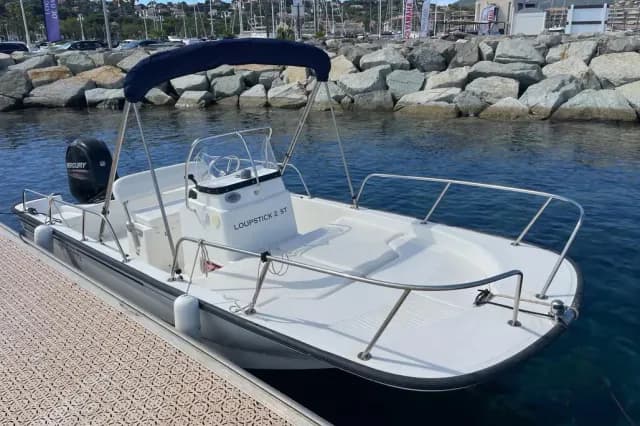
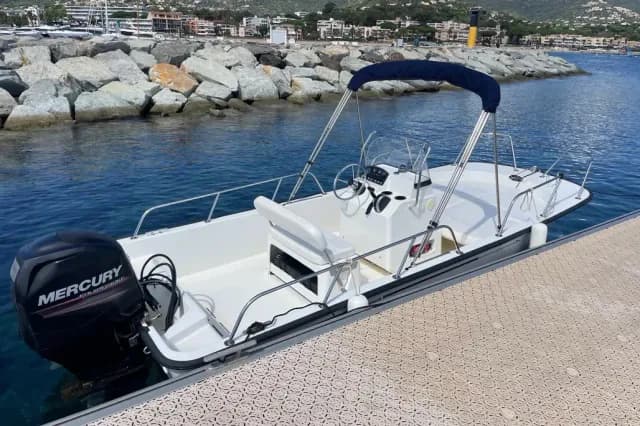
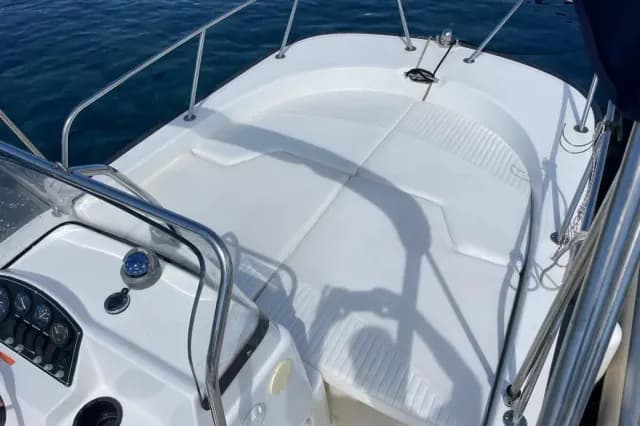
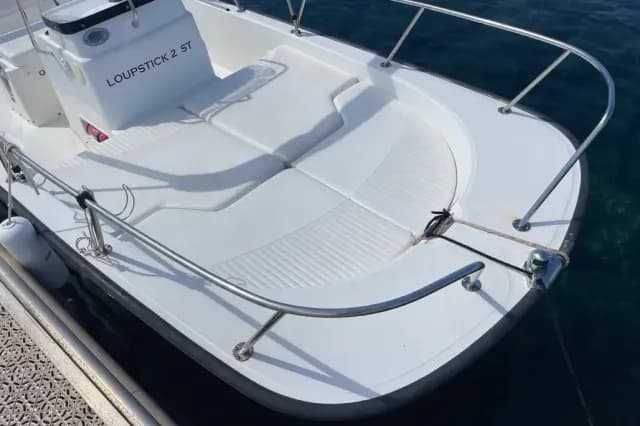
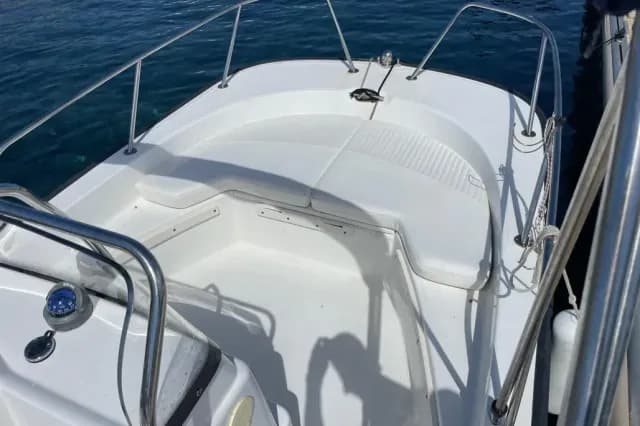
2014 Boston Whaler 170 Montauk
Boston Whaler 170 Montauk Specifications
| Specification | Detail |
|---|---|
| LOA | 17 ft 2 in (5.23 m) |
| Beam | 7 ft 2 in (2.18 m) |
| Draft (hull) | 10 in (0.25 m) |
| Transom deadrise | 18° |
| Dry weight (with engine) | ~1,500 lbs (680 kg) |
| Hull type | Deep-V modified with reverse chines |
| Hull construction | Unibond foam-core fiberglass (unsinkable) |
| Max horsepower | 90 hp |
| Standard engine | Mercury 90 hp FourStroke |
| Fuel capacity | 33 US gal (125 litres) |
| Max persons | 5 |
| CE category | C (Inshore) |
| Rod holders | 4 stainless steel flush-mount |
| Livewell | Integrated recirculating, transom-mounted |
| Console | Center console with windshield and grab rail |
| Swim platform | Integrated with boarding ladder |
| Stereo | Bluetooth-ready Fusion stereo system |
| Trailer | Available single-axle galvanized trailer |
| Builder | Boston Whaler, Edgewater, Florida, USA |
| Parent company | Brunswick Corporation |
| NMMA certified | Yes |
The defining specification on the sheet is the hull construction. Every Boston Whaler, from the 130 Super Sport to the 420 Outrage, uses the Unibond process: hull and deck are laid up in fiberglass, transferred to a precision steel mold, and filled under pressure with closed-cell polyurethane foam that expands to bond with every interior surface. The result is a hull that is structurally stiff, virtually rattle-free, and genuinely unsinkable — the foam provides enough positive buoyancy to keep the boat afloat even with catastrophic hull damage. On a 17-foot boat used in inshore waters, around docks, and by less experienced operators, this construction provides a margin of safety that no conventional fiberglass hull can match.
The 18-degree transom deadrise delivers a modified deep-V hull shape with reverse chines that provide spray deflection and additional stability at rest. This is not an offshore deep-V designed to cut through 6-foot seas — it is a hull optimised for inshore conditions: protected bays, coastal waters, rivers, and lakes. In its intended environment, the 170 Montauk delivers a dry, stable, predictable ride that inspires confidence in novice and experienced operators alike. The 10-inch hull draft means you can run skinny water that deeper-draught boats cannot access — an advantage for flats fishing and navigating shallow tidal creeks.
Performance & Handling
Power: The 170 Montauk is rated for a maximum of 90 horsepower and ships standard with the Mercury 90 hp FourStroke — the ideal match for this hull. The Mercury 90 is a naturally aspirated inline four-cylinder that delivers clean, quiet power with excellent fuel economy. At 90 hp, the 170 Montauk reaches approximately 34–36 mph at wide-open throttle, with a comfortable cruise of 22–26 mph at 4,000–4,500 RPM. These are honest, real-world numbers with two adults and typical gear aboard. The boat is adequately powered rather than overpowered, which suits its role as an all-purpose family and fishing platform.
Fuel economy: One of the 170 Montauk’s great virtues is its frugality. At cruise, the Mercury 90 burns approximately 5–7 gallons per hour. With the 33-gallon fuel tank, this provides a practical range of roughly 80–100 miles with a sensible fuel reserve — more than enough for a full day of inshore fishing, bay exploration, or island hopping. Annual fuel costs for a typical 50–75-hour recreational season might run as little as USD 1,500–2,500, making the 170 Montauk one of the most economical boats to operate in its class.
Handling: The 170 Montauk comes onto plane quickly and predictably, with minimal bow rise thanks to the relatively light hull and well-matched engine. At speed, the modified deep-V hull tracks straight, turns responsively without excessive lean, and handles wind chop and boat wakes with a dry, composed ride. The reverse chines knock down spray effectively and add lateral stability when the boat is at rest or at slow trolling speeds. In beam winds and cross-currents, the boat is manageable for a single operator — an important consideration for a vessel frequently used by solo anglers.
Limitations: This is a 17-foot boat rated for five persons and designed for inshore waters. It is not an offshore platform, and owners should respect its CE Category C (Inshore) rating. In protected bays, rivers, and lakes with moderate chop, the 170 Montauk is superb. In open ocean conditions with significant swell, the boat’s small size and limited freeboard make it unsuitable. Boston Whaler builds the 330 Outrage for that mission. The 170 Montauk excels precisely because it stays in its lane: a brilliantly engineered small boat that does what a small boat should do, and does it better than almost anything else on the water.
Features & Layout
The 170 Montauk’s layout is a masterclass in small-boat design. The center console arrangement provides 360-degree fishability with clear walking paths around the entire boat, unobstructed casting arcs from bow to stern, and enough open deck space for two or three anglers to fish simultaneously without tangling lines. Every element serves a function; there is no wasted space.
Center console: The console houses a forward-facing windshield with grab rail, engine instrumentation, helm seat, and space for a flush-mount chartplotter or fishfinder (up to 9 inches on current models). The console is compact enough to preserve walkway space on both sides, yet large enough to mount essential electronics and provide wind protection at cruise. A removable backrest cushion on the leaning post provides comfort during long runs.
Fishing features: Four stainless steel flush-mount rod holders are positioned in the gunwales for trolling. An integrated recirculating livewell at the transom keeps bait alive throughout the fishing day. Under-gunwale rod racks provide secure horizontal storage for rods and reels when not in use. The non-skid deck surfaces extend from bow to stern, and the cockpit sole drains quickly through transom scuppers. For a 17-footer, the fishing infrastructure is remarkably complete.
Comfort and convenience: A Bluetooth-ready Fusion stereo system with speakers provides entertainment on family outings. The integrated swim platform with boarding ladder makes the boat accessible for swimming, snorkelling, and water sports. Bow cushions (optional on some model years, standard on others) convert the forward deck into a comfortable lounging area. Under-seat storage compartments, a bow anchor locker, and cockpit drink holders round out the practical features.
What’s not included: At 17 feet, the 170 Montauk does not have a head compartment, an enclosed cabin, or a T-top (though aftermarket T-tops and Bimini tops are popular additions). There is no dedicated fish box — most owners use a portable cooler. These are deliberate design choices that keep the boat simple, light, and focused on what it does best: getting you on the water quickly and providing a reliable, well-built platform once you are there.
170 Montauk Ownership: What to Expect
One of the 170 Montauk’s most compelling qualities is its low total cost of ownership relative to the quality of the platform. This is an affordable boat to buy, cheap to run, easy to maintain, and — critically — it holds its value better than almost any other boat in its size class.
New pricing: A new 170 Montauk with the Mercury 90 hp FourStroke and a single-axle galvanized trailer runs approximately USD 30,000–40,000 depending on options, dealer preparation, and regional pricing. This positions it at the premium end of the 17-foot center console market — you can buy competing boats for less — but the Boston Whaler construction quality, resale value, and brand equity justify the premium for most buyers.
- Insurance: 1.0–2.0% of hull value. On a 170 Montauk valued at USD 25,000–35,000, budget USD 250–700 per year. This is a trailerable boat, and many insurers offer lower rates for boats stored on trailers rather than in the water.
- Storage: Most 170 Montauk owners tow and trailer their boats, eliminating slip fees entirely. For those who prefer a marina slip, wet slip fees for a 17-footer range from USD 1,200–4,000 per year depending on location. Dry stack storage at a marina typically runs USD 1,800–3,600 per year. Garage or driveway storage is free.
- Engine service: The Mercury 90 FourStroke is one of the most reliable and widely serviced outboard engines in production. Annual service (oil and filter change, gear lube, water pump impeller at intervals, anode replacement) costs approximately USD 300–600. Mercury’s dealer network is the most extensive in the marine industry, ensuring parts and service availability virtually anywhere in North America.
- Fuel: At 5–7 GPH at cruise, the 170 Montauk is one of the most fuel-efficient boats in its class. A 75-hour season costs roughly USD 1,500–2,500 in fuel at current marina prices. For many owners, fuel is not a significant financial consideration.
- Bottom maintenance: Trailered boats avoid bottom paint costs entirely. For wet-slipped boats, an annual haul-out and bottom paint runs approximately USD 600–1,000 for a 17-footer.
Resale value: Boston Whaler is consistently ranked as the strongest-reselling brand in recreational boating, and the Montauk line holds value exceptionally well. Five-year-old examples routinely sell for 70–85% of their original purchase price — a retention rate that is virtually unmatched in the sub-20-foot boat market. Well-maintained Montauks from the 1990s and 2000s still command USD 10,000–18,000, and even older models from the 1980s have a viable resale market. This extraordinary value retention means the true cost of ownership — purchase price minus eventual resale value — is often lower than competing boats that cost less to buy new but depreciate far more steeply.
How to Buy a Boston Whaler 170 Montauk
Buying New
A new 170 Montauk can be ordered through any authorised Boston Whaler dealer or configured online through the Build & Price tool on Boston Whaler’s website. Popular options include the Premium Package (upgraded upholstery, stereo, and lighting), Bimini top, ski tow pylon, and various electronics packages. A single-axle galvanized trailer is available as a factory option and is highly recommended — the 170 Montauk is one of the most trailerable boats in the Boston Whaler lineup, and storing it on a trailer saves thousands in annual marina fees while making the boat available for lake trips, vacations, and travel.
Buying Pre-Owned
Pre-owned 170 Montauks range from approximately USD 15,000 for older models (2008–2014) to USD 30,000–35,000 for recent low-hour examples (2020–2025). The strong resale market means pre-owned savings are more modest than with competing brands, but Boston Whaler owners tend to maintain their boats well, and the Unibond construction is inherently robust. A well-maintained 10-year-old Montauk with a re-powered or low-hour engine is a genuinely excellent value proposition.
Key Inspection Points
- Outboard engine: Check engine hours (if hour meter is installed — older models may lack one), compression readings, lower unit condition, and service records. Mercury FourStroke outboards are extremely reliable, but saltwater use accelerates corrosion. Test trim and tilt operation, check for a clean start, and listen for unusual noises at idle and cruise.
- Hull and foam core: The Unibond foam construction is the 170 Montauk’s greatest strength. Inspect the hull bottom for impact damage from groundings or trailer contact. Tap-test the hull for delamination. The foam core means water intrusion is far less destructive than on a conventional hull, but visible cracks or damage should be professionally assessed.
- Trailer: Many 170 Montauks are sold with trailers. Inspect wheel bearings, bunks or rollers, winch and strap, lights, and tyre condition. Galvanized trailers resist corrosion well, but check for rust on springs, axles, and tongue components — particularly on trailers used in saltwater launching ramps.
- Cosmetics and gel coat: Older Montauks may show gel coat chalking, crazing, or oxidation. These are cosmetic issues that can be addressed with compound and polish, but extensive gel coat work adds cost. Check nonskid surfaces for wear and verify all hardware is secure and corrosion-free.
- Electrical: Test all switches, the stereo system, navigation lights, livewell pump, and bilge pump. Verify battery condition and check wiring for chafe or corrosion, particularly on saltwater boats.
A professional marine survey is recommended for any pre-owned purchase, even on a boat of this size. Budget USD 400–800 for a thorough survey. Given the vessel’s strong resale value and the importance of verifying engine condition, the investment is worthwhile. For boats under USD 20,000, some buyers opt for a mechanic’s inspection of the engine in lieu of a full survey — a reasonable approach if the hull is visually sound and the boat has a documented history.
Boston Whaler 170 Montauk vs Competitors
The 17–18-foot center console segment is one of the most popular in recreational boating, with dozens of builders competing for first-time buyers, anglers, and families. The 170 Montauk competes on build quality, brand heritage, and resale value rather than price — it is almost never the cheapest boat in any showroom comparison, but it is consistently the one that holds its value best and outlasts the competition.
170 Montauk vs Grady-White Fisherman 180
Grady-White is the other blue-chip name in the small center console market, and the Fisherman 180 is the 170 Montauk’s most direct premium competitor. At 18 feet, the Grady-White is slightly larger and typically commands a higher price — new Fisherman 180s run USD 45,000–55,000 with engine and trailer. The Grady-White offers arguably the best fit-and-finish in the segment, a slightly deeper cockpit, and a proven SeaV² hull design. The Boston Whaler counters with the unsinkable Unibond construction, a lower entry price, stronger brand recognition in the entry-level market, and fractionally better resale retention as a percentage of original price. Both are exceptional boats. This comparison frequently comes down to budget and local dealer presence.
170 Montauk vs Mako 18 LTS
The Mako 18 LTS is a stablemate — also built by Brunswick Corporation — and is deliberately positioned as a value alternative to the Boston Whaler. The Mako offers a larger platform (18 feet), more standard horsepower options, and a significantly lower price point (approximately USD 22,000–30,000 with engine and trailer). The trade-off is conventional fiberglass construction rather than Unibond foam core, which means the Mako is not unsinkable and does not carry the same structural rigidity. For budget-conscious buyers who want a capable fishing boat at a lower entry price and are willing to accept steeper depreciation, the Mako is a sensible choice. For buyers who value the Whaler construction, brand, and resale story, the 170 Montauk justifies the premium.
170 Montauk vs Scout 175 Sportfish
The Scout 175 Sportfish is a family-oriented center console from a respected South Carolina builder. At 17 feet 6 inches, the Scout is nearly identical in size and offers a similar blend of fishing capability and family-friendly features. Scout uses NuV3 composite construction, which provides good structural integrity and a 10-year structural warranty. Pricing is competitive with the Boston Whaler. The Scout advantages include a slightly wider beam, a more open bow area, and a loyal following among East Coast anglers. The Boston Whaler counters with the unsinkable Unibond hull, stronger resale value, and a deeper dealer and parts network. For buyers in Scout territory (Carolinas and mid-Atlantic), the Scout merits strong consideration as a well-built regional alternative.
170 Montauk vs Robalo R180
The Robalo R180 is an 18-foot center console that offers a strong value proposition in the segment. At approximately USD 28,000–38,000 with engine, the Robalo is competitively priced and provides more interior volume than the 170 Montauk thanks to its additional foot of length and wider 8-foot beam. The Robalo features a comfortable cockpit layout, integrated rod holders, and a well-designed helm. Where the Boston Whaler separates itself is in construction quality (Unibond foam core vs conventional fiberglass), resale value (significantly stronger for the Whaler), and the intangible confidence that comes with the unsinkable promise. The Robalo is an excellent boat for buyers who want more space per dollar; the Boston Whaler is the choice for buyers who prioritise construction quality and long-term value.
For a full interactive comparison between the Boston Whaler 170 Montauk and other models, visit the Hulls.io Market Intelligence tool.
Boston Whaler 170 Montauk Value Retention
Newest vintage = 100%. Older vintages shown as % of that price.
Based on median asking prices by model year. The newest model year in our dataset is used as the 100% reference point. The curve is smoothed so retention never increases as age increases — hover over data points to see raw values. Shaded band shows the 25th–75th percentile price range. Figures reflect asking prices from tracked listings, not final sale prices.