


Cranchi Csl 27 for Sale
Sport CruiserThe Cranchi Csl 27 is available on Hulls.io with 1 listing currently for sale. This model is categorised as a Sport Cruiser.
Related models
Updated 7 October 2026 · By Hulls.io Editorial
The Cranchi CSL 27: A Complete Guide
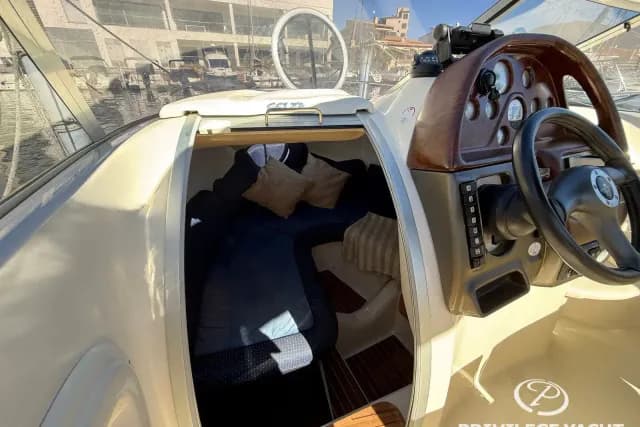
The CSL 27 is a 28-foot sportboat with a small cabin from Cranchi, the family-owned Italian yard. CSL stands for Cranchi Sport Line. What sets the boat apart is its helm: the wheel sits on the centreline, which BoatTEST called unusual on a boat of this size, because a central helm normally blocks the way into the cabin. Cranchi’s answer was to move the cabin entrance to port, beside the helm, and to give the boat an asymmetrical walk-through windscreen to suit.
The boat was new when the American magazines Boating and MotorBoating tested it. Boating carried what it billed as a world-exclusive test in its January 2005 issue, describing the CSL 27 as Cranchi’s new model, and MotorBoating followed in its April 2005 issue with a test of the “new 27-foot Cranchi Sportline”. BoatTEST filed its own review under the label “CSL 27 (2010-)”, a label that is not a launch date, since the dated 2005 tests already describe the boat as new. The CSL 27 appears in Cranchi’s 2007 catalogue, but we have not found a builder source for the years it was in production, so this guide does not state them; boats advertised in Europe carry a range of build years.
The name needs care when searching listings. The CSL 27 was not the first Cranchi Sport Line boat: Cranchi’s presentation of the CSL 28, an 8.75 m boat, as published on Cranchi USA’s website, says it was given the task of introducing the line, and it too was built around a central helm. A CSL 27 is about 8.57 m (28 ft 1 in) long, so a listing that gives its length as 28 feet is not necessarily a CSL 28. Check the model name and the length in metres.
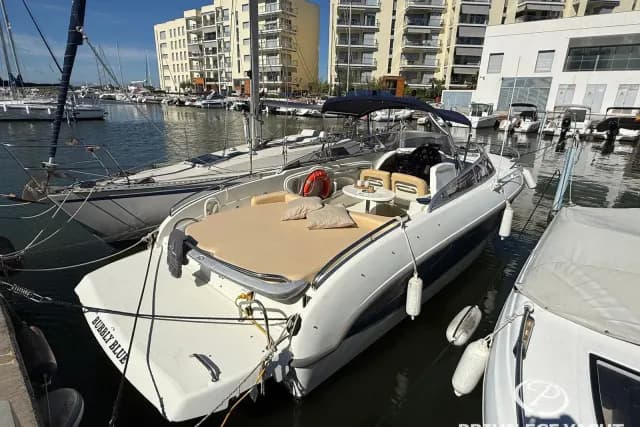
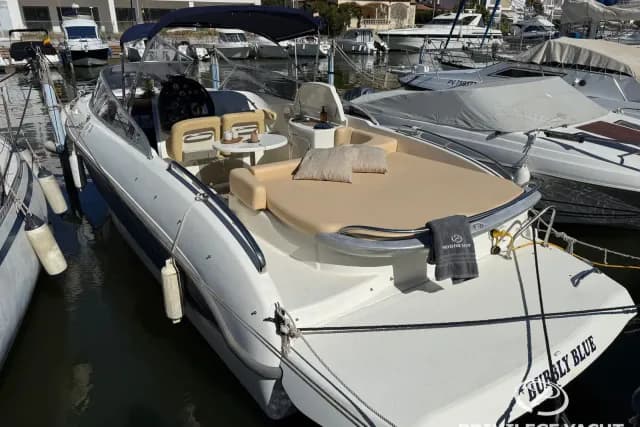
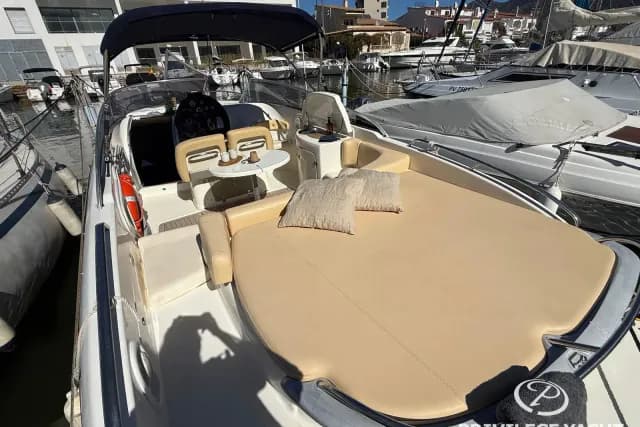
Hulls.io currently tracks 1 active listing for the Cranchi CSL 27. Among them is a 2007 Cranchi CSL 27 listed in Empuriabrava, Spain.
Showing 1–1 of 1 results
Cranchi CSL 27 Specifications
Most of these figures come from Cranchi’s 2007 catalogue, checked against the 2005 tests by Boating and MotorBoating and Cranchi USA’s 2005 specification page; the headroom, deadrise and construction details are Boating’s. Cranchi’s 2007 catalogue gives a maximum beam of 2.88 m (9 ft 5 in) and a hull beam of 2.83 m (9 ft 3 in), the figure its pre-owned listing quotes. The sources differ on water capacity: Cranchi gives about 70 litres, and 19 US gal in its US figures, as does Boating, while MotorBoating gave 20 US gal. Cranchi’s 2007 catalogue lists three engines. In the United States in 2005 Boating gave the single 5.7 GXi as the standard engine and also listed a single 375 hp 8.1-litre petrol option, and BoatTEST’s US list also includes a single 190 hp Volvo Penta D3 diesel. Boats may have been specified differently, so check the engine actually fitted.
| Length overall | 8.57 m (28 ft 1 in) |
|---|---|
| Beam | 2.88 m (9 ft 5 in) maximum; 2.83 m (9 ft 3 in) hull (Cranchi) |
| Draft | 0.88 m to the propellers (Cranchi); the 2005 US tests gave 2 ft 10 in (0.86 m) |
| Weight with engines | approx. 2,270 or 2,620 kg (5,000 or 5,800 lb); Cranchi gives both figures without saying which version each applies to |
| Transom deadrise | 19° |
| Max. cabin headroom | 1.60 m (5 ft 3 in) |
| Fuel capacity | approx. 326 litres (86 US gal) (Cranchi) |
| Water capacity | approx. 70 litres (Cranchi); 19 US gal in Cranchi’s and Boating’s US figures, 20 US gal in MotorBoating’s |
| Drives | Volvo Penta sterndrives with DuoProp (DP) legs |
| Engines (Cranchi 2007 catalogue) | Twin 225 hp Volvo Penta 4.3 GXi V6 petrol; single 320 hp 5.7 GXi V8 petrol; single 260 hp D4 diesel |
| US standard engine (2005) | Single 320 hp Volvo Penta 5.7 GXi V8 petrol |
| US options (2005) | Twin 225 hp Volvo Penta 4.3 GXi V6 petrol; single 375 hp 8.1-litre petrol; single 260 hp D4 diesel |
| Passengers | 8 (Cranchi) |
| Berths | 2 (Cranchi) |
| Design category | B (Cranchi) |
| Hull design | Aldo Cranchi |
| Construction | Hand-laid GRP with Kevlar reinforcement in the keel and chines |
| Builder | Cranchi, Italy |
Design and Layout
Helm and cockpit
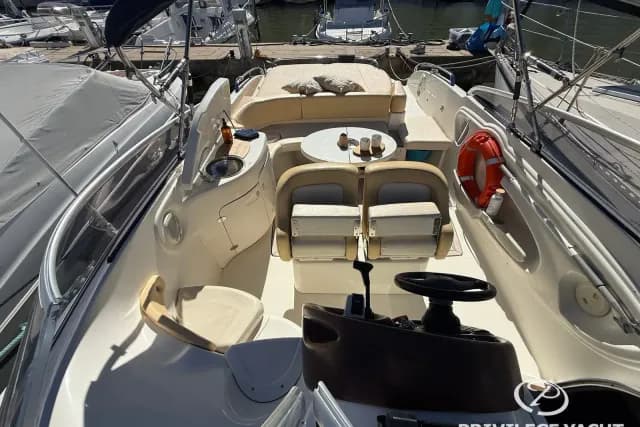
The skipper and a companion sit side by side at the central helm, in two power-adjusted bucket seats that swivel to face aft, so the cockpit becomes a dining area once a table is fitted. BoatTEST noted that the companion can get out to starboard without climbing over the driver. There are no real side decks: the way forward to the bow is through the windscreen. BoatTEST described the windscreen as asymmetrical, curving forward on the port side to ease the way down the companionway and running almost straight across to starboard, where a section swings open for access forward.
To starboard of the cockpit is a wet bar with a sink and a cutting board, and space for a refrigerator, which was optional on the US boats. An L-shaped bench runs around the back of the cockpit. Aft of it, the sunpad sits on a powered engine hatch; Boating measured it at 4 ft 9 in by 6 ft 7 in (about 1.45 m by 2.0 m), and MotorBoating noted that a small section of the rear bench swings open to give a way through to the sunpad and the bathing platform. BoatTEST found the platform large and noted that it extends well past the outdrives. Under the bench is a dedicated space for a liferaft, which Boating linked to the European rules for boats over 6 metres; to make up for the lost storage, a large lazarette under the cockpit floor, opened on gas struts, holds the batteries and the holding tank and has room for the cockpit table.
Cabin
The cabin is reached through a roll-top door to port of the helm. Boating saw it as a space for day cruising rather than serious overnighting, with a porcelain marine toilet aft to starboard and a lounge forward that converts into a berth; MotorBoating found room on the V-berth cushions for two six-foot adults, converting to a double. Boating measured maximum headroom at 5 ft 3 in (1.60 m). Light comes from two portholes and an overhead hatch; Boating pointed out that the portholes are fixed, so there is no cross-ventilation.
Hull and Performance
Boating described a hand-laid hull with stringers of fibreglass-encapsulated plywood and Divinycell foam, solid-wood transverse frames, and Kevlar reinforcement in the keel and chines. The bottom has 19 degrees of deadrise at the transom, a pad about 9 inches wide at the transom that tapers into the vee about 18 feet forward, one strake per side, and a 6-inch chine turned down aft.
Boating’s test boat had the optional twin 225 hp Volvo Penta 4.3 GXi V6 petrol engines with DuoProp drives. With two people aboard and half fuel and water, it reached 47.0 knots at 4,800 rpm and ran at 32.9 knots at 3,500 rpm; it planed in 4.6 seconds and turned cleanly through slalom turns at 30 and 40 mph. MotorBoating, which tested off Pompano Beach, Florida, in three- to four-foot waves on some stretches, found the ride comfortable and the handling flawless. MotorBoating’s speed and fuel-flow table, with fuel flow supplied by Cranchi, matches Boating’s exactly, so the two should not be read as separate measurements.
No independent test of the single-engine versions has been found. For the standard single 320 hp 5.7 GXi, Cranchi USA published a top speed of 33.5 knots and a cruising speed of 26 knots, and for the 260 hp D4 diesel 32.5 knots and 25.5 knots; these are Cranchi USA’s published figures, not test results.
How It Compares
Cranchi CSL 28. The larger Sport Line boat, at 8.75 m. Cranchi’s presentation, as published on Cranchi USA’s website, describes it as the model that introduced the Cranchi Sport Line, with a central helm under a central tower carrying the aerials and lights. The CSL 27 keeps the central-helm idea on a slightly shorter boat.
American sportboats. In 2005 Boating set the CSL 27 against the Formula 260 Sun Sport and the Cobalt 282, both US-built. BoatTEST’s point was that the Cranchi’s layout, with its central helm, offset cabin door and asymmetrical windscreen, is the thing that sets it apart from boats of that type.
Buying a Used Cranchi CSL 27
The first question is the engine. The CSL 27 was offered with a single petrol V8, twin petrol V6s or a single diesel, all Volvo Penta with DuoProp sterndrives, and the choice shapes the boat’s speed, servicing and running. The testers also left a short list of points worth checking on any boat.
What to check
- Which engine and drive are fitted, the engine hours, and the service history of the sterndrive legs.
- The drive-trim pumps: Boating found them hard to reach for topping up, the port one especially, as they are mounted on the transom.
- Electrical connections in the lazarette: Boating noted they were not heat-shrink type and warned they would corrode.
- The macerator pump switch, which Boating found tucked away under the deck.
- The powered ram that lifts the sunpad and engine hatch.
- Helm ergonomics on a sea trial: BoatTEST found that the high instrument panel limits forward visibility and that the throttles are mounted almost vertically.
- A full out-of-water survey of the hull and the sterndrive installations.
Asking prices depend heavily on year, engine, hours and condition. The listings on this page show what sellers are asking today. Browse every Cranchi boat for sale.
Cranchi Csl 27 Value Retention
Newest vintage = 100%. Older vintages shown as % of that price.
Based on median asking prices by model year. The newest model year in our dataset is used as the 100% reference point. The curve is smoothed so retention never increases as age increases — hover over data points to see raw values. Shaded band shows the 25th–75th percentile price range. Figures reflect asking prices from tracked listings, not final sale prices.