


Fairline Squadron 68 for Sale
Flybridge Motor YachtBritish-built flybridge motor yacht by Fairline Yachts. Alberto Mancini exterior design, four en-suite guest cabins plus crew quarters, Caterpillar or Volvo power.
Show 6 key features
Related models
Updated 10 June 2026 · By Hulls.io Editorial
The Fairline Squadron 68: A Complete Guide
The Fairline Squadron 68 is the flagship flybridge motor yacht from one of Britain’s most respected boatbuilders. Designed by Alberto Mancini — the Italian stylist who transformed Fairline’s visual identity from traditional to contemporary — the Squadron 68 combines Mediterranean design language with the engineering rigour and build quality that has defined the Oundle yard since 1963. At nearly 70 feet, it occupies the sweet spot between genuinely manageable owner-operation and the space, range, and presence of a much larger vessel.
The Squadron range has been the cornerstone of Fairline’s flybridge lineup for decades, and the 68 represents the culmination of that heritage. The model arrived during Fairline’s post-2015 renaissance — after the company emerged from administration with new investment and a mandate to challenge Princess, Sunseeker, and the Italian yards on both design and build quality. Mancini’s exterior styling introduced sharper lines, larger glazed areas, and a more assertive profile than any previous Squadron, whilst the interior retained the oak and walnut joinery, the meticulous fit-out, and the purposeful engineering that British buyers have always associated with the Fairline name.
Fairline Yachts was founded by Jack Newington in 1963 in Oundle, Northamptonshire, a small market town in the English Midlands that remains the company’s home to this day. The yard has survived multiple ownership changes, administration, and the 2008 financial crisis, each time re-emerging with renewed purpose. Today, Fairline builds from a purpose-built facility in Oundle and a second site in Hythe, Southampton, employing a workforce of skilled craftsmen whose knowledge of GRP construction, teak fitting, and systems integration represents decades of accumulated expertise. The Squadron 68 was the largest production model in the Fairline range during its production run and remains among the most capable flybridge motor yachts to emerge from a British yard.
Hulls.io currently tracks 1 active listing for the Fairline Squadron 68, drawn from brokerages worldwide.
Showing 1–1 of 1 results
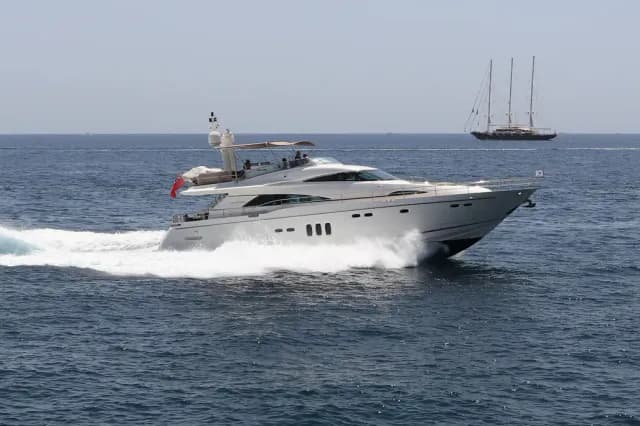
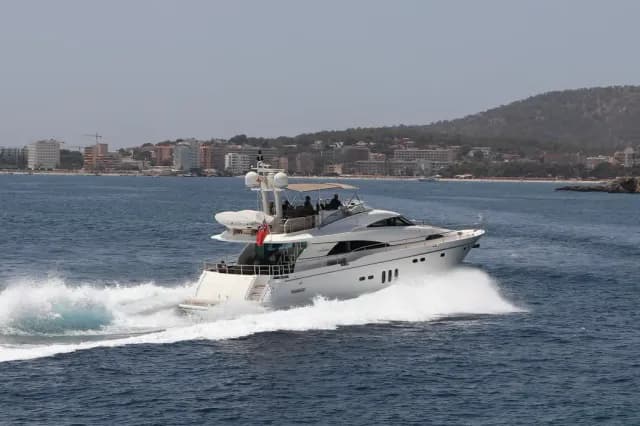
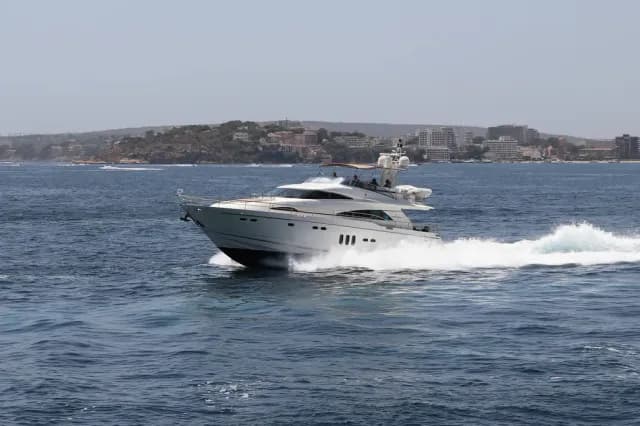
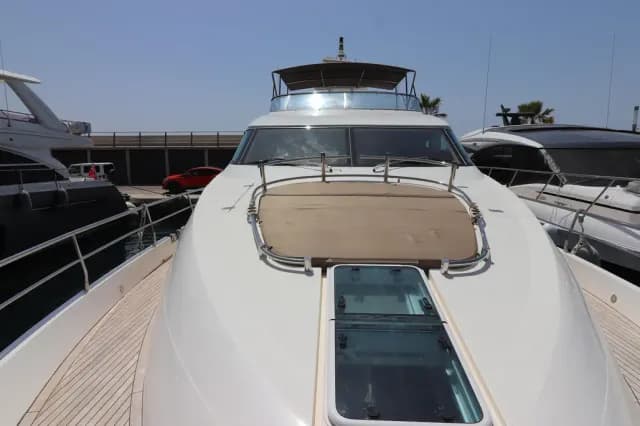
Fairline Squadron 68 Specifications
| Specification | Detail |
|---|---|
| LOA | 21.23 m (69 ft 8 in) |
| Beam | 5.31 m (17 ft 5 in) |
| Draft | 1.55 m (5 ft 1 in) |
| Displacement (dry) | ~38,000 kg (83,776 lbs) |
| Hull material | GRP, resin-infused with balsa/foam core |
| Hull type | Deep-V semi-displacement, 12° deadrise aft |
| CE category | A (Ocean) |
| Fuel capacity | 3,600 litres (951 US gal) |
| Water capacity | 780 litres (206 US gal) |
| Standard engines | 2× Caterpillar C18 ACERT (2,600 hp total) |
| Optional engines | 2× Volvo Penta D13-900 (1,800 hp total) |
| Propulsion | Shaft drive |
| Top speed | ~30 knots (Cat C18) |
| Cruising speed | 22–25 knots |
| Range (cruise) | ~320 nm at 22 kn (20% reserve) |
| Cabins | 4 (including full-beam master) |
| Heads | 4 en-suite |
| Crew cabin | 1 (single or twin berth, en-suite) |
| Generator | Onan 17.5 kW (standard), 22 kW optional |
| Exterior designer | Alberto Mancini |
| Builder | Fairline Yachts, Oundle, Northamptonshire, England |
| Production | 2014–2022 |
| New price (when available) | ~GBP 1,600,000–1,900,000 depending on specification |
The specification reveals a motor yacht engineered for extended cruising in serious conditions. The CE Category A (Ocean) rating confirms the hull’s suitability for open-water passages, while the 3,600-litre fuel capacity and shaft-drive propulsion deliver the range and reliability required for Mediterranean seasons, Channel crossings, and coastal cruising across northern Europe. The resin-infused GRP hull, with balsa and foam core sandwich construction, achieves an effective balance between structural rigidity, weight management, and production consistency.
The full-beam hull at 5.31 metres creates interior volume that rivals vessels considerably longer on the waterline. This is a deliberate Fairline design philosophy: maximising usable accommodation within a hull length that remains manageable for an experienced owner-operator, without requiring professional crew. The four en-suite cabins plus separate crew quarters represent the accommodation density of a 75-footer compressed into a 68-foot platform — a distinction that has proven central to the Squadron 68’s appeal on both the new and pre-owned markets.
Performance & Handling
At speed: The Squadron 68 is not a performance boat in the sport-cruiser sense, but it is a capable and confidence-inspiring platform at speed. With the Caterpillar C18 ACERT installation delivering 2,600 hp through conventional shaft drives, the yacht reaches approximately 30 knots at full throttle and cruises comfortably at 22–25 knots. The deep-V hull form provides a composed, predictable ride that rewards confident helming without punishing inexperience. Press reviews consistently noted the Squadron 68’s directional stability, minimal bow rise during acceleration, and the reassuring way the hull settles onto the plane.
Cruising efficiency: At a comfortable 22-knot cruise, combined fuel consumption sits at approximately 250–280 litres per hour. The generous 3,600-litre fuel capacity delivers a theoretical range of roughly 400 nm, reduced to approximately 320 nm with a prudent 20% reserve. Drop to a displacement cruise of 10–12 knots and the range extends dramatically — making the Squadron 68 a realistic proposition for longer coastal passages and inter-island hops in the Mediterranean.
Low-speed handling: The conventional shaft-drive configuration, combined with bow and stern thrusters (standard), provides effective close-quarters manoeuvrability. The Squadron 68 does not offer IPS joystick docking, but the twin-shaft setup with thrusters allows competent handling in marinas. The 5.31-metre beam demands awareness of berth width, and crosswind docking in a vessel of this displacement requires planning, but the Squadron responds predictably to throttle and helm inputs.
Engine choices: The Caterpillar C18 ACERT was the most popular specification, offering the best combination of power, torque, and cruising speed. The Volvo Penta D13-900 alternative provided a lower-powered, more fuel-efficient option that reduced top speed but suited owners who prioritised economy over performance. On the pre-owned market, Cat-powered boats command a slight premium reflecting both the performance advantage and the broad availability of Caterpillar marine service centres worldwide.
Interior Layout & Living Aboard
The Squadron 68’s interior represents Fairline’s most accomplished accommodation package: four guest cabins, each with its own en-suite head and shower, plus a separate crew cabin with private access from the transom. The full-beam master suite amidships, positioned at the widest point of the hull, offers a king-size island berth, full-height hull-side windows, a walk-in wardrobe, and an en-suite bathroom with a separate shower stall. It is a cabin that competes with vessels ten feet longer.
The VIP cabin forward features a double berth, en-suite facilities, and good natural light from the hull windows and overhead hatch. Two further guest cabins — typically configured as twin-berth rooms with the option of converting to doubles — complete the lower deck. Headroom throughout is approximately 1.98 m (6 ft 6 in), generous for a 68-foot motor yacht and sufficient for comfortable liveaboard use.
The main deck is where the Mancini redesign shows most clearly. The saloon features an open-plan layout with a sociable galley to port, a dining area, and a large L-shaped settee arrangement facing the entertainment centre. Floor-to-ceiling windows and sliding glass doors leading to the aft cockpit create seamless indoor-outdoor flow — a Mediterranean sensibility that was new to Fairline’s design vocabulary when the Squadron 68 launched. The aft cockpit itself provides a second dining table with seating for eight, a wet bar, and direct transom access to the hydraulic bathing platform.
The flybridge is the Squadron 68’s signature space. A hardtop with retractable sunroof provides shelter from sun and weather whilst maintaining the open-air character that makes flybridge motor yachts so appealing. A second helm station with full instrumentation, a U-shaped settee with dining table, a wet bar with grill, and a forward sunpad create a self-contained upper deck that becomes the social centre of the boat at anchor and in fair weather. The flybridge area is approximately 24 square metres — larger than many one-bedroom apartments.
The crew cabin, accessed via a separate companionway from the transom, provides a single or twin berth, en-suite head, and a functional workspace. This separation between crew and guest areas is essential for owners who employ a skipper or mate for Mediterranean seasons, and it elevates the Squadron 68 from a large private motor yacht to a vessel capable of semi-professional operation.
Squadron 68 Ownership: What to Expect
The Squadron 68 sits in the mid-range of the 65–75 ft flybridge market, with ownership costs reflecting the vessel’s size, complexity, and the expectations of owners operating at this level. Annual running costs for a UK or Mediterranean-based owner typically fall in the GBP 80,000–140,000 range:
- Insurance: 1.0–1.5% of hull value. For a used Squadron 68 insured at £1,200,000, approximately £12,000–£18,000 per year. Mediterranean cruising and professional skipper usage may affect premiums.
- Berthing: A 21 m motor yacht requires a correspondingly large berth. UK south coast marinas charge approximately £15,000–£25,000 annually. Mediterranean berths range from €12,000 (Croatia, Turkey) to €35,000+ (Côte d’Azur, Porto Cervo).
- Engine servicing: Caterpillar C18 ACERT engines require annual servicing by an authorised Cat dealer. Budget £5,000–£8,000 for routine annual service. Major service intervals (injectors, turbos, heat exchangers) add to costs as hours accumulate.
- Haul-out and antifouling: Annual haul-out for a vessel of this size costs approximately £6,000–£10,000 including hull cleaning, antifouling, and running gear inspection.
- Fuel: At 260 litres per hour combined at 22 knots, fuel is the largest variable cost. A 150-hour season at cruise burns approximately 39,000 litres — roughly £55,000–£65,000 at marina diesel prices.
- Crew: Many Squadron 68 owners employ a skipper for Mediterranean seasons (typically £3,000–£5,000 per month plus expenses). Some operate the vessel themselves with the occasional help of a day skipper for passage-making.
Value proposition: With production having ended in 2022, the Squadron 68 now trades exclusively on the pre-owned market. Prices have settled to levels that offer strong value relative to new-build competitors from Princess, Sunseeker, and Azimut. A well-maintained example at £800,000–£1,400,000 delivers Mancini styling, four-cabin accommodation, crew quarters, and the build quality of a British yard with sixty years of experience — a specification that would cost substantially more in a new equivalent.
How to Buy a Fairline Squadron 68: What to Look For
Production years and evolution: The Squadron 68 was produced from approximately 2014 to 2022. Earlier examples (2014–2017) established the platform with the Mancini exterior and a traditional Fairline interior. Later models (2018–2022) incorporated refinements to the helm electronics, interior finishes, and systems engineering. All share the same hull form and fundamental specification. On the pre-owned market, earlier boats are available from approximately £800,000, with later, well-specified examples reaching £1,400,000+.
Key Inspection Points
- Engines and running gear: Verify complete Caterpillar or Volvo service records. C18 engines are rated for approximately 3,000–5,000 hours before major overhaul depending on usage profile. Inspect shaft seals, cutlass bearings, propeller condition, and rudder stocks. A sea trial should confirm smooth, vibration-free operation at all speeds.
- Flybridge hardtop and sunroof: Test the retractable sunroof mechanism through multiple cycles. Check seals for deterioration and inspect for any evidence of water ingress. Examine the flybridge drain channels and scuppers — blocked drains can cause water pooling and subsequent damage.
- Hull and gel coat: Inspect for osmotic blistering (particularly on pre-2018 boats with extended water exposure), stress cracks around cleats and mooring points, and any evidence of impact damage. The hull-to-deck joint should show no signs of separation or sealant failure.
- Hydraulic systems: The bathing platform, passerelle (if fitted), and tender davits all rely on hydraulic actuators. Verify smooth operation, check for leaks, and inspect hydraulic fluid condition and levels.
- Generator: The Onan generator is essential for liveaboard comfort. Test under full load with air conditioning, watermaker (if fitted), and galley appliances operating simultaneously. Verify hours, service history, and exhaust condition.
- Teak decking: Examine the teak laid decks on the cockpit, flybridge, and side decks for lifting, blackened caulking, and softness underfoot (indicating moisture ingress to the substrate). Teak deck replacement on a 68-footer is a substantial expense (£30,000–£50,000+).
A comprehensive marine survey for a Squadron 68 should include a full hull inspection out of water, engine assessment by a qualified marine engineer, systems testing under load, and a thorough sea trial. Budget £4,000–£6,000 for a complete survey. Given the value of the vessel and the complexity of the onboard systems, the survey is non-negotiable — the cost is trivial relative to the risk of undetected issues.
Fairline Squadron 68 vs Competitors
The 65–75 ft flybridge segment is among the most competitive in the motor yacht market, dominated by established British and Italian builders. The Squadron 68 carved out a distinctive position during its production run: the accommodation champion with the strongest value proposition of the British trio.
Squadron 68 vs Princess 68
The Princess 68 is the Squadron’s most direct competitor and the comparison most buyers in this segment will make. Princess enjoys stronger brand recognition, particularly in Asia-Pacific markets, and the Plymouth yard’s reputation for build quality and engineering refinement is well deserved. The Princess 68 offers a similar four-cabin layout with crew quarters and a well-appointed flybridge. The Squadron 68 counters with Mancini’s more contemporary exterior styling, a slightly larger flybridge, competitive running costs thanks to its shaft-drive system, and a lower price point on the pre-owned market. For buyers who prioritise brand prestige and resale strength, Princess is the natural choice. For those seeking design distinction, accommodation volume, and value, the Fairline is the stronger proposition.
Squadron 68 vs Sunseeker Manhattan 68
The Sunseeker Manhattan 68 brings the Poole yard’s signature blend of sportiness and presence to the flybridge market. Sunseeker’s brand carries enormous recognition, and the Manhattan range is well established with a loyal following. The Manhattan tends to prioritise exterior drama and social spaces, while the Fairline invests more in the below-decks accommodation quality and the practical details of extended cruising. The Squadron 68’s larger fuel capacity and crew cabin arrangement make it the more practical proposition for Mediterranean seasons. On the pre-owned market, Sunseeker typically commands a brand premium, making the Fairline the stronger value choice for buyers who judge boats on specification rather than badge.
Squadron 68 vs Azimut 66 Fly
The Azimut 66 Fly represents the Italian approach to the flybridge segment: lighter construction, IPS propulsion as standard, and an interior design aesthetic that favours contemporary minimalism over the Fairline’s British warmth. The Azimut’s IPS drives provide joystick docking and, in some conditions, better fuel efficiency at cruising speed. The Squadron 68 counters with its shaft-drive simplicity, broader service network for running gear, the separate crew cabin, and a lower cost of ownership over time (IPS pod servicing is more expensive than conventional shaft maintenance). For buyers who value Italian design and cutting-edge propulsion technology, the Azimut is compelling. For those who want British build quality, proven engineering, and the lowest long-term running costs, the Fairline is the pragmatic choice.
For a full interactive depreciation comparison between the Fairline Squadron 68 and competing models, visit the Hulls.io Market Intelligence tool, where you can overlay pricing trends, track seasonal demand, and benchmark value retention across the 65–75 ft flybridge segment.