


Fairline Targa 34 for Sale
MotoryachtThe Fairline Targa 34 is available on Hulls.io with 1 listing currently for sale. This model is categorised as a Motoryacht.
Updated 7 October 2026 · By Hulls.io Editorial
The Fairline Targa 34: A Complete Guide
The Targa 34 is the open sports cruiser that Fairline launched in January 1997 and built until 2006. Motor Boat & Yachting and Powerboat & RIB both give the build period as 1996 to 2006 and put the production run at 295 boats. Fairline’s own specification credits the design to Bernard Olesinski and the Fairline design team, and every engine on the builder’s own list is a twin Volvo Penta installation driving through duo-prop sterndrives.
MBY describes it as the smallest of the Targa range of the early 2000s, listing the 40, 43 and 52 open-cockpit boats and a 62 with a retractable hard top, although Fairline’s own website also listed a smaller Targa 30 in 2001–02. With the most powerful diesels it was, by MBY’s account, the fastest of them, at speeds in the order of 40 knots. MBY also points out that, like the 40, 43 and 52, it is essentially an open boat: apart from its canvas covers there is little to keep the weather out.
The name needs care. Fairline’s Targa line began in the 1980s with the Targa 33, and MBY’s Nick Burnham notes that the names were later reused and shuffled: the first Targa 30, launched in January 1990, was renamed the Targa 33 to reflect its true length including the bathing platform, while the original Targa 33, which had a bolt-on platform, was replaced by a 34 with an integral platform that then became the Targa 35. This guide covers the Olesinski Targa 34 that MBY and Powerboat & RIB date to 1996–2006; if a listing’s build year falls outside that run, check which boat it is.
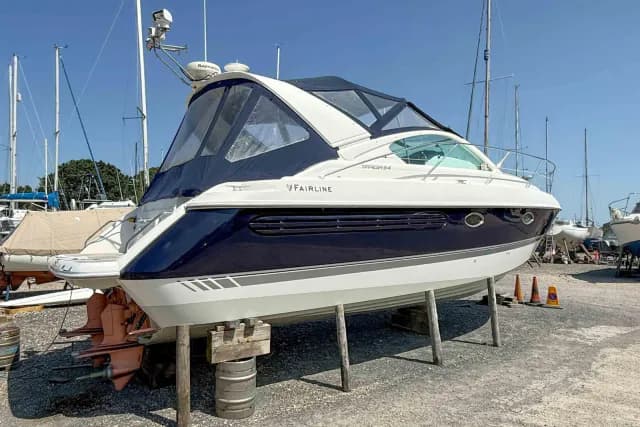
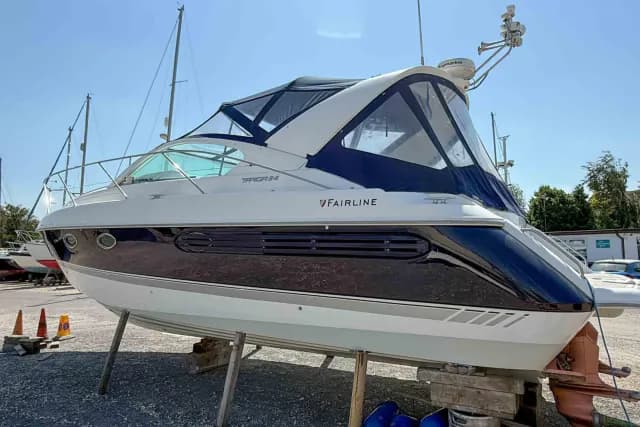
Hulls.io currently tracks 1 active listing for the Fairline Targa 34. Among them is a 1999 Fairline Targa 34 listed in Hayling Island, United Kingdom.
Showing 1–1 of 1 results
Fairline Targa 34 Specifications
Figures from Fairline’s own Targa 34 specification, whose dimensions were unchanged on Fairline’s websites from 2001 to late 2006. Listings and reviews variously give the 36 ft 3 in overall length or a figure close to the 34 ft 5 in hull length, so a “34 ft” and a “36 ft” Targa 34 are the same boat. The magazines’ figures differ in places: Powerboat & RIB gives a light displacement of 6.4 tonnes, 570 litres of fuel and a 3.41 m beam, where the builder lists a dry weight of about 6,100 kg with twin KAD43s, 592 litres and 3.45 m. The RCD category is from MBY and Powerboat & RIB, which agree on category B but not on the number of people.
| Length overall | 11.04 m (36 ft 3 in) |
|---|---|
| Hull length (bow to aft end of bathing platform) | 10.49 m (34 ft 5 in) |
| Beam | 3.45 m (11 ft 4 in) |
| Draught (approx., sterndrives down) | 0.91 m (3 ft 0 in) |
| Height above waterline (incl. mast) | 2.73 m (8 ft 11 in) |
| Dry weight (approx., with 2 × KAD43) | 6,100 kg (13,450 lbs) |
| Fuel capacity | 592 litres (130 imp gal / 156 US gal) |
| Water capacity (incl. calorifier) | 232 litres (51 imp gal / 61 US gal) |
| Berths | 4–6, in two cabins plus the converting dinette |
| Saloon headroom | 6 ft 6 in (1.98 m) |
| Hull | Deep-V forward, 19° deadrise aft; hand-laid GRP |
| Engines (builder’s list) | Twin Volvo Penta duo-prop sterndrives: diesels from 200 hp to 285 hp each, or petrol V8s |
| Builder’s speed estimate (2 × KAD44P, 260 hp) | 37–39 knots |
| RCD category | B |
| Design | Bernard Olesinski and the Fairline design team |
| Built | Launched January 1997 (Fairline); built 1996–2006, 295 boats (MBY, Powerboat & RIB) |
| Builder | Fairline, England |
Mark 1 and Mark 2
Powerboat & RIB’s Greg Copp distinguishes two versions of the boat. He dates the first, known unofficially as the Mark 1, to 1996–1998. Every Mark 1 had an emerald green hull, a different dash with a bigger chart table, and a smaller forecabin almost filled by a large convertible V-berth. Its heads was larger, with a separate shower cubicle, and its saloon had a deeper settee, a concealed drinks cabinet and a larger table.
The Mark 2 moved space forward: a larger forecabin with a walk-around island double, much more stowage, a bigger galley, and a smaller heads in which the shower is no longer a separate compartment. Copp also notes a large storage bin on the engine-bay bulkhead of the Mark 2, useful for gear but a squeeze for engine access, which is why some owners have removed it. By his dating a 1999 boat should be a Mark 2; the forecabin berth is the quickest way to confirm which version a particular boat is.
Design and Accommodation
Hull and construction
Fairline describes the hull as deep-V forward with 19 degrees of deadrise aft, and Copp calls it a variable deep-vee whose deadrise sharpens progressively towards the bow. Fairline’s specification lists a hand-laid hull with an isophthalic gelcoat backed by isophthalic resin, unidirectional and woven rovings, transverse and longitudinal stringers throughout, full-length moulded spray deflectors and a hull-to-deck joint that is both bolted and bonded.
Cockpit
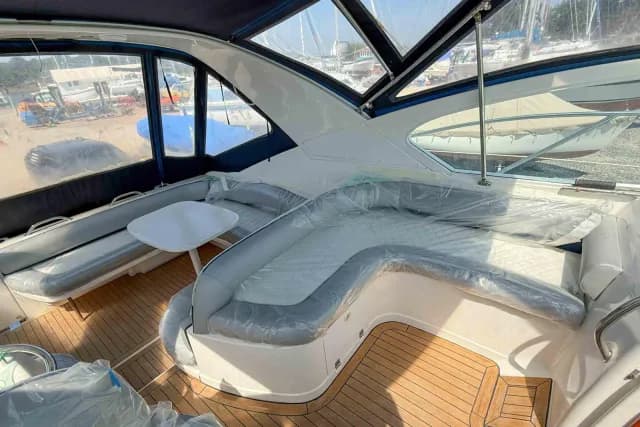
The cockpit runs from the transom to the helm, divided by a single step into two areas. Forward, the helm is to starboard with a wrap-around bench and navigator’s seat to port. Aft, a U-shaped dinette around a table converts to a sun pad; Fairline gives the sunbed as 6 ft 9 in by 4 ft. The builder’s standard list includes a cockpit bar with its own refrigerator, a GRP arch, a two-part cockpit hood whose forward section converts to a sun canopy, and an integral teak-laid bathing platform with a concealed ladder and a hot-and-cold transom shower. Side decks are narrow, about six inches by Copp’s measure, but have tall guard rails.
MBY found the helm the one weak area: the standard chart-plotter position is low on the left of the console and partly hidden by the wheel, which can be fixed with a helm pod. The engine master switches sit in a recess below the bolstered helm seat, where a standing skipper’s leg can knock them off in rough water; a hinged cover solves it. MBY also found that the storage box in the engine room will take a deflated tender, which it counted a real advantage on a boat this size.
Below decks
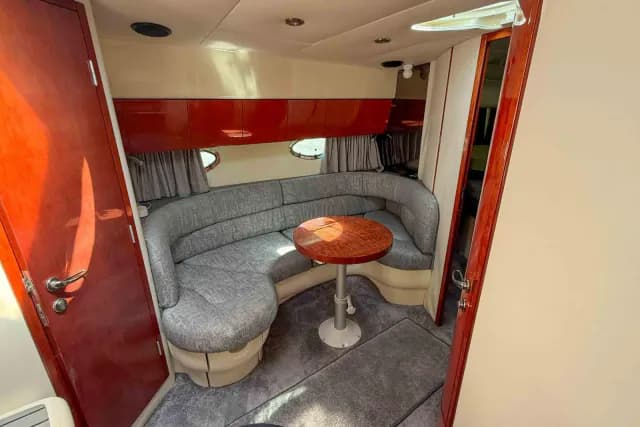
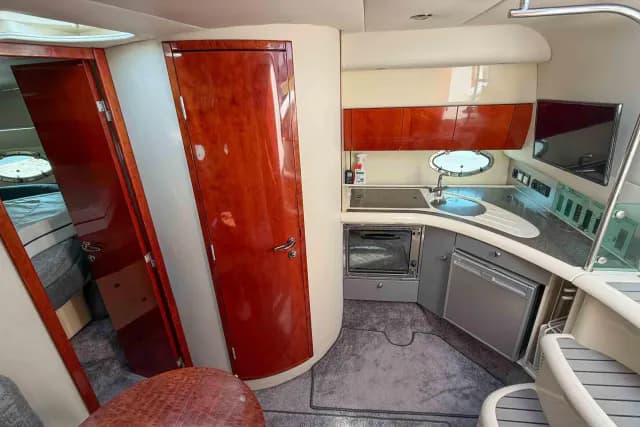
The layout is a double cabin forward and a twin cabin aft beneath the cockpit, with the saloon, galley and heads between them. Fairline quotes 6 ft 6 in of headroom in the saloon, where a U-shaped dinette converts to a double berth. In the Mark 2, MBY found the forward island double offset, so it is slightly shorter on one side, with three lockers beneath it. The aft cabin has two full-length single berths, which Fairline gives as 6 ft 8 in by 2 ft 3 in, plus a wardrobe and seat, but not enough headroom to sit up in bed. The galley has a two-burner hob, oven and grill and a 65-litre fridge, and Fairline listed the joinery as lacquered American cherry or maple. MBY called the finish of Fairlines of this era superb, and Powerboat & RIB’s surveyor singled out the quality of construction and fit-out.
Engines and Performance
Fairline’s own engine list was all twin Volvo Penta sterndrives. Its 2001 specification listed diesels of 200 hp (AD41), 230 hp (KAD43) and 260 hp (KAD44P), with estimated top speeds of 30–33, 32–34 and 37–39 knots respectively, and petrol V8s; by December 2001 it had added the 285 hp KAD300, estimated at 38–40 knots. Copp associates the Mark 1 with the 200 hp and 230 hp diesels (31–34 knots) and the post-1998 Mark 2 with the KAD44 and, later, the KAD300 (37–40 knots). He had yet to come across a petrol boat in the UK. Fairline’s own list, though, still offered the 200 hp and 230 hp diesels in 2001, and the 230 hp KAD43 in 2004, so the layout, not the engines, is the surer guide to version.
MBY’s test boat, with twin 260 hp KAD44s, made 36 knots. Copp, driving a KAD300 boat from Poole to Portsmouth, ran through the Needles Channel at 30 knots into a building easterly and saw the GPS nudge 40 knots heading east down the Solent in somewhat calmer water. MBY gives a fuel use of 1.8 litres per nautical mile at 20 knots and a range of 250 nautical miles at that speed with a 20 per cent reserve. Both magazines single out the handling: Copp wrote that it drives like a two-berth sports boat, and MBY’s owner found it cut through Solent chop well, if wet with the wind in the wrong direction.
Within the Targa Range
Fairline Targa 43. The step up in the same open-cockpit generation, launched in 1997 and, like the 34, on an Olesinski hull. MBY notes that it runs on straight shafts rather than sterndrives, and that at launch it came only with twin 370 hp Volvo Penta TAMD 63Ps, which gave 31 knots on test, and later with 480 hp TAMD 75Ps. It adds a second heads and a garage for a tender.
From 2004 Fairline introduced Gran Turismo versions of its larger Targa models, with a powered retractable hard top, and by 2023 Burnham noted that every then-current Targa came with a hard top. The Targa 34 was not among them: its specification on Fairline’s website still listed only a canvas cockpit hood in late 2006.
Buying a Used Fairline Targa 34
The youngest Targa 34s are now around twenty years old, so condition and history matter more than year. Surveyor Jim Pritchard, writing in Powerboat & RIB, called it a market leader in its day for the quality of its construction and fit-out, and found only one recurring defect.
What to check
- Which version it is: a V-berth forecabin and separate shower cubicle mean a Mark 1; a walk-around island double means a Mark 2.
- Which engines are fitted, and their hours and service records on both units.
- Sterndrive history: Pritchard warns that drives can need major work beyond about 1,000 hours, so study their maintenance and replacement record.
- The secondary bonding between hull and bulkhead under the aft end of the port berth — the one recurring defect Pritchard found, and an easy repair.
- The helm: whether the plotter has been raised in a pod and the engine master switches given a cover.
- Canvas and cockpit covers, which are the only weather protection on an open boat.
- The general standard of maintenance throughout, which Pritchard says determines both value and future reliability.
Asking prices depend heavily on version, engines, hours and condition. The listings on this page show what sellers are asking today. Browse every Fairline yacht for sale.