


Fountaine Pajot Lucia 40 for Sale
Sailing CatamaranThe Fountaine Pajot Lucia 40 is a 40-foot cruising catamaran produced from 2015 to 2020, positioned as FP's entry-level bluewater cat. Designed by Berret-Racoupeau with interiors by Pierangelo Andreani, the Lucia 40 was praised for build quality, sailing performance, and refined interior finish — competing directly with the Lagoon 42 in the 38–42 ft segment. Replaced by the Fountaine Pajot Isla 40 in 2020.
Updated 10 June 2026 · By Hulls.io Editorial
The Fountaine Pajot Lucia 40: A Complete Guide
The Fountaine Pajot Lucia 40 was introduced at the 2016 Cannes Yachting Festival to mark Fountaine Pajot’s 40th anniversary — a milestone the yard celebrated by launching what would become one of the most respected sub-40-foot cruising catamarans of its generation. Designed by Berret-Racoupeau with interiors by Pierangelo Andreani Design, the Lucia 40 occupied a strategic position in FP’s range: large enough for serious bluewater cruising with a CE Category A (Ocean) rating, yet compact enough that a couple could handle her without crew. The boat was produced from 2016 to 2020 and replaced by the Isla 40, which was itself later succeeded by the FP 41.
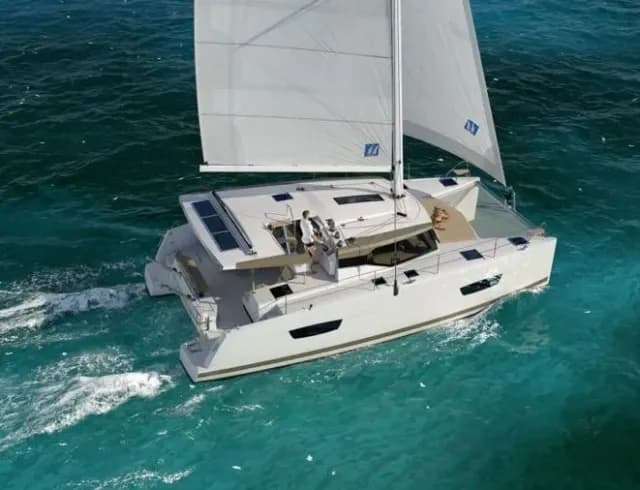
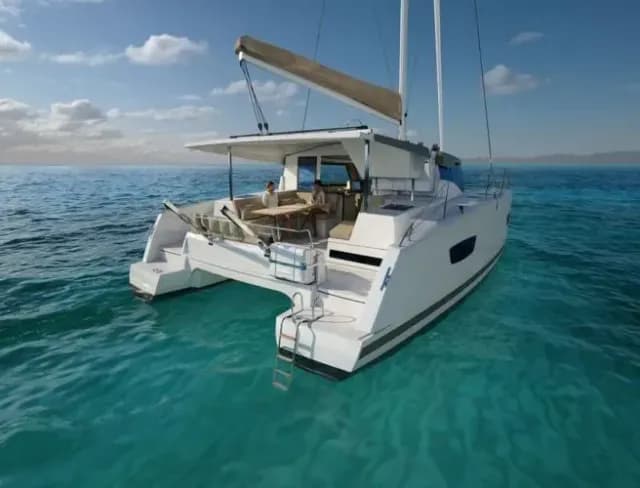
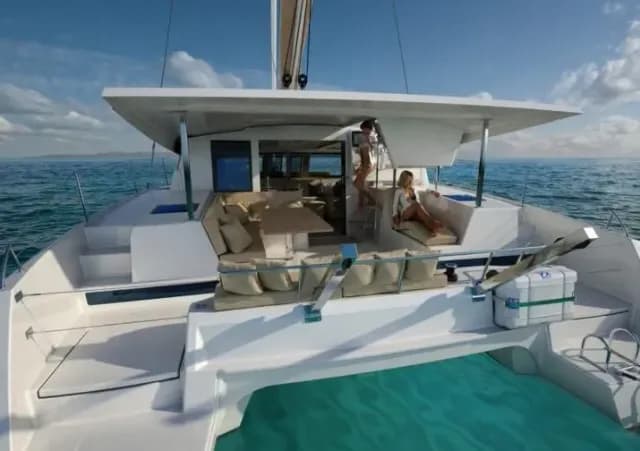
What distinguished the Lucia 40 from her competitors was a deliberate set of design priorities. Fountaine Pajot shifted the interior volume forward, freeing up an exceptionally large cockpit — roughly 130 square feet of protected outdoor living space that FP branded the “lounge cockpit.” This was not merely marketing. The cockpit was genuinely larger than anything else in the sub-40-foot catamaran class, and it transformed how owners used the boat: meals, sundowners, passage watches, and social life all gravitated to this single, well-proportioned outdoor space. The design philosophy was unmistakably Mediterranean — life aboard happens outside, and the boat should facilitate that.
Build quality was a step above the volume production norm. The hulls used PVC foam-core sandwich construction with vacuum lamination — a technique that produces a stronger, lighter, and more consistent laminate than hand lay-up. The deck was built using Resin Transfer Moulding (RTM), giving a smooth finish on both surfaces and excellent dimensional accuracy. At 8,900 kg displacement, the Lucia 40 was neither the lightest nor the heaviest in her class, but the construction methods ensured the weight was structural rather than resin-heavy. Fountaine Pajot’s factory at Aigrefeuille-d’Aunis in western France had decades of catamaran-building experience behind these methods.
The Lucia 40 arrived with a new base price of approximately €294,000 — competitive for the quality of construction and equipment, though options could push the as-delivered price substantially higher. On the used market today, the Lucia 40 trades between approximately $210,000 and $440,000, depending on year, condition, layout, and equipment. Ex-charter boats cluster at the lower end of this range, while well-equipped Maestro-version boats with low engine hours and private ownership histories command the premium.
In 2019, Fountaine Pajot showcased an electric prototype of the Lucia 40 fitted with Volvo Penta electric saildrives — an early demonstration of the industry’s shift towards electrification. While the electric version did not enter series production, it signalled the forward-thinking approach that FP was taking with the platform and helped position the Lucia 40 as a forward-looking design during the final years of its production run.
Hulls.io currently tracks 1 active listings for the Fountaine Pajot Lucia 40, drawn from brokerages worldwide. With 0 tracked listings in our market intelligence database, the Lucia 40 provides buyers and sellers with increasingly robust data on value retention, pricing trends, and seasonal demand patterns as more listings enter our tracking system.
Showing 1–1 of 1 results
2016 Fountaine Pajot Lucia 40
Fountaine Pajot Lucia 40 Specifications
| Specification | Detail |
|---|---|
| LOA | 11.73 m (38 ft 6 in) |
| Beam | 6.63 m (21 ft 9 in) |
| Draft | 1.20 m (3 ft 11 in) |
| Displacement | 8,900 kg (19,621 lbs) |
| Hull construction | GRP, PVC foam-core sandwich, vacuum lamination (hulls), RTM (deck) |
| CE category | A (Ocean) |
| Air draft | 19.3 m (63 ft 4 in) |
| Mainsail area | ∼58 m² (624 sq ft) |
| Genoa area | ∼37 m² (398 sq ft) |
| Total sail area | ∼95 m² (1,023 sq ft) |
| Engines (standard) | 2× Volvo Penta D1-20, 20 HP |
| Engines (optional) | 2× Volvo Penta D1-30, 30 HP |
| Fuel capacity | 300 litres (79 US gal) |
| Water capacity | 530 litres (140 US gal) |
| Cabin layouts | Maestro (3-cabin owner) / Quatuor (4-cabin charter) |
| Heads | 2–4 depending on layout |
| Naval architecture | Berret-Racoupeau |
| Interior design | Pierangelo Andreani Design |
| Builder | Fountaine Pajot, Aigrefeuille-d’Aunis, France |
| Production years | 2016–2020 |
These specifications describe a compact bluewater catamaran optimised for couples and small crews. The 1.20 m draft is shallow enough for the Bahamas, the ICW, and the thin-water anchorages of the Greek islands — and the 19.3 m air draft clears most ICW bridges without requiring a mast-down passage. The 530-litre water capacity is notably generous for a boat of this size and supports extended cruising without a watermaker, though most bluewater owners fit one regardless.
The 300-litre fuel tank is the most commonly cited limitation. With standard 20 HP Volvo Penta D1-20 engines, fuel consumption is modest — typically 3–5 litres per hour at cruising speed across both engines — but the tank capacity limits motoring range to approximately 300–400 nm in calm conditions. For owners who plan to motor-sail through doldrums or navigate areas with limited fuelling infrastructure, the small fuel tank is a genuine operational constraint. The optional 30 HP D1-30 upgrade provides better response in close-quarters situations and adverse weather but does not resolve the underlying fuel capacity issue.
How Does the Lucia 40 Sail?
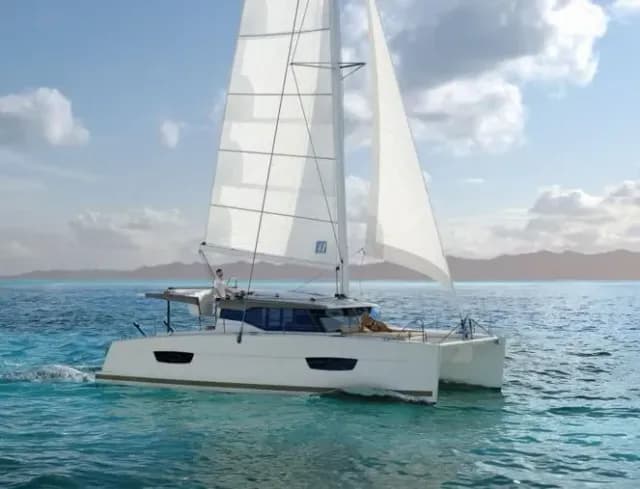
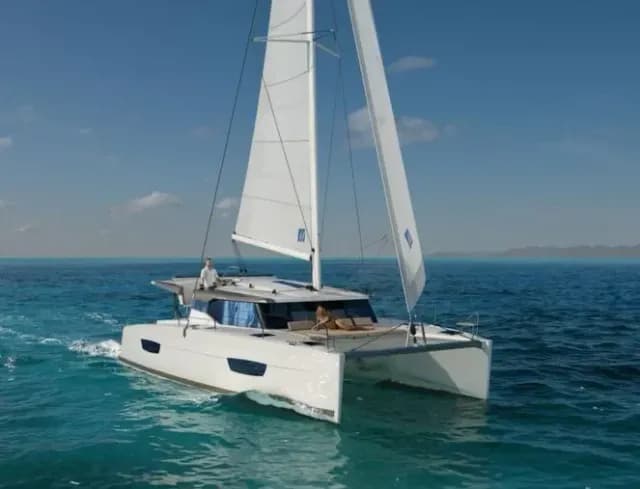
Sail plan: The Lucia 40 carries approximately 95 m² of working sail area — a mainsail of roughly 58 m² and a genoa of approximately 37 m². This is a healthy sail area for the displacement, and Berret-Racoupeau’s hull design extracts good performance from it. The fractional rig is manageable for a short-handed crew, and the mainsheet traveller is positioned within easy reach of the helm. Self-tacking jib options were available for owners prioritising ease of handling over outright pointing ability.
Upwind: In 12–15 knots of true wind, the Lucia 40 achieves approximately 6–7 knots at 50–55 degrees apparent wind angle. The tacking angle is roughly 90–95 degrees true, which is typical for a cruising catamaran of this size and displacement. She is not a close-winded boat, but she points respectably for a 38-footer carrying 8,900 kg. The relatively narrow beam of 6.63 m — narrower than the Lagoon 42’s 7.70 m — contributes to less windage and slightly better upwind performance.
Reaching and downwind: This is where the Lucia 40 comes alive. In 15+ knots of true wind on a beam reach, 8–9 knots is comfortable and sustainable. With a Code 0 deployed in moderate conditions, reaching speeds of 9–10 knots are achievable. Trade wind passages at 7–8 knots are well within her capability. The Berret-Racoupeau hull form produces a clean, balanced ride on a reach without the tendency to bury a bow that some fuller-bodied competitors exhibit.
Under power: The standard 2×20 HP Volvo Penta D1-20 engines deliver a fast cruise of approximately 7–7.5 knots. The optional 30 HP D1-30 upgrade adds meaningful reserve power for close-quarters manoeuvring and adverse-weather motoring, pushing the fast cruise closer to 8 knots. Most experienced owners recommend the 30 HP option. Fuel consumption under power is modest at 3–5 litres per hour total, but the 300-litre tank limits motoring endurance.
Steering: Fountaine Pajot specified cable steering rather than hydraulic — a deliberate engineering choice, not a cost-saving measure. Cable steering provides direct mechanical feedback from the rudders, which many experienced catamaran sailors prefer for the sensitivity it offers. Critically, cable steering can be repaired at sea with basic tools and spare parts — a hydraulic system failure mid-ocean is a far more serious proposition. For bluewater cruisers, this is a genuine advantage, though some owners accustomed to the smoother, lighter feel of hydraulic systems find the cable steering heavier at the helm.
Honest assessment: The Lucia 40 is a genuine sailing catamaran, not a powered vessel that happens to carry a mast. She sails well on all points, handles predictably in a blow, and rewards good seamanship with respectable performance. She is not as fast as a dedicated performance catamaran, nor does she carry the interior volume of a wider-beamed competitor like the Lagoon 42. Her strength is balance — a boat that sails well enough to make passages enjoyable, lives well enough for extended cruising, and is built solidly enough to inspire confidence offshore.
Interior Layout & Living Aboard
The Lucia 40 was offered in two primary layouts. The Maestro version is a 3-cabin owner’s configuration that dedicates the entire starboard hull to the master suite — a full-beam cabin with a centreline island berth, generous wardrobe storage, a large en-suite head with separate shower, and enough floorspace to feel like a proper bedroom rather than a boat cabin. The port hull contains two guest cabins, each with en-suite heads. The Quatuor version is a 4-cabin charter configuration with two cabins per hull, each with private heads — purpose-built for charter fleets and families with older children. On the used market, the Maestro commands a premium, typically 10–15% above equivalent Quatuor boats, reflecting private buyers’ overwhelming preference for the larger master suite.
The salon is bright and well-proportioned, with large windows and a galley-up layout that places the cook at the same level as the cockpit — practical both for socialising and for passage-making, where the cook needs to maintain situational awareness. Pierangelo Andreani’s interior design favours clean lines and light wood tones, creating an airy, modern feel. The joinery quality is a step above the volume production norm — edges are finished, surfaces are consistent, and the overall impression is of craftsmanship rather than industrial efficiency.
The signature 130-square-foot “lounge cockpit” is the defining feature of life aboard the Lucia 40. By shifting the interior volume forward, Fountaine Pajot created the largest cockpit in the sub-40-foot catamaran class. It accommodates a full dining table seating 6–8, generous lounging areas, and direct access to both the salon and the swim platform. The hardtop provides shade without enclosing the space, and the overall effect is of an outdoor living room that happens to be on a boat. For owners who spend the majority of their time in the cockpit — which, in fair weather, is most catamaran owners — this is the Lucia 40’s single strongest selling point.
Storage throughout the boat is adequate for cruising couples but requires discipline for families on extended passages. The forward locker between the bows provides sail storage and space for fenders, warps, and deck equipment. Each hull has under-berth and hanging storage. The galley storage is sufficient for week-long cruises but can feel limited during extended provisioning — a common trait of catamarans in this size range.
One point of criticism noted by owners is that some interior edges and corners are sharper than expected — a fit-and-finish detail that FP addressed in later production boats and in the successor Isla 40. It is a minor annoyance rather than a significant issue, but worth noting for families with young children aboard.
Fountaine Pajot Lucia 40 Ownership: What to Expect
Running costs for the Lucia 40 are moderate by catamaran standards, reflecting her compact size, efficient Volvo Penta engines, and straightforward systems. The principal annual cost areas are as follows:
- Insurance: 1.0–1.7% of hull value. For a boat insured at $300,000, this translates to approximately $3,000–$5,100 per year. Mediterranean cruising grounds sit at the lower end; Caribbean and hurricane-zone coverage pushes premiums higher.
- Marina berth: The 6.63 m beam incurs a catamaran premium at most marinas, though it is narrower than the Lagoon 42’s 7.70 m, which can translate to modestly lower berthing fees and better availability in smaller European marinas. Expect $6,000–$18,000 per year depending on location.
- Engine servicing: Twin Volvo Penta D1-20 or D1-30 engines are simple, reliable small diesels with low annual servicing costs of approximately $1,500–$3,000. Saildrive servicing (seal inspection, oil change, anode replacement) adds $500–$1,000 per year.
- Haul-out and antifouling: $3,000–$5,000 for a boat of this size, including travel lift, pressure wash, antifouling, anode replacement, and hull inspection.
- Annual maintenance: $3,000–$6,000 covering rigging inspection, sail repairs, electronics updates, and general consumables.
- Approximate total: $18,000–$38,000 per year depending on location, usage pattern, and cruising ground. This is at the lower end of the 40-foot catamaran ownership spectrum, reflecting the Lucia 40’s relatively small engines, modest fuel consumption, and narrower beam.
A meaningful number of Lucia 40s entered charter service, particularly in the Mediterranean and Caribbean. Ex-charter boats are now entering the used market at attractive price points — typically 20–30% below equivalent privately owned examples. These boats carry higher engine hours and more cosmetic wear but generally benefit from comprehensive professional maintenance records. The Quatuor 4-cabin layout dominates the charter resale pool; Maestro 3-cabin owner’s versions are rarer and command a premium.
Owner feedback — strengths: Cockpit size and usability, build quality relative to price, sailing performance in moderate-to-strong conditions, the Maestro master suite, cable steering reliability for offshore passages, manageable running costs, and the overall balance between sailing ability, living space, and bluewater capability. The Lucia 40 is frequently described by owners as a boat that does nothing badly and several things exceptionally well.
How to Buy a Fountaine Pajot Lucia 40: What to Look For
Model years: The Lucia 40 was produced from 2016 to 2020. Early 2016 boats may exhibit minor first-production-run fit-and-finish issues — primarily cosmetic rather than structural. Later production boats (2018–2020) benefited from incremental improvements including refined interior edge finishing and updated equipment specifications. All model years share the same hull design and construction methods, so the differences between early and late boats are evolutionary rather than fundamental.
Known Issues to Inspect
- Fuel tank capacity: At 300 litres (79 US gal), the fuel tank is small for a bluewater catamaran. This is not a defect but an inherent design limitation. Buyers planning extended offshore passages should consider whether portable jerry cans or a bladder tank will be needed to supplement range. Verify the fuel gauge accuracy during survey — inaccurate fuel gauges are reported on some boats.
- Interior edge finishing: Early production boats have sharper interior edges and corners than later models. This is a cosmetic and comfort issue rather than a structural concern. Inspect countertop edges, locker openings, and companionway trim for any areas that may need softening.
- Cable steering tension: The cable steering system requires periodic adjustment to maintain proper tension and responsiveness. Check for any play or slack in the steering during sea trial. Cable replacement is straightforward and inexpensive but should be factored into the maintenance schedule every 5–7 years or as needed.
- Saildrive seals: As with any saildrive-equipped catamaran, the saildrive seals are critical. Check service records for evidence of regular seal inspection and replacement. A failed saildrive seal can allow water ingress into the engine compartment — this is the single most important maintenance item on any saildrive boat.
- Gelcoat condition: Inspect the hull gelcoat carefully, particularly at the waterline and on the transoms where impact damage is most likely. PVC foam-core sandwich construction is resistant to osmosis, but gelcoat crazing or star cracks should be assessed by a surveyor with multihull experience.
Maestro vs Quatuor
For private ownership, the Maestro 3-cabin layout is overwhelmingly preferred. The full-beam master suite in the starboard hull transforms the ownership experience — it feels like a proper bedroom rather than a boat cabin, with walk-around bed access, a large en-suite, and meaningful storage volume. The Quatuor 4-cabin layout makes sense for charter operations and for families who routinely sail with four couples, but the smaller cabins and shared-wall arrangements are a compromise for private use. On the used market, Maestro boats command a 10–15% premium and typically sell faster.
Equipment That Adds Value
When assessing a used Lucia 40, the following additions represent genuine added value: the 30 HP engine upgrade, watermaker, solar panels, davits with dinghy and outboard, upgraded electronics (chartplotter, radar, AIS), Code 0 or asymmetric spinnaker, lithium battery conversion, and generator. A boat equipped with the majority of these items represents significantly better value than one requiring the buyer to retrofit them — particularly the engine upgrade, which cannot be economically changed after purchase.
Surveying a Catamaran
A catamaran survey should pay particular attention to bridgedeck stress, hull-to-deck joint integrity, rudder bearing condition, and saildrive seal status. Ensure the surveyor has specific multihull experience — monohull surveyors frequently miss catamaran-specific structural concerns. The Lucia 40’s PVC foam-core construction should be checked for delamination using a moisture meter and percussion testing. Have the surveyor inspect the mast step, standing rigging terminals, and chainplates carefully, and conduct a full sea trial under both sail and power to assess steering response, engine performance, and any unusual vibrations.
Fountaine Pajot Lucia 40 vs Competitors
The Lucia 40 competed in the fiercely contested 38–42-foot cruising catamaran segment, where several established models vied for the same buyer. Each competitor represents a distinct design philosophy and set of trade-offs. Now that the Lucia 40 is available exclusively on the used market, these comparisons are particularly relevant for buyers weighing a proven, well-documented platform against newer alternatives.
Fountaine Pajot Lucia 40 vs Lagoon 42
This is the most common cross-shop for buyers in this segment. The Lagoon 42 is the larger boat — 42 feet vs 38 ft 6 in, with a significantly wider beam of 7.70 m (25 ft 3 in) vs the Lucia’s 6.63 m (21 ft 9 in). That extra beam translates directly into more interior volume, larger cabins, and a more spacious salon. The Lagoon also benefits from the largest production run of any cruising catamaran in history (1,100+ hulls), meaning exceptional parts availability and a deep pool of comparable sales data. The Lucia 40 counters with higher build quality per square foot, a cockpit-level helm that gives the skipper better feel for sail trim, the signature 130-square-foot lounge cockpit, lighter displacement for better sailing performance in moderate winds, and a narrower beam that makes berthing significantly easier in smaller European marinas. The Lagoon is the space-and-volume choice. The Lucia is the quality-and-sailing choice.
Fountaine Pajot Lucia 40 vs Bali 4.2
The Bali 4.2 represents the most radical design philosophy in this segment. Its signature tilting “garage door” eliminates the boundary between salon and cockpit, and the solid foredeck replaces traditional trampoline netting with a usable forward lounge. The Bali maximises indoor-outdoor integration and usable deck area. The Lucia 40 takes a more traditional catamaran approach — trampolines forward, a distinct salon-to-cockpit transition, and a design that prioritises sailing ability alongside living space. The Lucia is lighter, sails better in moderate conditions, and uses vacuum-laminated PVC foam-core construction that many surveyors regard as superior for long-term bluewater durability. The Bali appeals to lifestyle-oriented buyers who prioritise innovative deck space and the open-plan living concept. The Lucia appeals to sailing-oriented buyers who want a well-built, well-balanced cruising catamaran with proven offshore credentials.
Fountaine Pajot Lucia 40 vs Leopard 42
Built by Robertson & Caine in South Africa, the Leopard 42 is the value leader in the 40–42-foot catamaran segment. It offers competitive pricing, strong build quality with laminated cabinetry and properly finished edges, and a cockpit helm that keeps the skipper close to the action. The Leopard has a massive charter fleet presence, which supports parts availability and resale liquidity but also means the used market is dominated by ex-charter boats. The Lucia 40 offers a more refined interior finish from Pierangelo Andreani Design, the signature oversized cockpit, and European construction standards with vacuum lamination and RTM. The Leopard is the pragmatic, value-driven choice — particularly for buyers entering catamaran ownership or purchasing for charter. The Lucia is the quality-driven European alternative for buyers willing to pay a modest premium for construction methods and design refinement.
For value retention comparisons across all these models, visit the Hulls.io Market Intelligence tool.
Owner feedback — concerns: While the Lucia 40 is a well-regarded boat, prospective buyers should weigh several recurring owner concerns: the 300-litre fuel tank limiting motoring range on extended passages, sharp interior edges on early production boats, cable steering that some owners find heavier than expected (particularly those transitioning from hydraulic systems), modest interior volume compared to wider-beamed competitors like the Lagoon 42, and the fact that production ended in 2020 — while Fountaine Pajot continues to support the model with parts and service, the Isla 40 and FP 41 successors have shifted the yard’s focus. None of these are dealbreakers, but all should be factored into the purchase decision and ongoing ownership expectations.