


Lagoon 42 for Sale
Sailing CatamaranThe Lagoon 42 is the best-selling cruising catamaran in history, with over 1,000 units delivered since its introduction in 2015. Designed by VPLP with interior styling by Nauta Design, the 42 struck a near-perfect balance between liveable space, sailing performance, and accessible pricing that made it the default choice for first-time catamaran buyers and charter fleet operators worldwide.
Show 2 awards
Show 6 key features
Updated 10 June 2026 · By Hulls.io Editorial
The Lagoon 42: A Complete Guide
The Lagoon 42 is the best-selling cruising catamaran ever built. Over 1,100 units were launched between 2016 and 2024, a production volume unmatched by any other model in the 40–45 ft catamaran segment. The boat’s success was not accidental — it arrived at the intersection of three converging forces: VPLP’s hull design expertise delivering genuine sailing performance from a cruising platform, Nauta Design’s interiors bringing a level of refinement previously unseen at this price point, and Groupe Beneteau’s industrial production scale keeping the price competitive against rivals building fewer boats at higher cost. The Lagoon 42 won European Yacht of the Year and Cruising World Boat of the Year in 2017, received over 160 orders in its first six months, and reached its 1,000th hull in October 2023.
The 42 replaced the Lagoon 420/421 (2007–2015, approximately 270 hulls built). It was part of Lagoon’s fourth-generation design language, first seen on the Lagoon 52 in 2012, characterised by vertical bows (sharp, plumb stems replacing the earlier rounded profiles), a flybridge helm station offering panoramic visibility, an aft-positioned mast reducing pitching and enabling a self-tacking jib, and a “suspended” coachroof with wraparound glazing. The vertical bow in particular became Lagoon’s visual signature and a genuine functional improvement, increasing forward buoyancy and reducing hobby-horsing in a seaway. The exterior styling was the work of Patrick Le Quement, former Director of Industrial Design at Renault for 22 years, who brought automotive digital modelling tools to yacht design — resulting in the sculptural quality that distinguishes the fourth-generation Lagoons from their predecessors.
Lagoon traces its origins to 1984, when Jeanneau’s advanced technology division JTA — which had dominated offshore racing for nearly a decade — launched the first Lagoon catamaran, the Lagoon 55. Groupe Beneteau (Euronext: BEN) acquired the brand through its purchase of Construction Navale Bordeaux in 1995. Today Lagoon operates from two production sites in France: the Belleville-sur-Vie facility in the Vendée region builds models under 50 feet (including the 42), while the historic CNB shipyard in Bordeaux, on the banks of the Garonne, builds the 51-foot and larger models. Together, the two sites span over 100,000 m² with 44,000 m² of covered production halls and more than 1,200 workers. Lagoon has launched over 7,000 catamarans since 1984 and holds approximately 18% of the global catamaran market — with Lagoon models representing 26% of the global charter fleet and 30% of all booked charter weeks.
In September 2024, the Lagoon 43 was revealed as the successor. It introduces a semi-flybridge concept (previously reserved for 50 ft+ models), a forward cockpit, and slightly more interior volume at 13,900 kg displacement — 15% heavier than the 42. Whether the added weight compromises the 42’s nimble character remains to be seen as the 43 enters service. For buyers today, the used Lagoon 42 represents a known quantity: over a thousand boats on the water, a well-documented maintenance record, excellent parts availability, and a deep pool of comparable sales data.
Hulls.io currently tracks 1 active listings for the Lagoon 42, drawn from brokerages worldwide. With 134 tracked listings in our market intelligence database, the Lagoon 42 is one of the most comprehensively documented models on the used catamaran market — providing buyers and sellers with an unusually clear picture of value retention, pricing trends, and seasonal demand patterns.
Showing 1–1 of 1 results
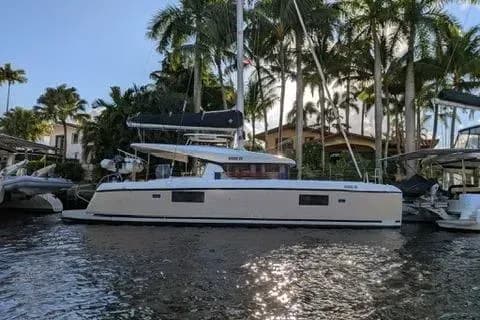
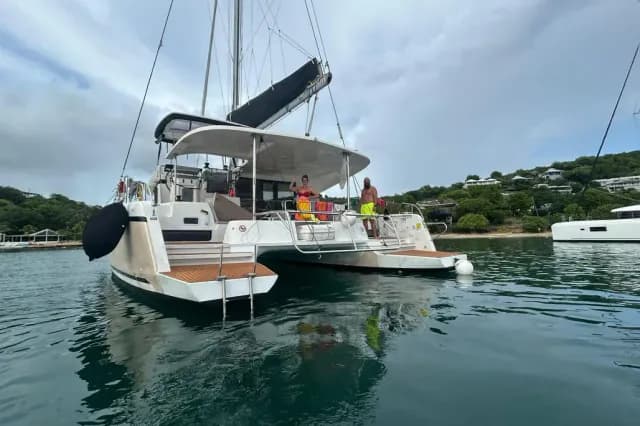
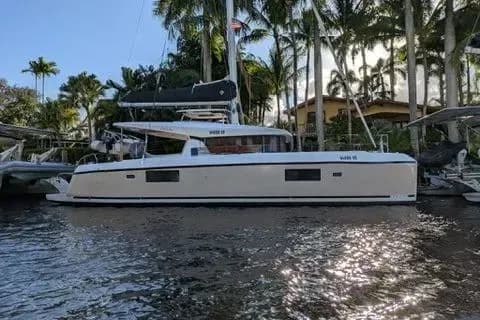
2019 Lagoon 42 - 'Bolubo'
Lagoon 42 Specifications
| Specification | Detail |
|---|---|
| LOA | 12.80 m (42 ft 0 in) |
| Waterline length | 12.50 m (41 ft 0 in) |
| Beam | 7.70 m (25 ft 3 in) |
| Draft | 1.25 m (4 ft 1 in) |
| Light displacement (EEC) | 12,100 kg (26,681 lbs) |
| Mast clearance | 20.65 m (67 ft 9 in) |
| Mainsail area (standard) | 55 m² (592 sq ft) |
| Mainsail area (square-top option) | 59 m² (635 sq ft) |
| Self-tacking jib | 35 m² (377 sq ft) |
| Total upwind sail area | 90–94 m² |
| Code 0 (option) | 68–78 m² |
| Engines (standard) | 2× Yanmar 4JH45, 45 HP |
| Engines (optional) | 2× Yanmar 4JH57, 57 HP |
| Propulsion | Saildrives with Flexofold folding propellers |
| Fuel capacity | 300 litres (151 US gal), optional +300 L |
| Water capacity | 300 litres (79 US gal), optional +300 L |
| Cabin layouts | 3-cabin owner / 4-cabin charter |
| Heads | 3 (owner) / 4 (charter) |
| Naval architecture | VPLP Design |
| Exterior design | Patrick Le Quement |
| Interior design | Nauta Design (Milan) |
| Construction | Vacuum infusion, balsa core sandwich |
| Builder | Lagoon (Groupe Beneteau) |
| Build location | Belleville-sur-Vie, France |
| CE category | A (Ocean) |
| Production years | 2016–2024 |
| Units built | 1,100+ |
The hull was designed by VPLP — Van Peteghem Lauriot-Prévost — the Paris-based naval architecture firm founded in 1983 by Marc Van Peteghem and Vincent Lauriot Prévost, who met at the Southampton School of Naval Architecture. VPLP is the world’s pre-eminent multihull design house, with credits including the America’s Cup-winning BMW Oracle trimaran (2010), multiple around-the-world record holders, and over 240 cruising catamaran designs for brands including Lagoon, Outremer, and Gunboat. For the Lagoon 42, VPLP created deliberately curvy, slim performance-oriented hulls with a swooping gullwing bridgedeck designed to minimise slamming in rough seas. The bridgedeck-to-LOA ratio was reduced to 1.52:1 — a significant improvement over the earlier Lagoon 420 — and the fixed keels are positioned further aft for more effective lateral resistance without the complexity of daggerboards.
Construction uses vacuum infusion with balsa core sandwich — hull materials are laid dry into the mould and polyester resin with anti-osmotic barrier is drawn through under vacuum, producing a stronger, lighter, and more consistent laminate than traditional hand layup. In practical terms, these numbers describe a boat that is spacious enough to live aboard comfortably, light enough to sail respectably in moderate conditions, and robust enough for ocean crossings — the CE Category A rating permits operation in wind up to Beaufort 9 and seas to 10 metres. The 300-litre water capacity is notably low for extended cruising, and most bluewater owners install a watermaker early in ownership. The standard 45 HP engines are adequate for calm conditions but the 57 HP upgrade is strongly recommended by experienced owners, particularly for close-quarters manoeuvring and adverse weather passages.
How Does the Lagoon 42 Sail?
Upwind: In a 48 North boat test, the Lagoon 42 achieved 6.1 knots in 11.6 knots of true wind speed at 50 degrees apparent wind angle. The tacking angle sits at approximately 90–100 degrees, which is typical for a cruising catamaran of this size. The boat is best sailed at 60 degrees to the true wind, where 7 knots is achievable in a reasonable breeze. In 18+ knots of true wind, the boat manages 7+ knots at 60 degrees true with one reef and full jib. This is not a close-winded boat — it is a cruising catamaran and behaves like one.
Light air: Below 10 knots TWS, the Lagoon 42 struggles without a Code 0, managing barely 3–4 knots of boat speed. With a Code 0 deployed in 12 knots of true wind, 8–10 knots is achievable on reaching angles. Most owners consider a Code 0 or asymmetric spinnaker essential for any kind of enjoyable light-air sailing — it transforms the boat’s character in conditions that would otherwise require motoring.
Trade wind sailing: This is where the Lagoon 42 comes alive. A comfortable cruising range of 7–9 knots is maintained in 15+ knots of reaching conditions, with speeds touching the low teens in stronger breeze. Atlantic crossings are well within its capability — a Lagoon 42 named “Ice Cat” won first place on adjusted time in the ARC 2018 Multihull B division. The self-tacking jib on its curved genoa track makes tacking a single-handed operation — simply turn the wheel — which is a genuine advantage for couples cruising without crew.
Under power: With the 57 HP engine upgrade, a fast cruise of 8.1 knots at 2,400 RPM is achievable, with a maximum of approximately 9 knots at 3,200 RPM. The standard 45 HP engines give approximately 7.5–8 knots. Fuel consumption at cruising RPM runs approximately 4 litres per hour per engine. A practical tip: single-engine motoring at 7 knots loses only 0.5–1 knot compared to twin-engine operation, making it the preferred mode for fuel efficiency on longer passages. Run engines up to 3,000 RPM for a few minutes every three hours to reduce soot buildup.
Honest assessment: The Lagoon 42 is not a performance catamaran. Owners who expect monohull-like pointing or dinghy-like responsiveness will be disappointed. But in reaching conditions — the angle most cruising catamarans spend the majority of their time at — the Lagoon 42 delivers a satisfying, comfortable, and surprisingly quick ride. VPLP’s racing DNA is evident in the hull shapes; this is a design house that won the America’s Cup, and their cruising work benefits from that relentless focus on hydrodynamic efficiency.
Interior Layout & Living Aboard
The Lagoon 42 was offered in two primary layouts: a 3-cabin owner’s version, in which the entire starboard hull is given over to the master suite with a queen berth featuring walk-around sides, a large head forward with separate shower, desk, standing headroom, and generous storage; and a 4-cabin charter version, with two cabins per hull, each with en-suite facilities and a Jack-and-Jill bathroom arrangement. Both layouts include two pilot berths in the bow compartments. On the used market, the 3-cabin owner’s version commands a premium of approximately 10–15% due to the larger master suite and additional storage — private buyers overwhelmingly prefer it over the 4-cabin configuration.
The interior was designed by Nauta Design, the Milan-based studio founded in 1985 by Mario Pedol, Massimo Gino, and Ezio Moiso, whose credits include the 180-metre superyacht Azzam. Nauta’s philosophy of fluid, light-filled spaces with continuous lines and generous volumes is evident throughout the saloon, where panoramic vertical windows — bending around cabin corners to reduce the greenhouse effect in tropical climates — flood the space with natural light and dissolve the boundary between inside and out. The U-shaped galley-up configuration faces the aft cockpit with direct serving through a window, featuring a three-burner stovetop with oven, front-loading fridge, and refrigerator drawers in the cockpit for cold drinks without entering the saloon.
The cockpit is one of the boat’s great strengths. Large enough for 8–10 people, with a hardtop providing shade, it creates a seamless flow between indoor and outdoor living. The flybridge adds a second social area with generous lounging space and the elevated helm station, effectively doubling the usable outdoor entertaining area. The helm position — set at the coachroof bulkhead with 360-degree visibility — was innovative for a 42-footer, offering direct communication between cockpit and saloon and easy access forward for sail handling. Owners note, however, that the helm seat is small, not adjustable, and set too low for optimal visibility on long passages — a common first upgrade.
For those considering living aboard, storage is adequate for cruising couples but can feel tight for families on extended passages. Ventilation relies heavily on hatches and opening ports — in tropical climates, air conditioning or additional Dorade vents are common additions. The galley storage is frequently cited as limited for extended provisioning, though the overall galley is rated among the most functional in the class. Many liveaboard owners add supplementary storage solutions, a watermaker, solar panels (minimum 1,300W recommended), and a lithium battery bank early in their ownership.
Lagoon 42 Ownership: What to Expect
New pricing for the Lagoon 42 started at approximately €499,000 (the 2024 Millennium Edition base price), with a fully equipped boat reaching €550,000–700,000 depending on configuration and options. Used examples range from approximately £300,000 for early 2016–2018 models to £500,000+ for low-hours 2023 boats. Lagoon’s own guidance suggests annual running costs of 5–10% of purchase price. The principal cost areas:
- Insurance: 1.0–1.7% of hull value. Mediterranean cruising grounds sit at approximately 1.0%, whilst Caribbean and hurricane-zone coverage rises to 1.5–1.7%. Pacific coverage can reach 2.0%. For a boat insured at £400,000, this translates to approximately £4,000–£6,800 per year.
- Marina berth: The “cat tax” — the 7.70 m beam means premium berth fees everywhere. The French Mediterranean commands up to €20,000 per year. Croatia ranges from €5,500–13,400. Caribbean marinas charge $1,600–$2,000 per month. Many cruisers reduce costs substantially by anchoring out — the 1.25 m draft opens up numerous anchorages inaccessible to deeper-draught vessels.
- Annual maintenance: £5,000–10,000 covering engine servicing, consumables, and minor repairs.
- Haul-out and antifouling: £3,000–5,000. Catamarans require a travel lift rated for the 7.70 m beam, and yards frequently charge a catamaran surcharge. The factory-applied antifouling has a poor reputation — budget for a proper repaint early in ownership.
- Approximate total: £24,000–46,000 per year depending on location, usage pattern, and cruising ground. Liveaboard cruisers anchoring out can reduce this to £15,000–25,000.
A significant proportion of Lagoon 42s enter the used market as ex-charter boats after 3–5 years of service. These typically carry higher engine hours (1,500–2,500+ in 3–5 years) and more cosmetic wear, but benefit from comprehensive service histories and competitive pricing — typically 20–35% below equivalent private-use boats. Charter versions come equipped with generator, air conditioning, watermaker, and full electronics — equipment that would cost tens of thousands to retrofit on a privately specified boat. The 4-cabin charter configuration is most common on the brokerage market; 3-cabin owner’s versions are rarer and correspondingly more valuable.
When evaluating ex-charter boats, pay close attention to engine hours, saildrive seals (water ingress is a documented issue across the fleet), rudder bearings, upholstery condition, gel coat integrity, trampoline condition, electronics age and functionality, and crucially whether all manufacturer recalls were completed during the charter management period.
How to Buy a Lagoon 42: What to Look For
Model years: Early production 2016 boats may exhibit first-generation fit-and-finish issues that were resolved in later production runs. The 2019 mast step recall is critical — two dismastings were reported on pre-2019 boats, and Lagoon issued a recall modifying the mast-to-mast-step connection. Any pre-2019 boat must have documentation that this recall was completed. Early models also required an escape hatch reinforcement kit. Post-2019 boats have the revised designs from factory.
Known Issues to Inspect
- Saildrive water ingress: Multiple owners report water in the saildrives within days of launch. Several required haul-outs for service in their first season. Inspect saildrive seals carefully and request service records for any seal replacement work.
- Watermaker installation defect: Factory-fitted Sea Recovery units had the thru-hull and strainer placed above the waterline, causing air ingestion and premature failure. This affects nearly all 42s in charter fleets and is one of the most widely reported issues.
- Anchor roller corrosion: Well-documented across the fleet. Most owners have replaced the factory unit.
- Inadequate refrigerator ventilation: A common fix involves installing small fans to improve airflow around the compressor.
- Factory antifouling failure: The factory-applied antifouling can strip to gelcoat within months of Caribbean cruising. Budget for a proper repaint.
- Undersized factory anchor: The Delta 20 kg supplied from the factory is widely considered inadequate. Most owners upgrade to a Rocna 33 or similar.
Equipment That Adds Value
When assessing a used Lagoon 42, the following additions represent genuine added value: watermaker, solar panels (1,300W+ recommended), davits with dinghy, upgraded electronics (chartplotter, radar, AIS), lithium battery conversion, good inverter (2,000W minimum), Code 0 or asymmetric spinnaker, folding propellers, and an upgraded anchor and chain. A boat fitted with the majority of these items represents significantly better value than one requiring the buyer to retrofit them — these upgrades can easily total £30,000–50,000 when purchased and installed individually.
Surveying a Catamaran
A catamaran survey should pay particular attention to bridgedeck stress, hull-to-deck joint integrity, and rudder bearing condition. Lagoon does not publish the bridgedeck clearance specification — have the surveyor measure it and compare against the fleet average. Ensure the surveyor has specific multihull experience; monohull surveyors frequently miss catamaran-specific structural concerns including bridgedeck slamming damage, hull asymmetry, and saildrive alignment issues.
Lagoon 42 vs Competitors
The Lagoon 42 did not exist in a vacuum. Several models competed directly for the same buyer during its production run, each with a distinct philosophy and set of trade-offs. The Lagoon’s unique position is its combination of interior volume, VPLP-designed hull performance, Nauta Design interiors, and the unmatched parts availability and market data that come from over 1,100 hulls on the water.
Lagoon 42 vs Bali 4.2
The Catana Group’s offering, built in Tunisia, takes a fundamentally different approach. The solid foredeck (no trampoline) provides 10% more usable deck area with lounging sunbeds, and the electrically lifting aft bulkhead creates a seamless saloon/cockpit space. A narrower beam of 23 ft 3 in (vs the Lagoon’s 25 ft 3 in) makes berthing considerably easier but reduces interior volume. The Bali is lighter by approximately 700 kg with significantly more standard tankage — 640 litres of fuel and 800 litres of water versus the Lagoon’s 300/300 base. Its philosophy maximises indoor-outdoor integration and lifestyle features at the expense of a more traditional catamaran sailing feel. The Lagoon suits experienced sailors and couples who value sailing performance; the Bali suits families and larger groups who prioritise living space.
Lagoon 42 vs Leopard 42
Built by Robertson & Caine in South Africa, the Leopard 42 is a strong charter market competitor. Build quality is generally rated higher than the Lagoon — water circuits, electrics, and machinery are described as “immaculately installed, clearly labelled and easily accessible” — and the laminated cabinetry features properly finished edges, a detail Lagoon’s joinery often lacks. The cockpit helm, rather than flybridge, keeps the skipper closer to the action. The Leopard’s saloon is praised as feeling like a 48-footer. However, the Leopard can be sluggish in light airs and slips sideways in close-winded sailing. The Lagoon 42’s wider beam and VPLP hull shapes deliver better reaching performance. The Leopard commands a slight price premium for its cleaner construction.
Lagoon 42 vs Fountaine Pajot Lucia 40
Smaller at 39 ft 5 in but competing in the same price bracket, the Lucia 40 offers a cockpit-level helm that gives the skipper a better feel for sail trim. Fountaine Pajot builds approximately 80% of its boats for private owners rather than charter fleets, resulting in a different quality emphasis. Build quality is generally regarded as slightly higher than the Lagoon, and the finish is more refined, though interior volume is less generous. The Lucia 40 has since been discontinued, replaced by the Fountaine Pajot Isla 40, but remains a strong competitor on the used market.
Lagoon 42 vs Excess 12
From the same parent company (Groupe Beneteau) but deliberately positioned as the sportier alternative. The Excess 12 has a lighter displacement, better upwind performance, and a more engaged sailing experience — but less interior volume. This is the boat for the buyer who wants to actually sail rather than motor between anchorages. Its existence highlights the Lagoon 42’s positioning as a comfort-first cruiser rather than a performance platform.
For value retention comparisons across all these models, visit the Hulls.io Market Intelligence tool.
Value & Market Insight
Based on analysis of 134 tracked listings across 8 model years, the Lagoon 42 retains around 95% of its value after two years. Two-year retention figures for recent models may reflect proximity to original list prices rather than resale transactions. At the five-year mark, values typically settle to around 79% of the original asking price. This sits 5 percentage points below the Multi-Hull average of 84%, suggesting competitive pricing opportunities for buyers.
The newest qualifying model year in our dataset (2024) has a median asking price of £564K.
Market insight based on asking prices from 134 tracked listings analysed by Hulls.io (April 2026 data). Figures reflect asking prices, not final sale prices.
Lagoon 42 Value Retention
Newest vintage = 100%. Older vintages shown as % of that price.
Based on median asking prices by model year. The newest model year in our dataset is used as the 100% reference point. The curve is smoothed so retention never increases as age increases — hover over data points to see raw values. Shaded band shows the 25th–75th percentile price range. Figures reflect asking prices from tracked listings, not final sale prices.