


Four Winns H230 Buyer’s Guide
Family RunaboutBuilt for families with a focus on comfort and stability. The Four Winns H230 is strong in "family boat" search queries, offering a well-designed cockpit layout, ample seating, and the kind of predictable handling that makes every family outing safe and enjoyable.
Lighter review 27 Oct 2026, full check due Jan 2027How we check our guides
Show 1 award
Show 5 key features
Updated 10 June 2026 · By Hulls.io Editorial
The Four Winns H230: A Complete Guide
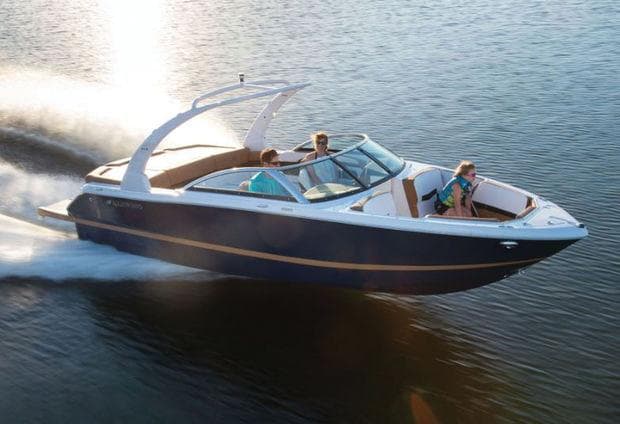
The Four Winns H230 is a 23-foot sterndrive bowrider that earned a loyal following for its combination of build quality, ride comfort, and thoughtful cockpit layout during its decade-long production run from 2013 to 2022. Built by Four Winns at their Cadillac, Michigan facility, the H230 was the mid-range entry in the Horizon bowrider line — a nameplate that dates to 1984 — and showcased the brand’s patented Stable-Vee hull design, all-composite construction philosophy, and an attention to materials that set it apart from competitors.
Four Winns was founded in 1975 by the Winn family in Cadillac, Michigan. The brand changed hands several times over the following decades: Outboard Marine Corporation owned it before Genmar Holdings bought it in early 2001, and after Genmar’s bankruptcy Platinum Equity acquired the brand portfolio in 2010 and ran it as Rec Boat Holdings with Glastron, Wellcraft and Scarab. In 2014 Platinum Equity sold Rec Boat Holdings to Groupe Beneteau, bringing Four Winns into the same group as Beneteau and Jeanneau. On 15 June 2026 Groupe Beneteau announced a production halt at the Cadillac, Michigan, facility during the third quarter of 2026 and the planned divestiture of the site and of the Four Winns, Glastron and Scarab Jet brands, saying that after-sales service and spare parts supply would be maintained until the divestiture is finalised.
The H230 was produced in three variants: the standard H230 (2013–2022), the H230 SS (2016–2017), and the H230 RS (2016–2022). All three shared the same Stable-Vee hull but differed in trim level, graphics, and standard equipment. The model has since been replaced in the Four Winns lineup by the H2 and H2 Freedom, which adopt the brand’s current design language while retaining the proven hull platform.
Four Winns H230 Specifications
| Specification | Detail |
|---|---|
| LOA | 23′4″–23′7″ (7.1–7.2 m) |
| Beam | 8′5″ (2.57 m) |
| Max draft (drive down) | 2′9″–2′10″ (0.84 m) |
| Min draft (drive up) | 1′4″ (0.40 m) |
| Bridge clearance | 4′5″ (1.35 m) |
| Transom deadrise | 20 degrees |
| Hull type | Modified Vee (Stable-Vee), Fiberglass / GRP |
| Dry weight | 3,850–4,400 lbs (1,746–1,995 kg) |
| Fuel capacity | 52 gallons (197 L) |
| Max passengers | 10–11 |
| Drive type | Sterndrive only (no outboard option) |
| Engine options | MerCruiser 4.5L 250 HP to 6.2L 380 HP; Volvo Penta V6-280 |
| Construction | All-composite, no wood in structure |
| Wiring | Tin-coated copper with silicone seals |
| CE category | C (Inshore) |
| Production years | 2013–2022 (discontinued) |
The defining technical feature is the Stable-Vee hull. Patented in 1993 and awarded a Popular Mechanics Design and Engineering Innovation Award in 1994, the Stable-Vee design uses a modified vee hull shape with a 20-degree transom deadrise that delivers a softer ride in chop while maintaining stability at rest. The hull’s geometry also enables narrower gunwales, which translates directly into more usable cockpit width — a measurable advantage on a 23-foot boat where every inch of interior space matters.
The all-composite, wood-free construction is worth highlighting. Four Winns eliminated wood from the structural components of the H230, using fiberglass and composite materials throughout the stringers, transom, and hull. Inspect the laminate, structural bonds and electrical connections on any used example; composite construction does not remove the need for a survey.
Performance & Handling
Sea trial: Confirm the engine model and power, then measure speed and fuel consumption with a representative load. Plan range from measured consumption, usable fuel and an appropriate reserve.
Stable-Vee handling: The hull’s real advantage shows in cornering and rough-water behaviour. The Stable-Vee design reduces bow rise during acceleration, enabling the driver to maintain forward visibility throughout the power band. In turns, the hull tracks predictably with minimal slip — a characteristic that inspires confidence in less experienced drivers and makes the boat genuinely enjoyable to helm in varied conditions. In confused chop, the 20-degree deadrise softens the impacts that punish flatter-bottomed competitors.
Limitations: The H230 is a sterndrive-only platform — no outboard option was ever offered. This is worth noting because the broader bowrider market has shifted heavily toward outboard power, which offers simpler maintenance, shallower draft, and a larger swim platform. The sterndrive configuration does provide better low-speed manoeuvrability and a quieter ride at speed, but it requires annual drive service and limits shallow-water access compared to an outboard-powered alternative.
Interior Layout & Design
The H230 is a pure bowrider — an open-deck day boat with no enclosed cabin or head compartment. The layout is designed around maximising social space and watersports functionality within a 23-foot hull. This is a boat built for day trips, weekend raft-ups, sunset cruises, and tow sports, not overnight stays.
Bow section: The bow features bench seating with integrated armrests and cup holders. The seating area is wide enough for four adults to sit comfortably, benefiting from the Stable-Vee hull’s narrower gunwales, which push the usable width outboard. The bow area includes grab handles and a dedicated anchor locker.
Helm and cockpit: The driver and passenger sit in Four Winns’ ComfortRide flip-up bolster bucket seats, which allow the driver to stand in a leaning position for better visibility or sit fully down in calmer conditions. The helm station features analogue gauges, a tilt steering wheel, and a standard-fit swim platform remote. The cockpit is finished in stainless steel hardware throughout — a material choice that distinguishes the H230 from competitors that rely more heavily on plastic trim.
Aft section: A U-shaped aft lounge wraps around a removable cockpit table. The aft seating converts to a sun lounge configuration, creating a flat sun pad across the full width of the cockpit. Beneath the cockpit sole, a full-length in-floor ski locker with gas-assist lid provides dedicated storage for wakeboards, skis, and tubes — keeping them accessible but out of the living space.
Swim platform: The fiberglass swim platform extends aft of the transom with a telescoping boarding ladder, non-skid surface, and stainless steel grab rails. On the sterndrive model, the platform wraps around the drive unit — functional but not as expansive as the full-width platforms found on outboard-powered competitors.
H230 Ownership: What to Expect
- Trailering: The H230 is trailerable at a total tow weight of 5,500–6,400 lbs (boat, engine, fuel, and trailer). A full-size pickup truck with a tow rating above 7,000 lbs is recommended. Trailering allows access to multiple waterways.
Ask a Four Winns dealer to confirm any remaining warranty for the hull identification number and whether it can transfer to you. Coverage and transfer conditions depend on the original terms; a used boat should still have a structural survey.
How to Buy a Four Winns H230
New vs used: The H230 was discontinued after the 2022 model year, so all purchases are now on the used market. The successor models — the Four Winns H2 and H2 Freedom — carry forward the Stable-Vee hull and all-composite construction with updated styling and electronics. Buyers who want a new Four Winns bowrider in this size class should evaluate the current H2 range.
Model variants: The standard H230 is the most common on the used market. The H230 RS (2016–2022) adds sport-oriented graphics, upgraded upholstery, and additional standard equipment. The H230 SS (2016–2017) was a limited premium variant with enhanced trim and a higher equipment level. All three share the same hull, so the choice between them is primarily cosmetic and equipment-driven.
Key Considerations for Buyers
- Sterndrive condition: The single most important inspection point on any used H230 is the sterndrive. Check for bellows integrity, gimbal bearing wear, U-joint condition, and corrosion on the drive unit. A sterndrive service history with annual maintenance records is a strong positive indicator.
- Engine hours: Check the recorded hours against service records and condition. Ask about periods of storage and have a mechanic inspect the fuel system, seals and cooling system.
- Upholstery and canvas: Marine vinyl upholstery on bowriders is a consumable item. Inspect for UV damage, stitching failure, and mildew. Check the condition of the cockpit cover, bimini, and tonneau cover too.
- Trailer included: Many H230s are sold with a matching trailer. Inspect the trailer for frame corrosion, bearing condition, brake function, and tyre age.
Assess the hull, deck, systems and sterndrive together; documented maintenance does not replace a survey.
Four Winns H230 vs Competitors
The 23-foot bowrider segment is one of the most competitive classes in recreational boating. The H230 competed against established models from Sea Ray, Chaparral, Cobalt, and Bayliner — each offering a different balance of price, performance, build quality, and features.
H230 vs Sea Ray SLX 260
The Sea Ray SLX 260 is a larger, more premium platform — a 26-footer with capacity for up to 15 passengers and availability in both sterndrive and outboard configurations. The SLX 260 offers more space, more passenger capacity, and the outboard option that the H230 lacks. The H230 counters with easier trailering at 23 feet and the Stable-Vee hull’s proven ride quality. Buyers choosing between the two are typically deciding between a compact day boat (H230) and a larger, more versatile family platform (SLX 260).
H230 vs Chaparral 267 SSX OB
The Chaparral 267 SSX OB is a newer-generation competitor with a single outboard. Like the Sea Ray, the Chaparral is a larger boat, at 25 ft 6 in. The 267 SSX name also covers a separate sterndrive boat, 26 ft 5 in long, so check which version an advert describes.
H230 vs Cobalt R33
The Cobalt R33 sits in a significantly larger size class — this is a premium 33-foot twin-sterndrive bowrider. The comparison is less about direct competition and more about aspiration: Cobalt represents the premium end of the sport boat market that Four Winns approaches from a mid-market position.
H230 vs Four Winns HD8
For buyers already sold on the Four Winns brand, the Four Winns HD8 is a larger alternative within the same brand. It is a 26 ft 6 in (8.08 m) deck boat from the builder’s HD-Series, which Four Winns describes as combining the space of a deck boat with a more traditional V-bottom hull. It has an 8 ft 4 in (2.54 m) beam, a single sterndrive of up to 380 hp, a CE category C rating for 12 people and a changing room with a portable-toilet head. The outboard version is a separate model, the HD8 OB. Buyers who want more length and deck space than the H230 offers within the Four Winns range should consider the HD8.
H230 vs Bayliner VR6
The Bayliner VR6 is a 22-foot bowrider. Compare the actual engine packages, loaded towing weights, construction records and condition. Sea-trial both boats rather than assuming that either model has better fuel economy or build quality.
For a full interactive comparison between the Four Winns H230 and other models, visit the Hulls.io Market Intelligence tool.