


Gunboat 48 for Sale
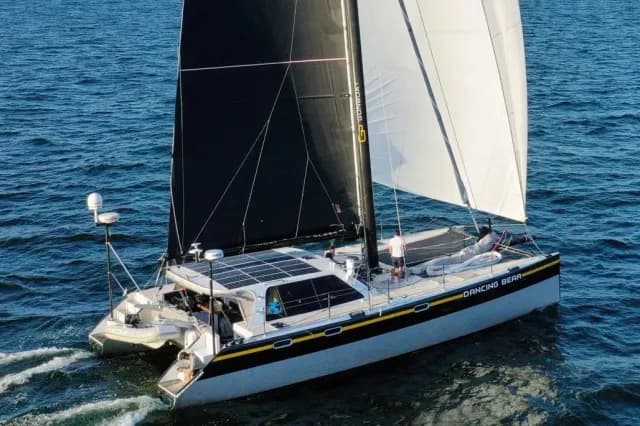
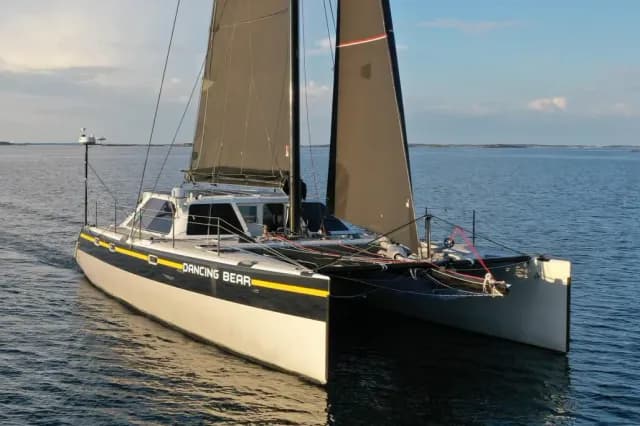
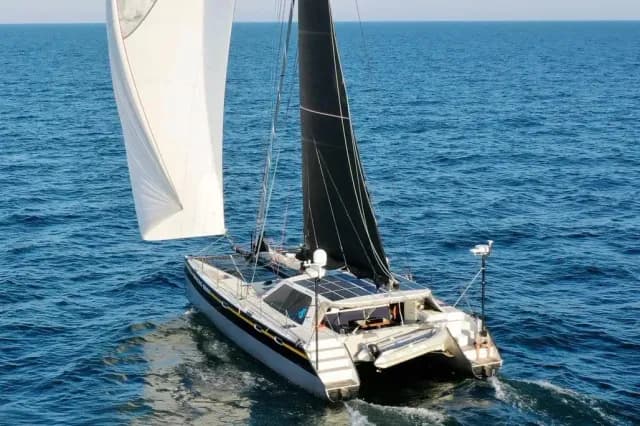
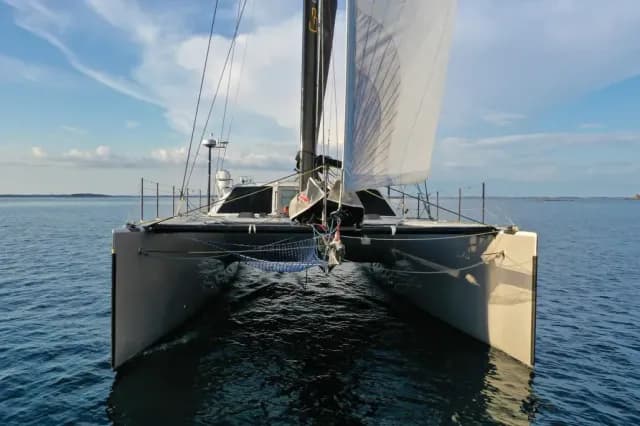
Performance Sailing CatamaranThe Gunboat 48 is a high-performance carbon fibre cruising catamaran built by Gunboat in Wanchese, North Carolina. Designed for sailors who refuse to compromise between speed and comfort, the 48 is the entry point to the Gunboat range and delivers performance that embarrasses catamarans twice its price. With a carbon fibre hull and deck, the 48 weighs significantly less than equivalent-length production cats, enabling sustained sailing speeds of 12-18 knots in moderate conditions. Despite its racing pedigree, the 48 offers a fully appointed cruising interior with standing headroom, a proper galley, and comfortable cabins.
Show 2 awards
Show 6 key features
Updated 10 June 2026 · By Hulls.io Editorial
The Gunboat 48: A Complete Guide
The Gunboat 48 is one of the rarest and most coveted performance cruising catamarans ever built. Designed by Morrelli & Melvin and commissioned by Gunboat founder Peter Johnstone, it was the second model in the Gunboat range — following the larger Gunboat 62 — and the boat that proved a full carbon fibre performance catamaran could also be an owner-operated bluewater cruiser. Only six hulls were built between 2004 and 2009 at Gunboat’s yard in Cape Town, South Africa, and each one is semi-custom with owner-specified interior layouts and systems.
Peter Johnstone comes from American sailing royalty — his father Bob and uncle Rod co-founded J/Boats in 1977. Before Gunboat, Johnstone had revived Sunfish Laser from bankruptcy and taken the Laser class to the Olympics. He founded Gunboat around 2002 with a single conviction: that the cruising catamaran market was underserving sailors who wanted to sail fast while living aboard in comfort. The Gunboat 62 had proven the concept at a larger scale; the 48 brought it down to a size manageable by a couple without professional crew.
What sets the Gunboat 48 apart from every production catamaran in its size class is construction. The hull and deck are vacuum-bagged, oven-cured carbon fibre and Kevlar over foam core — with Kevlar on the outer skins for impact resistance and carbon on the inner skins for stiffness. The daggerboards, rudders, stringers, ring frames, and crossbeams are all carbon fibre. The Marstrom rotating wing mast and ECsix standing rigging are carbon. The result is a 48-foot catamaran that displaces under 8,100 kg light — roughly half the weight of a production Lagoon 46 — with a sail area to displacement ratio of 32.4, nearly 50% higher than any mainstream cruising cat.
All six Gunboat 48s were built before the company’s 2015 bankruptcy and subsequent acquisition by Grand Large Yachting. They are therefore untouched by the quality concerns that affected later Chinese-built Gunboat 60s, and represent the purest expression of Johnstone’s original vision: South African craftsmanship, American design thinking, and uncompromising carbon construction. Today, under GLY ownership, Gunboat builds the larger 68 from a facility in La Grande-Motte, France, with VPLP handling design duties. The 48 remains a product of its original era — a Morrelli & Melvin design from the company’s founding chapter.
Hulls.io currently tracks 1 active listing for the Gunboat 48. With only six hulls in existence and strong demand from the performance cruising community, these boats rarely appear on the brokerage market — and when they do, they command asking prices of US$1.2–1.6 million despite being 17–22 years old.
Showing 1–1 of 1 results
Gunboat 48 Specifications
| Specification | Detail |
|---|---|
| LOA | 14.74 m (48 ft 4 in) |
| LWL | 14.00 m (45 ft 11 in) |
| Beam | 7.40 m (24 ft 3 in) |
| Draft (boards up) | 0.60 m (2 ft 0 in) |
| Draft (boards down) | 2.26 m (7 ft 5 in) |
| Light displacement | 8,025 kg (17,700 lbs) |
| Mast clearance | 22.00 m (72 ft 2 in) |
| Mainsail area | 91 m² (980 sq ft) — square-top, fully battened |
| Genoa | 36 m² (388 sq ft) |
| Total upwind sail area | 127.5 m² (1,372 sq ft) |
| Gennaker | 129 m² (1,389 sq ft) |
| Spinnaker | 145 m² (1,561 sq ft) |
| SA/D ratio | 32.4 |
| Engines | 2× Volvo Penta D2-40, 40 HP (direct drive) |
| Fuel capacity | 475 litres (125 US gal) |
| Water capacity | 415 litres (110 US gal) |
| Cabins | 3 queen berths + 1 convertible office |
| Heads | 2 (with showers) |
| Mast | Marstrom carbon rotating wing mast |
| Standing rigging | ECsix carbon fibre |
| Naval architecture | Morrelli & Melvin |
| Builder | Gunboat (Cape Town, South Africa) |
| Production years | 2004–2009 (6 hulls built) |
These numbers tell an extraordinary story. At 8,025 kg light displacement, the Gunboat 48 weighs less than many 38-foot monohulls — yet carries 127.5 m² of upwind sail area on a carbon rotating mast. The SA/D ratio of 32.4 places it firmly in racing territory, while the retractable daggerboards allow the boat to anchor in just 0.60 m of water with boards raised. The 475-litre fuel capacity is modest by cruising catamaran standards — reflecting the design philosophy that this boat sails rather than motors — but the twin 40 HP Volvo Penta diesels on direct drive provide reliable performance when needed. The direct drive arrangement (as opposed to saildrives) reduces maintenance complexity and eliminates the saildrive seal as a potential failure point.
How Does the Gunboat 48 Sail?
Upwind: The carbon daggerboards transform the Gunboat 48’s windward ability. With boards fully deployed (2.26 m draft), the boat achieves 7.5–9 knots close-hauled in moderate conditions. Morrelli & Melvin recommend tacking through approximately 100 degrees for optimal VMG, though 90 degrees is achievable in flat water. During the Heineken Regatta in St. Maarten, a Gunboat 48 outpaced the 115-foot superyacht Sojana over a 15-mile beat — a result that underscores the boat’s genuine windward capability. This is not a catamaran that drifts sideways upwind; the daggerboard foils, carbon construction, and rotating mast combine to deliver performance that embarrasses boats twice its length.
Reaching: This is the Gunboat 48’s sweet spot. In 12–15 knots of true wind, expect 12–13 knots of boat speed with the roller-furling screecher and mainsail. During the same Heineken Regatta, one hull recorded 24 knots on a Code 0 reach — speeds that most production catamarans cannot approach under any conditions. In sustained trade wind sailing at beam reach to broad reach, 10–14 knots is a realistic cruising range. The rotating wing mast automatically feathers to the optimal angle, maximising drive while minimising drag — a significant aerodynamic advantage over conventional fixed-mast rigs.
Downwind: Under spinnaker in 15+ knots of breeze, the Gunboat 48 regularly achieves 19–21 knots. Owner reports from the Heineken Regatta document 21 knots on a spinnaker leg. In ideal conditions — 20–25 knots of true wind on a broad reach — the boat approaches true wind speed. VMG optimum sits between 130–150 degrees apparent. Under these conditions, 300–400 nautical mile days are theoretically achievable, placing the Gunboat 48 in the same passage-time bracket as boats three times its price.
Light air: Below 8 knots of true wind, the 8-tonne displacement and relatively modest genoa (36 m²) make the boat “sticky” compared to a pure racing multihull. The large gennaker (129 m²) or asymmetric spinnaker is essential in these conditions. Most owners carry an extensive sail wardrobe — typically including a self-tacking jib, a screecher or Code 0 on a top-down furler, and either a gennaker or full spinnaker — to cover the full range of apparent wind angles.
Under power: The twin 40 HP Volvo Penta diesels deliver a comfortable 7–8 knot cruise. The 475-litre fuel capacity gives approximately 40–50 hours of motoring range — adequate for coastal passages and harbour approaches, but considerably less than the 1,000+ litre tanks found on production cruising cats. This is by design: the Gunboat 48 was built to sail, and its owners overwhelmingly do. The direct drive arrangement provides responsive handling in marinas, and the shallow draft with boards up (0.60 m) opens anchorages that deeper-draft boats cannot access.
Interior Layout & Living Aboard
The Gunboat 48 borrows its deck layout concept partly from Chris White’s forward cockpit philosophy: the primary sail-handling station is a forward cockpit positioned near the mast, where all lines are led to chest-level Harken blocks and Spinlock clutches. This keeps the helmsman close to the action and provides direct visibility of sail trim — a fundamentally different experience from the flybridge helms found on production catamarans. The aft cockpit, described by owners as the “back porch,” serves as a protected entertaining and dining area with dinghy davits and swim access.
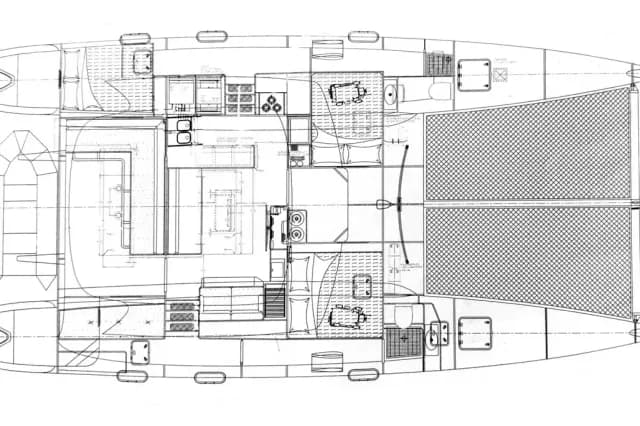
The bridgedeck saloon sits between the cockpits, spanning the full beam with a pilothouse arrangement that provides 360-degree visibility. Interior headroom is 1.98 m (6 ft 6 in) throughout. Fit-out quality reflects the semi-custom nature of each hull: early boats featured African Sapele cabinetry and Brazilian Mahogany flooring, though individual specifications vary. The galley is located on the bridgedeck, offering a practical serving arrangement to both cockpits.
Below decks, each hull contains a forward cabin with a queen-sized athwartships berth and a head with shower, plus an aft cabin. The standard layout provides three queen berths and a convertible office/fourth berth. One notable layout limitation: the heads are accessed through the forward cabins, which works well for one or two couples but becomes awkward when all berths are occupied — guests in aft cabins must pass through the forward cabin to reach the bathroom.
For liveaboard use, the Gunboat 48 offers a different proposition to a production cruising cat. Storage volume is significantly less than on a Lagoon or Fountaine Pajot of similar length — the carbon construction and lightweight ethos mean there is less cabinetry, fewer lockers, and smaller tankage. What it offers instead is the ability to sail fast enough to make shorter passages, arriving days ahead of heavier boats. Many Gunboat 48 owners have completed extended circumnavigations and transatlantic crossings, proving the platform’s liveaboard viability for sailors willing to embrace a more spartan approach to offshore cruising.
Gunboat 48 Ownership: What to Expect
Owning a Gunboat 48 is a fundamentally different financial proposition to owning a production catamaran. The acquisition cost is higher, specialist maintenance is required, and parts availability for a run of six boats is inherently limited. The upside is exceptional value retention and a boat that delivers a sailing experience no production catamaran can match.
- Insurance: 0.8–1.7% of hull value depending on cruising area. On a boat insured at US$1.3 million, this translates to approximately US$10,400–$22,100 per year. Caribbean and hurricane-zone coverage sits at the upper end; Mediterranean or Pacific cruising at the lower end. Carbon construction and performance multihull classification may attract premium rates from some underwriters.
- Marina berth: The 7.40 m beam typically requires a catamaran-specific berth or double-width slip. Premium marina locations charge US$200–$300 per foot annually, translating to US$9,600–$14,400 per year for a 48-footer. Many Gunboat 48 owners anchor out or use moorings, reducing this cost significantly.
- Annual maintenance: US$15,000–$30,000 covering engine servicing, rigging inspection, daggerboard and rudder servicing, antifouling, and consumables. Carbon fibre hulls eliminate osmosis concerns but require specialist repair if damaged. The rotating mast bearing surface and carbon rigging demand periodic professional inspection.
- Carbon rigging replacement: ECsix carbon standing rigging has a finite service life. Budget US$30,000–$50,000 for eventual replacement — a significant but infrequent expense that should be factored into the total cost of ownership.
- Haul-out and antifouling: US$4,000–$7,000 per haul. The 7.40 m beam requires a travel lift with adequate capacity, which limits yard options. Annual haul-outs are standard for antifouling and underwater inspection.
The counterbalance to these costs is remarkable value retention. Gunboat 48s originally sold for approximately US$1.68 million (2006 dollars). Today, 17–22 years later, clean examples with comprehensive refits are trading at US$1.2–$1.6 million — in some cases approaching or exceeding original purchase prices in nominal terms. With only six hulls in existence and irreplaceable carbon construction, supply is permanently constrained. The Gunboat 48 is one of a handful of production sailing yachts that can genuinely be described as an appreciating asset when properly maintained.
Engine age is a near-universal consideration across the fleet. All six boats now carry engines that are 17–22 years old. Several hulls have already been refitted with new powerplants — hull #3 (Traverse) received Yanmar 3JH40 engines in 2023/24. Buyers should budget for engine replacement if the current units have not been recently overhauled or replaced.
How to Buy a Gunboat 48: What to Look For
The fleet: With only six hulls built, the buying pool is extremely small. Known boats include Malolo (hull #1, 2004), Dancing Bear (hull #2, 2006), Traverse (hull #3, 2006), Vela (hull #4, 2007), Blast (hull #5, ~2008), and Osi (hull #6, 2009). At any given time, one or two may be on the market. Patience is essential — the right boat may take months or years to appear. Specialist brokerages such as Denison Yacht Sales and Grabau International handle most Gunboat transactions.
Known Issues to Inspect
- Carbon hull and deck integrity: Inspect for delamination, stress cracks, and impact damage. While carbon fibre is extraordinarily strong, it does not show damage as visibly as fibreglass. A specialist composite surveyor is essential — not optional.
- Daggerboard trunks: High-stress area. Check the daggerboard cassettes for wear, alignment, and any signs of water ingress. The carbon daggerboards themselves should be inspected for hairline cracks and leading-edge erosion.
- Rotating mast step: The Marstrom carbon mast rotates on a bronze bearing surface. Inspect for wear, corrosion, and correct fit. Check the mast itself for hairline cracks, UV degradation, and fitting corrosion — particularly around halyard turning blocks built into the mast base.
- Carbon standing rigging: ECsix carbon rigging has a finite service life. Determine the age of the current rigging and budget for replacement if it has not been done within the last 10–12 years. Aramid forestays are also subject to UV degradation.
- Engine condition: All boats now carry engines that are 17–22 years old. Compression test, oil analysis, and hour meter reading are essential. Check whether engines are original (Volvo D2-40 or Westerbeke) or have been replaced. Direct drive alignment and coupling condition should be verified.
- Retractable rudder cassettes: The retractable rudders are a critical system. Check for bearing wear, alignment, and smooth operation. Replacement parts for these semi-custom components may require bespoke fabrication.
Equipment That Adds Value
When assessing a used Gunboat 48, the following additions represent genuine added value: recent engine replacement or rebuild, new standing rigging, comprehensive sail wardrobe (mainsail, self-tacking jib, screecher/Code 0, gennaker or spinnaker), upgraded electronics and autopilot, watermaker, solar panels, lithium battery bank, and modern safety equipment (liferaft, EPIRB, AIS). Given the cost and complexity of retrofitting specialist carbon systems, a boat that has been comprehensively refitted may justify a significant premium over one requiring work.
Surveying a Carbon Catamaran
A conventional marine surveyor is not sufficient for a Gunboat 48. The buyer must engage a surveyor with specific experience in advanced composite construction — ideally one who has inspected carbon multihulls. Key areas include crossbeam-to-hull bonding, bridgedeck stress analysis, daggerboard trunk integrity, and the rotating mast step assembly. Non-destructive testing (NDT) methods such as ultrasonic inspection may be appropriate for critical structural areas. The extreme rarity of these boats means that structural damage or poor previous repairs can be prohibitively expensive to rectify — thorough pre-purchase inspection is non-negotiable.
Gunboat 48 vs Competitors
The Gunboat 48 essentially created the performance cruising catamaran category. When it launched in 2004, nothing else on the market combined full carbon construction, racing-level sail area, and genuine liveaboard capability in a sub-50 ft package. Two decades later, several competitors have entered the space — but none replicates the exact combination of lightweight construction, raw speed, and sailing pedigree that defines the original.
Gunboat 48 vs HH 44 / HH 50
The most direct modern competitor. The HH 44 (and its successor, the HH 50) is also designed by Morrelli & Melvin and built in full carbon fibre — in this case at Hudson Yacht & Marine in Xiamen, China. The HH offers a more refined, modern interior with better use of volume, newer construction techniques (prepreg carbon), and a design that benefits from 15 years of evolution since the Gunboat 48. New pricing for the HH 50 starts around US$1.5–2.5 million. The trade-off is that the HH lacks the Gunboat’s cult status and proven race record. For buyers seeking the latest technology in a carbon performance cruiser, the HH is the natural choice; for those who value provenance and heritage, the Gunboat 48 remains the icon.
Gunboat 48 vs Outremer 45
Now stablemates under the Grand Large Yachting group, the Outremer 45 represents a more accessible entry point to performance cruising. Built in composite with carbon reinforcement (not full carbon) in La Grande-Motte, France, the Outremer is heavier but offers better interior volume, a more refined galley, and significantly lower new pricing (approximately US$800,000–$1.2 million). The Outremer has a strong bluewater pedigree — many have completed circumnavigations — and its French construction benefits from established parts networks and yard support. The Gunboat 48 is materially faster and lighter, but the Outremer is the more practical and affordable choice for extended cruising.
Gunboat 48 vs Catana 47
The Catana 47 (now produced under the Catana brand within Bali’s parent company) uses carbon-infused composite construction and offers excellent interior volume combined with genuine sailing performance. The Catana is heavier than the Gunboat but considerably lighter than mainstream production cats, with a strong bluewater heritage and well-documented ocean crossings. New pricing of US$1–$1.5 million makes it significantly more affordable than a Gunboat 48 on the used market. For buyers who want performance without the maintenance demands and specialist requirements of full carbon construction, the Catana 47 represents a compelling middle ground.
Gunboat 48 vs Balance 442
Built in South Africa — like the original Gunboat 48 — the Balance 442 uses carbon-reinforced composite construction with retractable daggerboards. It shares the Gunboat’s performance-cruising philosophy and benefits from the same Southern African boatbuilding heritage that produced the early Gunboats. At US$1.5–$2 million new, the Balance is competitively priced against the Gunboat 48 on the used market and offers newer systems, modern electronics, and updated construction techniques. The Balance lacks the Gunboat’s pure carbon construction and extreme lightness, but it is arguably a more refined and better- finished boat for extended liveaboard cruising.
Gunboat 48 vs Production Cruising Catamarans
Comparing the Gunboat 48 to a Lagoon 46, Fountaine Pajot Elba 45, or Bali 4.6 is instructive but ultimately a comparison of different philosophies. The production cats offer twice the interior volume, three times the tankage, lower maintenance costs, established dealer networks, and new pricing that is broadly comparable to the Gunboat 48’s used value. What they cannot offer is speed: the Gunboat 48 will sail circles around any production catamaran in its size class, consistently delivering 12–20+ knots in conditions where a Lagoon or Bali would motor at 7. The buyer who chooses a Gunboat 48 is choosing sailing performance and exclusivity over interior comfort and convenience — and doing so deliberately.
For current pricing data and market trends on the Gunboat 48 and competing models, visit the Hulls.io Market Intelligence tool.