


Lagoon 46 for Sale
Sailing CatamaranThe Lagoon 46 is a mid-range cruising catamaran that slots between the best-selling Lagoon 42/43 and the flagship Lagoon 50/51 in the Groupe Beneteau lineup. Designed by VPLP with interior styling by Nauta Design, the 46 offers significantly more interior volume and deck space than the 42, while remaining manageable for a couple to sail shorthanded. The model was introduced in 2019 and has become a popular choice for both private owners planning extended cruising and charter fleet operators seeking a step-up from the 42.
Show 2 awards
Show 6 key features
Updated 10 June 2026 · By Hulls.io Editorial
The Lagoon 46: A Complete Guide
The Lagoon 46 is the production cruising catamaran that cemented Lagoon’s new-generation design language in the 45–50 ft segment. Launched at Boot Düsseldorf in January 2019, it replaced the enormously successful Lagoon 450/450F/450S lineage (2010–2021, approximately 850 units built) and brought the vertical bow, aft-positioned mast, and self-tacking jib — first introduced on the smaller Lagoon 42 — up to a larger, more capable platform. Over 600 hulls had been built by 2025, making it one of the highest-volume production catamarans in its size class.
The design team reads like a who’s who of marine architecture. VPLP Design handled the naval architecture, bringing their America’s Cup and offshore racing pedigree to the hull forms. Nauta Design, the Milan-based studio responsible for interiors on superyachts and the entire Lagoon range, created the living spaces. Patrick le Quement, formerly head of design at Renault, shaped the exterior styling — a collaboration that gave the 46 its distinctive, polarising aesthetic. The result is a boat that prioritises volume, comfort, and ease of handling whilst retaining enough sailing DNA to cross oceans under canvas.
The key structural change from the 450 was the repositioning of the mast significantly further aft. This enabled the self-tacking jib — removing the requirement for a genoa track on the coachroof — and allowed a higher-aspect mainsail that improved upwind efficiency. The trade-off was interior space in the salon, which Nauta compensated for with careful rearrangement of the galley and living areas. The factory at Belleville-sur-Vie operates 24 hours across three shifts, producing approximately three catamarans per day (a mix of 42s and 46s), a throughput that speaks to the industrial scale of the operation.
The Lagoon 46 Iconic, a special edition with enhanced specification, was released in 2024/2025. Looking ahead, Lagoon has announced the Lagoon 47 as the successor, due for its world premiere at Cannes in September 2026. For buyers today, the used Lagoon 46 represents a mature, well-understood platform: hundreds of boats on the water, a growing body of owner experience, strong parts availability through Groupe Beneteau’s global network, and an increasingly clear picture of long-term reliability.
Hulls.io currently tracks 1 active listings for the Lagoon 46, drawn from brokerages worldwide. With 113 tracked listings in our market intelligence database, the Lagoon 46 benefits from a growing pool of comparable sales data — providing buyers and sellers with reliable pricing trends, value retention metrics, and seasonal demand patterns.
Showing 1–1 of 1 results
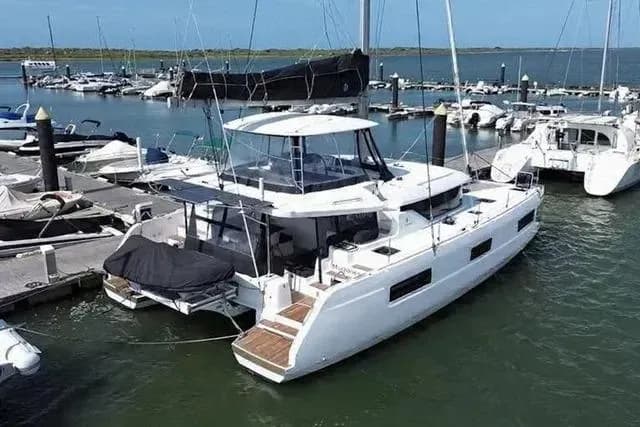
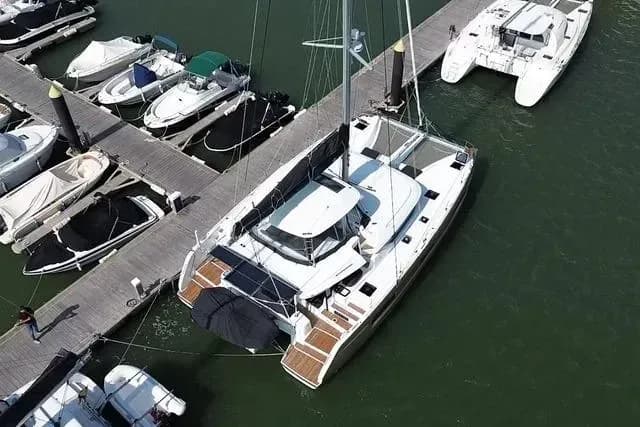
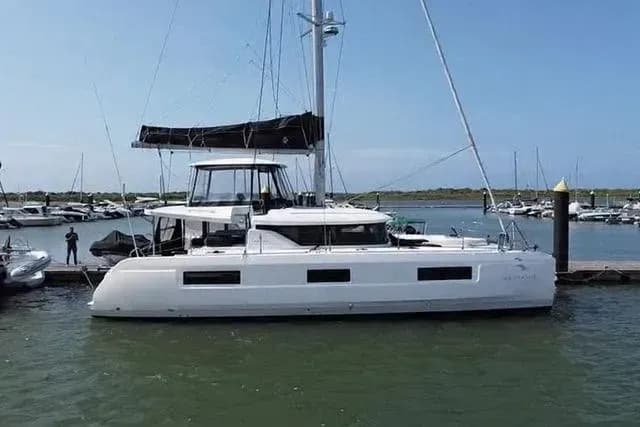
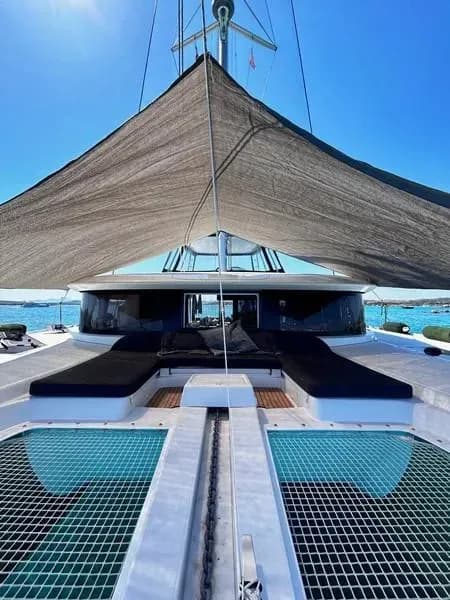
Lagoon 46 Specifications
| Specification | Detail |
|---|---|
| LOA | 13.99 m (45 ft 11 in) |
| Beam | 7.96 m (26 ft 1 in) |
| Draft | 1.30 m (4 ft 3 in) |
| Light displacement (EEC) | 16,300 kg (35,935 lbs) |
| Mast clearance | 23.21 m (76 ft 2 in) |
| Mainsail area (standard) | 76.5 m² (823 sq ft) |
| Mainsail area (square-top option) | 80.5 m² (866 sq ft) |
| Self-tacking jib | 46.5 m² (500 sq ft) |
| Total upwind sail area | 127 m² |
| Code 0 (optional) | 105 m² (1,130 sq ft) |
| Engines (standard) | 2× Yanmar 4JH57, 57 HP |
| Fuel capacity | 1,040 litres (275 US gal) |
| Water capacity | 600 litres (159 US gal) |
| Cabin layouts | 3-cabin owner / 4-cabin charter |
| Heads | 3 (owner) / 4 (charter) |
| Naval architecture | VPLP Design |
| Interior design | Nauta Design |
| Exterior design | Patrick le Quement |
| Builder | Lagoon (Groupe Beneteau) |
| Build location | Belleville-sur-Vie, France |
| CE category | A (Ocean) |
| Production years | 2019–present |
These numbers describe a boat that sits firmly in the long-range cruising category. The 1,040-litre fuel capacity — nearly double that of the Lagoon 42 — gives genuine autonomy for extended passages and island-hopping without constant fuel dock visits. The 600-litre water capacity is adequate for a cruising couple or small family, though most bluewater owners still install a watermaker for true self-sufficiency. At 16,300 kg light displacement, this is a substantial vessel; the standard 57 HP Yanmar engines are well-matched to the hull, providing reliable performance under power in both calm conditions and close-quarters manoeuvring. The CE Category A rating confirms ocean capability in wind up to Beaufort 9 and seas to 10 metres.
How Does the Lagoon 46 Sail?
Upwind: In a Boatnews sea trial conducted in 14–19 knots of true wind, the Lagoon 46 achieved 6.5–7 knots upwind. This is respectable for a 16-tonne cruising catamaran. The tacking angle sits at approximately 90–100 degrees — typical for the class — and the self-tacking jib makes short-handed upwind work significantly easier than on boats requiring genoa furling and sheeting with each tack. The boat is at its best when cracked off to 60–70 degrees apparent, where the larger sail plan begins to tell.
Reaching: This is where the Lagoon 46 excels. The Cruising World test in the low 20s of true wind speed recorded 9 knots close-hauled and over 11 knots reaching with the Code 0 deployed. Boatnews logged 9 knots at 110 degrees apparent wind angle with a spike to 10 knots in the gusts. In sustained trade wind conditions, 8–10 knots is a realistic cruising range. The SA/D ratio of 21.87 is respectable for the class — 5,400 kg heavier than the Lagoon 42 but carrying significantly more sail area, resulting in a marginally better power-to-weight figure.
Light air: Below 10 knots of true wind, the 16-tonne displacement makes itself felt. The Code 0 — 105 m² of additional sail area — transforms the boat in these conditions and most experienced owners consider it essential equipment rather than an optional extra. Without it, motoring becomes the realistic option below 8–10 knots TWS.
Under power: A fast cruise of 7 knots is achievable at 2,200 RPM, with wide-open throttle reaching 8.5 knots. Fuel consumption at cruising speed sits at approximately 8–10 litres per hour combined, giving a theoretical range of over 100 hours from the 1,040-litre tanks. The twin 57 HP Yanmars provide confident handling in marinas, though the aft visibility from the flybridge is limited when docking astern — a common complaint that necessitates a dedicated crew member at the stern for close-quarters work.
Bluewater credentials: The Lagoon 46 is a proven ocean-crosser. A Lagoon 46 named “Cut and Run” competed in the ARC 2025, joining a growing list of 46s that have completed transatlantic passages. The combination of generous tankage, a comfortable motion in a seaway, and the ease of the self-tacking rig makes it a genuinely capable offshore cruiser — not merely a charter boat that occasionally ventures beyond coastal waters.
Interior Layout & Living Aboard
The Lagoon 46 is offered in two primary layouts: a 3-cabin owner’s version with the entire starboard hull dedicated to the master suite (featuring a large island bed, generous head with separate shower, and ample hanging storage), and a 4-cabin charter version with two cabins per hull, each with en-suite heads. A notable improvement over the Lagoon 42 is that the forward cabins on the 46 feature the same bed size as the aft cabins — eliminating the compromised forward berths that were a frequent criticism of the smaller model.
The salon is a Nauta Design showpiece. Panoramic wraparound glazing dissolves the boundary between interior and exterior, flooding the space with natural light from every angle. The galley-up configuration provides a direct serving window to the cockpit — practical for both entertaining and passage-making. Interior headroom throughout is generous, and the overall volume represents a meaningful step up from the 42 — something immediately apparent when stepping below.
The cockpit is one of the boat’s strongest features. Fully shaded by the flybridge above, it comfortably accommodates 8–10 people and creates a seamless flow between the salon and the aft platform. The flybridge itself is considerably larger than on the 42, featuring a hardtop bimini, a dedicated helm station with panoramic visibility, and generous lounging space — effectively creating a second outdoor living area that doubles the usable social space on the boat.
For liveaboard owners, the 46 addresses several limitations of the 42. Storage capacity is noticeably improved, with better-planned locker space in the hulls and salon. The larger tanks — 1,040 litres of fuel and 600 litres of water — reduce the frequency of provisioning stops. Ventilation remains reliant on hatches and opening ports; in tropical climates, air conditioning is a near-essential addition. The galley, whilst well-appointed, can still feel compact for provisioning on extended offshore passages, and many liveaboard owners add supplementary storage solutions.
Lagoon 46 Ownership: What to Expect
The Lagoon 46 sits in a higher cost bracket than the 42, both to acquire and to maintain. New pricing typically runs €70,000–130,000 more than an equivalently specified Lagoon 42. Running costs reflect the larger platform:
- Insurance: 1.0–1.7% of hull value. On a boat insured at €600,000, this translates to approximately €6,000–€10,200 per year. Caribbean and hurricane-zone coverage sits at the upper end of the range.
- Marina berth: The 7.96 m beam commands premium berth fees everywhere — wider even than the 42’s 7.70 m. French Mediterranean marinas charge up to €20,000 per year. Croatia ranges from €6,000–14,000 per year. Caribbean marinas typically charge $1,800–$2,200 per month for a 46 ft catamaran.
- Annual maintenance: €6,000–12,000 covering engine servicing, consumables, rigging inspection, and minor repairs.
- Haul-out and antifouling: €3,500–6,000. As with the 42, the factory-applied antifouling has a poor reputation — budget for a proper repaint early in ownership.
- Approximate total: €28,000–55,000 per year depending on location, usage pattern, and cruising ground.
A growing number of Lagoon 46s are entering the brokerage market as ex-charter boats after 3–5 years of service. These typically carry higher engine hours and more cosmetic wear, but benefit from comprehensive service histories maintained by the charter management company. Ex-charter 46s are typically priced 20–35% below equivalent private-use boats. The 4-cabin charter configuration dominates the brokerage market; 3-cabin owner’s versions are rarer and correspondingly more valuable to private buyers.
Fuel costs are worth noting separately. The 1,040-litre capacity at 8–10 litres per hour at cruise means a full fill can represent a significant expense depending on fuel prices in your cruising ground. The upside is genuine autonomy — the range under power exceeds that of most competitors in the class.
How to Buy a Lagoon 46: What to Look For
Model years: Production began in 2019, so the oldest boats are now approaching six years of age. Early 2019–2020 production may exhibit first-generation fit-and-finish issues that were refined in later runs. The 2020–2021 mast climbing steps recall is critical — any boat from these model years must have documentation that the recall was completed. Post-2021 boats have the revised design from factory. The 2024/2025 Iconic special edition carries a premium specification that may justify a higher asking price.
Known Issues to Inspect
- Mast climbing steps (2020–2021): A recall was issued for mast climbing steps on these model years. Verify the recall work was completed and documented.
- Bulkhead integrity: A fleet-wide concern prompted Lagoon to conduct an inspection programme in conjunction with VPLP. Ask the seller for documentation of the inspection outcome and any remedial work carried out.
- Factory antifouling: As with the 42, the factory-applied antifouling has a poor reputation and can degrade rapidly. Budget for a proper repaint if not already completed by the previous owner.
- Undersized factory anchor: The factory-supplied anchor is widely considered inadequate for a 16-tonne catamaran. Most owners upgrade to a larger model such as a Rocna 40 or similar.
- Electrical and lighting panel malfunctions: Reports of panel malfunctions have surfaced across the fleet. Inspect all electrical systems thoroughly and test every panel during the survey.
- Aft visibility from flybridge: Limited visibility when docking astern is a design characteristic rather than a defect, but it affects handling confidence. Boats fitted with aft cameras represent added value.
Equipment That Adds Value
When assessing a used Lagoon 46, the following additions represent genuine added value: watermaker, solar panels (the larger roof area accommodates more capacity than the 42), davits with dinghy, upgraded electronics (chartplotter, radar, AIS), lithium battery conversion, Code 0, aft cameras, generator, and an upgraded anchor and chain. A boat fitted with the majority of these items represents significantly better value than one requiring the buyer to retrofit them — particularly given the higher base cost of a 46 compared to the 42.
3-Cabin vs 4-Cabin Resale
As with the 42, the 3-cabin owner’s version commands a premium of approximately 10–15%, as private buyers overwhelmingly prefer the larger master suite and additional storage. The 4-cabin configuration is easier to find on the brokerage market but less differentiated from ex-charter stock. For buyers intending to charter the boat themselves, the 4-cabin version maximises revenue potential.
Surveying a Catamaran
A catamaran survey should pay particular attention to bridgedeck stress, hull-to-deck joint integrity, bulkhead condition (especially given the fleet-wide inspection programme), and rudder bearing condition. Given the bulkhead concerns specific to the 46, ensure the surveyor inspects all structural bulkheads with particular care. As with any catamaran purchase, ensure the surveyor has specific multihull experience; monohull surveyors frequently miss catamaran-specific structural concerns.
Lagoon 46 vs Competitors
The 45–47 ft catamaran segment is fiercely contested, with several manufacturers offering compelling alternatives. Each takes a distinct approach to the same fundamental challenge: balancing living space, sailing performance, and build quality at a competitive price.
Lagoon 46 vs Fountaine Pajot Elba 45
Lighter by approximately 2,700 kg, the Elba 45 is the more sailing-oriented choice. The narrower beam and lower displacement give it a livelier feel under sail, particularly upwind. The cockpit helm keeps the skipper closer to the action and provides better awareness of sail trim — a meaningful difference for owners who actively sail rather than motor between anchorages. Interior volume is slightly less generous than the Lagoon, but Fountaine Pajot’s build quality and fit-and-finish are generally well-regarded. For the buyer who prioritises sailing over sheer living space, the Elba 45 merits serious consideration.
Lagoon 46 vs Bali 4.6
The Catana Group’s offering takes a fundamentally different approach. At approximately 3,500 kg lighter than the Lagoon 46, the Bali 4.6 features a solid foredeck (no trampoline), providing more usable deck area and a distinctive aesthetic. The “garage door” salon-to-cockpit connection creates an enormous open-plan living space when deployed — maximising indoor-outdoor integration to a degree no other manufacturer has matched. The closed-cell foam core construction is lighter and arguably more modern. The trade-off is a different sailing character; the solid foredeck and lighter displacement create a distinct motion in a seaway that some owners find less comfortable than the Lagoon’s more traditional catamaran behaviour.
Lagoon 46 vs Leopard 45/46
Built by Robertson & Caine in South Africa, the Leopard is a strong competitor on build quality alone. Laminated cabinetry with properly finished edges, more robust construction overall, and a forward helm option on newer models give the Leopard a reputation for durability that Lagoon’s joinery sometimes struggles to match. The Robertson & Caine construction is considered more robust, and the Leopard enjoys a loyal following amongst experienced cruisers who have owned multiple boats and know what corners to inspect. For buyers where build quality ranks above interior design flair, the Leopard is the natural alternative.
Lagoon 46 vs Lagoon 42
The obvious within-range comparison. The 46 is 5,400 kg heavier but carries significantly more sail area, resulting in a marginally higher SA/D ratio. It offers nearly double the fuel capacity (1,040 litres vs 570 litres) and double the water capacity (600 litres vs 300 litres). The forward cabins feature full-sized berths (an improvement over the 42), the flybridge is larger with a hardtop bimini, and the overall sense of space and tankage represents a meaningful upgrade for extended cruising. The price difference — €70,000–130,000 more when new — is justified for buyers planning bluewater passages or extended liveaboard use, but the 42 remains the better value proposition for coastal and Mediterranean cruising where the additional range and volume are less critical.
Lagoon 46 vs Lagoon 450 / 450F / 450S
The 46’s direct predecessor deserves consideration as a budget alternative. The Lagoon 450 series (2010–2021, approximately 850 units built) offers a proven, well-understood platform at substantially lower used prices — typically €250,000–400,000 for a 2015–2019 example, compared to €395,000–800,000 for a used 46. The 450 shares a similar beam and overall layout concept but with a conventional rig position, less angular styling, and smaller forward cabins. Hulls.io tracks 76 historical listings for the Lagoon 450 family, providing strong comparable data for pricing. The 450 is the pragmatic choice for buyers who want the Lagoon 45–46 ft experience at a lower entry price and with the deepest pool of comparable sales data in the segment.
For a full interactive depreciation comparison between the Lagoon 46 and competing models, visit the Hulls.io Market Intelligence tool.
Value & Market Insight
Based on analysis of 113 tracked listings across 5 model years, the Lagoon 46 retains around 93% of its value after two years. Two-year retention figures for recent models may reflect proximity to original list prices rather than resale transactions. At the five-year mark, values typically settle to around 90% of the original asking price. This outperforms the Multi-Hull average of 84% by 6 percentage points, suggesting above-average demand for this model.
The newest qualifying model year in our dataset (2024) has a median asking price of £751K.
Market insight based on asking prices from 113 tracked listings analysed by Hulls.io (April 2026 data, enriched with 6 live market comparables). Figures reflect asking prices, not final sale prices.
Lagoon 46 Value Retention
Newest vintage = 100%. Older vintages shown as % of that price.
Based on median asking prices by model year. The newest model year in our dataset is used as the 100% reference point. The curve is smoothed so retention never increases as age increases — hover over data points to see raw values. Shaded band shows the 25th–75th percentile price range. Figures reflect asking prices from tracked listings, not final sale prices.