


Hallberg-Rassy 55 for Sale
Sail Cruiser1
listing for sale
1 for sale
The Hallberg-Rassy 55 is available on Hulls.io with 1 listing currently for sale. This model is categorised as a Sail Cruiser.
Lighter review 27 Oct 2026, full check due Jan 2027How we check our guides
Updated 7 October 2026 · By Hulls.io Editorial
The Hallberg-Rassy 55: A Complete Guide
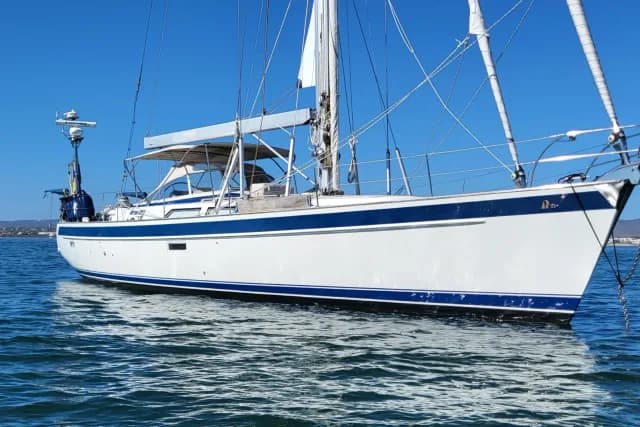
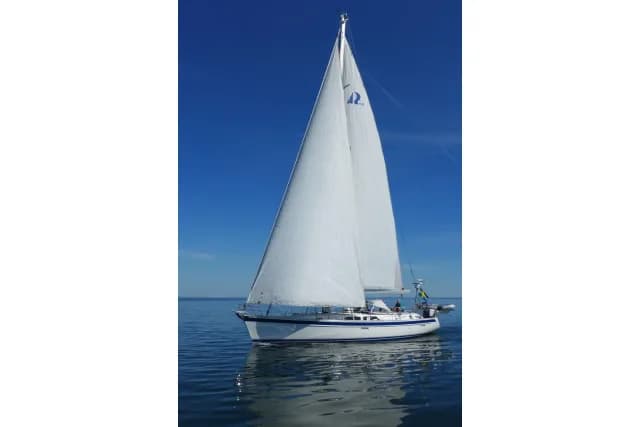
The Hallberg-Rassy 55 is a centre-cockpit bluewater cruiser designed by Germán Frers and built by Hallberg-Rassy at its yard in Ellös, on the Swedish island of Orust. It replaced the Hallberg-Rassy 54, and the builder records that it was built from 2012 to 2017, in nine units. A YACHT magazine preview, republished by boats.com in September 2012, reported that the boat would be shown for the first time at the Boot Düsseldorf show in January 2013, and Yachting Swissboat, testing it later that year, reported the Düsseldorf premiere and that hull number five was then being completed.
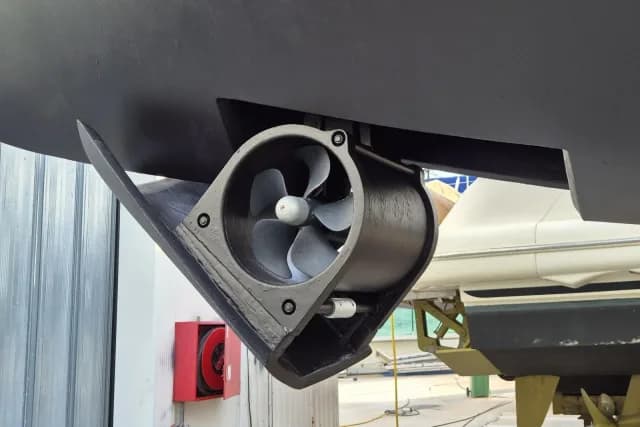
The 55 is an evolution of the 54 rather than a new hull. Hallberg-Rassy describes it as based on the 54 with numerous updates: an all-new deck with a cockpit 30 cm (1 ft) longer, a cleaner deck with flush hatches, a lower sheerline and transom aft, larger saloon portlights, four added hull portlights and a reworked rudder area with room for a stern thruster. Both YACHT and the builder link the new styling to the larger Hallberg-Rassy 64. Yachting Swissboat reported that the changes came from the yard’s head, Magnus Rassy, after five years of regular sailing on a 54.
The name needs care. Hallberg-Rassy has built several large Frers designs with similar numbers, and the 55 is not the 54 it replaced, which the builder says was built in 44 units from 2006 to 2012, nor the later HR 57, a different design with twin wheels and twin rudders. In February 2014 the 55 was named Sweden’s Sailboat of the Year 2014 (Årets Segelbåt) in the large-boat/luxury class, at the Göteborg boat show, and it was one of five nominees in the luxury cruiser category of the European Yacht of the Year 2014, which was won by the Contest 42 CS.
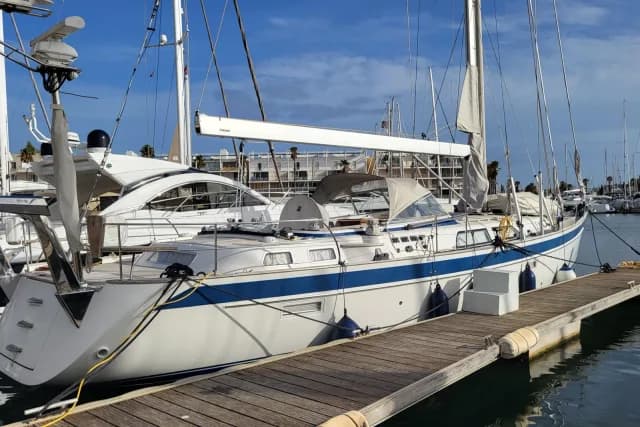
Hulls.io currently tracks 1 active listing for the Hallberg-Rassy 55. Among them is a 2013 Hallberg-Rassy 55 listed in Lagos, Portugal.
Showing 1–1 of 1 results
Hallberg-Rassy 55 Specifications
Figures from Hallberg-Rassy’s data sheet for the 55 and its January 2013 standard specification. The two builder documents give the same dimensions, except that the January 2013 specification swaps the two beam labels (we follow the data sheet: 4.73 m with the rubbing strake) and gives different sail areas: 151.3 m² with a 100% jib and 175.5 m² with the genoa, figures Yachting Swissboat also used in its test, while the data sheet on the builder’s website gives 156.9 m² and 181.3 m² — the same figures it lists for the HR 54.
| Hull length | 16.68 m (54 ft 9 in) |
|---|---|
| Waterline at rest | 14.30 m (46 ft 11 in) |
| Beam | 4.73 m (15 ft 6 in) with rubbing strake; 4.69 m (15 ft 5 in) without |
| Draft (standard keel) | 2.30 m (7 ft 6½ in), empty standard boat |
| Draft (shallow keel option) | About 2.00 m (6 ft 7 in): the builder gives it as 30 cm less than standard |
| Displacement | 26.3 t (approx. 58,000 lb), empty standard boat |
| Lead keel | 9.75 t (21,500 lb), on a deep bilge |
| Sail area | 151.3 m² (1,629 sq ft) with 100% jib; 175.5 m² (1,889 sq ft) with genoa (builder’s January 2013 specification) |
| Air draft | 24.50 m (80 ft 5 in), excluding Windex |
| Engine | Volvo Penta D4-180, 132 kW (180 hp), 3.7 litres, 500 Nm |
| Fuel capacity | 900 litres (238 US gal) |
| Water capacity | 1,050 litres (277 US gal) |
| Holding tanks | 2 × 80 litres |
| Accommodation (standard) | 3 cabins, 2 heads, each with a separate shower |
| CE category | A (unlimited ocean voyages) |
| Designer | Germán Frers |
| Builder | Hallberg-Rassy Varvs AB, Ellös, Sweden |
| Built | 2012–2017, 9 units (builder) |
| Predecessor | Hallberg-Rassy 54 (2006–2012) |
Design and Accommodation
Hull, deck and rig
Robert Perry, reviewing the design for SAILING magazine, put its displacement-to-length ratio at 250, its length-to-beam ratio at 3.53 and its sail-area-to-displacement ratio at 20.18. He singled out the bow overhang, which carries the ground tackle without a bowsprit, and the 21,500 lb of lead ballast. The hull is hand-laid GRP, insulated with Divinycell closed-cell PVC foam except in the keel area and high-load areas, which are solid laminate; the lead keel and bulb are bolted on with seventeen 30 mm stainless bolts, and the deck, coachroof and cockpit are of sandwich construction with a teak deck. A shallow-draft keel, 30 cm shallower, was available, though Magnus Rassy told marina.ch he regarded the standard deep keel as the better solution.
The Seldén rig has triple spreaders swept back only three degrees. YACHT reported that the shrouds are led down past the coachroof to structure in the bilge, so the boat can carry a large overlapping genoa of around 140%. The standard specification includes a removable cutter stay and runners stowed at the mast, and the builder lists a jumpstay as an option for use with a permanent hydraulic cutter stay. As standard the mainsail is a battened Dacron sail with two reefs; the test boats sailed by Yachting Swissboat and marina.ch had Elvström’s in-mast “Fat Furl” mainsail, which marina.ch reported Elvström had developed with Hallberg-Rassy.
Cockpit and push-button handling
The centre cockpit is 30 cm longer than the 54’s, with Hallberg-Rassy’s windscreen forward and the helm position raised slightly, as on the 64; the steering pedestal has room for a 14-inch plotter. The sliding companionway hatch no longer needs a garage. The standard specification includes electric self-tailing genoa sheet winches and Lewmar rod steering. Much of the push-button handling that testers described is not in that standard specification: YACHT listed an optional automated system that tacks the boat at the press of a button, which it said had already proved effective on the HR 412, and a joystick docking system using bow and stern thrusters. On the boats tested by Yachting Swissboat and marina.ch, the furling main and genoa, outhaul, vang and backstay were all operated from a console at the helm, with the furlers and outhaul hydraulic, marina.ch reported.
Interior
Perry described three interior layouts, all with three cabins, which differ in the berths: aft, the owner’s cabin can have a centreline double or two separate berths; forward, the bow can take V-berth singles or a single crew berth, and in the crew-berth version, Perry noted, a toilet can be squeezed in forward. The builder’s standard specification has a starboard cabin with either a double or two berths on different levels, the galley to starboard, two saloon sofas and two separate berths aft, with two saloon armchairs, a queen-size centre berth aft, a walk-through galley to port and a skipper’s cabin forward among the options. The interior is on one level throughout. The two standard heads both have separate shower stalls, and the aft head is the one fitted to the 64. Standard joinery is light mahogany, and the builder gives the saloon headroom as 2.02 m. The walk-in engine room has its own door and, the builder says, houses the main engine, generator, heaters and pumps.
Under Sail and Power
marina.ch sailed the 55 off Ellös in a southerly of 15 knots and reached 8 knots of boat speed without difficulty, finding the boat responsive to small movements of the wheel with precise, direct feedback through the rod steering. Its verdict was that the boat, at close to 30 tonnes, picks up speed quickly even in light wind and is soon making 7 to 8 knots as the breeze builds. Yachting Swissboat, also off Ellös with Magnus Rassy aboard, reached along the Bohuslän coast at 7 knots over the ground in 14 knots of apparent wind under the 89.1 m² Fat Furl mainsail and a 138 m² Code Zero.
Under power, Hallberg-Rassy and Yachting Swissboat both give 8 knots at 1,400 rpm from the Volvo Penta D4-180, helped by the optional three-bladed Gori folding propeller with overdrive; a fixed three-bladed propeller is standard. At that speed Yachting Swissboat measured 65 dB(A) in the saloon and 71 dB(A) in the aft cabin. The builder’s standard specification gives a calm-water range of about 1,600 nautical miles on the 900 litres of diesel at 1,300 rpm and 7.2 knots, with the Gori overdrive propeller fitted.
How It Compares
Hallberg-Rassy 54. The predecessor, built in 44 units from 2006 to 2012. By the builder’s figures it shares the 55’s waterline, displacement, keel weight and engine, with a hull length of 16.74 m. The 55 adds the longer cockpit, the new deck and coachroof, the hull portlights and the room for a stern thruster. YACHT reported that the interior layout carried over from the 54.
Hallberg-Rassy 64. The larger yacht, which Hallberg-Rassy called its new flagship of 2011, that shaped the 55’s styling and which Yachting Swissboat reported had its world premiere at Düsseldorf in 2011. By the builder’s figures it is 19.85 m on the hull and 5.17 m wide, with a displacement of 36 tonnes and a 300 hp Volvo Penta D6-300, against the 55’s 16.68 m, 4.73 m, 26.3 tonnes and 180 hp.
Hallberg-Rassy 57. Hallberg-Rassy’s next design in this size, announced by YACHT in February 2018 for a world premiere at the yard’s open days in Ellös that August. Also by Frers, it is a different concept: Cruising World describes a plumb bow, twin rudders and beam carried aft, and YACHT reported it as the yard’s first true centre-cockpit yacht with two wheels. The builder gives its hull length as 17.44 m.
Buying a Used Hallberg-Rassy 55
With only nine built, a 55 rarely comes up for sale, and boats can differ considerably: much of the equipment that defines the model on test — the in-mast mainsail, hydraulic furling, the push-button tacking system, the folding propeller — is not in the builder’s standard specification. The first job is to establish exactly how a given boat was specified at build and what has been added since.
What to check
- Keel: the standard 2.30 m deep keel or the 30 cm shallower option.
- Mainsail and furling: a standard battened slab-reefing main, or an in-mast furling main, and whether the furlers, vang and backstay are hydraulic.
- Hydraulic systems: service history of the pump, rams and hoses for any hydraulic furlers and controls.
- Thrusters: whether bow and stern thrusters are both fitted, and their condition.
- Rig: whether a permanent cutter stay and jumpstay are fitted, or the standard removable cutter stay and runners, and the date of the last rig inspection.
- Propeller: the standard fixed three-blade or the optional Gori folding propeller.
- Layout: aft-cabin berth arrangement, galley position and the forward cabin version.
- Engine, generator and heating: hours and service records for everything in the walk-in engine room.
- Teak deck: condition and remaining thickness, as with any teak-decked boat of this age.
- A full out-of-water survey, including the keel bolts and the rudder bearings.
Asking prices depend heavily on year, specification, equipment and condition. The listings on this page show what sellers are asking today. Browse every Hallberg-Rassy yacht for sale.