


Hinckley Sou'wester 42 for Sale
Semi-Custom Cruising SailboatThe Hinckley Sou’wester 42 is one of the finest semi-custom cruising sailboats ever built in the United States. Designed by McCurdy & Rhodes and produced from 1982 to 2006 at Hinckley’s Southwest Harbor, Maine boatyard, approximately 46 hulls were completed — each built to individual owner specification. The successor to the legendary Bermuda 40 (203 hulls, 1960–1991), the Sou’wester 42 combines hand-fitted Honduran mahogany joinery, exceptional offshore stability (capsize screening formula 1.74), and multiple rig and keel options. MkI (1982–c.1994) and MkII (1995–2006) variants differ significantly in construction method and specification.
Show 2 awards
Show 6 key features
Updated 10 June 2026 · By Hulls.io Editorial
The Hinckley Sou’wester 42: A Complete Guide
The Hinckley Sou’wester 42 is one of the finest semi-custom cruising sailboats ever built in the United States. Produced from 1982 to 2006 at Hinckley’s boatyard in Southwest Harbor, Maine, approximately 46 hulls were completed — each built to individual owner specification in a process that sits somewhere between bespoke craftsmanship and limited production. The boat replaced the legendary Bermuda 40 (203 hulls, 1960–1991), which had established Hinckley’s reputation as the builder of America’s most distinguished fibreglass sailing yachts. No two Sou’wester 42s are exactly alike: keel configurations, rig types, engine choices, and interior layouts were tailored to each owner’s cruising plans.
The design was drawn by McCurdy & Rhodes, the New York naval architecture firm founded by James A. McCurdy and Philip “Bodie” H. Rhodes (son of the legendary designer Philip L. Rhodes). Jim McCurdy was deeply involved in the Society of Naval Architects and Marine Engineers’ research on safety from capsizing — work that directly informed the Sou’wester 42’s exceptional stability characteristics. The capsize screening formula of 1.74 (well below the 2.0 threshold for offshore sailing) and a comfort ratio of 36.99 confirm a hull designed, first and foremost, to keep its crew safe and comfortable in the worst conditions the ocean can deliver.
The Hinckley Company was founded in 1928 by Benjamin B. Hinckley. His son Henry R. Hinckley, a Cornell engineering graduate, took control in 1932 and built his first boat —Ruthyeolyn, a 36-foot fisherman — the following year. After the war, the yard shifted to pleasure craft, building the original Sou’wester 34 (62 boats by the early 1950s, making it the largest fleet of single-design cruising boats of its time). In 1958, Hinckley began experimenting with fibreglass, and by 1960 had launched the Bermuda 40 — the boat that defined the brand. The Sou’wester 42 continued that lineage, combining traditional craftsmanship with evolving construction technology.
The production run divides into two distinct eras. The MkI (1982–c.1994) used hand-laid polyester resin with Airex foam core. The MkII (1995–2006) adopted SCRIMP (Seemann Composites Resin Infusion Molding Process) with vinylester resin, carbon fibre, Kevlar, and E-glass in a vacuum-infused sandwich layup — Hinckley was a pioneer of SCRIMP in the yacht industry, adopting the technology in 1994. The MkII also introduced a revised deck mould, spade rudder option, improved cockpit and interior layout, carbon rigs, electric LeisureFurl booms, power winches, and retractable bow thrusters. Later boats were sometimes referred to as the Sou’wester 43, reflecting a slight increase in overall length due to transom modifications.
Hulls.io currently tracks 1 active listings for the Hinckley Sou’wester 42. With 0 tracked listings in our market intelligence database, the Sou’wester 42 is a rare and thinly traded model — consistent with a semi-custom yacht of which fewer than 50 were built. When examples do appear on the brokerage market, they tend to sell to knowledgeable buyers who understand the Hinckley premium and the long-term value these boats represent.
Showing 1–1 of 1 results
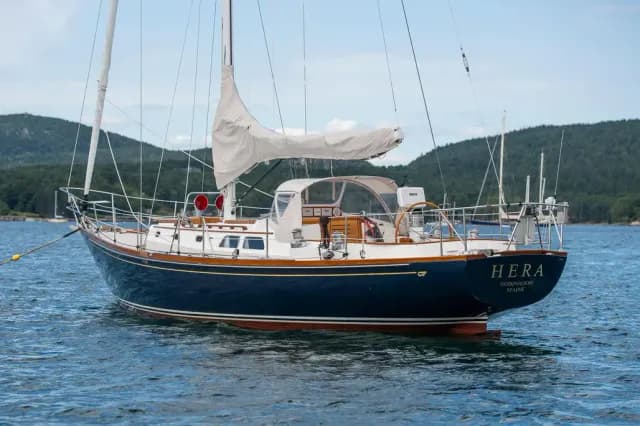
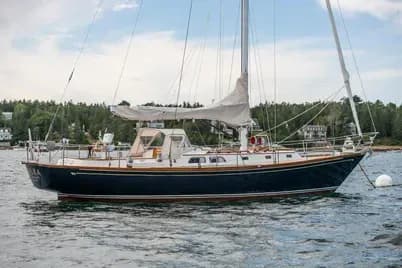
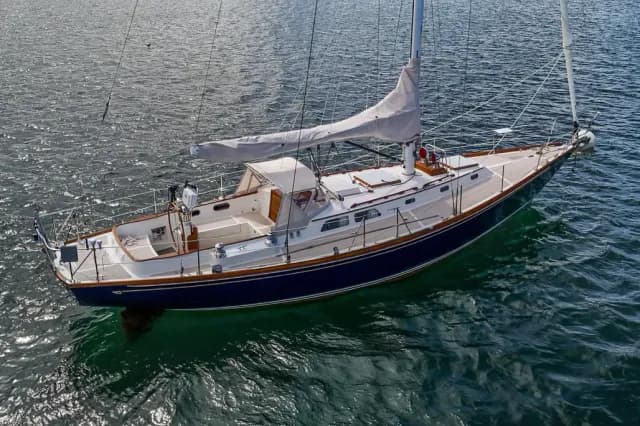
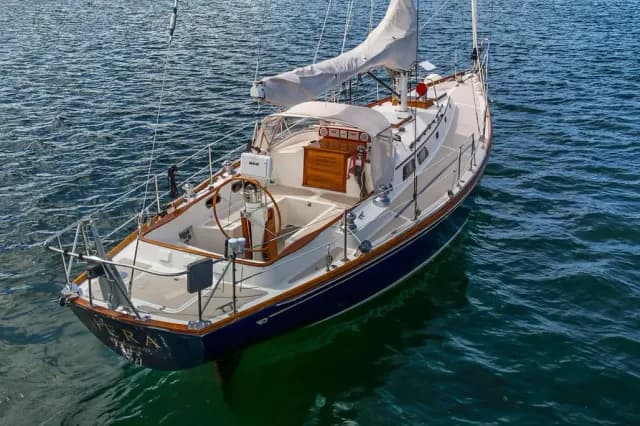
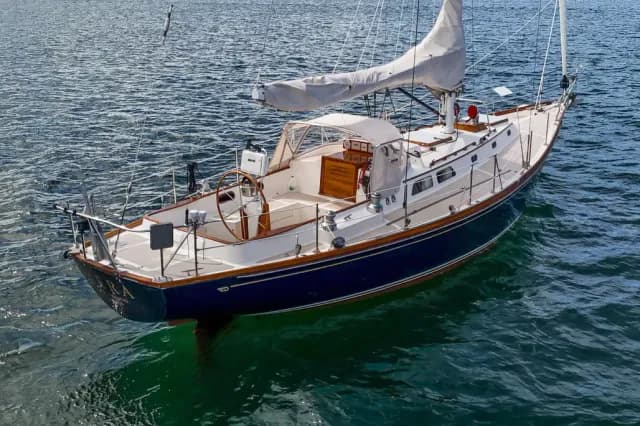
Hera - Hinckley Sou'wester 42
Hinckley Sou’wester 42 Specifications
| Specification | Detail |
|---|---|
| LOA | 42 ft 9 in (13.03 m) |
| LWL | 31 ft 3 in (9.53 m) |
| Beam | 12 ft 6 in (3.81 m) |
| Draft (standard fin) | 7 ft 0 in (2.13 m) |
| Draft (shoal / centreboard up) | 5 ft 0 in (1.52 m) |
| Light displacement | 24,000 lbs (10,886 kg) |
| Ballast | 8,500 lbs (3,856 kg) |
| Ballast ratio | 35.4% |
| Mainsail area | 343 sq ft (31.8 m²) |
| Foretriangle / jib area | 475 sq ft (44.1 m²) |
| Total upwind sail area | 817 sq ft (75.9 m²) |
| Mast height | 47.2 ft (14.4 m) |
| SA/D ratio | 15.77 |
| D/L ratio | 351 |
| Comfort ratio | 36.99 |
| Capsize screening formula | 1.74 |
| Engines (early) | Westerbeke M-52 or 4-108, 52 HP |
| Engines (later) | Yanmar 4JH2E 48 HP / 4JH2-DE 88 HP |
| Fuel capacity | 55–60 US gal (208–227 litres) |
| Water capacity | 150–160 US gal (568–605 litres) |
| Hull material | GRP with Airex foam core (MkI polyester; MkII SCRIMP vinylester with carbon, Kevlar, E-glass) |
| Rig options | Masthead sloop, cutter, or yawl |
| Keel options | Fin with skeg-hung rudder, spade rudder (MkII), centreboard |
| Naval architecture | McCurdy & Rhodes, New York |
| Builder | The Hinckley Company, Southwest Harbor, Maine |
| Production years | 1982–2006 (MkI: 1982–c.1994; MkII: 1995–2006) |
| Hulls built | ≈46 |
| Headroom | 6 ft 2 in (1.88 m) |
| Hull speed | 7.49 knots |
These numbers describe a heavy-displacement cruising yacht built for offshore work. The D/L ratio of 351 places the Sou’wester firmly in the heavy-displacement category — this is a boat that carries its weight deep and low, prioritising stability and seakeeping over speed. The ballast ratio of 35.4% is high, reflecting McCurdy & Rhodes’ emphasis on righting moment and ultimate stability. The capsize screening formula of 1.74 is exceptionally low for a 42-footer (anything below 2.0 is considered safe for offshore sailing), confirming the design’s pedigree in heavy weather. The generous water capacity of 150–160 US gallons is notably higher than most boats in this size range and supports extended cruising without frequent dock visits. Multiple keel configurations were offered — buyers should understand which option their prospective boat carries, as it fundamentally affects draft, sailing characteristics, and suitable cruising grounds.
How Does the Hinckley Sou’wester 42 Sail?
Upwind: This is where the Sou’wester 42 is at its very best. The combination of relatively narrow beam (12 ft 6 in for a 42-footer), low-positioned lead ballast, and a tall masthead rig creates a boat that points well and powers through a chop with authority. The fin keel with skeg-hung rudder provides excellent tracking, and the boat balances beautifully on the helm. The trade-off is the pointy bow and relatively low freeboard, which produce wet rides in short, steep seas — expect spray over the bow when driving hard to weather. In 15–20 knots of true wind, owners consistently report confident, comfortable upwind work that belies the boat’s 24,000 lb displacement.
Reaching: The 817 sq ft of total upwind sail area drives the Sou’wester well on a reach. The SA/D ratio of 15.77 is moderate — this is not a fast boat by modern standards, but it moves purposefully and tracks true. The yawl-rigged versions are particularly praised for their downwind and reaching stability, and owners fly asymmetric spinnakers and staysails to good effect. In sustained breeze, the boat’s heavy displacement keeps it pushing through waves rather than hobby-horsing, which is both comfortable and efficient over long distances.
Light air: Below 8–10 knots of true wind, the 24,000 lb displacement makes itself felt. The SA/D ratio, whilst adequate, does not give the Sou’wester the power to ghost along in drifting conditions. A 135% roller-furling genoa helps, and a Code 0 is a worthwhile addition for light-air cruising grounds. The boat really comes alive above 12 knots of true wind — in those conditions, the heavy displacement transitions from a liability to an asset, providing momentum and stability that lighter boats cannot match.
Under power: Engine options varied across the production run. Earlier boats typically carry a Westerbeke M-52 or 4-108 (52 HP); later MkII boats were often fitted with Yanmar 4JH2E (48 HP) or 4JH2-DE (88 HP) units. The 52 HP options are adequate for calm conditions and harbour manoeuvring, but owners who regularly face adverse weather or tidal conditions strongly favour the larger engine options. A three-blade feathering Max-Prop is a common and worthwhile upgrade. The heavy displacement means the boat carries momentum well under power, making close-quarters work manageable despite the relatively modest horsepower.
Heavy weather: This is the Sou’wester 42’s defining strength. Owners report handling 40+ knot conditions double-handed without feeling unsafe. Jim McCurdy’s capsizing research is directly reflected in the hull form: the boat is remarkably settled in a seaway, with a motion that keeps the crew below unaware of deteriorating conditions on deck. One long-term owner describes the experience simply: “Anyone below will have no idea at all that it’s shitty outside. These things define solid and quiet.” The Sou’wester 42 has crossed the Atlantic, cruised north of the Arctic Circle, and sailed extensively throughout the Baltic, Northern Europe, and the Caribbean — credentials that speak for themselves.
Interior Layout & Living Aboard
The interior of the Sou’wester 42 is finished in satin-varnished Honduran mahogany (earlier boats used ash; later boats offered cherry as an alternative), with a gloss-varnished solid teak-and-holly cabin sole throughout. Hinckley essentially builds a wooden boat inside a fibreglass hull — there is no visible raw fibreglass anywhere in the interior. Headroom is 6 ft 2 in throughout. The level of joinery is extraordinary: every surface is hand-fitted, every edge is finished, every detail reflects the work of craftsmen who build individual boats rather than production units. It is this interior quality, more than any other single factor, that distinguishes a Hinckley from every production alternative.
Forward cabin: A V-berth measuring 6 ft 3 in long by 6 ft 8 in wide at the aft end, with a hanging locker and storage. Private but accessed through the main head compartment, which acts as a passage between the forward cabin and the salon.
Head: One full head compartment, centrally located and accessible from both the forward cabin and the main salon. Features include an electric-flush Tecma head, stainless-steel sink, shower with hose, and holding tank. The single-head arrangement is a concession to the 42 ft hull length — it works well for a cruising couple but is a limitation when hosting guests.
Main salon: The full-width amidships cabin is the social heart of the boat. To port, a U-shaped dinette with a custom Hinckley drop-leaf table (two folding leaves) that converts to a 6 ft 6 in single berth with lee cloth. To starboard, a settee with pilot berth outboard. A partial bulkhead with cherry-wood cap rail and built-in handhold separates the salon from the galley — open enough to maintain the social connection, closed enough to brace against in a seaway.
Galley: Located to port at the base of the companionway steps — the ideal position for sea cooking, with easy access from the cockpit. A U-shaped design with double stainless-steel sink, three-burner propane stove and oven, refrigeration accessible through countertop hatches (separate refrigerator and freezer compartments), dome lights, and a 12V fan. The galley is compact but exceptionally well-designed for its purpose: serious offshore cooking in comfort and safety.
Navigation station and quarter berth: To starboard at the companionway base. A proper chart table (32 in × 28 in) with full navigation electronics, and a walk-in aft quarter berth (6 ft 6 in × 24 in) that doubles as the navigator’s sea berth. For liveaboard use, the Sou’wester 42 is capable but compact. The 150–160 gallon water capacity is generous for the size. Storage is adequate for extended cruising. The boat was designed for serious offshore passages — it prioritises seaworthiness and sailing performance over interior volume. Owners who want a floating apartment should look elsewhere; those who want a boat that will take them anywhere safely will find the Sou’wester 42 entirely sufficient.
Hinckley Sou’wester 42 Ownership: What to Expect
Owning a Hinckley is a materially different proposition from owning a production sailboat. The build quality is exceptional, which reduces the frequency of catastrophic surprises, but the semi-custom construction and premium materials demand specialist maintenance. The single largest recurring expense — and the one that catches new Hinckley owners off guard — is exterior brightwork. The principal cost areas are as follows:
- Insurance: 0.8–1.2% of hull value. For a boat insured at $250,000–$400,000, this translates to approximately $2,000–$5,000 per year. Bluewater coverage and Caribbean hurricane-season endorsements sit at the upper end.
- Marina or mooring: New England marinas charge $50–$80 per foot per month during the sailing season, translating to approximately $6,000–$15,000 per year depending on location. A mooring is significantly cheaper where available.
- Exterior brightwork (varnish): This is the Hinckley-specific cost that defines the ownership experience. The teak toe rail, handrails, hatch coamings, dorade boxes, and other exterior woodwork require regular professional maintenance. Owners in sunny climates (California, Caribbean) report $12,000–$15,000 per year for professional varnish maintenance alone. New England owners typically spend $8,000–$12,000.
- Haul-out and bottom paint: $3,000–$6,000 including travel lift, pressure wash, antifouling, anode replacement, and hull inspection.
- General maintenance and repairs: $5,000–$15,000 depending on the boat’s age and condition. The systems are well-built and reliable, but on a boat now 20–44 years old, ongoing maintenance is a fact of life.
- Winter storage (New England): $2,000–$5,000 for indoor heated storage, shrink-wrap, and decommissioning.
- Approximate total: $30,000–$65,000 per year. One long-term owner frames this as “1–2% of new replacement cost,” noting it is “less money than the depreciation of a 45-foot production boat.”
The Hinckley premium is not limited to acquisition cost — it extends into every aspect of ownership. However, Hinckley owners consistently argue that the total cost of ownership, when viewed over a 10–20 year horizon, compares favourably to production alternatives because the boat’s resale value holds firm and the core structure requires less invasive (and expensive) work. A well-maintained Sou’wester 42 from the 1980s still commands $200,000+ — a level of value retention that few production yachts of the same era can match.
A critical advantage of Hinckley ownership is factory support. The Hinckley Company retains construction plans from every boat it has built and actively supports owners through its service network and brokerage division. This level of manufacturer engagement — decades after the boat was built — is virtually unique in the sailing world and represents a tangible, ongoing benefit of the Hinckley premium.
How to Buy a Hinckley Sou’wester 42: What to Look For
Two generations, distinct construction: The most important distinction for buyers is between MkI (1982–c.1994) and MkII (1995–2006) boats. The MkI uses hand-laid polyester resin with Airex foam core; the MkII uses SCRIMP vinylester resin with carbon fibre, Kevlar, and E-glass. The MkII laminate is generally considered superior in consistency and strength. MkII boats also feature a revised deck mould, improved cockpit layout, and optional spade rudder. On the used market, MkI boats trade at $150,000–$260,000 while MkII examples command $275,000–$450,000+.
Known Issues to Inspect
- Laminate integrity (MkI boats): Some early polyester-resin boats exhibited dry laminate issues in the hand-laid construction. Hinckley corrected these under warranty when reported. Inspect the hull laminate carefully with moisture metres and tap tests, paying particular attention to areas below the waterline and around through-hull fittings.
- Exterior brightwork condition: The forward cabin trunk receives significant sun exposure and is the first area where varnish fails. If neglected, the wood underneath can suffer permanent damage. Inspect all exterior teak carefully — look for soft spots, greying, lifted varnish, and evidence of water penetration beneath the finish. The cost of restoring neglected brightwork can be $20,000–$30,000.
- Keel and rudder configuration: Because these were semi-custom boats, keel and rudder configurations vary significantly. Some have skeg-hung rudders, others have spade rudders (MkII). Some have fin keels, others have centreboards. Each configuration must be understood on its own merits and inspected accordingly. Ensure the surveyor knows exactly which configuration the boat carries.
- Through-hull fittings and seacocks: On boats now 20–44 years old, all bronze through-hulls and seacocks must be inspected for dezincification and corrosion. Replacement of substandard fittings should be budgeted.
- Rigging: Rod rigging (common on these boats) has a finite lifespan of approximately 15–20 years. If the boat has original or ageing rod rigging, plan for replacement at $15,000–$25,000+. Check chainplates for crevice corrosion — a critical inspection point on any boat of this vintage.
- Engine condition: Westerbeke 4-108 and M-52 engines are generally reliable but parts availability can vary for older units. Yanmar engines (MkII boats) tend to have better long-term parts support. Check engine hours, cooling system condition, raw water pump, and exhaust system thoroughly.
Equipment That Adds Value
When assessing a used Sou’wester 42, the following additions represent genuine added value: recently replaced standing rigging, new or recent sails, upgraded electronics (chartplotter, radar, AIS), feathering propeller (Max-Prop), watermaker, inverter, lithium battery conversion, recently completed brightwork, bow thruster (MkII), and a well-documented maintenance history. A boat with a complete Hinckley service record — particularly one that has been maintained through the Hinckley service network — commands a significant premium over one with gaps in its provenance.
Using the Hinckley Network
Hinckley operates its own brokerage division, and many Sou’wester 42s change hands through this channel. Buying through Hinckley Brokerage provides access to factory records, construction details, and a level of provenance documentation that no independent broker can match. The company’s service yards in Southwest Harbor, Portsmouth, and other locations along the US East Coast can also perform pre-purchase inspections and advise on the condition and history of specific boats.
Commissioning a Survey
A survey of the Sou’wester 42 should include a full hull and structural inspection (out of water), moisture metre readings across the entire hull, a keel bolt and rudder bearing assessment, a rigging inspection by a qualified rigger, an engine and systems survey, and a sea trial covering all points of sail. The surveyor should have specific experience with composite construction and, ideally, familiarity with Hinckley builds. Budget $3,000–$5,000 for a comprehensive survey of a boat of this calibre — the cost of undetected problems on a Hinckley far exceeds the survey fee.
Hinckley Sou’wester 42 vs Competitors
The Sou’wester 42 occupies a rarefied segment of the cruising sailboat market: American semi-custom yachts built to the highest standards of craftsmanship and designed for serious offshore sailing. The competition is a small group of builders who share a commitment to quality over volume, each with a distinctive design philosophy and loyal following.
Hinckley Sou’wester 42 vs Sabre 42
The Sabre 42 (officially the Sabre 426, designed by Jim Taylor, 2003–2012) is the Sou’wester’s most direct competitor: another Maine-built cruising yacht of exceptional quality. At around 24,000 lbs the Sabre carries similar weight to the Hinckley, but a longer waterline and a far lower displacement-to-length ratio (225 vs 351) give it a livelier, more easily driven feel in light air. The Sabre’s interior is bathed in natural light from four large fixed ports, twelve opening ports, eight hatches, and four dorade vents — a distinctive and appealing approach to below-decks ambience. Build quality is superb, described by one surveyor as “halfway between products and works of art.” On the used market, Sabre 42s typically trade at 20–30% below comparable Hinckley examples. For the buyer who wants Maine-built quality with slightly better light-air performance and at a lower price point, the Sabre merits serious consideration. The deep-draft version (6 ft 11 in) draws slightly less than the Hinckley’s 7 ft standard keel.
Hinckley Sou’wester 42 vs Morris 42
Morris Yachts, also based in Maine (Trenton and Bass Harbor), produces the Ocean Series 42 to a standard that directly rivals Hinckley’s own. Designed by Chuck Paine, the Morris 42 won Cruising World Boat of the Year in 2005. At 19,400 lbs, it is significantly lighter than the Sou’wester, creating a fundamentally different sailing character — quicker, more responsive, and more forgiving in light conditions. Interior fit and finish in cherry or teak are comparable to Hinckley. The Morris is more of a coastal and Caribbean cruiser than a heavy-weather offshore passagemaker, and its lighter displacement means a different motion in a seaway. For the buyer who values agility and all-round sailing performance over outright offshore capability, the Morris 42 is the natural alternative from the same boatbuilding tradition. Used prices are generally lower than Hinckley equivalents.
Hinckley Sou’wester 42 vs Tartan 4400
The Tartan 4400 represents the modern performance cruiser alternative. Designed by Tim Jackett and produced from 2002 in Fairport Harbor, Ohio, it features a standard carbon fibre mast, epoxy-resin vacuum-bagged construction, and a much wider beam of 14 ft 1 in (vs the Hinckley’s 12 ft 6 in). The wider beam creates significantly more interior volume — two staterooms and two heads versus the Hinckley’s single head arrangement. The Tartan is a lighter, more modern boat with a lower D/L ratio (203 vs 351) that sails with more verve in all conditions. What it lacks is the Hinckley cachet, the semi-custom build process, and the hand-fitted joinery that defines the Sou’wester ownership experience. For the buyer who prioritises modern performance, interior volume, and a second head over heritage and bespoke craftsmanship, the Tartan 4400 is a compelling alternative at a substantially lower price.
Hinckley Sou’wester 42 vs Hylas 44
Designed by the renowned German Frers and built by Queen Long Marine in Taiwan (1985–1993), the Hylas 44 is a centre-cockpit cruiser that offers a fundamentally different layout with a true aft cabin providing genuine guest privacy. The Hylas is an excellent upwind boat — close-winded for a cruiser — though it shares the Sou’wester’s tendency toward wet rides due to its sharp entry. At 22,320 lbs with a 49% ballast ratio, the Hylas is well-ballasted and stable offshore. On the used market, the Hylas 44 typically trades at $100,000–$200,000 — significantly less than the Hinckley — reflecting both the Taiwanese build and the absence of the Hinckley brand premium. For the buyer who needs aft-cabin privacy and wants bluewater capability at a fraction of the Hinckley price, the Hylas 44 is worth investigating.
Hinckley Sou’wester 42 vs Pacific Seacraft 44
The Pacific Seacraft 44 is the pure bluewater passagemaker in this comparison. Built in Washington, North Carolina, the PSC 44 features a traditional canoe stern, cutter rig, and semi-long keel — a conservative, proven approach to offshore yacht design. At 27,500 lbs, it is even heavier than the Sou’wester, with a Scheel shallow-draft keel option that opens up cruising grounds the Hinckley’s standard 7 ft draft cannot access. The PSC has a devoted following amongst circumnavigators and serious offshore sailors. Interior joinery is high quality but does not match Hinckley’s bespoke fit and finish. For the buyer whose primary mission is circumnavigation or extended offshore cruising, and who values a proven full-keel hull form above all else, the Pacific Seacraft 44 is the purposeful choice. Used prices are generally lower than Hinckley equivalents, making it an attractive option for buyers who want offshore capability without the Hinckley premium.
For a full interactive depreciation comparison between the Hinckley Sou’wester 42 and competing models, visit the Hulls.io Market Intelligence tool.