

Jeanneau Sun Odyssey 440 Buyer’s Guide
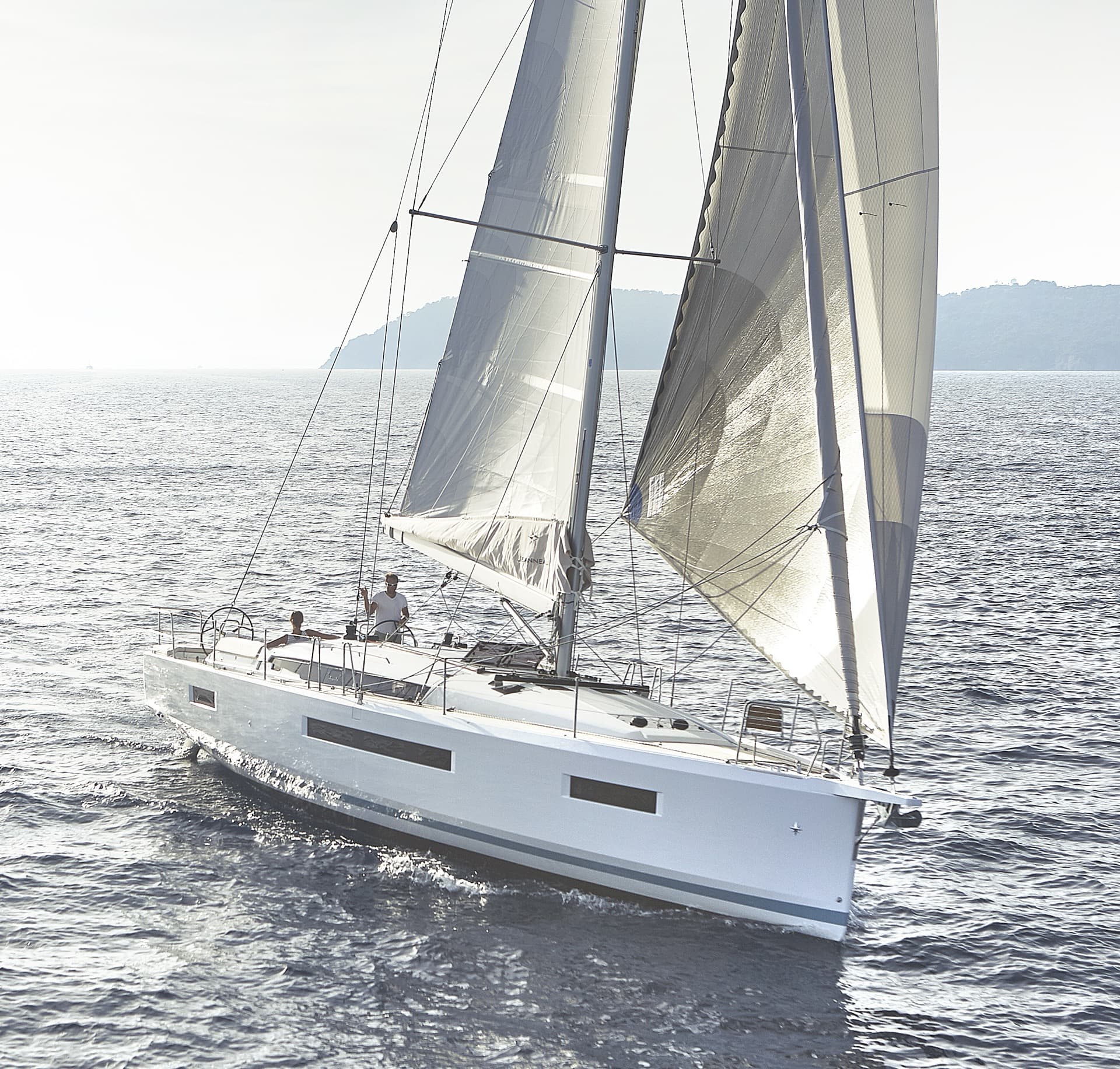
Cruising MonohullOptimised for offshore sailing with massive charter fleet presence. The Sun Odyssey 440 offers excellent ventilation and livability thanks to its innovative deck layout, making it one of the most popular charter-to-buy models in the Mediterranean.
Show 5 awards
Show 5 key features
Updated 10 June 2026 · By Hulls.io Editorial
The Jeanneau Sun Odyssey 440: A Complete Guide
The Jeanneau Sun Odyssey 440 is a 44-foot cruising monohull that marked a decisive turning point for the Sun Odyssey range. Introduced at the 2018 Cannes Yachting Festival, it was the first model in Jeanneau’s new-generation Sun Odyssey line — the range that replaced the long-running Philippe Briand–designed cruisers of the 2000s and early 2010s with a fundamentally rethought deck architecture. The headline innovation is the walk-around deck concept: flush, unobstructed side decks with low, folding bulwarks that eliminate the raised coachroof-to-toerail step found on virtually all production cruisers, creating a flat, beach-club-like environment at anchor and safer, more ergonomic passage forward under sail.
Philippe Briand drew the hull — a continuation of a partnership with Jeanneau that stretches back decades and has produced some of the most commercially successful cruising sailboat designs in history. Briand’s approach to the 440 emphasised hard chines aft for form stability, twin rudders for responsive steering, and a moderate displacement that prioritises sailing ability without sacrificing the load-carrying capacity a cruising couple or family demands. The interior was designed by Jean-Marc Piaton of the Jeanneau Design Studio, who brought a light, contemporary aesthetic with notably large hull windows and an emphasis on natural light that set a new standard for the brand.
Jeanneau’s history anchors the context. Founded in 1957 by Henri Jeanneau in Les Herbiers, in the Vendée region of western France, the company initially built small outboard-powered boats before expanding into sailing yachts in the 1960s. The Sun Odyssey line launched in 1990 and quickly became one of the best-selling production cruiser ranges in the world. In 1995, Jeanneau joined Groupe Beneteau — the global leader in leisure boating — gaining access to industrial-scale production resources, a worldwide dealer network, and shared platform engineering with sister brands including Beneteau, Lagoon, and Excess. The SO 440 benefits directly from this infrastructure: parts availability is excellent, dealer coverage spans virtually every cruising ground on earth, and production consistency is reinforced by Groupe Beneteau’s quality management systems.
The Sun Odyssey 440 occupies the heart of the European production monohull market — the 40–45-foot segment where couples and families choose their first serious offshore cruiser. It competes directly with the Beneteau Oceanis 46.1 (from the same Groupe Beneteau stable), the Hanse 460, the Bavaria C42, and the Dufour 470. Within that field, the SO 440 differentiates itself through the walk-around deck concept, the Briand chined hull, and a price point that positions it as strong value within the segment.
Hulls.io currently tracks 0 active listings for the Jeanneau Sun Odyssey 440, drawn from brokerages worldwide. With 60 tracked listings in our market intelligence database, the SO 440 benefits from deep pricing data — particularly useful given the high volume of ex-charter boats now entering the secondary market.
Jeanneau Sun Odyssey 440 Specifications
| Specification | Detail |
|---|---|
| LOA | 13.39 m (43 ft 11 in) |
| Hull length | 12.95 m (42 ft 6 in) |
| LWL | 12.64 m (41 ft 6 in) |
| Beam | 4.29 m (14 ft 1 in) |
| Draft (standard keel) | 2.15 m (7 ft 1 in) |
| Draft (shoal keel) | 1.75 m (5 ft 9 in) |
| Light displacement | ≈9,240 kg (20,370 lbs) |
| Ballast (standard) | ≈2,770 kg (6,107 lbs) |
| Ballast ratio | ≈30% |
| Fuel capacity | 200 litres (53 US gal) |
| Water capacity | 330 litres (87 US gal) |
| Engine (standard) | Yanmar 4JH45, 45 HP diesel |
| Engine (optional) | Yanmar 4JH57, 57 HP diesel |
| Drive | Saildrive |
| Mainsail area | ≈44 m² (474 sq ft) |
| Genoa area | ≈45 m² (484 sq ft) |
| Total upwind sail area | ≈89 m² (958 sq ft) |
| Berths | 6–8 (2- or 3-cabin versions) |
| Head compartments | 1 or 2 |
| Naval architecture | Philippe Briand |
| Interior design | Jean-Marc Piaton (Jeanneau Design Studio) |
| Builder | Jeanneau (Groupe Beneteau) |
| Build location | Les Herbiers, France |
| Hull construction | Hand-laid fibreglass, polyester resin |
| CE category | A (Ocean) |
| Year introduced | 2018 (Cannes Yachting Festival) |
The walk-around deck is the defining feature of the SO 440’s specification, and it deserves particular attention because it fundamentally changes how the boat is used. On a conventional production cruiser, the side decks are narrow passages bounded by a raised coachroof on one side and a toerail or lifeline stanchion on the other — functional for going forward but otherwise wasted space. On the SO 440, the deck is flush from gunwale to gunwale. The bulwarks fold down to create a flat, open platform at anchor, and fold up to provide a secure rail when sailing. The result is a boat that feels significantly larger on deck than its 44-foot length would suggest, and one that lends itself to a Mediterranean-style outdoor living experience that competitors in this size range cannot replicate without substantial custom work.
The Philippe Briand hull employs hard chines aft — angular transitions in the hull sections that widen the stern waterplane and generate form stability. This allows the designer to achieve adequate stability at a lower displacement and with less ballast than a purely round-bilged hull would require. The practical benefit is a lighter boat that accelerates more readily in light air and responds more quickly to the helm, while the chines add volume aft for the interior accommodation. Twin rudders, spaced well apart, provide excellent directional control and balanced feel on the helm, particularly on a reach and when heeled.
What makes the new-generation Sun Odyssey line distinctive is the coherence of the design concept. The walk-around deck, the chined hull, the folding transom, and the large hull windows are not independent features bolted onto a conventional platform — they are integrated elements of a single design philosophy that prioritises outdoor living, ease of movement, and natural light. The SO 440 was the first boat to express this philosophy, and it set the template for the SO 410, SO 380, and subsequent models in the range.
Performance & Sailing
The honest assessment: The Sun Odyssey 440 is a cruising sailboat. It is not a performance cruiser in the mould of a Dehler or a J/Boat, and Jeanneau does not market it as one. But within the production cruiser segment, the Briand hull delivers sailing qualities that are a clear step above many competitors. The combination of moderate displacement (approximately 9,240 kg light), hard chines for stability, and 89 m² of upwind sail area produces a boat that sails well enough to make the sailing itself enjoyable — not merely a means of getting from one anchorage to the next.
Upwind: In 12–15 knots of true wind, the SO 440 achieves approximately 6.0–6.5 knots close-hauled at 38–42 degrees true wind angle with the standard keel and a well-trimmed genoa. The twin rudders provide a balanced, communicative helm feel. In stronger conditions of 18–22 knots, the boat stiffens well under its 2,770 kg of ballast (30% ballast ratio) and maintains 7.0–7.5 knots with a reef in the main and partially furled genoa. The shoal keel option sacrifices approximately 3–5 degrees of pointing ability but opens up cruising grounds with limited depth — the Bahamas, the Chesapeake, and the Greek islands’ shallower anchorages.
Reaching and downwind: The SO 440 comes alive off the wind. In 14–18 knots of true wind on a beam reach, speeds of 7.5–8.5 knots are achievable. The chined hull provides inherent stability on a reach, reducing the rolling tendency that plagues round-bilged boats on this point of sail. With a Code 0 or asymmetric spinnaker deployed on the optional bowsprit, owners report sustained speeds of 8.0–9.0 knots on a broad reach in trade wind conditions — entirely respectable for a 44-foot cruiser.
Self-tacking jib option: Jeanneau offers an optional self-tacking jib on a curved track forward of the mast. This dramatically simplifies tacking for shorthanded crews, allowing the helm to tack without any sheet handling from the cockpit. The trade-off is a smaller headsail area, which reduces power in light air. Most privately owned SO 440s are specified with the standard furling genoa for maximum versatility; the self-tacking jib is more common on charter-spec boats where ease of handling is the priority.
Walk-around deck and sailing ergonomics: The flush deck design has practical sailing benefits beyond aesthetics. Going forward to handle sails, set an anchor, or manage ground tackle is easier and safer on the flat, unobstructed deck than on a conventional side deck. The low profile of the folding bulwarks also reduces windage — a minor but measurable advantage that contributes to the boat’s light-air ability. The cockpit is well-arranged for sail handling, with all halyards and control lines led to the twin helm stations.
Under power: The standard Yanmar 4JH45 (45 HP) provides adequate performance for harbour manoeuvring and calm-weather motorsailing, with a cruising speed of approximately 6.0–6.5 knots at 2,200 RPM. The optional Yanmar 4JH57 (57 HP) is a worthwhile upgrade that delivers noticeably better performance in headwinds and adverse conditions — most experienced buyers specify the 57 HP engine, and it commands a premium on the used market. The 200-litre fuel capacity provides an approximate motoring range of 350–450 nautical miles at economy cruise. An optional bow thruster simplifies marina handling and is strongly recommended for shorthanded crews.
Interior Layout & Design
Jean-Marc Piaton’s interior for the Sun Odyssey 440 set a new direction for the Jeanneau brand. The design language is lighter, more contemporary, and more visually connected to the sea than previous Sun Odyssey interiors. The large hull windows — notably taller and wider than those on the preceding generation — flood the saloon and cabins with natural light, creating an airy, open feel that belies the boat’s moderate beam. The overall aesthetic is Scandinavian-influenced: pale wood finishes, clean lines, and a restrained colour palette that feels modern without becoming dated.
The SO 440 is offered in two primary layouts: a 2-cabin owner’s version and a 3-cabin version. The 2-cabin layout dedicates the entire forward section to a master suite with an island double berth, access from both sides, a large en-suite head with separate shower stall, and generous hanging and stowage space. This is the preferred configuration for private cruising couples and commands a meaningful premium on the used market. The 3-cabin version splits the forward area into two cabins with a shared head, sacrificing the owner’s suite for additional berths — better suited to family sailing or charter use, where capacity takes priority over luxury. Both versions sleep six to eight in total.
The galley is positioned in an L-shape to port, equipped with a two-burner stove and oven, a top-loading refrigerator, a double stainless steel sink, and adequate counter space for meal preparation underway. The cook can brace effectively against the galley counters at sea — a practical consideration that matters on passage. The saloon features a settee arrangement to starboard with a dining table, comfortably seating four to six. Headroom throughout is approximately 1.98 m (6 ft 6 in) — adequate for most adults but slightly less than the 2.03–2.06 m found on wider-beamed competitors like the Beneteau Oceanis 46.1 and Hanse 460.
The innovative fold-down cockpit transom is one of the SO 440’s most distinctive features. When lowered, it creates a large swim platform and tender-launching area that integrates seamlessly with the cockpit. Combined with the fold-down bulwarks on the side decks, the boat at anchor becomes an open-air platform with a connection to the water that few production cruisers at this price point can match. The cockpit itself is deep, well-protected by the sprayhood or optional hardtop, and provides comfortable seating for socialising alongside the dual helm positions.
For extended cruising, stowage is the perennial concern on a 44-foot monohull. The SO 440 provides reasonable locker space under berths, behind settees, and in cockpit lockers, but it does not match the cavernous storage volume of wider-beamed competitors. Buyers planning long-term cruising should consider carefully whether the 330-litre water capacity and 200-litre fuel capacity are adequate for their intended cruising grounds — a watermaker and additional jerry cans are common additions for bluewater passages. The boat is a practical, liveable cruising platform for a couple or a small family, but it rewards disciplined provisioning and a willingness to prioritise essentials.
Sun Odyssey 440 Ownership: What to Expect
The SO 440 was positioned as a mid-market production cruiser, and its pricing reflects that positioning. New boats from the factory listed at approximately €250,000–€300,000 ex-VAT in base-to-mid specification, with a fully loaded example (teak cockpit, bow thruster, electric winches, Code 0, upgraded electronics, generator, air conditioning) pushing towards €350,000–€380,000 including VAT. Used market pricing has settled as the first generation of privately owned and ex-charter boats reaches 5–7 years old:
- 2018–2019 ex-charter: €160,000–€210,000 depending on condition, hours, and specification. Charter boats typically carry 1,000–2,000+ engine hours and more cosmetic wear, but offer the lowest entry price.
- 2018–2019 private: €200,000–€260,000 for well-maintained, low-hour examples with desirable options.
- 2020–2022 private: €240,000–€310,000 depending on specification and condition.
- Late-model / low-hour: €280,000–€340,000 for 2022–2024 examples approaching new-boat condition.
Annual operating costs for a 44-foot sailing yacht in European waters follow a predictable pattern. Insurance runs 1.0–2.0% of hull value — approximately €2,000–€5,000 per year on a boat insured at €250,000. Marina berth fees for a monohull of this size range from €4,000–€8,000 per year in Croatia and Greece to €10,000–€16,000 on the Côte d’Azur or Mallorca. Engine servicing for the Yanmar 4JH45/57 is approximately €400–€1,200 annually, with saildrive seal inspection and replacement every 5–7 years (€800–€1,500). Haul-out and antifouling run €1,500–€3,000 per year. Budget €10,000–€25,000 annually in total, depending on location and usage pattern.
Charter market presence: A significant proportion of SO 440s entered charter fleets upon delivery, particularly in Croatia, Greece, and the French Riviera. These boats are now cycling out of charter at 3–5 years old and entering the brokerage market in substantial numbers. This is a double-edged dynamic: it provides excellent supply and competitive pricing for buyers, but it also means that a significant percentage of used SO 440 inventory consists of higher-hour, 3-cabin charter-configuration boats with more cosmetic wear.
Depreciation: Jeanneau holds its value respectably within the production cruiser segment — better than Bavaria, broadly comparable to Beneteau, but below the residual value retention of premium brands such as Hallberg-Rassy, Oyster, or even Hanse. Expect approximately 25–35% depreciation over the first five years on a privately owned boat, and 35–50% on an ex-charter example. The walk-around deck concept, which is unique to the new-generation Sun Odyssey line, helps differentiate the SO 440 from generic production cruisers and may support stronger residual values as the novelty of the design becomes an established and sought-after feature.
How to Buy a Sun Odyssey 440
New vs used: The Sun Odyssey 440 has been succeeded by updated models in the new-generation Sun Odyssey range, which means new-boat buyers are now directed towards the latest iterations. The used market, however, is well supplied with privately owned and ex-charter SO 440s from 2018 onwards. For most buyers, a 2020–2022 privately owned example with moderate hours and a good specification represents the value sweet spot — three to four years of depreciation absorbed by the first owner, with the majority of the boat’s service life remaining.
Ex-charter boats: These are plentiful and represent the lowest-cost entry into SO 440 ownership. Charter boats are typically 3-cabin configurations with basic specification — functional but without the premium options that private buyers value (teak cockpit, electric winches, upgraded electronics, Code 0). They carry higher engine hours (1,000–2,000+), more cosmetic wear on interior surfaces, and sails that have endured inexperienced handling. The upside is structured service histories maintained by the charter management company and significant price discounts (typically 20–35% below equivalent privately owned boats). Budget €8,000–€18,000 to bring an ex-charter SO 440 to private-ownership standard, covering upholstery, sail servicing or replacement, and cosmetic refreshment.
Key Options That Add Value
- Teak cockpit and side decks: The single most desirable cosmetic option. Teak adds warmth, grip, and resale value — but inspect carefully for worn seams and delamination on older boats.
- Bow thruster: Strongly recommended for shorthanded crews and Mediterranean marina berths. Adds approximately €4,000–€6,000 of value to a used boat.
- Electric winches: Primary and/or halyard winches with electric power make sail handling significantly easier for older or smaller-statured crews. A meaningful upgrade for cruising comfort.
- 57 HP engine upgrade: The 45 HP standard engine is adequate but not generous. The 57 HP option provides noticeably better performance in adverse conditions and commands a premium on the used market.
- Heating system: Essential for northern European and shoulder-season Mediterranean cruising. Diesel-fired heating (Webasto or Eberspacher) transforms the boat into a year-round platform.
- Code 0 on bowsprit: Extends the boat’s light-air and off-wind performance range significantly. A near-essential addition for serious cruising.
Survey Considerations
The SO 440 is a production boat built in volume, and the survey should reflect that context. Key inspection points include: keel bolt condition and torque (critical on any production monohull), rudder bearing play, saildrive seal condition and service history, hull laminate moisture readings (the hull is conventional hand-laid GRP — moisture ingress is a known risk on any polyester-resin hull), the walk-around deck hinges and bulwark mechanisms (check for corrosion, binding, and seal integrity), gel coat condition on the hull and deck, and standing rigging condition and age. The boat should be surveyed out of the water with a full inspection of the underwater surfaces, keel attachment, and through-hull fittings.
The Jeanneau dealer network advantage: As a Groupe Beneteau brand, Jeanneau benefits from one of the largest dealer and service networks in the world. Parts availability is excellent, warranty support is well-structured, and surveyors in any major cruising region will be familiar with the model. This is a meaningful practical advantage over niche builders: if something breaks in a remote anchorage, the parts and expertise to fix it are more likely to be available locally.
Jeanneau Sun Odyssey 440 vs Competitors
The 40–46-foot production monohull segment is the most competitive in the sailing market. Every major European builder offers a compelling option, and the differences between them are often matters of emphasis rather than capability. The Sun Odyssey 440 competes on the strength of its walk-around deck concept, Philippe Briand hull, and Groupe Beneteau dealer network — set against strong rivals from Germany, France, and Bavaria.
Sun Odyssey 440 vs Beneteau Oceanis 46.1
This is the intra-group comparison that every buyer in this segment encounters. Both boats are built by Groupe Beneteau — the Jeanneau in Les Herbiers, the Beneteau in Cholet and Marion, South Carolina — and they share some supply chain efficiencies. But they are genuinely different designs with different priorities. The Oceanis 46.1 (Finot-Conq design, Nauta Design interior) is a larger boat — 14.60 m LOA vs 13.39 m, with a wider 4.50 m beam — that prioritises interior volume, comfort at anchor, and a superbly spacious saloon. The SO 440 counters with the walk-around deck concept, a lighter displacement, and a design philosophy that tilts slightly more towards sailing and outdoor living than the Oceanis’s emphasis on indoor space. The Oceanis 46.1 has three keel options including a performance keel with a lead bulb — a nod to more serious sailing ambitions. On the used market, both models are available in abundance. The Oceanis is typically priced 10–20% higher than an equivalent-year SO 440, reflecting its larger size. For buyers who prioritise interior volume above all else, the Oceanis is the stronger choice. For those who value the innovative deck concept and a more sailing-focused experience, the SO 440 merits the nod.
Sun Odyssey 440 vs Hanse 460
The Franco-German rivalry at its most direct. The Hanse 460 (Judel/Vrolijk design) is a larger boat at 14.40 m LOA with a 4.42 m beam and approximately 11,400 kg displacement — meaningfully bigger and heavier than the SO 440. The Hanse offers the Jefa self-tacking jib system as a hallmark feature, VARTM vacuum-infused construction that produces a lighter and stiffer laminate than Jeanneau’s hand layup, and a German build quality reputation that commands a premium. The SO 440 counters with the walk-around deck (the Hanse has a conventional coachroof and side deck layout), lower displacement for better light-air performance per foot, and a lower price point on both the new and used markets. The Hanse is the more conventional but arguably more complete offshore cruising package — better construction, more interior space, greater tankage. The SO 440 is the more innovative, more visually distinctive boat that sails lighter on its feet. On the used market, the Hanse typically commands 10–20% more than an equivalent-year SO 440. Both boats are excellent and genuinely well-suited to the couples-cruising mission that defines this segment.
Sun Odyssey 440 vs Bavaria C42
Bavaria has always been the value proposition in the European production cruiser market, and the C42 continues that tradition. It is the most affordable direct competitor to the SO 440 — offering a generously proportioned interior, three cabin layouts, and competitive standard specification at a price point that typically undercuts the Jeanneau by 15–25% for an equivalent model year. The trade-offs are real, however: Bavaria’s interior finish and design refinement are a step below Jeanneau’s, resale values are the weakest in the segment (expect faster depreciation and lower residual values), and the sailing experience is less rewarding. The SO 440’s walk-around deck, Briand hull, and stronger brand cachet justify the price premium for buyers who intend to keep the boat long-term or who value the sailing experience. The Bavaria suits budget-conscious first-time buyers who prioritise maximum interior space per euro — particularly those entering the market through charter management schemes where purchase price is the dominant consideration.
Sun Odyssey 440 vs Dufour 470
French versus French — and a comparison that illuminates how two La Rochelle–adjacent builders have diverged in recent years. The Dufour 470 (Felci Design hull) is a slightly larger, newer design that has carved a more performance-oriented niche within the production cruiser market. The Felci hull is widely praised for its sailing characteristics, and Dufour’s interior quality has improved markedly in recent model years. The SO 440 counters with the walk-around deck concept (which the Dufour lacks), a lower price point on the used market (the Dufour is newer and commands a premium), and the Groupe Beneteau dealer network that dwarfs Dufour’s more limited service infrastructure. Both boats share a fundamentally French approach to cruising yacht design — a balance of sailing ability, outdoor living, and aesthetic design that distinguishes French builders from their German competitors. For buyers who lean towards performance and are willing to pay a premium for a newer design, the Dufour 470 is a compelling alternative. For those who value the walk-around deck innovation and broader support network, the SO 440 holds its ground.
For a full interactive depreciation comparison between the Jeanneau Sun Odyssey 440 and competing models, visit the Hulls.io Market Intelligence tool.
Value & Market Insight
Based on analysis of 60 tracked listings across 6 model years, the Jeanneau Sun Odyssey 440 retains around 88% of its value after two years. At the five-year mark, values typically settle to around 71% of the original asking price.
The newest qualifying model year in our dataset (2024) has a median asking price of £404K.
Market insight based on asking prices from 60 tracked listings analysed by Hulls.io (April 2026 data). Figures reflect asking prices, not final sale prices.
Jeanneau Sun Odyssey 440 Value Retention
Newest vintage = 100%. Older vintages shown as % of that price.
Based on median asking prices by model year. The newest model year in our dataset is used as the 100% reference point. The curve is smoothed so retention never increases as age increases — hover over data points to see raw values. Shaded band shows the 25th–75th percentile price range. Figures reflect asking prices from tracked listings, not final sale prices.