


Leopard 51 Powercat for Sale
Power CatamaranThe Leopard 51 Powercat is the flagship power catamaran from Robertson and Caine, the South African builder responsible for all Leopard catamarans. Designed by Simonis Voogd, the 51 PC offers the space and stability of a 50-foot catamaran with the convenience of power-only propulsion — no mast, no rigging, no sailing complexity. The result is an unusually spacious and quiet motor yacht with fuel efficiency far superior to equivalent-length monohull motor yachts. The Leopard 51 PC is closely associated with The Moorings and Sunsail power catamaran charter fleets, giving the model exceptional brand recognition and proven reliability across thousands of charter hours.
Show 2 awards
Show 6 key features
Related models
Updated 10 June 2026 · By Hulls.io Editorial
The Leopard 51 Powercat: A Complete Guide
The Leopard 51 Powercat is the vessel that established Leopard as the dominant force in the production power catamaran market. Designed by Simonis Voogd and built by Robertson & Caine in Cape Town, South Africa, the 51 PC was launched in October 2013 as the replacement for the Morelli & Melvin–designed Leopard 47 PC — and went on to become the best-selling power catamaran of its size class ever produced, reaching over 137 hulls before production concluded in 2020. It was the first Leopard powercat to break the 100-unit barrier, a commercial achievement that no competitor in the 50-foot power catamaran segment has matched.
The Simonis Voogd partnership — Alexander Simonis and Maarten Voogd, whose collaborative pedigree includes the Cape-to-Rio-winning Broomstick and the Sydney-Hobart line-honours-winning Nicorette — brought racing-derived hydrodynamic expertise to the power catamaran format. The 51 PC’s tall, narrow hulls with pronounced hard chines were developed using computational fluid dynamics (what Simonis terms “digital towing tank” technology), optimised for drag reduction at cruising speeds rather than simply maximising interior volume. The result is a power catamaran that achieves genuine efficiency at displacement speeds and can transition to planing at full throttle — a combination that gives the 51 PC its defining characteristic: the ability to cruise comfortably at 17 knots while maintaining a reasonable fuel burn.
Robertson & Caine, South Africa’s largest boat builder, has constructed over 2,800 Leopard catamarans across 26 models in facilities spanning 66,000 m² across Cape Town. The 51 PC benefits from this industrial scale — standardised construction processes, consistent quality, and parts availability through the global Leopard dealer network. The close relationship between Robertson & Caine and THL Group (owners of The Moorings and Sunsail) means a substantial proportion of the 137 hulls were delivered into charter fleets, where they operate as the Moorings 514 PC. These ex-charter boats now form a significant part of the brokerage inventory.
The 51 PC was succeeded by the Leopard 53 PC in 2020 — a more radical design that was the first Leopard powercat with an interior helm station and offered 31% more interior volume. The 53 PC won the 2020 Multihull of the Year award. For used buyers, the 51 PC now represents a mature, well-understood platform: proven hulls, proven engines, a deep parts network, and an increasingly competitive price point as the newer model draws attention.
Hulls.io currently tracks 1 active listing for the Leopard 51 Powercat, drawn from brokerages worldwide.
Showing 1–1 of 1 results
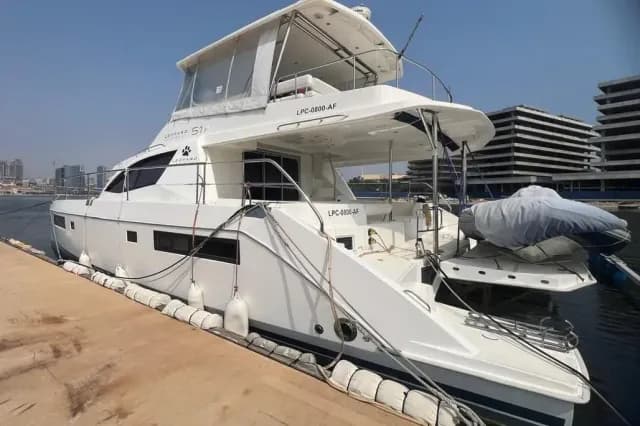
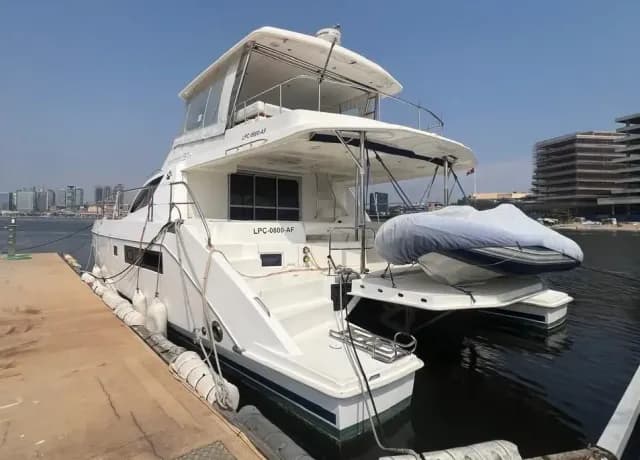
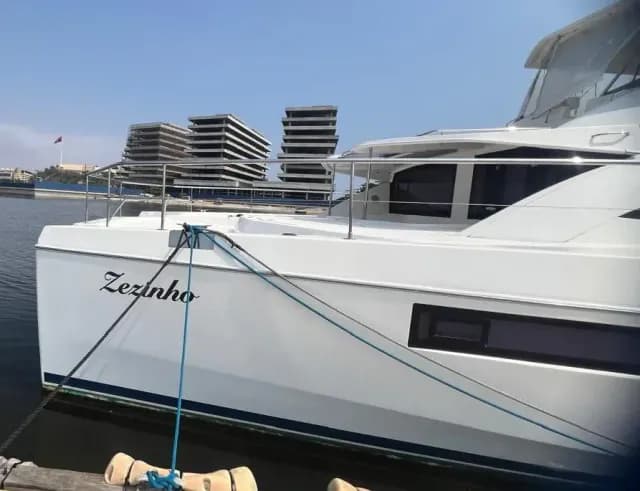
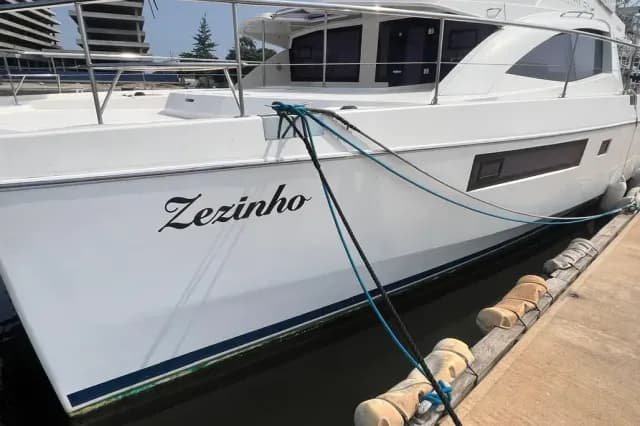
ZEZINHO - 2016 Leopard 51 Powercat
Leopard 51 Powercat Specifications
| Specification | Detail |
|---|---|
| LOA | 15.54 m (51 ft 0 in) |
| Beam | 7.64 m (25 ft 1 in) |
| Draft | 0.98 m (3 ft 3 in) |
| Displacement (dry) | 18,500 kg (40,785 lbs) |
| Hull material | GRP, vinylester resin, closed-cell foam core |
| Hull construction | Vacuum-infused resin infusion |
| Hull type | Simonis Voogd high-efficiency power catamaran hulls with hard chines |
| Engines | 2× Yanmar 8LV V8 diesel, 370 HP each |
| Drive | Shaft drive with 4-blade propellers |
| Top speed | 23 knots |
| Cruising speed | 17 knots |
| Economy speed | 8–10 knots |
| Fuel capacity | 1,500 litres (396 US gal) |
| Water capacity | 780 litres (206 US gal) |
| Cabin layouts | 3-cabin owner / 4-cabin charter |
| Heads | 3 (owner) / 4 (charter) |
| Crew cabins | 2 (with 1 crew head) |
| Naval architecture | Simonis Voogd Design (Netherlands) |
| Builder | Robertson & Caine, Cape Town, South Africa |
| Brand owner | THL Group (The Moorings / Sunsail) |
| Charter designation | Moorings 514 PC |
| Production years | 2013–2020 |
| Successor | Leopard 53 PC |
| Units built | ≈137 hulls |
The headline number is the draft: 0.98 m (3 ft 3 in). This opens up shallow cruising grounds — Bahamas, Keys, ICW — that are inaccessible to most monohull motor yachts of equivalent size. The twin Yanmar 8LV V8 diesels are proven, high-output powerplants delivering 370 HP each (740 HP combined) — a significant upgrade from the predecessor 47 PC’s 150–265 HP engines and a key factor in the 51 PC’s 23-knot top speed.
The 1,500-litre fuel capacity provides approximately 1,000 nautical miles of range at economy speed (8–10 knots) — sufficient for a Florida-to-New-York run without refuelling. The 780-litre water capacity matches the Leopard 45 sailing catamaran, supporting extended cruising without constant water dock visits. The vinylester resin and closed-cell foam core construction is resistant to osmosis and eliminates the water absorption risk associated with balsa core construction — a genuine structural advantage for a boat that spends its life in the water.
Performance & Handling
At speed: BoatTEST measured a top speed of 23.2 knots at wide-open throttle (3,800 RPM), consuming 37.4 US gallons per hour combined. Time to plane was 8.8 seconds, and the 0–20 mph sprint completed in 12.9 seconds. The noise level at WOT measured 80 dB at the flybridge helm — a reasonable figure for a 740 HP power catamaran. The Simonis Voogd hull form transitions cleanly from displacement through semi-displacement to planing, without the abrupt hump that characterises some power catamaran designs.
Cruising speed: The practical cruising band sits at 17 knots (3,000 RPM), where the hulls operate in their most efficient planing mode. At this speed, fuel consumption is approximately 20 US gallons per hour combined, giving a range of approximately 300 nautical miles from the 1,500-litre tanks. This is the speed most owners settle into for day cruising and inter-island passages.
Economy cruise: At 8.2 knots (1,500 RPM), fuel consumption drops dramatically to 2.9 US gallons per hour — yielding an efficiency of 2.9 nautical miles per gallon and a range of approximately 1,000 nautical miles. This is the speed for long-distance repositioning, overnight passages, and fuel-conscious cruising. The difference between 17-knot cruising and 8-knot economy is sevenfold in fuel burn — a significant operational consideration.
Handling: The twin engines provide excellent close-quarters manoeuvrability through differential thrust — the 51 PC pivots virtually on its own axis, making marina work intuitive for experienced operators. At low speeds, the rudders provide limited directional effect; centred rudder position is recommended in marinas, with steering achieved primarily through engine throttle differential. A bow thruster is an optional extra but strongly recommended by experienced owners for crosswind docking. The flybridge helm provides a commanding view forward but creates a slight blind spot astern; the integrated stern-view camera on the chartplotter compensates effectively.
Seakeeping: The generous bridgedeck clearance, narrow hull floats, and catamaran stability combine to produce a comfortable ride in moderate sea states. In beam seas, the 51 PC’s light pitching motion is notably more comfortable than equivalent monohull motor yachts. In following seas at speed, the hull form tracks well without the tendency to broach that affects some planing monohulls. The 0.98 m draft is both an advantage (shallow-water access) and a limitation (less directional stability in rough quartering seas than a deeper-draught vessel).
Interior Layout & Living Aboard
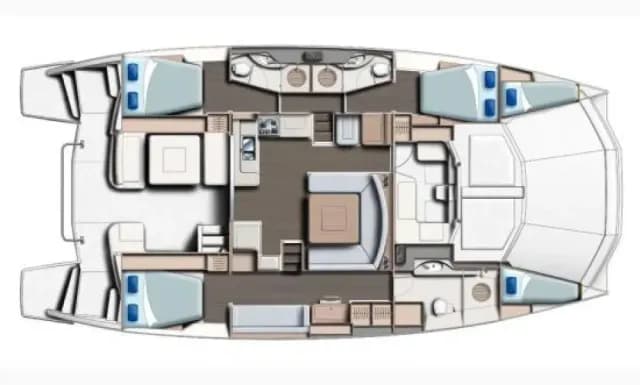
The Leopard 51 PC was offered in two primary layouts: a 3-cabin owner’s version with the entire starboard hull dedicated to a master suite featuring a walk-around queen bed, his-and-her sinks, and a large separate shower forward; and a 4-cabin charter version with four double cabins, each with en-suite heads. Two crew cabins with one crew head are located forward, accessible via a separate companionway — a practical arrangement that keeps crew access independent of guest areas. The 3-cabin owner’s version is significantly more desirable on the used market and commands a premium accordingly.
The forward cockpit is a signature Leopard feature that transfers directly from the sailing catamaran range to the power platform. Accessed from the saloon through a large door, it provides a sheltered, private seating area at the bow — ideal for speed-watching underway or quiet sundowners at anchor. This is where the 51 PC differentiates itself from competitors that offer only an aft cockpit: the forward cockpit creates a second outdoor living zone that transforms how the boat is used at anchor, particularly when hosting guests.
The flybridge is the 51 PC’s primary social space. With the helm station forward, lounge seating for eight, a wet bar, and options for an ice maker and barbecue, it effectively serves as an outdoor living room with commanding 360-degree views. The main salon features panoramic glazing, a fully equipped galley positioned forward for views while cooking, and an open-plan dining and lounging area. The three-level living arrangement — lower deck cabins, main deck salon and cockpits, flybridge — provides genuine separation between public and private spaces.
The hydraulic swim platform at the stern doubles as a tender launch and recovery system, eliminating the need for traditional davits. The platform accommodates a suitable tender and provides direct water access — a self-contained system that is both practical and aesthetically cleaner than davit-mounted alternatives. Later production models upgraded to electric operation.
For extended cruising, the 51 PC is a capable platform. The 780-litre water capacity supports multi-day passages without marina stops, and the generator-powered air conditioning is essential for tropical comfort. Engine access is via the aft cabin berth area — adequate for routine checks but disruptive if guests are sleeping. Robertson & Caine’s laminated wood joinery is well-regarded for durability, though some owners note that the production-oriented finish has sharper edges on interior woodwork than expected at this price point.
Leopard 51 Powercat Ownership: What to Expect
Owning a power catamaran involves a fundamentally different cost structure from a sailing catamaran: higher fuel consumption, more demanding engine maintenance (twin V8 diesels versus twin 45–57 HP saildrives), and the operational costs of generator-dependent systems. The 51 PC can be operated by an owner couple without professional crew, keeping the cost structure manageable:
- Insurance: 1.0–1.7% of hull value. On a boat insured at $600,000, this translates to approximately $6,000–$10,200 per year. Caribbean hurricane-zone coverage sits at the upper end of the range.
- Marina berth: The 7.64 m beam commands catamaran-width berth fees, typically 1.5× the monohull rate. Caribbean marinas charge $1,500–$2,500 per month for a 51-foot catamaran. Mediterranean berths range from €12,000–€30,000 per year depending on location.
- Engine servicing: Twin Yanmar 8LV V8 diesels require professional servicing at $3,000–$6,000 annually. The Yanmar 8LV is a proven powerplant with excellent global service support, but V8 maintenance costs are materially higher than the Yanmar 4JH saildrives on sailing catamarans.
- Fuel: The largest variable cost. At 17-knot cruise, fuel consumption is approximately 76 litres per hour (20 US GPH) combined. A full day’s cruising at speed can consume $400–$600 in diesel depending on fuel prices. At economy speed (8 knots), consumption drops to approximately 11 litres per hour — roughly comparable to a sailing catamaran motoring.
- Haul-out and antifouling: $3,500–$6,000 for a catamaran of this size, including running gear inspection, propeller and shaft maintenance, and zinc replacement.
- Approximate total (without crew): $40,000–$80,000 per year depending on usage intensity, fuel consumption, and cruising ground — significantly more than a sailing catamaran of equivalent size due to the fuel and engine maintenance components.
The charter ownership option through The Moorings Yacht Ownership programme can meaningfully offset these costs. Buyers who purchase a 51 PC and place it in the charter fleet receive guaranteed charter income while retaining personal use weeks. Depending on the base location and utilisation rate, charter income can offset all or most annual ownership costs.
Depreciation: Used pricing for the 51 PC has settled into a mature pattern. A 2015–2016 ex-charter boat trades at approximately $485,000–$599,000, representing roughly 25–35% depreciation from the original price. Privately owned examples with lower hours and upgrades command $599,000–$899,000. The introduction of the Leopard 53 PC as successor has absorbed new-buyer demand, creating stable but accessible pricing for used 51 PCs.
How to Buy a Leopard 51 Powercat: What to Look For
Production run and market: The 51 PC was produced from 2013 to 2020, with 137 hulls built. A substantial proportion were delivered into The Moorings and Sunsail charter fleets (designated Moorings 514 PC), and these ex-charter boats now dominate the brokerage inventory. Privately owned examples are less common but typically in better condition with lower engine hours. All purchases are on the secondary market.
Key Inspection Areas
- Yanmar 8LV engine condition: The twin V8 diesels are the 51 PC’s most expensive mechanical components. Verify engine hours against service records, confirm all scheduled maintenance was performed, and request oil analysis reports. The Yanmar 8LV is a reliable engine, but V8 rebuilds are costly. Ex-charter boats may carry 2,000–4,000+ hours after 5–7 years of fleet service.
- Hatch and window leaks: A known issue across the Leopard range. Inspect all hatches, deck windows, and salon doors for evidence of water ingress. Check headliners near windows for staining or delamination.
- Swim platform mechanism: The hydraulic (or electric, on later models) swim platform is a complex system with moving parts exposed to salt water. Test the full deployment and recovery cycle during the survey. Check hydraulic lines, rams, and pumps for leaks and corrosion.
- Rudder condition: The small spade rudders provide limited steering effect at low speeds. Check for play in the rudder bearings and inspect the rudder blades for impact damage.
- Flybridge canvas: The flybridge canvas enclosure must be partially rolled at higher speeds. Inspect all canvas, zippers, and fasteners for UV degradation and wear — replacement can cost $5,000–$10,000.
- Generator hours and condition: The generator runs extensively on a power catamaran (air conditioning, watermaker, and electrical loads). Check generator hours separately from engine hours and verify service records.
Ex-Charter Considerations
Ex-charter Leopard 51 PCs from The Moorings and Sunsail fleets are the most numerous on the brokerage market. They come with documented maintenance histories from fleet management but also with significantly more wear: higher engine and generator hours, cosmetic degradation from hundreds of different charterers, and accumulated stress on systems and fittings. Budget $15,000–$30,000 to bring an ex-charter boat to private-owner standard — covering upholstery, canvas, electronics updates, and systems servicing. The 4-cabin charter layout is almost universal on ex-charter boats; 3-cabin owner’s versions are rare and valuable.
Surveying a Power Catamaran
A pre-purchase survey should include: hull and deck condition with moisture meter readings across all surfaces, both engines under load (sea trial), propeller shaft alignment and condition, rudder bearing play, all hydraulic systems (swim platform, engine hatches), generator under load, electrical system integrity including the charging system, all through-hull fittings and seacocks, and a thorough test of all electronics and navigation equipment. The closed-cell foam core construction eliminates the water absorption risk of balsa core boats, but impact damage and delamination around hardware fastening points should still be checked. Ensure the surveyor has power catamaran experience — the inspection priorities differ significantly from sailing catamarans.
Leopard 51 Powercat vs Competitors
The 50-foot power catamaran segment has grown significantly since the 51 PC’s introduction, with new entrants raising the bar on volume, technology, and customisation. As a discontinued model, the 51 PC now competes on the used market — where its combination of proven performance, accessible pricing, and deep parts availability creates a compelling value proposition.
Leopard 51 PC vs Leopard 53 PC
The direct successor deserves first consideration. The 53 PC (2020 onwards) was designed as a “pure motoryacht from the start” rather than sharing a sailing catamaran platform — a fundamental philosophical shift. It offers 31% more interior volume, an interior helm station (a first for Leopard power catamarans), and the same Yanmar 8LV 370 HP engines. The 53 PC won the 2020 Multihull of the Year award. On the used market, the 53 PC commands a significant premium — new pricing approaches $1,590,000 versus $485,000–$899,000 for a used 51 PC. The 51 PC is the value choice for buyers who want the Leopard power catamaran experience without the premium of the current model.
Leopard 51 PC vs Aquila 54 Yacht
The Aquila 54 is the 51 PC’s closest direct competitor in size and market positioning. The Aquila offers a larger platform (54 ft vs 51 ft), a more modern interior with greater customisation options, and optional higher-power engines (Cummins 550 HP). Build quality is well-regarded, and the head of Aquila’s product development reportedly spent years at Leopard Catamarans — the DNA connection is evident. The Aquila commands a substantially higher new price ($1,690,000–$2,690,000). The 51 PC counters with a proven 137-hull track record, the Leopard/Moorings parts and service network, superior availability on the used market, and a significantly lower entry price. For buyers who want the newest technology and larger interior, the Aquila leads. For value and proven reliability, the 51 PC is compelling.
Leopard 51 PC vs Fountaine Pajot Veya 53
The French alternative brings Fountaine Pajot’s refined design sensibility and build quality to the power catamaran segment. The Veya 53 offers a distinctly European interior aesthetic, competitive performance, and the Fountaine Pajot reputation for fit-and-finish. At approximately $2,554,000, the Veya is a premium proposition. The 51 PC’s advantage is clear: established used-market pricing at a fraction of the Veya’s new cost, proven Yanmar V8 reliability, the Leopard forward cockpit (absent on the FP), and the deepest parts network in the power catamaran segment. The Veya is the aspirational choice; the 51 PC is the pragmatic one.
Leopard 51 PC vs Monohull Motor Yachts
The most fundamental comparison is not with other power catamarans but with conventional monohull motor yachts. A 50-foot monohull flybridge cruiser — Riviera, Princess, Sunseeker — offers a deeper-V hull for offshore work, a more traditional aesthetic, and simpler marina berthing. The 51 PC counters with dramatically more interior and deck space per foot, the 0.98 m shallow draft that opens entire cruising grounds, superior fuel efficiency at displacement speeds, and the catamaran stability that eliminates rolling at anchor. For coastal and island cruising in moderate conditions — the BVI, Bahamas, Mediterranean islands — the power catamaran format is compelling. For open-ocean passages in heavy weather, the monohull’s deeper hull and lower windage may be preferred.
For a full interactive depreciation comparison between the Leopard 51 Powercat and competing models, visit the Hulls.io Market Intelligence tool.
Leopard 51 Powercat Value Retention
Newest vintage = 100%. Older vintages shown as % of that price.
Based on median asking prices by model year. The newest model year in our dataset is used as the 100% reference point. The curve is smoothed so retention never increases as age increases — hover over data points to see raw values. Shaded band shows the 25th–75th percentile price range. Figures reflect asking prices from tracked listings, not final sale prices.