


Leopard 50 Sail for Sale
Sailing CatamaranThe Leopard 50 is the flagship sailing catamaran from Robertson and Caine, the South African builder that produces all Leopard catamarans. Designed by Simonis Voogd Design and launched in 2018 with first deliveries from 2019, the 50 replaced the award-winning Leopard 48 with an entirely new hull design featuring carbon-infused ring frames, near-360-degree salon visibility, and the signature Leopard forward cockpit. Winner of Cruising World's 2019 Boat of the Year for Best Charter Boat (as the Moorings 5000). Leopard catamarans are closely associated with The Moorings and Sunsail charter fleets, giving the brand massive global visibility and strong resale values.
Show 2 awards
Show 6 key features
Related models
Updated 10 June 2026 · By Hulls.io Editorial
The Leopard 50: A Complete Guide
The Leopard 50 is the flagship sailing catamaran from Robertson & Caine, designed by Alexander Simonis of Simonis Voogd Design as a ground-up replacement for the award-winning Leopard 48. Launched in 2018 with first deliveries from 2019, the 50 was not a stretched 48 but an entirely re-thought design that borrowed the best elements from both the 48 and the smaller Leopard 45 while introducing meaningful construction innovations. The model won Cruising World’s 2019 Boat of the Year award for Best Charter Boat (as the Moorings 5000), continuing Leopard’s remarkable run of BOTY wins that includes the 48 (2012) and the 45 (2017).
Simonis described the 50 as having “most of the work done under the bonnet” — advances in construction geometry that enabled the open-plan layouts and expansive visibility that define the interior. The most significant structural innovation was the use of carbon-infused ring frames replacing traditional bulkheads in critical load areas — a technique Simonis pioneered on larger all-carbon racing catamarans and adapted for production cruising. This freed up interior space, enabled wider bulkhead openings, and contributed to the near-360-degree views from the salon that reviewers consistently highlight.
Robertson & Caine — South Africa’s largest boat builder with over 3,000 catamarans built, 2,600 employees, and facilities spanning 66,000 m² across Cape Town — produces the Leopard 50 alongside the full Leopard range. The company’s close relationship with THL Group (owners of The Moorings and Sunsail) means a substantial proportion of 50s were delivered into charter fleets as the Moorings 5000. The dual CE and NMMA certification — Leopard claims to be the only catamaran brand certified under both European and American standards — reflects the boat’s role in both private and commercial markets worldwide.
The Leopard 50 is offered in two variants: the 50L (“Lounge”) with a full flybridge accessed via floating stairs from the aft cockpit, and the 50P (“Performance”) with a lower-profile solid hardtop bimini instead of a flybridge, saving approximately 600 kg of displacement. The 50L is the more popular choice for private owners seeking social space; the 50P appeals to performance-oriented sailors who value the weight savings and lower windage. The Leopard 52, unveiled in 2024/2025 as the successor, introduces hybrid-electric propulsion, a taller rig with 17% more upwind sail area, and up to ten layout options — the next evolution of this design lineage.
Hulls.io currently tracks 1 active listing for the Leopard 50, drawn from brokerages worldwide.
Showing 1–1 of 1 results
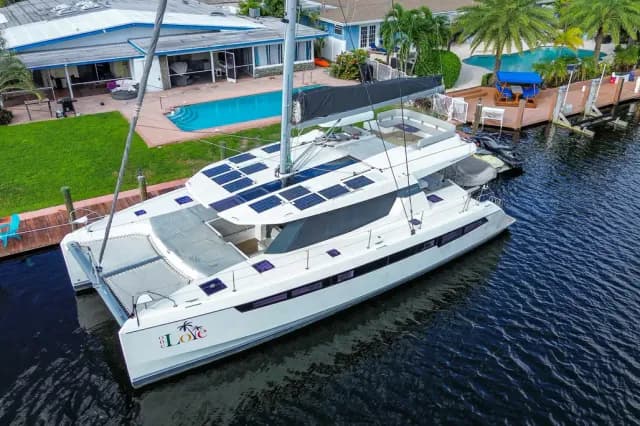
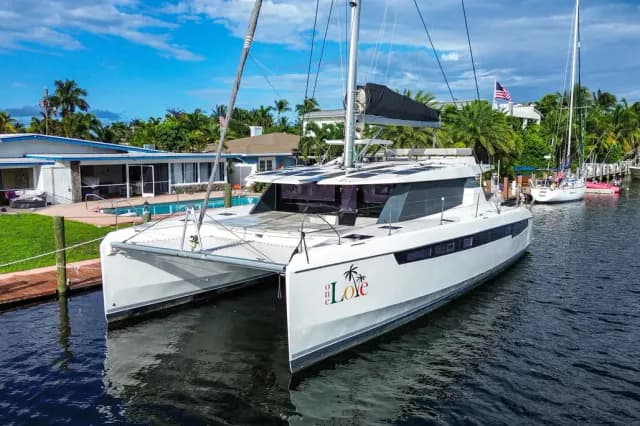
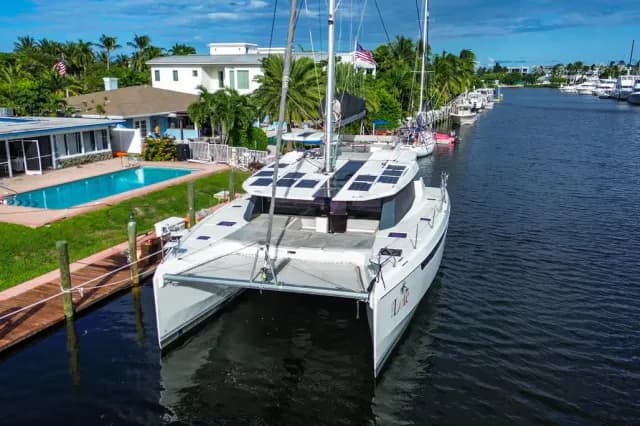
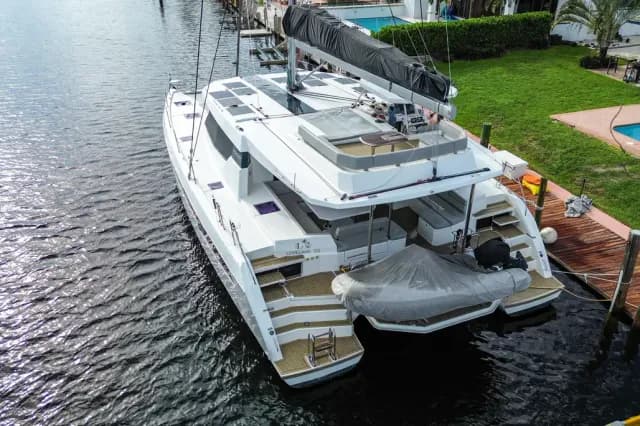
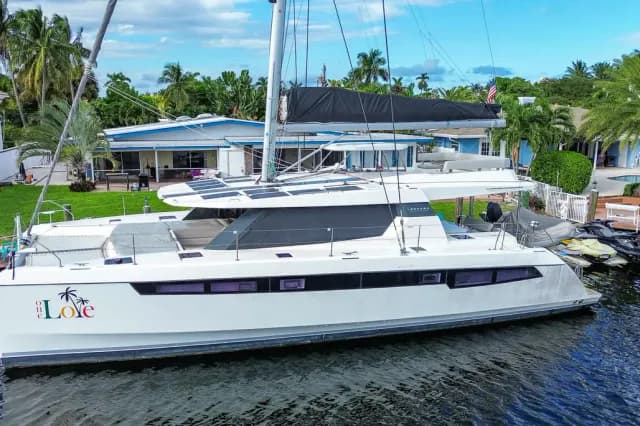
2019 Leopard 50 Sail - Next Generation Bluewater Cruising Catamaran
Leopard 50 Specifications
| Specification | Detail |
|---|---|
| LOA | 15.40 m (50 ft 6 in) |
| LWL | 14.90 m (48 ft 11 in) |
| Beam | 8.04 m (26 ft 5 in) |
| Draft (half load) | 1.61 m (5 ft 3 in) |
| Light displacement | 19,000 kg (41,888 lbs) |
| Loaded displacement | 20,600 kg (45,415 lbs) |
| Load capacity | 7,000 kg (15,432 lbs) |
| Bridgedeck clearance | 1.03 m (3 ft 5 in) |
| Mast height (half load) | 23.52 m (77 ft 2 in) |
| Mainsail area (standard) | 90.3 m² (972 sq ft) |
| Mainsail area (square-top) | 95.5 m² (1,028 sq ft) |
| Genoa area | 63.9 m² (688 sq ft) |
| Total upwind sail area | 154.2 m² (1,660 sq ft) |
| Code 0 (optional) | 90.1 m² (970 sq ft) |
| SA/D ratio (standard main) | 20.9 |
| Engines (standard) | 2× Yanmar 57 HP saildrives |
| Engines (optional) | 2× Yanmar 80 HP turbocharged |
| Fuel capacity | 920 litres (243 US gal) |
| Water capacity | 700 litres (185 US gal) |
| Cabin layouts | 3 / 4 / 5 / 6-cabin configurations |
| Heads | 4–6 (layout dependent) |
| Variants | 50L (Lounge/flybridge) / 50P (Performance/bimini) |
| Naval architecture | Simonis Voogd Design (Netherlands) |
| Builder | Robertson & Caine, Cape Town, South Africa |
| Brand owner | THL Group (The Moorings / Sunsail) |
| Charter designation | Moorings 5000 |
| CE category | A (Ocean) |
| Production years | 2019–present (successor Leopard 52 from 2025) |
| Predecessor | Leopard 48 |
The numbers describe a substantial ocean-going catamaran. At 20,600 kg loaded displacement, the Leopard 50 is heavier than both the Lagoon 46 (16,300 kg) and the Leopard 45 (14,500 kg), reflecting the additional volume, the wider 8.04 m beam, and the optional flybridge structure. The SA/D ratio of 20.9 with the standard mainsail is competitive for the class, rising to 21.6 with the optional square-top main.
The 920-litre fuel capacity and 700-litre water tankage provide genuine long-range capability. The standard 57 HP Yanmar saildrives are adequate for coastal cruising, but owners unanimously recommend the optional 80 HP turbocharged engines for a meaningful improvement in motoring performance — particularly valuable for close-quarters manoeuvring, adverse current, and windward motoring on a 20-tonne catamaran. The 1.61 m draft sits deeper than the Lagoon 46 (1.30 m) but provides better lateral resistance and windward performance. The CE Category A Ocean certification, combined with dual CE/NMMA certification, confirms worldwide operational capability.
How Does the Leopard 50 Sail?
Reaching: This is where the Leopard 50 excels. In 15 knots of true wind on a beam reach, the 50 delivers a steady 9 knots GPS speed, with peaks to 10.4 knots in gusts. The 1,660 sq ft of total upwind sail area drives the 20,600 kg displacement efficiently in moderate trade wind conditions. Cruising World described the 50 as “nippy, seaworthy and comfortable” — praise that captures the balance between performance and liveability. In sustained trade winds of 18–22 knots, 9–10 knot averages are achievable over extended passages.
Upwind: Without daggerboards, the Leopard 50 tacks through approximately 55–60 degrees to the true wind — typical for a production cruising catamaran of this displacement. The 1.61 m draft provides better lateral resistance than shallower competitors, reducing leeway and improving pointing compared to the Lagoon 46 (1.30 m) and the Bali 4.8 (approximately 1.35 m). The three electric winches at the helm station make tacking manageable for a short-handed crew — all control lines are led aft for single-position operation.
Light air: At 20,600 kg, the Leopard 50 needs breeze. Below 10 knots of true wind, the boat requires a Code 0 or asymmetric spinnaker to maintain forward progress under canvas alone. The optional square-top mainsail provides approximately 56 sq ft of additional sail area over the standard main — worth having in light conditions, though some owners report it can be finicky to manage. Feathering propellers (MaxProps are a popular aftermarket upgrade) reportedly add approximately 1 knot of boat speed under sail compared to fixed props.
Under power: With the standard 57 HP engines, motoring speed is 7–8 knots at cruise. The optional 80 HP turbocharged engines push this to 9 knots at 2,500 RPM — a significant improvement that most owners consider essential rather than optional. Manoeuvrability under power is excellent: one owner described it as “like driving a zero-turning-radius lawnmower” thanks to the differential thrust from twin engines. Single-engine economy mode at 6 knots is practical for fuel conservation on longer passages.
Bluewater credentials: Many Leopard 50s are delivered on their own hulls from Cape Town to their charter or owner destinations — documented Atlantic crossings include Cape Town to St Helena to St Lucia, approximately 8,000 nautical miles. One owner described heavy-weather handling in 30-knot winds and 9-foot seas as “a bulldozer running through marshmallow fluff” — minimal creaking and banging, confirming the structural integrity of the carbon-infused ring frame construction. The 920-litre fuel capacity and 700-litre water tankage support extended passages, and the forward cockpit provides a sheltered crew position even in challenging conditions. The Leopard 50 is a proven ocean-crosser, not merely a coastal cruiser.
Interior Layout & Living Aboard
The Leopard 50 offers exceptional layout flexibility: 3-cabin with a dedicated utility room, 4-cabin (the most common private-owner configuration), 5-cabin, and 6-cabin charter version (as the Moorings 5000). The master suite is positioned aft starboard with a private companionway — a deliberate separation from the guest cabins that provides genuine privacy for the owner couple. All guest cabins feature walk-around berths on both sides — a significant improvement over the Leopard 48, where the extra 17 inches of beam makes the difference between squeeze-past and walk-around access.
The forward cockpit is the Leopard 50’s defining social feature — carried forward from the 48 and the 45, refined with an improved watertight door between saloon and bow. This is where owners and guests naturally gather at anchor: protected from wind, shaded by the cabinhouse, with a view forward over the anchorage. The watertight door also means the forward cockpit can be sealed in heavy weather without compromising the saloon — a genuine safety feature that competitors with open bow areas cannot match. It is the single feature most frequently cited by Leopard owners as the reason they chose the brand.
The saloon is a departure from the Leopard 48. Near-360-degree visibility through extensive glazing, a full-length overhead skylight, and widened bulkhead openings create an extraordinarily light and airy interior. The galley is positioned for views while cooking. Headroom of 6 ft 6 in to 6 ft 8 in is generous throughout. The 50L flybridge variant adds a substantial upper-deck social space with wrap-around seating, sunbed, and shade awning — effectively creating a fourth living zone above the aft cockpit, saloon, and forward cockpit. The 50P trades this for a lower-profile hardtop bimini, saving 600 kg of displacement and reducing windage.
The raised helm station sits between the bridgedeck and the upper lounge (on the 50L) or under the solid bimini (on the 50P), with three electric winches handling all control lines. The helm provides excellent 360-degree visibility and easy communication with crew on deck — the helmsperson is integrated into the social flow rather than isolated on a distant flybridge. The hydraulic swim platform aft accommodates a 10-foot tender and provides direct water access.
For liveaboard cruising, the Leopard 50 is a formidable platform. The 7,000 kg load capacity (some sources cite 5,400 kg of cargo) supports serious provisioning for extended passages. Storage throughout is generous. The 3-cabin variant with utility room is the liveaboard configuration of choice, providing dedicated space for a washer-dryer, workshop tools, and systems access. Ventilation through hatches and hull ports is effective in temperate climates; air conditioning is essential for tropical use. Owner reports indicate daily electrical consumption of 13–18 kWh at anchor with air conditioning running — solar panels provide only 4–5 kWh per day, making a generator necessary every 1–2 days.
Leopard 50 Ownership: What to Expect
The Leopard 50 sits at the upper end of the production cruising catamaran market, with ownership costs reflecting the larger platform, wider beam, and greater systems complexity compared to the 42 or 45:
- Insurance: 1.0–1.7% of hull value. On a boat insured at $850,000, this translates to approximately $8,500–$14,450 per year. Caribbean hurricane-zone coverage sits at the upper end. Some insurers may require a named storm plan or haul-out clause.
- Marina berth: The 8.04 m beam commands premium catamaran berth fees — wider than the Lagoon 46 (7.96 m) and the Leopard 45 (7.37 m). Caribbean marinas charge $1,800–$3,000 per month for a 50-foot catamaran. Mediterranean berths range from €15,000–€25,000 per year. Many owners reduce costs significantly by anchoring out — the generous tankage supports this approach.
- Engine servicing: Twin Yanmar saildrives require annual servicing at $2,000–$4,000 (57 HP) or $3,000–$5,000 (80 HP). Saildrive seals should be inspected annually and replaced every 5–7 years.
- Haul-out and antifouling: $4,000–$7,000 for a 50-foot catamaran, including hull preparation, antifouling, zinc replacement, and running gear inspection.
- Generator and systems: Generator servicing at $1,500–$3,000 annually. The 50’s electrical demands (air conditioning, watermaker, refrigeration) make the generator a critical system that requires regular maintenance.
- Approximate total: $30,000–$60,000 per year depending on location, usage pattern, and whether the boat is marina-berthed or anchored out. Former charter boats may require above-average spending in the first year of private ownership.
New vs used pricing: When new, a well-optioned Leopard 50 with 80 HP engines, generator, air conditioning, watermaker, MaxProps, and full electronics cost approximately $1,000,000 delivered to the US East Coast (base price around $850,000). Used examples from 2019–2024 trade at $849,000–$999,000, with ex-charter boats (Moorings 5000) at the lower end and privately owned, well-maintained examples at the top. The introduction of the Leopard 52 as successor may soften used 50 prices as buyers wait for the newer model or negotiate harder on existing stock.
The charter ownership option through The Moorings is available for the 50 (as the Moorings 5000), providing guaranteed charter income while retaining personal use weeks. For owners who can tolerate charter use of their boat, this programme can meaningfully offset annual ownership costs.
How to Buy a Leopard 50: What to Look For
Variants: Determine whether the boat is a 50L (flybridge/Lounge) or 50P (Performance/hardtop bimini). The 50L is the more common variant and carries the flybridge premium. The 50P, at approximately 600 kg lighter, is the better sailing platform but less common on the brokerage market. Cabin configurations range from 3 to 6 cabins — the 3- or 4-cabin versions are most desirable for private ownership, while the 6-cabin charter layout (Moorings 5000) is the most common on the used market.
Known Issues to Inspect
- Balsa core construction: Like the Leopard 45, the 50 uses end-grain balsa core in the hull and deck construction. While the keels are filled with closed-cell polyurethane foam and structural areas use carbon-infused ring frames, the balsa core in the hull panels is susceptible to moisture ingress if the laminate is compromised. Percussive testing and moisture meter readings across all hull and deck surfaces are essential during the survey.
- Window and door leaks: Reports of salon sliding door leaks, window seal failures, and patio-style doors jumping off tracks are common across the fleet. Inspect all window and door seals for evidence of water ingress and check headliners for staining.
- Electrical system issues: The deadman fuse failure (reported on the 45 range as well) can cause total blackout. A commonly reported issue is that all galley outlets are wired to a single 20-amp breaker, causing daily trips when using multiple appliances simultaneously. Ask whether the electrical panel has been rewired to address this.
- Handover quality control: Early owners reported numerous delivery issues: exhaust hoses too short, drains moulded but not cut through, half the lights not working, deck hatches not fitting properly, and cabin door latches installed incorrectly. On used boats, most of these will have been resolved, but inspect carefully regardless.
- Anchor bridle geometry: The bowsprit-mounted anchor rode and bridle geometry can create excessive yawing at anchor (approximately 45 degrees reported). Some owners have modified the bridle attachment points to reduce swinging. Check the anchor system configuration and ask the owner about anchoring behaviour.
- Refrigerator “off” button: A design quirk — the refrigerator has an exposed “off” button on the front panel that gets bumped accidentally. A minor annoyance but worth being aware of.
Equipment That Adds Value
When assessing a used Leopard 50, the following additions represent genuine added value: the 80 HP engine upgrade (strongly recommended by experienced owners), watermaker, solar panels (the flybridge roof accommodates significant capacity), MaxProp feathering propellers, upgraded electronics (chartplotter, radar, AIS), lithium battery conversion, Code 0 or asymmetric spinnaker, davits with dinghy, generator, and air conditioning. A boat with the 80 HP engines and a comprehensive electronics suite is worth a meaningful premium over a base-specification example.
Surveying a Catamaran
A catamaran survey at this level should include: hull and deck percussive testing with moisture meter readings at a grid pattern across all surfaces (essential given the balsa core), all window and door seal integrity, bridgedeck stress assessment, rudder bearing condition, saildrive seal condition and service history, engine compression test and oil analysis, all through-hull fittings and seacocks, electrical system integrity (particularly the galley circuit and deadman fuse), trampoline condition, standing rigging condition and age, and a sea trial in at least moderate conditions. Ensure the surveyor has specific multihull experience — catamaran-specific concerns (bridgedeck loads, core integrity, saildrive seals) require different expertise from monohull surveys.
Leopard 50 vs Competitors
The 50-foot sailing catamaran segment is one of the most competitive in the marine market, with French, South African, and Australian builders offering compelling alternatives. The Leopard 50 competes on the strength of its construction quality, forward cockpit, and the deep Leopard/Moorings parts and service network.
Leopard 50 vs Lagoon 46 / Lagoon 50/51
The Lagoon is the volume leader in the cruising catamaran market, and the Lagoon 50/51 is the Leopard 50’s most direct competitor by size. The Lagoon 50 is heavier (25,500 kg vs 20,600 kg) with a wider beam (8.56 m vs 8.04 m), providing more interior volume but at the cost of higher displacement and windage. The Lagoon’s self-tacking jib simplifies short-handed sailing; the Leopard counters with the forward cockpit (absent on all Lagoons), deeper draft for better windward performance, and Robertson & Caine build quality that is generally regarded as more robust than Lagoon’s volume production. For buyers in the 46–50 ft range, the Lagoon 46 at a lower price point and the Leopard 50 represent distinctly different value propositions: the Lagoon for interior space and ease of sailing, the Leopard for construction quality, sailing performance, and the unique forward cockpit lifestyle.
Leopard 50 vs Fountaine Pajot Aura 51
The Fountaine Pajot Aura 51 is the newest entrant in this segment, with a design that emphasises environmental sustainability (integrated solar panels, eco-focused systems) and a large retractable bulkhead door creating a 3-metre opening between saloon and cockpit. At approximately 19,200 kg, the Aura is lighter than the Leopard 50 and draws less. The build quality and fit-and-finish are well-regarded in the French tradition. The Leopard 50 counters with the forward cockpit (absent on the FP), proven ocean-crossing durability, the deeper draft for windward work, and a lower price point — particularly on the used market where the 50 now offers significant savings against the Aura’s new price. The Aura is the more modern, sustainability-focused choice; the Leopard is the proven, value-oriented ocean cruiser.
Leopard 50 vs Bali 5.4
The Catana Group’s flagship takes the most radically different approach in this segment. The Bali 5.4 features a solid foredeck (no trampoline), the signature “garage door” salon-to-cockpit opening, closed-cell foam core construction that eliminates the water absorption risk of balsa core, and a wider beam (8.66 m) for maximum interior volume. The foam core construction is a genuine structural advantage for long-term tropical ownership. The Leopard 50 counters with the forward cockpit as a distinct social space (the Bali replaces trampolines with a solid lounge area), deeper draft for better sailing performance, carbon-infused ring frame construction for structural integrity, and a strong charter resale network through Moorings/Sunsail. The Bali is the more innovative lifestyle platform; the Leopard is the more conventional, proven ocean cruiser.
Leopard 50 vs Leopard 52
The direct successor warrants careful comparison. The Leopard 52 (2024/2025 onwards) offers 17% more upwind sail area, a taller mast, longer boom, CFD-refined hull shapes, up to ten layout options (3 to 6 cabins), and the option of hybrid-electric propulsion developed with Joool — including hydro-regeneration under sail and integrated solar panels. The 52 represents a meaningful generational advance. For buyers deciding between a used Leopard 50 at $849,000–$999,000 and a new Leopard 52 at a substantially higher price, the decision comes down to budget versus specification. The 50 is a proven, well-understood platform with established resale data; the 52 is the cutting edge of Leopard’s design evolution.
For a full interactive depreciation comparison between the Leopard 50 and competing models, visit the Hulls.io Market Intelligence tool.
Leopard 50 Sail Value Retention
Newest vintage = 100%. Older vintages shown as % of that price.
Based on median asking prices by model year. The newest model year in our dataset is used as the 100% reference point. The curve is smoothed so retention never increases as age increases — hover over data points to see raw values. Shaded band shows the 25th–75th percentile price range. Figures reflect asking prices from tracked listings, not final sale prices.