


Moody 41 DS for Sale
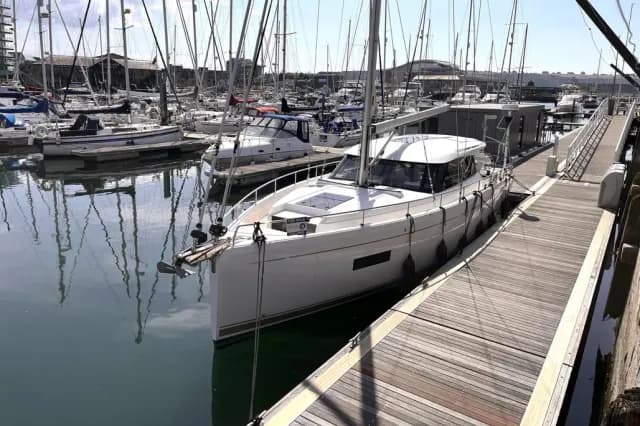
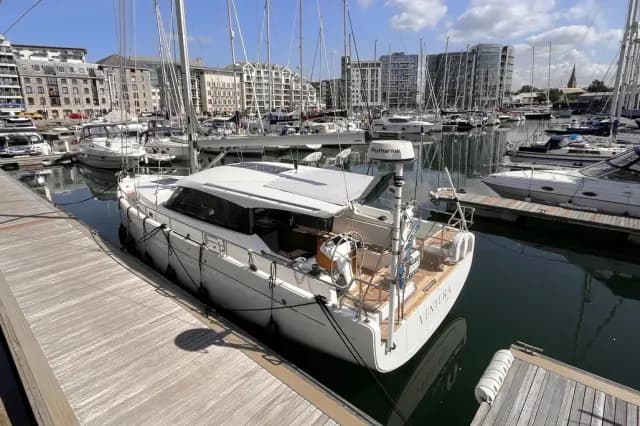
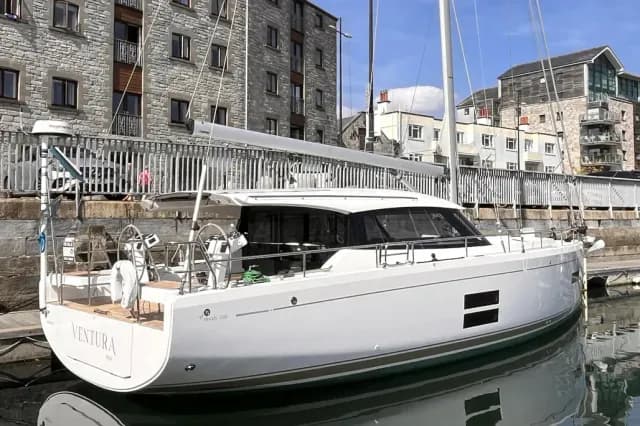
Deck Saloon Cruising SailboatThe Moody 41 DS is a premium deck saloon cruising sailboat designed by Bill Dixon and built by Hanse Group AG at their facility in Greifswald, Germany. The "DS" stands for Deck Saloon — Moody's signature configuration, where the saloon is raised to deck level and wrapped in panoramic glazing, providing 360-degree views while maintaining full standing headroom in the cabin area below. The result is a yacht that can be sailed comfortably from an inside helm station in all weather conditions, making the 41 DS particularly popular for cold-weather and high-latitude cruising. As the entry point to the modern Moody DS range, the 41 DS delivers the brand's trademark inside-out living concept in a manageable 41-foot package that a couple can handle with ease, thanks to a self-tacking jib and well-engineered deck hardware. Twin rudders and a choice of deep or shoal keel options give the 41 DS genuine versatility across cruising grounds from the shallow Baltic to open Atlantic passages.
Show 1 award
Show 6 key features
Updated 10 June 2026 · By Hulls.io Editorial
The Moody 41 DS: A Complete Guide
The Moody 41 DS is the yacht that proved a 41-foot monohull can deliver the open-plan, panoramic living experience that has driven millions of buyers towards catamarans — without sacrificing the ability to sail upwind, fit in a standard marina berth, or carry ballast where it matters. Moody’s signature deck saloon concept, designed by Bill Dixon and built by HanseYachts AG at their Greifswald facility in northern Germany, raises the entire saloon to deck level and wraps it in panoramic glazing — creating 360-degree views, full standing headroom, and a step-free transition between cockpit and interior that Dixon calls “One Level Living.”
Launched at Boot Düsseldorf in January 2020, the 41 DS was an immediate critical success. It won Cruising Yacht of the Year at the British Yachting Awards 2020, followed by Best Full-Size Cruiser at Cruising World’s 2023 Boat of the Year awards — the latter by unanimous judges’ decision. One judge stated: “I expected it to sail like a typical motorsailer, i.e., not so well. Boy was I wrong.” That quote captures the 41 DS in a sentence: it defies expectations. A deck saloon yacht that actually sails well.
Bill Dixon’s connection to Moody runs deep. Born into the Dixons of Exmouth boatbuilding dynasty (established 1740), Dixon studied yacht design at Southampton Solent University, worked under the legendary Angus Primrose, and took over the practice at age 24 when Primrose was tragically lost at sea. He founded Dixon Yacht Design in 1981 and has since designed over 4,000 built yachts across the Moody range alone. His earlier innovations for the brand include the Moody 333 — the first walk-through centre-cockpit yacht ever built. Under HanseYachts ownership (since 2007), Dixon was appointed sole naval architect for all new Moody models.
Hulls.io currently tracks 1 active listing for the Moody 41 DS, drawn from brokerages worldwide.
Showing 1–1 of 1 results
Moody 41 DS Specifications
| Specification | Detail |
|---|---|
| LOA | 12.52 m (41 ft 1 in) |
| LWL | 11.40 m (37 ft 5 in) |
| Beam | 4.25 m (13 ft 11 in) |
| Draft (standard) | 2.25 m (7 ft 5 in) |
| Draft (shoal keel) | 1.85 m (6 ft 1 in) |
| Displacement | 11,200 kg (24,690 lbs) |
| Ballast | 3,130 kg (6,900 lbs) cast iron |
| Keel | L-shaped cast iron fin |
| Rig | Deck-stepped, double-spreader, high-fractional sloop |
| Mainsail area | 45 m² (484 sq ft) |
| Self-tacking jib | 38 m² (409 sq ft) |
| Total upwind sail area | 83 m² (893 sq ft) |
| Mast height (above DWL) | 20.17 m (66 ft 2 in) |
| Engine (standard) | Yanmar 57 HP diesel |
| Engine (optional) | 80 HP diesel |
| Fuel capacity | 212 litres (56 US gal) |
| Water capacity | 473 litres (125 US gal) |
| Cabins | 2 (owner’s forward + guest aft) |
| Heads | 1 standard (optional second) |
| Hull construction | GRP, vinylester resin first layer, balsa sandwich core |
| Naval architecture | Dixon Yacht Design (Bill Dixon) |
| Builder | HanseYachts AG, Greifswald, Germany |
| CE category | A (Ocean) |
| Production years | 2020–present |
The numbers describe a yacht engineered around the deck saloon concept. Dixon drew a hull with plumb ends, high freeboard, full forward sections, near-vertical topsides, and beam carried well forward — creating the interior volume necessary for the raised saloon without resorting to catamaran-style beam. At 11,200 kg with a 3,130 kg cast iron keel (28% ballast ratio), the 41 DS carries enough weight low down for stability and a comfortable motion at sea while keeping displacement moderate for a boat with this much internal volume.
The 212-litre fuel capacity is intentionally modest — this is a sailing yacht, not a motorsailer. The single 57 HP Yanmar is well-matched to the hull, delivering 7 knots at a frugal 2.6 litres per hour, with a theoretical motoring range of approximately 570 nautical miles at cruising speed. The 473-litre water capacity is generous for a 41-footer, supporting extended cruising without constant marina water fills. The CE Category A Ocean certification confirms genuine offshore capability.
How Does the Moody 41 DS Sail?
Reaching: In 13 knots of true wind, the 41 DS achieves 8 knots on a reach — with the log nudging above 8 knots in gusts. With the optional 55.2 m² genoa deployed in fresh conditions, reaching performance extends further. This is remarkable for a deck saloon yacht. The Briand-drawn competitors in the 40-foot range struggle to match these numbers, yet the Moody delivers them from a hull optimised for living space rather than racing.
Close-hauled: Approximately 6 knots hard on the wind under the self-tacking jib, rising slightly on a reach with the genoa in 10 knots of true wind. The twin rudders provide positive helm feel, and the L-shaped cast iron keel with 2.25 m standard draft gives adequate lateral resistance for genuine windward work. The shoal keel option (1.85 m) opens up shallower cruising grounds with only a modest compromise in pointing ability.
Sail handling: Engineered for couple-handed sailing. A Seldén Furlex 304 self-tacking jib and a pair of electric Lewmar 45 primary winches are standard. All halyards and sheets are led under the deck to both helm stations. Slab reefing is standard; optional push-button in-mast furling is available for owners who prioritise convenience. A double forestay can be added to expand the headsail wardrobe with a genoa and/or Code 0. The entire sail plan can be managed without leaving the cockpit.
Under power: The single 57 HP Yanmar delivers 7 knots at 2,000 RPM, consuming just 2.6 litres per hour — remarkably efficient for an 11,200 kg yacht. The optional 80 HP engine provides additional grunt for adverse conditions. Twin rudders give positive directional control at low speeds, and the helm response is described as predictable and confidence-inspiring in marina situations.
Heavy weather: Owners of the larger DS 45 (same hull concept) report sailing in 3-metre seas with 30–35 knot winds with “wonderful performance and rock solid handling,” including surfing at 17 knots. While the 41 DS is smaller, the Dixon hull form’s sea-keeping characteristics are consistent across the range. The high freeboard and enclosed deck saloon mean the crew stays dry and comfortable in conditions that would be unpleasant on a conventional yacht.
The Deck Saloon: Interior Layout & Living Aboard
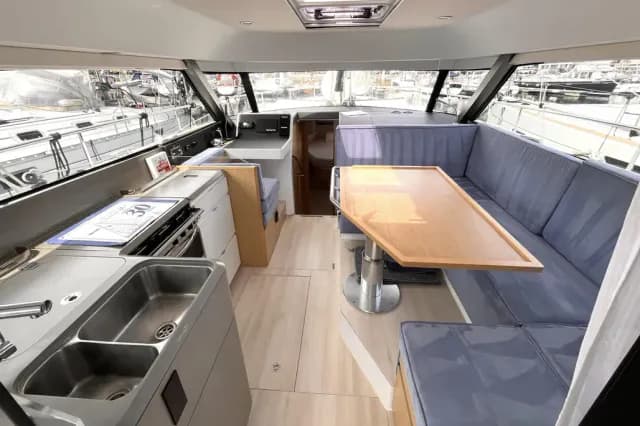
The deck saloon is the entire point of the Moody 41 DS — and understanding it is essential to understanding why this yacht exists. The cockpit, saloon, navigation station, and galley all sit on a single continuous level. A large sliding glass door creates a flush, step-free transition between cockpit and interior. The person cooking or navigating shares the same visual plane as the helmsman in the cockpit. Panoramic glazing provides 360-degree views from inside. Full standing headroom throughout. This is what Moody calls “One Level Living” — and it fundamentally changes how you experience a monohull.
Galley: Port side, straight-line layout with double sink, three-burner hob, and front- and top-opening fridge. A large port opens directly to the cockpit for passing food and drinks. Beneath the galley sole is the signature “cellar” — a utility area accessed via a hatch with steps, housing space for a washing machine, a second fridge, additional stowage, and access to electrical systems. A washing machine on a 41-foot sailing yacht is a genuine liveaboard feature.
Navigation station: Forward of the galley, with optional autopilot and engine controls for an inside helm station. In poor weather, the skipper can steer the yacht from below while maintaining full panoramic visibility through the deck saloon glazing — a feature that transforms cold-weather and night sailing.
Below deck: Four interior layout options are available, all two-cabin configurations. The forward owner’s cabin features a semi-island berth with generous stowage. The aft guest cabin is configurable with a double berth, twin berths, or twins with an infill for double conversion. An owner’s en-suite head with shower is standard; an optional second head replaces a walk-in storage area. The design intentionally avoids cramming in extra cabins — the boat is optimised for a couple with occasional guests, delivering living space and stowage few 41-footers can match.
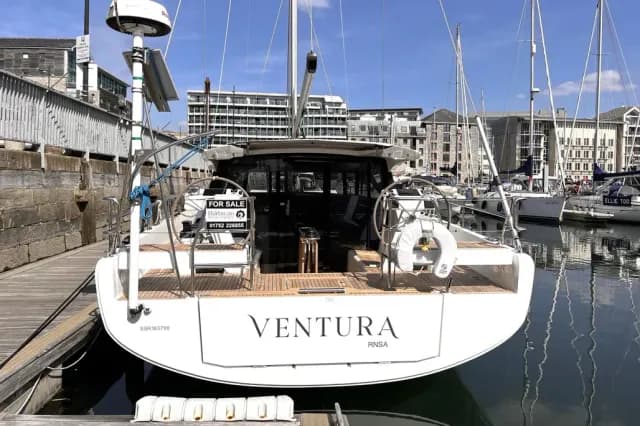
Cockpit: Twin raised helm stations with excellent sightlines forward. A hardtop extends aft from the deck saloon with a sliding central canvas section. The liferaft stows above the static waterline in the stern, designed to slide into the water with the bathing platform lowered — a thoughtful safety detail.
Moody 41 DS Ownership: What to Expect
The Moody 41 DS is a premium cruising yacht positioned above volume production brands but below fully bespoke builders. Ownership costs reflect this positioning:
- New pricing: Base price approximately €520,000–€625,000 ex-works Greifswald, rising to €650,000+ with full specification. US market pricing ranges from USD 430,000–580,000+ depending on specification, year, and dealer.
- Used market: The model is still young (production from 2020), so the used market is thin. Early 2023–2024 models list at €480,000–€686,000 depending on specification and hours. Value retention appears strong given limited supply and the model’s award-winning reputation.
- Insurance: 1.0–1.7% of hull value. On a boat insured at €550,000, this translates to approximately €5,500–€9,350 per year.
- Marina berth: The 4.25 m beam fits standard monohull berths — a significant cost advantage over catamarans. Mediterranean marinas range from €5,000–€18,000 per year; UK south coast marinas charge £7,000–£14,000 per year.
- Engine servicing: The single Yanmar diesel requires annual servicing at approximately €500–€1,500. Simple, single-engine maintenance is a running cost advantage.
- Approximate total: €15,000–€30,000 per year depending on location, usage pattern, and marina versus anchor-out cruising.
Warranty: HanseYachts provides a 2-year general warranty and a 5-year structural warranty. The Moody production line operates as a separate entity within HanseYachts, building to different standards than the volume Hanse brand.
How to Buy a Moody 41 DS: What to Look For
New vs used: The 41 DS remains in active production, so buyers can choose between a factory-specified new build and the small but growing used market. New boats allow full specification through the Moody configurator; used boats offer savings but with limited choice of configurations given the low production volume to date.
Known Issues to Inspect
- Engine noise in the cockpit: The proximity of the engine to the cockpit sole (on the same level in the one-level layout) means engine noise is more noticeable than on conventional yachts with deeper engine compartments. Test this during the sea trial at various RPM settings.
- Cockpit small-item stowage: Owners consistently report an absence of convenient grab-and-go stowage in the cockpit for phones, binoculars, and drinks. The cavernous cockpit lockers are excellent for large items but inconvenient for everyday small items.
- Windage: The high freeboard and deck saloon structure present a larger lateral surface area to the wind than a conventional yacht. Assess behaviour at anchor and in crosswind docking during the sea trial.
- Early-production teething issues: Some first-year owners reported warranty loops between manufacturer and dealer. On used boats, verify that all initial issues have been resolved and documented.
Equipment That Adds Value
When assessing a used Moody 41 DS: in-mast furling (convenience), the 80 HP engine upgrade (recommended for Mediterranean and tidal waters), Code 0 sail, the second head, upgraded electronics, solar panels, a watermaker, and the inside helm controls. A boat with the full specification list is worth a meaningful premium over a base-option example.
Surveying the DS41
A pre-purchase survey should include: GRP hull and deck condition with moisture meter readings (the balsa sandwich core requires careful assessment), keel bolt integrity, twin rudder bearing condition, engine and saildrive assessment, all deck hardware and standing rigging condition, deck saloon glazing seal integrity (critical given the extensive window area), sliding door track and mechanism, and a sea trial in at least moderate conditions. The vinylester skin and balsa sandwich construction are confidence-inspiring when properly maintained, but moisture ingress into the balsa core is the primary structural risk on any cored GRP yacht.
Moody 41 DS vs Competitors
The deck saloon segment at 40–45 feet is a specialist niche with a small number of dedicated builders. The 41 DS competes on its unique “One Level Living” concept, surprising sailing performance, and the Moody/Hanse production quality.
Moody 41 DS vs Sirius 40 DS
The Sirius 40 DS is the Moody’s most direct German competitor. The Sirius positions its deck saloon approximately 60 cm lower than the Moody, placing eye-level inside at the same height whether sitting in the cockpit, sitting inside, or standing inside — a subtly different design philosophy. The Sirius is more than €225,000 more expensive than the Moody and offers extensive customisation options. Build quality is regarded as semi-custom standard. The Moody counters with better sailing performance in head-to-head tests, the more radical “One Level Living” flat-floor concept, and a significantly lower price point. The Sirius is for buyers who want bespoke quality at any price; the Moody is for buyers who want the deck saloon lifestyle with genuine sailing ability at a more accessible entry point.
Moody 41 DS vs Nordship 380 DS
The Danish Nordship 380 DS combines a deck saloon with a centre cockpit and master cabin aft — a unique layout at this size. In a YACHT magazine group test, the Nordship pulled away hard on the wind, demonstrating better upwind performance than the Moody. The Moody counters with its more radical flat-floor living concept, the cellar utility space beneath the galley, and the larger interior volume that the higher deck saloon position creates. For sailing-focused buyers, the Nordship deserves serious consideration. For buyers who prioritise the deck saloon living experience, the Moody is the more fully realised concept.
Moody 41 DS vs Hallberg-Rassy 40C
The HR 40C is a centre-cockpit cruiser designed by German Frers rather than a true deck saloon. Magnus Rassy called it “the best sailing boat the yard has ever built.” The HR offers legendary Swedish build quality, the Hallberg-Rassy brand cachet, and superior offshore sailing credentials. The Moody counters with the panoramic deck saloon living experience, the flat-floor interior, and the inside helming capability that transforms cold-weather sailing. These are fundamentally different design philosophies: the HR for sailors who prioritise sailing performance and traditional build quality; the Moody for cruisers who prioritise the onboard living experience without sacrificing the ability to sail.
Moody 41 DS vs Production Cruising Catamarans
This is the most important comparison. Many buyers considering the 41 DS are actively cross-shopping with catamarans in the 40–45 ft range — attracted by the catamaran lifestyle of space, light, and flat-floor living. The Moody delivers all three in a monohull that sails upwind, fits in standard marina berths (saving thousands annually in berthing costs), carries its ballast low for stability, and costs significantly less than equivalent catamarans. The catamaran counters with more deck space, greater stability at anchor, and the dual-hull layout that provides cabin separation. For buyers drawn to the catamaran lifestyle but who still want to sail a monohull, the Moody 41 DS is the most compelling argument in the market.
For a full interactive comparison between the Moody 41 DS and competing models, visit the Hulls.io Market Intelligence tool.