


Sunseeker Manhattan 55 for Sale
Flybridge Motor YachtThe most popular Sunseeker range by sold volume with 83+ US sales since 2021. The Manhattan 55 features an iconic flybridge design that has become synonymous with British luxury yachting, offering exceptional space and timeless styling.
Show 2 awards
Show 5 key features
Updated 10 June 2026 · By Hulls.io Editorial
The Sunseeker Manhattan 55: A Complete Guide
The Sunseeker Manhattan 55 is the fastest-selling yacht in Sunseeker’s history. Over 131 units were ordered early in the Gen 2 production run, with 83+ sales in the United States alone since 2021 — extraordinary numbers for a flybridge motor yacht in the 55–60 ft segment. The boat’s commercial success stems from a formula Sunseeker refined across two generations: aggressive styling that photographs well on social media, a flybridge 25% larger than the class average, genuine offshore capability backed by a CE Category B rating, and a signature powered glass galley window that transforms the main deck into an open-air entertaining space at the touch of a button.
The Manhattan 55 name has a complex lineage. The Gen 1 Manhattan 55 was produced from 2013 to 2016, establishing the model in Sunseeker’s range. When that generation ended, Sunseeker introduced the Manhattan 52 — a slightly smaller but wider-beamed refinement that bridged the gap between generations. The Manhattan 52 proved enormously successful in its own right, with over 130 units sold, before Sunseeker revived the Manhattan 55 nameplate for the Gen 2 in 2021. The current boat is a substantially different vessel from the original — wider, heavier, more refined in its construction, and designed from the outset around the indoor-outdoor living concept that the powered glass galley window enables.
Built at Sunseeker’s facility in Poole, Dorset, the Manhattan 55 sits at the heart of the company’s flybridge range. Interior styling by Design Unlimited — Sunseeker’s long-standing design partner — delivers a contemporary European aesthetic with light oak joinery, stone-effect countertops, and a level of kitchen appliance specification (Miele ovens, Vitrifrigo refrigeration) that reflects the boat’s positioning as a floating apartment as much as a motor yacht. The beach club with hydraulic bathing platform extends the usable outdoor space aft, creating a waterline-level social area that has become near-mandatory in this segment.
With a new price of approximately £1.3–1.4 million, the Manhattan 55 competes directly with the Princess F55, Ferretti 550 (now discontinued), and to a lesser extent the Azimut Magellano 53 — though the latter is a fundamentally different type of boat. The competitive landscape in this segment is fierce, and the Manhattan 55’s sales figures suggest Sunseeker is winning the battle for market share, at least in terms of volume.
Hulls.io currently tracks 1 active listings for the Sunseeker Manhattan 55, drawn from brokerages worldwide. Hulls.io tracks value retention data for the Sunseeker Manhattan 52, the Manhattan 55’s direct predecessor, based on 57 tracked listings in our market intelligence database. This provides a useful proxy for expected depreciation on the 55, given the shared platform, similar buyer profile, and overlapping market positioning between the two models.
Showing 1–1 of 1 results
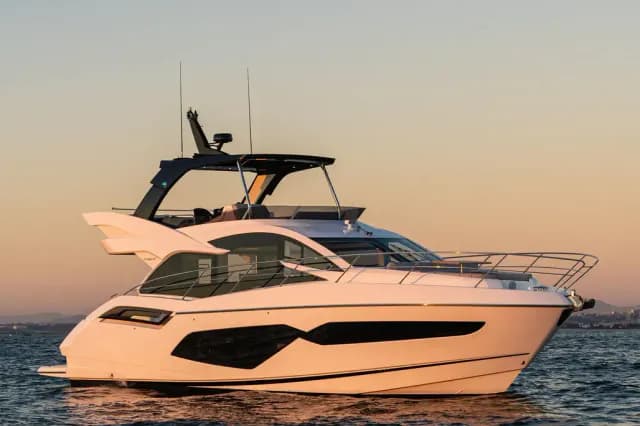
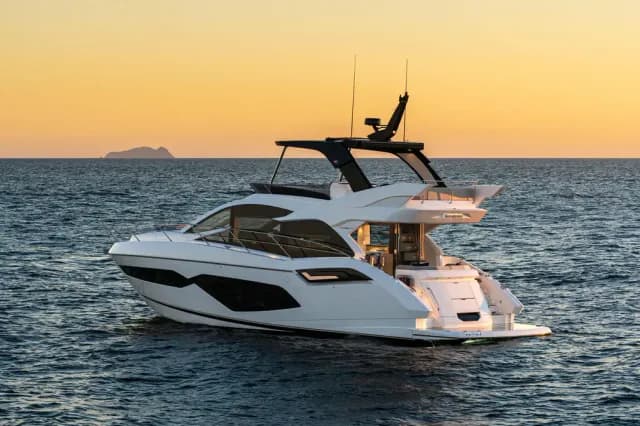
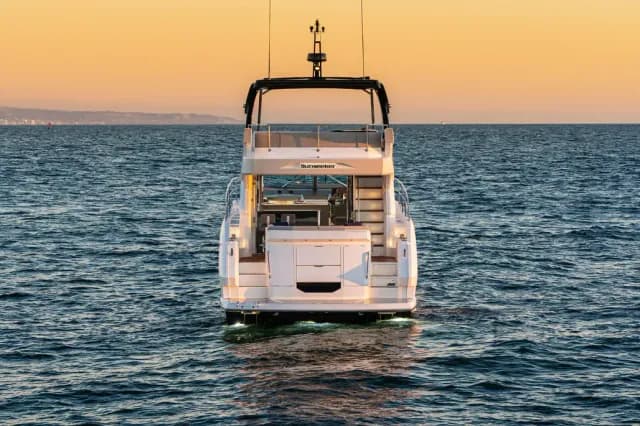
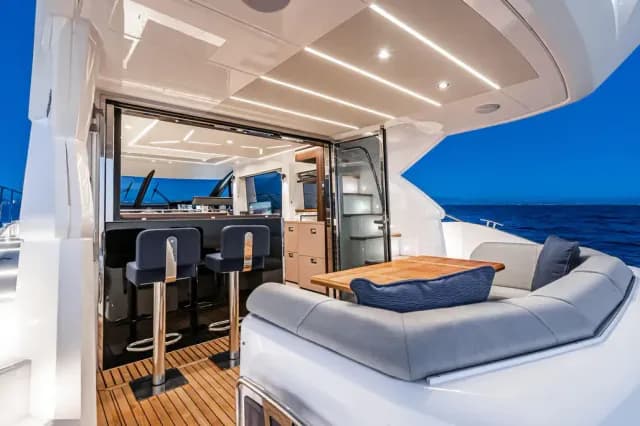
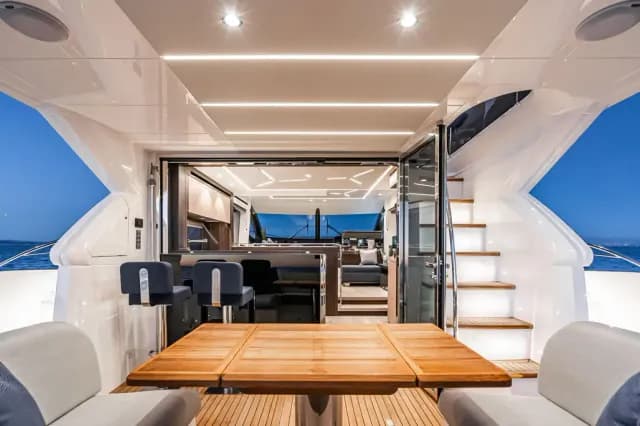
2024 Sunseeker Manhattan 55 - Exquisite British Craftsmanship
Sunseeker Manhattan 55 Specifications
| Specification | Detail |
|---|---|
| LOA | 17.21 m (56 ft 6 in) |
| Beam | 4.87 m (16 ft 0 in) |
| Draft | 1.26 m (4 ft 2 in) |
| Displacement | 27,000 kg (59,525 lbs) |
| Hull material | GRP (fibreglass) |
| CE category | B (Offshore) |
| Fuel capacity | 2,200 litres (581 US gal) |
| Water capacity | 600 litres (158 US gal) |
| Standard engines | 2× Volvo Penta D13-800 shaft drives (800 HP each) |
| Optional engines | Volvo Penta IPS-950 / IPS-1050, MAN i6 800PS |
| Top speed | 30 knots (32.5 knots on test) |
| Cruising speed | 25 knots |
| Economy speed | 7.8 knots |
| Range at economy | 572 nm |
| Range at cruise | 250 nm |
| Cabins | 3 (master full-beam amidships + VIP forward + twin starboard) |
| Heads | 2 (1 en suite to master, 1 shared / day head) |
| Optional crew cabin | Aft, beneath cockpit |
| Builder | Sunseeker International, Poole, UK |
| Interior design | Design Unlimited |
| Production | Gen 1: 2013–2016 | Gen 2: 2021–present |
These numbers describe a boat optimised for Mediterranean-style coastal cruising with occasional offshore passages. The 2,200-litre fuel capacity is adequate for the Manhattan 55’s intended use pattern but notably less than the Princess F55’s 2,748 litres (726 US gal) — a point competitors are quick to highlight. The 600-litre water tank is generous for a motor yacht of this size and supports extended weekends without shore connections. The 1.26 m draft keeps shallow-water options open, particularly in the Bahamas, Croatia, and the Greek islands where many of these boats cruise. At 27,000 kg displacement, the Manhattan 55 is a substantial vessel — it rides well in a chop and feels planted at cruising speed, though the weight demands serious horsepower to achieve planing speeds, hence the standard 2×800 HP Volvo Penta D13 engines.
Performance & Handling
Top speed: The standard twin Volvo Penta D13-800 shaft drive configuration delivers a top speed of 30 knots in standard trim. On test, with a clean hull and optimal conditions, 32.5 knots has been recorded — impressive for a flybridge motor yacht displacing 27 tonnes. The boat reaches planing speed at approximately 16 knots and transitions cleanly, without the dramatic bow-rise that plagues some competitors in this weight class.
Cruising: The sweet spot is 25 knots, where the engines are working comfortably and fuel consumption is manageable. At this speed, range is approximately 250 nautical miles — enough for a comfortable hop between Mediterranean ports but insufficient for extended blue-water passages. Drop to the economy speed of 7.8 knots (semi-displacement mode) and range extends to 572 nm, transforming the Manhattan 55’s capabilities for longer repositioning passages.
Engine choice: Approximately 70% of buyers choose the standard shaft drive configuration over the optional Volvo Penta IPS-950 or IPS-1050. The shaft drive’s advantages are lower purchase cost, simpler maintenance, and mechanical familiarity for experienced motor yacht owners. The IPS option, however, provides significantly better low-speed manoeuvrability — including joystick docking — and marginally better fuel economy at cruising speed. For owners who plan to berth regularly in tight Mediterranean marinas, the IPS is worth serious consideration despite its higher cost and the complexity of its electronic vessel control (EVC) system. The MAN i6 800PS is the third option, favoured by some European buyers for its perceived durability, though Volvo dominates order books.
Sea-keeping: The Manhattan 55 is a deep-V hull designed for comfort at speed. In moderate seas (up to 1.5 m), it delivers a composed, predictable ride at cruising speed. In rougher conditions, the flybridge becomes less comfortable and most owners retreat to the lower helm. The CE Category B (Offshore) rating permits operation in winds to Beaufort 8 and seas to 4 metres — though few owners would choose to push the boat in those conditions. The hull handles beam seas better than most in its class, thanks to the wide 4.87 m beam providing stability, though it can develop an uncomfortable roll at anchor in exposed anchorages.
Honest assessment: The Manhattan 55 is not a sports boat. It is a flybridge cruiser that happens to be capable of 30+ knots. Its true strength is delivering a smooth, comfortable, and surprisingly quiet ride at 20–25 knots, with enough reserve power to get home quickly when weather deteriorates. Owners who buy this boat for top-speed runs will burn through fuel and miss the point. Those who cruise at 22–25 knots, use the flybridge for sundowners, and exploit the beach club at anchor will understand exactly why the Manhattan 55 outsells its competitors.
Interior Layout & Living Aboard
The Manhattan 55’s interior is arranged across three cabins below decks. The master cabin sits full-beam amidships — an arrangement that maximises space and minimises motion at sea. It features a centreline island berth, walk-around access on both sides, generous wardrobe storage, and an en-suite head with separate shower stall. The quality of the master cabin is frequently cited by owners as one of the boat’s standout features — it feels genuinely luxurious, not merely “good for a boat.”
Forward, the VIP cabin offers a double berth with its own access to the shared day head. To starboard, a twin cabin provides flexibility for families or crew. An optional crew cabin aft, beneath the cockpit sole, adds a compact but functional berth for professional crew — increasingly common on boats in this segment used for Mediterranean charter or by owners who prefer a skipper aboard.
The main deck is where the Manhattan 55 distinguishes itself from the competition. The powered glass galley window — Sunseeker’s signature feature — slides open to merge the galley with the cockpit, creating a single indoor-outdoor entertaining space. In practice, this transforms the main deck experience: the cook is no longer isolated below or behind a closed window, and the flow between the galley, the salon, and the aft cockpit becomes seamless. The galley itself is equipped with Miele appliances and Vitrifrigo refrigeration — a notch above the standard domestic equipment found in many competitors.
The flybridge is 25% larger than the class average, with a wet bar, generous seating, and a helm station that provides excellent all-round visibility. Most owners spend the majority of their time here in fair weather, and the space is large enough to comfortably host 8–10 guests. The foredeck sunpad provides a further lounging area, accessible via wide side decks with secure handholds.
Aft, the beach club with hydraulic bathing platform has become a defining feature of the modern flybridge yacht. On the Manhattan 55, it deploys to create a waterline-level platform for swimming, tender launching, or simply sitting with feet in the water. When retracted, it forms a clean transom that integrates with the cockpit. The combination of flybridge, main deck salon, cockpit, and beach club gives the Manhattan 55 four distinct living zones — an unusual amount of versatility for a 55-foot boat.
Sunseeker Manhattan 55 Ownership: What to Expect
Owning a 55-foot flybridge motor yacht is a materially different proposition from smaller boat ownership. The Manhattan 55 demands a realistic annual budget that covers the following principal cost areas:
- Insurance: 1.5–2.0% of hull value. For a boat insured at £1.0–1.4 million, this translates to approximately £20,000–£28,000 per year. Mediterranean cruising grounds sit at the lower end; transatlantic deliveries or Caribbean hurricane-season cover push premiums higher.
- Marina berth: A 17-metre berth in the Mediterranean ranges from €15,000–€25,000 per year depending on location. Premium ports (Antibes, Puerto Portals, Porto Cervo) command significantly more. UK marina berths are typically £8,000–£15,000 per year.
- Engine servicing: Twin Volvo Penta D13 engines require annual servicing at approximately £3,000–£5,000 per service. Major service intervals (every 500–1,000 hours) can reach £8,000–£12,000. Raw water pump replacement is recommended every two years — a known weak point across Volvo marine diesel installations.
- Haul-out and antifouling: £5,000–£8,000 for a boat of this size, including travel lift, pressure wash, antifouling, anode replacement, and hull inspection.
- Winterisation: Essential for northern European owners. Full winterisation including engine, generator, water systems, and shrink-wrap or indoor storage runs £2,000–£4,000.
- Approximate total: £50,000–£80,000 per year depending on location, usage, and maintenance philosophy. This figure shocks many first-time owners but is consistent across the 55-foot flybridge segment.
The Manhattan 55 is charter-relevant in the Mediterranean, particularly in Croatia and the French Riviera, where skippered charter rates of $16,000–$25,000 per week are achievable during peak season. Some owners offset running costs through a managed charter programme, though wear and tear on charter boats is significantly higher than on privately used vessels, and this is reflected in resale values.
Owner feedback — strengths: Build quality, indoor-outdoor living enabled by the powered glass galley window, performance (32.5 knots on test), flybridge space (25% larger than the class average), beach club utility, master cabin quality, Miele and Vitrifrigo galley specification, and the simple fact that this is the fastest-selling Sunseeker ever built — strong residual demand supports resale values.
How to Buy a Sunseeker Manhattan 55: What to Look For
Generations explained: The Manhattan 55 name spans two distinct generations. Gen 1 (2013–2016) boats are now available pre-owned at significantly lower price points but represent an older design philosophy with a narrower beam and less refined interior. The Manhattan 52 (2018–2020) bridged the gap between generations — it shares the Gen 2’s wider beam and updated design language but at a slightly smaller LOA. Over 130 units of the Manhattan 52 were sold, making it the most available Sunseeker in this size range on the used market. The Gen 2 Manhattan 55 (2021–present) is the current production model and a substantially different boat from the Gen 1, with a wider beam, redesigned interior, improved structural engineering, and the full indoor-outdoor living package. Buyers should be clear about which generation they are considering — price, specification, and market positioning differ significantly.
Known Issues to Inspect
- HVAC system: Owners report persistent issues with air conditioning performance, particularly uneven cooling across cabins and compressor reliability. Inspect the HVAC system thoroughly during survey — replacement or upgrade is expensive on a boat of this size.
- Structural flex: Some owners report doors and windows not sealing properly, attributed to structural flex under way. This manifests as whistling or minor water ingress at speed. Check all door and window seals carefully during sea trial.
- Volvo EVC complexity: The electronic vessel control system on Volvo-powered boats is sophisticated but can be costly to diagnose and repair. Ensure the complete Volvo service history is available and that all software updates have been applied. Intermittent EVC faults are the single most common cause of unplanned yard visits.
- Raw water pump lifespan: The raw water impeller pumps on Volvo D13 engines have an expected lifespan of approximately two years under normal use. Budget for regular replacement and check service records for evidence of proactive maintenance.
- Fuel capacity limitation: At 581 US gallons, the Manhattan 55’s fuel capacity is notably less than the Princess F55’s 726 gallons. This limits range at cruising speed and can be a genuine operational constraint on longer passages. It cannot be easily remedied after purchase.
Shaft Drive vs IPS
This is the single most consequential specification decision on the Manhattan 55. Approximately 70% of buyers choose shaft drives, primarily for lower acquisition cost, mechanical simplicity, and familiarity. However, shaft-drive boats are significantly harder to manoeuvre at low speed — there is no joystick docking, and twin-engine handling requires confidence and practice. IPS-equipped boats offer joystick control, making tight marina berths straightforward, and deliver marginally better fuel economy at cruise. The trade-off is higher purchase price, greater mechanical complexity, and the Volvo EVC system that some owners find frustrating. For buyers who will regularly berth in crowded Mediterranean marinas, IPS is strongly worth considering. For those with open-water moorings or extensive motor yacht experience, shafts remain the pragmatic choice.
What to Check on Survey
Beyond the items listed above, a pre-purchase survey should include: a thorough sea trial at all speed ranges (displacement, semi-displacement, and planing), full inspection of the hydraulic bathing platform mechanism, testing the powered galley window operation, checking generator hours and condition, inspecting shaft alignment (shaft-drive boats), verifying bow and stern thruster operation, and confirming that all electronic systems — particularly the Volvo EVC, Garmin or Raymarine navigation suite, and stabiliser system if fitted — are fully functional. Complete Volvo Penta service history documentation is essential; boats without it should be priced accordingly or avoided.
Sunseeker Manhattan 55 vs Competitors
The Sunseeker vs Princess comparison is the most fiercely debated rivalry in British motor yachting — both headquartered in the south of England, both targeting the same buyer at every size. The Manhattan 55 vs Princess F55 is the most directly comparable flybridge pair on the market, and MBY’s head-to-head video of the two generated massive engagement. But the competitive set extends beyond this Anglo-Saxon rivalry. Italian builders Ferretti and Azimut offer distinct alternatives, and Sunseeker’s own Predator range presents an internal choice for buyers who want the badge but a different character of boat.
Sunseeker Manhattan 55 vs Princess F55
The “BMW vs Mercedes” of the flybridge world. The Princess F55 is the Manhattan 55’s most direct competitor and the most searched comparison in the flybridge segment. The F55 offers a larger fuel tank (726 US gallons vs 581), an optional fourth cabin, and a slightly deeper draft that improves sea-keeping in rough water. Its styling is more understated — conservative where the Manhattan is bold — and the interior finish leans towards a more traditional British aesthetic. The F55’s additional fuel capacity is a genuine operational advantage, extending range at cruising speed by approximately 35%. For buyers who value range and a fourth cabin over the Manhattan’s larger flybridge and powered galley window, the Princess is the obvious cross-shop. Both boats hold their value well, and the choice between them often comes down to styling preference and dealer relationship.
Sunseeker Manhattan 55 vs Ferretti 550
Now discontinued (produced 2015–2022), the Ferretti 550 is available pre-owned only. Powered by MAN engines with a larger fuel capacity than the Manhattan, the Ferretti brings Italian craftsmanship and a distinctly Mediterranean design philosophy. Interior woodwork is exceptional, and the hull design delivers a comfortable ride. On the used market, the Ferretti 550 typically trades at a slight premium to equivalent-year Manhattans, reflecting both the Italian brand’s cachet and the lower production numbers. Maintenance costs for MAN engines are broadly comparable to Volvo, though parts availability outside of Europe can be more limited.
Sunseeker Manhattan 55 vs Azimut Magellano 53
A fundamentally different concept. The Magellano 53 is a semi-displacement long-range cruiser, not a planing flybridge yacht. Where the Manhattan 55 reaches 30 knots and covers 250 nm at cruise, the Magellano cruises at 10–12 knots and achieves a range of approximately 900 nm. The Magellano is for the buyer who wants to cover distance in comfort rather than arrive quickly — think Scandinavian coastlines, the ICW, or extended Mediterranean circuits. It is included here because buyers in the 55-foot bracket genuinely cross-shop these two philosophies: speed versus range, planing versus displacement. They are not directly comparable on specification, but they compete for the same chequebook.
Sunseeker Manhattan 55 vs Sunseeker Predator 55
The Manhattan’s sportier sibling within the Sunseeker range. Same manufacturer, very different character. The Predator trades the Manhattan’s flybridge for a lower profile, harder chine, and more aggressive styling. Performance is sharper, with higher top speeds from equivalent power. The interior sacrifices the Manhattan’s full-beam master and third cabin for a more open-plan layout oriented around the cockpit and helm. The Predator buyer wants a sports cruiser that happens to have overnight accommodation; the Manhattan buyer wants a floating home that happens to go fast. They rarely cross-shop in practice, but the choice between Manhattan and Predator is the first fork in the road for any buyer entering a Sunseeker dealership at this size.
For a full interactive depreciation comparison between the Sunseeker Manhattan 55 and competing models, visit the Hulls.io Market Intelligence tool.
Owner feedback — concerns: While the Manhattan 55 is a genuinely impressive boat, prospective buyers should weigh several recurring owner concerns: the fuel capacity deficit relative to the Princess F55 (581 vs 726 US gallons), HVAC reliability issues, reports of structural flex causing door and window seal failures, Volvo EVC system complexity and diagnostic costs, raw water pump lifespan of approximately two years requiring proactive replacement, and the fact that shaft-drive boats — chosen by 70% of buyers — offer less manoeuvrability at low speed than IPS-equipped alternatives. None of these are dealbreakers, but all should be factored into the purchase decision and ongoing ownership budget.
Sunseeker Manhattan 55 Value Retention
Newest vintage = 100%. Older vintages shown as % of that price.
Based on median asking prices by model year. The newest model year in our dataset is used as the 100% reference point. The curve is smoothed so retention never increases as age increases — hover over data points to see raw values. Shaded band shows the 25th–75th percentile price range. Figures reflect asking prices from tracked listings, not final sale prices.