


Tayana 48 Center Cockpit for Sale
Center Cockpit Bluewater CruiserThe Tayana 48 Center Cockpit is a Robert H. Perry-designed bluewater passage maker built by Ta Yang Building Co. in Kaohsiung, Taiwan since 1992. With over 200 hulls launched, the 48 CC has established itself as one of the most proven offshore cruising platforms of the past three decades — combining heavy-displacement stability (28,000 lbs ballast on a 38,000 lb displacement), a protected center cockpit, and the aft-cabin privacy that long-range cruising couples demand. The fin keel with skeg-hung rudder provides directional stability and rudder protection for grounding events. Ta Yang's reputation for solid fibreglass layup and teak craftsmanship has made the Tayana name synonymous with value-oriented bluewater cruising.
Show 2 awards
Show 6 key features
Updated 10 June 2026 · By Hulls.io Editorial
The Tayana 48 Center Cockpit: A Complete Guide
The Tayana 48 Center Cockpit is a Robert H. Perry-designed bluewater cruiser built by Ta Yang Yacht Building Co. in Kaohsiung, Taiwan. With over 200 hulls built since 1992, the Tayana 48 CC is one of the most proven offshore passage-makers in its size class — a yacht that combines genuine ocean-going capability with superb Taiwanese teak joinery, a practical three-cabin layout, and the kind of solid, hand-laminated fibreglass construction that gives owners confidence to cross oceans.
The design evolved from the Tayana 47 CC, also a Perry creation, which was produced in the mid-1980s for only a few years. In 1992, the addition of an integrated sugar-scoop swim platform extended the stern, bringing the LOA to 48 feet. The core hull lines remained identical — Perry’s proven fin keel with skeg-hung rudder underbody — but the construction was improved with vinylester resin (from 1992 onwards), significantly reducing the risk of osmotic blistering that affected earlier Taiwanese-built yachts. The result was a yacht that kept everything sailors loved about the 47 while addressing its few weaknesses.
Robert H. Perry is one of the most prolific and influential yacht designers of the modern era, with over 380 designs and more than 6,000 launched boats to his credit. Born in Toledo, Ohio, Perry grew up in Seattle, apprenticed with Jay Benford and Dick Carter, and opened his own design office on Shilshole Bay in 1974. His landmark design was the Valiant 40 — a yacht that effectively created the “performance cruiser” category by combining a traditional canoe-stern aesthetic with a modern fin keel and skeg-hung rudder. The Tayana 48 is a direct expression of this philosophy: it looks traditional, sails like a modern yacht, and is built to go anywhere.
“Ta Yang” means “big ocean” in Mandarin, and “Tayana” means “belongs to big ocean.” Founded in 1973 in Kaohsiung, the yard has built over 1,400 bluewater cruisers across models ranging from the iconic Tayana 37 (over 600 hulls, designed by Perry) to the Tayana 64/65. The Tayana 48 sits at the heart of the range — large enough for serious liveaboard cruising, small enough for a couple to handle, and priced to be achievable for experienced sailors planning their dream passage.
Hulls.io currently tracks 1 active listing for the Tayana 48 Center Cockpit, drawn from brokerages worldwide.
Showing 1–1 of 1 results
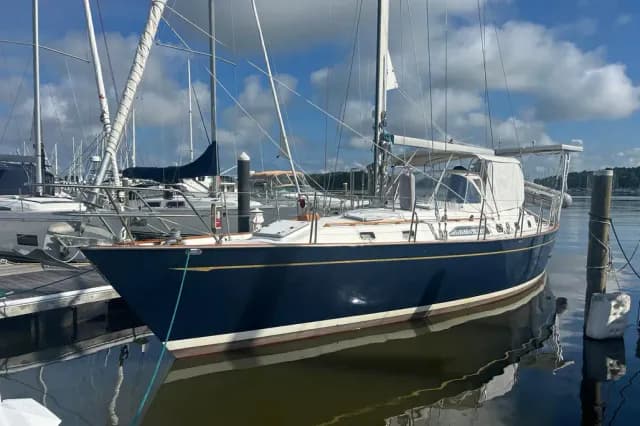
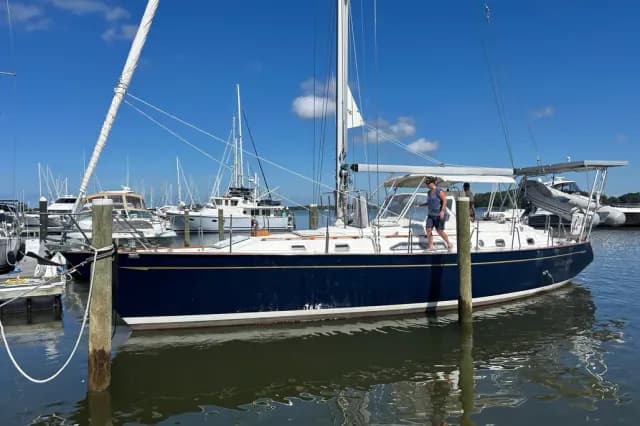
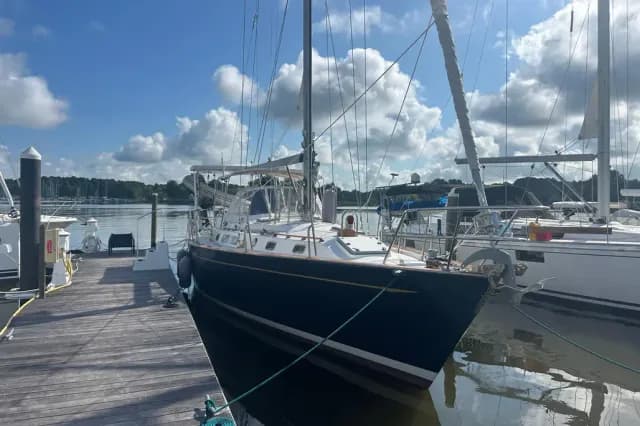
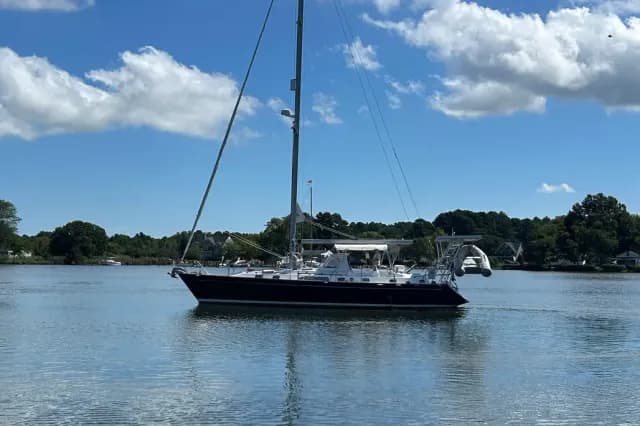
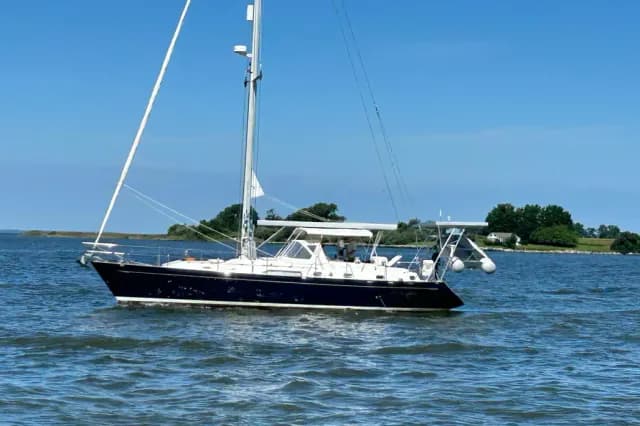
1995 Tayana 48 Center Cockpit
Tayana 48 CC Specifications
| Specification | Detail |
|---|---|
| LOA | 14.63 m (48 ft 0 in) |
| LWL | 12.19 m (40 ft 0 in) |
| Beam | 4.42 m (14 ft 6 in) |
| Draft (standard) | 1.83 m (6 ft 0 in) — fin keel |
| Draft (shoal) | 1.60 m (5 ft 3 in) — lead ballast |
| Displacement | 15,422 kg (34,000 lbs) |
| Ballast | 5,443 kg (12,000 lbs) |
| Ballast ratio | ~33% |
| D/L ratio | 239 |
| SA/D ratio | 19.68 |
| Capsize screening | 1.77 (below 2.0 ocean threshold) |
| Comfort ratio | 36.1 |
| Rig | Cutter — double-spreader, Selden anodized aluminium |
| Working sail area | 97.4 m² (1,048 sq ft) |
| Mast height (from DWL) | 21.3 m (70 ft) — performance rig |
| Engine | Yanmar 4-cylinder diesel (75–100 HP options) |
| Fuel capacity | 454 litres (120 US gal) |
| Water capacity | 833 litres (220 US gal) |
| Cabins | 3 staterooms |
| Heads | 2 (each with separate shower stall) |
| Hull construction | Hand-laminated GRP — solid below waterline, PVC foam-cored above |
| Naval architecture | Robert H. Perry |
| DS version | Rob Ladd (deck salon conversion) |
| Builder | Ta Yang Yacht Building Co., Kaohsiung, Taiwan |
| Production years | 1992–present (evolved from Tayana 47 CC, mid-1980s) |
| Hulls built | 200+ |
The numbers tell the story of a genuine offshore yacht. The displacement/length ratio of 239 places the Tayana 48 in the moderate range — heavy enough for a comfortable motion in ocean swells, light enough to sail efficiently. The capsize screening formula of 1.77 falls comfortably below the 2.0 threshold required for offshore racing qualification, confirming the hull’s inherent stability. The comfort ratio of 36.1 places the yacht firmly in the bluewater cruiser category — expect a smooth, forgiving motion during extended passages rather than the quick, sharp response of a lighter performance boat.
The cutter rig is the sail plan of choice for serious offshore sailing. The double-spreader Selden aluminium mast carries a mainsail, genoa, and staysail, allowing progressive sail reduction as conditions build. In heavy weather, the staysail alone provides enough drive to maintain steerage without the complexity and risk of managing large headsails. The 70-foot mast height provides excellent sail area for light-air performance, though an ICW-friendly (Intracoastal Waterway) rig option was available for owners planning coastal US cruising.
Performance & Sailing
The Perry underbody: Perry’s fin keel with skeg-hung rudder is the design’s most important contribution to handling. Unlike full-keel boats that resist course changes and require significant rudder input to tack, the Tayana 48’s fin keel provides responsive helm feel and efficient windward performance. Unlike pure fin-and-spade configurations that can feel nervous in heavy following seas, the skeg-hung rudder provides directional stability and protects the rudder from floating debris. It is the optimal compromise for a yacht that needs to perform well in all conditions, from Caribbean trade-wind sailing to heavy-weather passages.
Speed: The theoretical hull speed is 8.5 knots. In moderate to fresh conditions (15–20 knots of true wind), the Tayana 48 reaches hull speed comfortably and will occasionally surf beyond it off the wind. The SA/D ratio of 19.68 reflects a well-balanced sail plan — enough canvas to drive the yacht efficiently without being overpowered in building conditions. Below 10 knots of true wind, the 34,000-pound displacement makes the yacht sluggish — this is a passage-maker optimised for the trade winds, not a light-air daysailer.
Passage-making: The Tayana 48 has an extensive bluewater record. At least one hull (S/Y TUTKUM) has completed a full circumnavigation. Multiple Tayana 48s have crossed the Atlantic and Pacific, cruised the Caribbean circuit, and completed extended Pacific island-hopping voyages. The 220-gallon water capacity and 120-gallon fuel tankage support extended passages, and the cutter rig allows shorthanded crews to manage the boat safely in deteriorating conditions. The ballast ratio of 33% provides a strong righting moment for confidence in gusty winds and rough seas.
Shorthanded capability: The Tayana 48 was designed for a cruising couple to manage without crew. The LeisureFurl boom with electric main halyard winch simplifies mainsail handling, all running rigging is led aft to the center cockpit for convenient single-point sail management, and the cutter rig allows incremental sail reduction without leaving the cockpit. Electric Lewmar primary winches and a Max-Prop auto-feathering propeller complete the shorthanded package. This is a yacht built for the retirement dream — a couple, a plan, and the open ocean.
Interior Layout & Craftsmanship
The center cockpit configuration defines the Tayana 48’s interior arrangement. The cockpit sits amidships, creating two distinct living zones: the salon, galley, and forward cabins forward of the cockpit, and a private owner’s suite aft. This separation is the defining advantage of a center cockpit design — the aft master stateroom is completely isolated, providing privacy for the owners while guests or crew occupy the forward cabins.
Aft master stateroom: The full-width owner’s suite features a centreline queen berth accessible from both sides, an en-suite head with separate shower stall, and extensive hanging and drawer storage. Headroom is 6 ft 3 in to 6 ft 4 in. The cabin sits beneath the center cockpit and aft deck, making it one of the quietest, most stable locations on the yacht — close to the waterline and near the vessel’s pivot point, minimising pitching motion during passage.
Salon: The main salon is raised 6 inches from the forward passageway, providing 6 ft 6 in headroom. A J-shaped dinette to port and straight settee to starboard create comfortable seating for six. The navigation station sits to starboard of the companionway, with an L-shaped console providing separate workspaces for chartwork and electronics. The entire interior is finished in solid teak and teak veneers — the hallmark of Taiwanese yacht building at its best.
Galley: Located to port, down 6 inches from the salon, with Corian countertops, tall fiddles, and toe kicks for security at sea. A three-burner stove/oven with stainless steel crash bar, top-loading and front-loading refrigerator and freezer (stainless-lined with automatic lights), and a four-drawer bank beneath the counter provide the storage and functionality required for extended cruising.
Forward cabins: A forward guest stateroom with V-berth or double berth (6 ft 5 in headroom) and a third cabin complete the three-stateroom layout. A forward head with separate shower stall serves the forward cabins. The arrangement accommodates six to eight comfortably — a genuine three-couple cruising yacht.
The Deck Salon (DS) version: In the early 2000s, designer Rob Ladd created a deck salon variant using Perry’s original hull. Ladd raised the salon sole and added panoramic windows, creating a pilothouse-style atmosphere with 7 ft headroom (versus 6 ft 6 in on the standard) and dramatically improved natural light. The raised sole also created additional tankage below. The DS is generally considered the superior version for offshore sailing, offering all-weather visibility without the structural concerns of the pilothouse variant’s large square windows.
Ventilation: Fifteen stainless steel opening ports, five deck hatches, dorade vents, and Hella fans throughout provide excellent airflow — a critical consideration for tropical cruising where the Tayana 48 spends much of its working life. The boat was designed for the tropics as much as for the open ocean.
Tayana 48 CC Ownership: What to Expect
The Tayana 48 occupies the sweet spot of the bluewater cruising market — serious offshore capability at a price point that remains accessible to experienced sailors planning extended voyages:
- Used pricing: Early 1990s hulls start from approximately USD 150,000–250,000 depending on condition. The sweet spot for well-maintained examples is 1998–2005 production at USD 225,000–400,000. DS versions command a USD 30,000–60,000 premium over equivalent-year standard center cockpit models. Late-production boats (2010–2018) reach USD 400,000–550,000+.
- Insurance: 1.0–1.5% of agreed hull value. On a boat insured at USD 300,000, expect approximately USD 3,000–4,500 per year. The Tayana 48’s solid construction record and experienced owner profile typically secure reasonable terms from specialist marine insurers.
- Maintenance: Annual maintenance on a 48-foot bluewater cruiser — including engine service, antifouling, systems maintenance, and minor repairs — runs USD 8,000–15,000. The teak deck requires ongoing attention to caulking between planks and will eventually need partial or full replacement (USD 30,000–80,000+ after 20–30 years).
- Standing rigging: On boats now 20–30+ years old, standing rigging is likely original and due for replacement. Budget USD 15,000–25,000 for a full re-rig including shrouds, stays, swages, and turnbuckles.
- Value retention: The Tayana 48 has held value well compared to many production bluewater boats, supported by Perry’s design pedigree, solid build quality, and a loyal owner community. Well-maintained examples with recent upgrades (new rigging, electronics, sails, lithium batteries) command significant premiums on the brokerage market.
The TOG (Tayana Owners Group): Tayana boasts one of the most active owners’ groups of any production sailboat manufacturer. The TOG News website and mailing list provide detailed technical information, searchable maintenance archives, and an engaged community of owners who respond to questions. For prospective buyers, joining TOG before purchasing is essential — the collective knowledge of hundreds of Tayana owners is an invaluable resource for identifying the right boat and planning a refit.
How to Buy a Tayana 48 CC: What to Look For
With over 200 hulls built across three decades, the Tayana 48 is well-represented on the brokerage market. Production quality is generally consistent, but specific inspection areas deserve close attention:
Key Inspection Areas
- Chainplates: The most critical inspection area on any Tayana. Chainplates are mounted to laminated knees on the inside of the hull. Moisture can wick in around the penetrations, causing waterlogged plywood in the knees, corroded stainless steel (crevice corrosion), and loose bolts. Look for discolouration at nuts and backing plates. Accessing chainplates requires removal of interior panels — any surveyor familiar with Tayanas will prioritise this area.
- Teak deck condition: Inspect caulking between planks for cracking or separation. Water infiltration through the teak deck to the fibreglass substrate is the primary deck-related concern. Check for soft spots around deck hardware, stanchion bases, and chainplate exits. Teak plugs should be 3/8 in diameter and bedded in flexible sealant (not epoxy or 5200).
- Hull blistering: All Tayana 48s (1992 onward) were built with vinylester resin, which significantly reduces blistering risk. However, boats stored long-term in warm tropical waters without adequate bottom maintenance may still show some osmotic blistering. Moisture meter readings across the hull bottom are essential.
- Water tanks: Some owners report poor welds on stainless steel water tanks that rust and leak. Inspect tank condition carefully — complete replacement is expensive and labour-intensive. Check for staining or corrosion around tank access panels.
- Rudder post: Early Tayana 47 hulls had insufficient rudder post bracing, which Ta Yang subsequently retrofitted. On the 48, this was largely addressed, but the rudder post bearing area should be inspected for play, water ingress, and corrosion.
- Standing rigging and engine: On boats 20–30 years old, verify rigging replacement history and engine hours. Oil analysis is recommended. The Yanmar diesels are reliable engines, but gaskets, hoses, and cooling systems deteriorate with age regardless of maintenance quality.
Engage a surveyor with specific experience in Taiwanese-built cruising yachts. The construction methods, materials, and typical failure modes differ from European and American builders, and an experienced surveyor will know exactly where to look. Cross-reference any findings with the TOG archives — most issues are well-documented with proven repair procedures.
Tayana 48 CC vs Competitors
The 45–50 foot center cockpit bluewater cruiser segment is one of the most competitive in sailing. Each competitor offers a different balance of performance, comfort, build quality, and price.
Tayana 48 CC vs Hylas 46
The Hylas 46 is a German Frers design also built in Taiwan (by Queen Long Marine). At 27,777 lbs, the Hylas is significantly lighter than the Tayana 48’s 34,000 lbs, with a higher SA/D ratio (20.5 vs 19.68) and a lower comfort ratio (31.3 vs 36.1). The Tayana is beamier, has more freeboard, and carries more sail area on its 70 ft rig. The Hylas offers a Frers-designed hull with superior light-air performance; the Tayana counters with more interior volume, a more forgiving motion offshore (higher comfort ratio), and generally lower brokerage prices. The Hylas is the better sailer; the Tayana is the better liveaboard.
Tayana 48 CC vs Island Packet 45
The Island Packet 45 is a Bob Johnson design built in Largo, Florida, with a full keel and cutaway forefoot. At 28,400 lbs with a shallow 5 ft draft, the IP 45 excels at gunkholing in thin water — a capability the Tayana’s 6 ft draft cannot match. The Island Packet offers American-built quality with a strong domestic service network. The Tayana counters with superior windward performance from the fin keel, more responsive helm feel, better passage-making speed, and lower used prices. The IP appeals to coastal cruisers who value shallow draft and American support; the Tayana appeals to offshore passage-makers who prioritise sailing performance.
Tayana 48 CC vs Hallberg-Rassy 46
The Swedish Hallberg-Rassy 46, with 132 hulls built between 1995 and 2005, is the European benchmark in this segment. The HR offers legendary Swedish build quality, the signature windshield and centre-cockpit protection, and a reputation as one of the finest bluewater cruisers ever produced. However, Hallberg-Rassy pricing is substantially higher — used HR 46s typically command USD 100,000–200,000 more than equivalent-year Tayana 48s. The Tayana offers comparable offshore capability, superior Taiwanese teak joinery, and significantly better value. The HR is the aspirational choice; the Tayana delivers 90% of the capability at 60% of the price.
Tayana 48 CC vs Valiant 42
The Valiant 42 is another Robert Perry design — the yacht that essentially created the performance cruiser category. At 42 feet, it is smaller and lighter than the Tayana 48, with a canoe stern that provides excellent downwind stability. The Valiant offers the same Perry design DNA in a more compact, more easily handled package. The Tayana counters with 6 additional feet of waterline, greater interior volume, the center cockpit layout with isolated aft master stateroom, and better accommodations for extended liveaboard cruising. Both are Perry designs; the Valiant is for purist sailors who value performance, the Tayana is for cruisers who need space.
For a full interactive comparison between the Tayana 48 CC and competing models, visit the Hulls.io Market Intelligence tool.