


Viking 45 Convertible for Sale
Sportfishing ConvertibleThe Viking 45 Convertible is an iconic American sportfishing yacht built at Viking Yachts' legendary facility in New Gretna, New Jersey. The 45 is a tournament-grade fishing machine that embodies everything Viking is known for — exceptional ride quality, cold-molded construction, a cavernous cockpit, and the kind of offshore performance that has won more billfish tournaments than any other brand. First introduced in 1989, the 45 Convertible became the most produced model in Viking's history and the entry point to the company's convertible range. The cold-molded hull construction — a Viking trademark involving multiple layers of wood laminate and fibreglass — delivers a hull that is lighter, stronger, and more resilient than conventional fibreglass, translating to better fuel efficiency and a softer ride in head seas. The 45 remains one of the most sought-after sportfishing boats on the used market, with well-maintained examples holding their value exceptionally well.
Show 2 awards
Show 6 key features
Related models
Updated 10 June 2026 · By Hulls.io Editorial
The Viking 45 Convertible: A Complete Guide
The Viking 45 Convertible is the most produced model in Viking Yachts’ history and the boat that defined the mid-range sportfishing convertible category. First introduced in 1987 and built across two generations — the original 45 Convertible (1987–1993) and the comprehensively redesigned Gen 2 (2003–2009) — the Viking 45 earned its place as the benchmark against which every competitor in the 43–46 ft sportfishing segment is measured. The model was succeeded by the Viking 46 Convertible (2010–2019) and the current Viking 44 Convertible, ensuring an unbroken lineage of mid-range Viking convertibles spanning nearly four decades.
Viking Yachts was founded on 1 April 1964, when brothers Bill and Bob Healey purchased Peterson-Viking Builders — a small, struggling manufacturer of 37-foot wooden sportfishing boats — in New Gretna, New Jersey. Bill, a Marine Corps veteran with a political science degree from St. Joseph’s College in Philadelphia, took charge of production. Bob, a corporate lawyer, ran the business side. In 1972, Viking introduced its first fibreglass model, the 33 Convertible, recognising the material’s superiority over wood. The Viking 40 Convertible debuted at the 1973 New York Boat Show and became a phenomenon — over 600 units of the 40/41 series were built over 16 years, at peak producing one boat every five days. That model established the template of vertical integration, in-house craftsmanship, and tournament performance that defines Viking to this day. The company remains family-owned under Bill’s son Patrick Healey, who assumed leadership in 2013.
What sets Viking apart is its extraordinary level of vertical integration. The New Gretna facility spans 880,000 square feet on 55 acres with over 800 employees, and approximately 90% of every Viking is manufactured in-house — from hull lamination and cabinetry to electrical harnesses, metalwork, and upholstery. Only engines, transmissions, pumps, electronics, and entertainment systems are sourced externally. The Viking Marine Group extends this self-sufficiency through subsidiary companies: Atlantic Marine Electronics (navigation, communications, and fishfinding systems, founded 2003), Palm Beach Towers (custom aluminium tuna towers and fiberglass hardtops, founded 2003), Valhalla Boatworks (centre-console boats, launched 2019), and the Viking Yacht Service Center in Riviera Beach, Florida. Viking has delivered over 5,000 boats since 1964, including 159 superyachts, and produces approximately 80 boats per year across models ranging from 33 to 105 feet.
The Viking tournament culture is legendary. In 2024, 44% of all pre-owned sportfish yachts sold were Vikings — compared to 28% each for Bertram and Hatteras. Viking owners dominate major billfish tournaments worldwide, and the 45 Convertible was the entry-level platform for many tournament teams that went on to fish Viking’s larger models. Owning a Viking is membership in a community, not merely a boat purchase.
Hulls.io currently tracks 1 active listing for the Viking 45 Convertible. Viking’s legendary value retention makes our market intelligence tools particularly useful for establishing fair market value on these sought-after sportfishers.
Showing 1–1 of 1 results
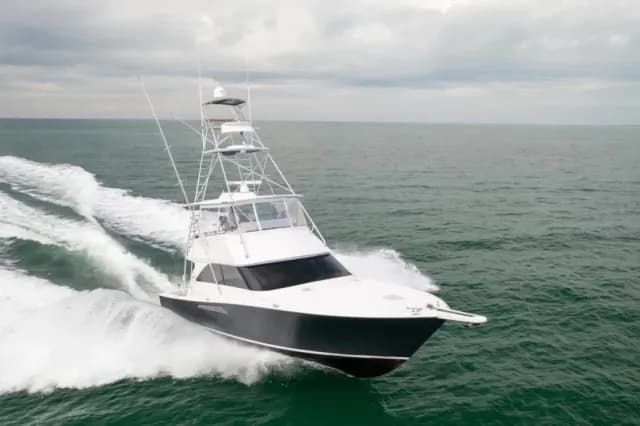
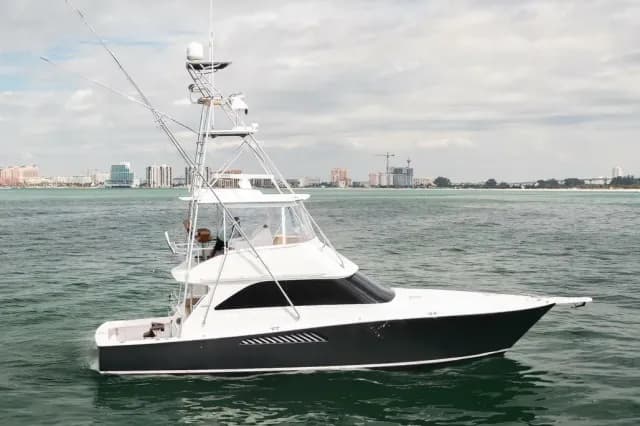
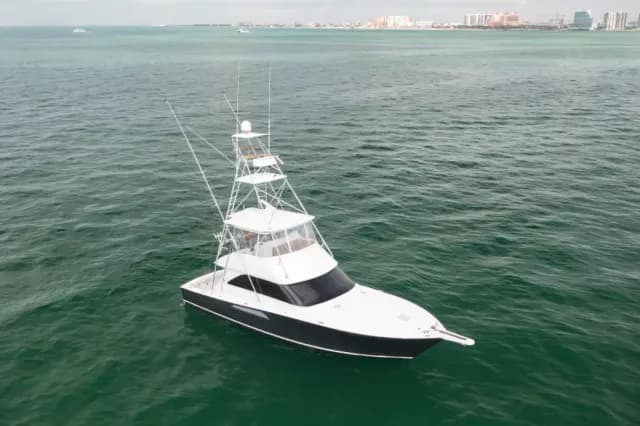
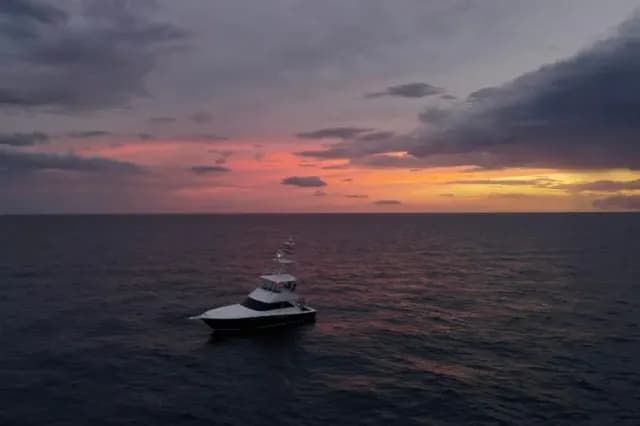
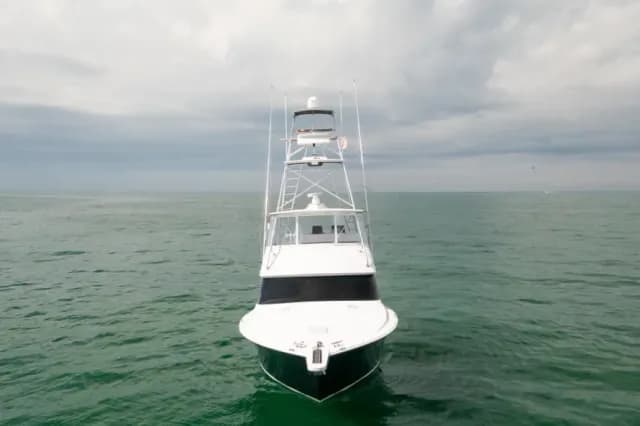
2003 Viking 45 Convertible 'Big Sky' - Extensively Upgraded Sportfish
Viking 45 Convertible Specifications
| Specification | Detail |
|---|---|
| LOA | 45 ft 10 in (13.97 m) |
| LOA (with bow pulpit) | 48 ft 10 in (14.88 m) |
| Beam | 16 ft 4 in (4.98 m) |
| Draft (full load) | 4 ft 6 in (1.37 m) |
| Displacement | ~50,550 lbs (22,930 kg) |
| Deadrise (aft) | 15 degrees |
| Hull construction | Vacuum-infused vinylester resin, balsa/foam core |
| Fuel capacity | 665–848 US gal (varies by year) |
| Water capacity | 150 US gal (568 litres) |
| Holding tank | 50 US gal |
| Engines (2003–2007) | 2× MAN D2848LE 403, 800 HP each |
| Engines (2008+) | 2× MAN V8-900 CRM, 888 HP each |
| Top speed | 35 knots (MAN V8-900) |
| Cruising speed | 30 knots at 2,100 RPM |
| Range at cruise | ~401 NM |
| Cockpit area | 128 sq ft |
| Staterooms | 2 (master + guest) |
| Heads | 2 (each with stall shower) |
| Outriggers | Rupp hydraulic (standard) |
| Builder | Viking Yachts, New Gretna, New Jersey |
| Production | Gen 1: 1987–1993 | Gen 2: 2003–2009 |
| Successor | Viking 46C (2010–2019), Viking 44C (2017–present) |
The Gen 2 (2003–2009) represented a comprehensive redesign over the Gen 1 (1987–1993). The beam increased from 15 ft 0 in to 16 ft 4 in, the single head became two full en-suite heads, MAN diesels replaced the original Detroit Diesel 6V92 turbos, fuel capacity grew from 600 to 665–848 gallons, and the cockpit expanded to a tournament-grade 128 sq ft. The 2008 model year brought a radical interior reconfiguration: the salon sliding door entry moved to starboard, the companionway reversed to port (matching Viking’s larger convertibles), the galley shifted from a U-shape on the port side to an L-shape with island to starboard, and the engines upgraded to the MAN V8-900 CRM producing 888 hp per side.
Hull construction uses vacuum-infused vinylester resin with engineered composite fibreglass fabrics over end-grain balsa and closed-cell foam coring. Viking calculates the resin-to-fibreglass ratio precisely for optimal stiffness-to-weight, producing hulls that are approximately 15% lighter and significantly stiffer than conventional hand-laid fibreglass of the same dimensions. Powder-coated structural steel web frame engine beds carry the MAN diesels, and the modified-V hull with raked forward stem delivers a 15-degree aft deadrise that balances stability at rest — critical for drift fishing — with a comfortable ride in chop. This is the construction method that costs more and takes longer, but that Viking has never compromised on.
Performance & Sea-Keeping
Top speed: With the 2008+ MAN V8-900 CRM engines (888 hp each, 1,776 hp combined), the Viking 45 reaches approximately 35 knots at wide-open throttle. Earlier models with the MAN D2848LE 403 (800 hp each) achieved 34.6 knots. These are outstanding numbers for a 50,550 lb sportfishing yacht and reflect the vacuum-infused hull’s weight advantage over conventional fibreglass construction. The current successor, the Viking 44C with optional 1,000 hp Volvo Penta D13 engines, pushes past 38 knots — evidence of the continuous refinement Viking applies to each generation.
Cruise: A comfortable cruise of 30 knots at 2,100 RPM is the standard operating speed, with fuel burn of approximately 56–60 GPH combined. With the 848-gallon tank fitted to 2008 models, practical range reaches approximately 401 nautical miles — covering virtually any tournament day, Northeast canyon runs, and south Florida to Bahamas crossings with comfortable fuel reserves. Earlier models with 665-gallon tanks deliver approximately 330 NM at cruise. Fuel efficiency runs approximately 0.5 MPG at cruise, dropping to 0.25 MPG under heavy throttle — numbers that are competitive for the class.
Ride quality: This is where the Viking 45 truly distinguishes itself. The vacuum-infused hull delivers a ride that is noticeably softer and quieter than conventional fibreglass sportfishers in head seas. The hull dampens vibration and impacts in a way that reduces crew fatigue during long offshore runs — a genuine competitive advantage during multi-day tournament fishing where comfort translates directly to performance. The 15-degree aft deadrise provides the stability needed for drift fishing while the raked forward stem with Carolina flare and sharp entry slices through 4–6 foot seas at speeds competitors cannot match.
Sea-keeping: The Viking 45’s hull form is designed for running offshore in conditions that keep lesser boats at the dock. The combination of deadrise, entry angle, chines and strakes for spray knockdown and directional stability, and the vacuum-infused construction’s inherent damping properties creates a boat that inspires confidence in rough water. Owners report the ride can be wet in certain conditions — spray reaching the bridge in 1-foot chop at speed is a common observation for sportfishing convertibles of this size — but the hull tracks straight and true at speed, giving the captain confidence to keep running when conditions deteriorate.
Tournament-Grade Fishing Platform
The cockpit is the heart of any sportfishing convertible, and the Viking 45’s 128 sq ft of unobstructed fishing space is a masterpiece of functional design. The flush deck provides maximum working area for fighting fish, with a floor plate for a Release Marine fighting chair, Rupp hydraulic outriggers as standard, flush-mounted rod holders, and rounded gunwale edges that reduce knee wear during extended fishing sessions. In-deck insulated fish boxes provide approximately 360 quarts of chilled storage, and the transom door with lift-gate serves double duty as a fish-landing platform for releasing billfish or gaffing pelagics.
Bait and prep: The bait prep station includes a cutting board, five tackle drawers beneath, a live well, gaff stowage, and fresh and raw-water hoses. An insulated icebox is built into the step to the salon, allowing anglers to hydrate without leaving the cockpit or tracking salt water through the interior. The mezzanine seating area above the engine room hatch converts from a working observation perch with Sunbrella cushions and integrated drinks chiller to a comfortable spectator area. Viking extended the flybridge overhang specifically to provide shade to the mezzanine below.
Flybridge: The fiberglass hardtop flybridge houses the primary helm station with 360-degree visibility, a 7.5-foot L-shaped settee forward of the helm, side chaise-longue and L-shaped sunpad, and an electronics console with hinged acrylic doors protecting the displays. The flybridge position provides the elevated sightline essential for spotting bait, birds, and weed lines — the intelligence advantage that separates tournament winners from the fleet. An optional custom Palm Beach Towers aluminium tuna tower, available through Viking’s subsidiary PBT, adds a further elevated station for the most serious tournament teams.
Tournament pedigree: Viking 45 Convertibles have won multiple major billfish tournaments over the years. The Viking tournament culture is unmatched in the industry — the company sponsors and supports events throughout the sport, and Viking owners took 44% of all pre-owned sportfish sales in 2024. The 45 was the entry-level platform for many tournament teams that went on to fish Viking’s larger models. Owning a Viking is membership in a community of serious anglers.
Interior & Accommodation
The Viking 45 features a two-stateroom, two-head interior designed to balance living comfort with the practical requirements of offshore fishing. The master stateroom features a queen-sized island berth with opening hatch, cedar-lined closet, and a private en-suite head with stall shower. The guest stateroom offers two athwartship over/under bunks, a hanging locker, and its own private head with separate shower. A laundry centre with stacked front-loading washer/dryer sits in the companionway — a meaningful convenience for extended fishing trips.
Salon and galley: The salon features an L-shaped Ultraleather settee that converts to additional sleeping for crew, with rod storage beneath. The galley evolved across the production run: early models (2003–2007) used a U-shape on the port side with a large serving counter, while the 2008 redesign moved to an L-shape with island on the starboard side. Sub-Zero undercounter refrigerator and freezer drawers, a three-burner electric range (concealed), microwave/convection oven, sink with garbage disposal, and Corian solid-surface countertops are standard. The teak cabinetry and drawer storage are manufactured in-house at the New Gretna facility. Amtico flooring, frameless windows capped with upholstered valances concealing air-conditioning registers, and Corian-topped vanities complete the fitout.
Engine room: The engine room is finished with bright white Awlgrip to a glossy lustre, with 12V and 110V lighting, a dedicated sump for air-conditioning condensation, and a water manifold system. The 22 inches of clearance between engines allows reasonable service access. Viking’s attention to engine room presentation — every wire routed, every component labelled — is part of the brand’s quality DNA and makes inspection and routine maintenance straightforward.
Viking interiors are functional and well-built rather than lavish. The joinery is excellent — manufactured in-house to exacting standards — but the aesthetic is purposeful rather than decorative, with teak woodwork finished in a UV-resistant coating throughout. This is a boat designed to fish hard and run offshore in demanding conditions; the interior reflects that mission with robust materials and practical layouts.
How to Buy a Viking 45: What to Look For
Generations explained: The Gen 1 (1987–1993) featured Detroit Diesel 6V92 power, a 15-foot beam, single head, teak joinery, and 600-gallon fuel capacity. The Gen 2 (2003–2009) is a fundamentally different boat: wider beam, twin MAN diesels, two full heads, vacuum-infused construction, larger cockpit, and modern systems throughout. The 2008+ models with MAN V8-900 engines and redesigned interior are the most desirable on the brokerage market. Gen 1 boats trade from $120,000–$180,000; Gen 2 boats from $350,000–$550,000 depending on year and condition.
New pricing (when in production): The Gen 2 carried a base MSRP of approximately $810,000 with standard MAN 800 hp diesels. A fully equipped boat with upgraded engines, tower, and tournament electronics approached $1 million. The current successor Viking 44C lists from approximately $1.8–2.2 million, reflecting both inflation and the continuous upgrades Viking applies to each generation.
Inspection Priorities
- Engine hours and maintenance history: MAN diesels are reliable when properly maintained but parts and qualified technicians are less widely available than Caterpillar or Cummins. The 1,000-hour MAN service is expensive and must be performed by factory-authorised technicians. Look for documented oil analysis, regular impeller changes, cooling system maintenance, and heat exchanger service records. Engine hours below 2,000 on a well-maintained boat are excellent.
- Hull condition: The vacuum-infused construction is extremely durable, but inspect for any signs of moisture in the balsa core, particularly around through-hulls and underwater fittings where holes were drilled but not properly sealed. A hull survey by a surveyor experienced with advanced composite construction is essential.
- Running gear: Inspect propeller shafts, struts, cutlass bearings, rudders, and Nibral propellers carefully. Running gear on sportfishers takes significant abuse from debris, lobster pots, and hard reversing during fish fights. Check shaft alignment on any boat with high hours.
- Teak decking: The cockpit teak and covering boards require regular sealing and eventual replacement. Inspect for softness, caulking separation, and delamination — teak deck replacement is a significant expense.
- Electronics and tower: Tournament boats often have extensive aftermarket electronics (radar, sonar, satellite comms, FLIR). Verify everything works and assess the remaining useful life — a full electronics refit can cost $30,000–$50,000+. Check tower and outrigger base plates for corrosion, particularly on saltwater boats.
Value Retention
Viking Yachts are among the strongest value-retention brands in sportfishing. A well-maintained Viking 45 typically retains 65–75% of its original value after 5 years, compared to 50–60% for most competitors. Viking’s limited production numbers (approximately 80 boats per year across all models), dominant 44% share of the pre-owned sportfish market, and loyal owner base create consistent demand that supports firm pricing. Low-hours examples with recent MAN service records and current electronics command significant premiums. A Viking 45 is not merely a depreciating asset — it’s as close to an investment as a sportfishing yacht can be.
Viking 45 vs Competitors
The 43–46 ft sportfishing convertible segment is one of the most competitive in boating. Each builder takes a distinct approach, but Viking’s vacuum-infused construction, vertical integration, and tournament pedigree give it a resale advantage that competitors struggle to match. Viking’s 44% share of pre-owned sportfish sales in 2024 dwarfs Bertram and Hatteras at 28% each.
Viking 45 vs Bertram 450
Bertram is the other legendary name in sportfishing, with Ray Hunt’s deep-V hull design defining the category from the 1960s onward. The Bertram 450 (2000–2008) offered a narrower 14 ft 11 in beam at a lighter 35,280 lbs, with standard MAN 620 hp engines producing a 30-knot top speed and 26-knot cruise. The Viking 45’s wider beam (16 ft 4 in), higher power (800–888 hp per side), and larger cockpit give it meaningful advantages in speed, interior volume, and fishing capability. Bertram counters with a legendary deep-V hull renowned for its rough-water ride and a high-gloss Italian-influenced interior. Bertram went through ownership changes and production interruptions that affected parts availability — an area where the Healey family’s sixty years of continuous ownership at Viking provides stability. Both brands hold value exceptionally well on the used market.
Viking 45 vs Hatteras GT45X
Hatteras (founded 1959) is Viking’s primary American competitor. The GT45X comes standard with twin CAT C-12.9 835 HP diesels, with optional CAT C-18 ACERT 1,136 HP units pushing top speed to 43 knots — faster than the Viking 45. At approximately 49,700 lbs, the Hatteras is similar in displacement. The GT45X is available in four configurations: express, tower, open, and flybridge. However, Viking’s vacuum-infused construction, deeper vertical integration, and stronger tournament culture give it the edge in resale value. The Hatteras appeals to buyers who want CAT engine availability (CAT dealers outnumber MAN dealers significantly in the US) and the flexibility of multiple layout configurations.
Viking 45 vs Cabo 44 HTX
The Cabo 44 Hardtop Express (now relaunched under Hatteras ownership) is a purpose-built fishing machine with a loyal following on the US West Coast and Hawaii. At 50,000 lbs loaded with 800 gallons of fuel and twin CAT C18 ACERT 1,001 hp engines, the Cabo is a heavy, capable offshore platform with a 16-degree deadrise. The Cabo’s hardtop express configuration provides weather protection without a traditional flybridge, putting the helm closer to the cockpit action. The Viking 45’s convertible/flybridge layout offers better elevated visibility for spotting fish, a fully enclosed air-conditioned salon, and the two-stateroom interior that the express-style Cabo cannot match. For West Coast and Hawaii-based anglers, the Cabo has strong regional appeal; for East Coast tournament fishing, the Viking dominates.
Viking 45 vs Riviera 45 Open Flybridge
The Australian-built Riviera (produced 2007–2021) brings a different philosophy to the segment, emphasising luxury interior accommodation and dual-purpose capability — cruising and fishing — rather than pure tournament performance. The Riviera’s LOA of 51 ft 3 in is substantially larger, with 3–4 cabins and a more luxurious interior fit-out. However, Riviera lacks Viking’s vacuum-infused construction advantage, the tournament pedigree, and the resale strength that comes from Viking’s dominant market position. The Riviera typically commands $500,000–$600,000 more for comparable model years. For buyers who want a boat that fishes hard during the day and entertains in style at the dock, the Riviera is worth considering. For dedicated tournament anglers, the Viking remains the standard.
For broader comparisons across the sportfishing yacht market, visit the Hulls.io Market Intelligence tool.