


Azimut Grande 36M Buyer’s Guide
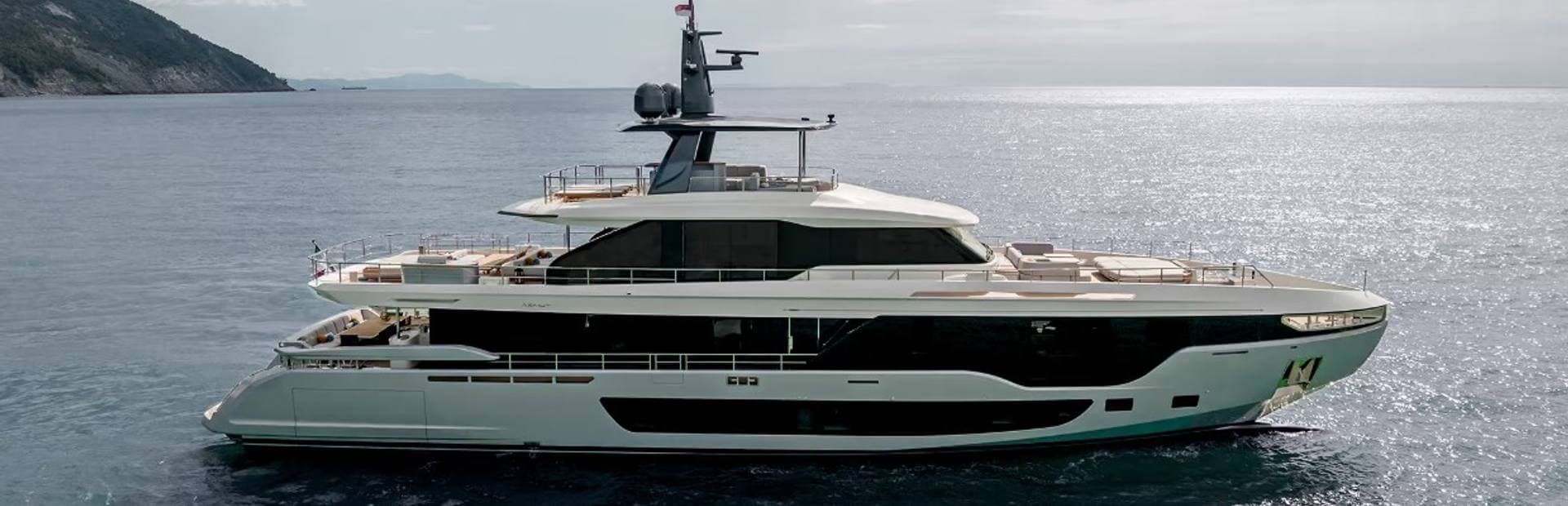
SuperyachtTop trending superyacht of 2025 and the Italian craftsmanship benchmark. The Azimut Grande 36M features a spacious beach club and represents the pinnacle of Italian yacht design, blending contemporary luxury with proven seakeeping performance.
Show 3 awards
Show 5 key features
Related models
Updated 10 June 2026 · By Hulls.io Editorial
The Azimut Grande 36M: A Complete Guide
The Azimut Grande 36M is the yacht that demonstrates where Azimut draws the line between series production and bespoke superyacht construction. At 35.29 metres and 260 GT, the Grande 36M sits firmly in superyacht territory — requiring professional crew, commanding six-figure annual running costs, and offering the kind of volume and finish that justify the classification. The Azimut|Benetti Group, founded by Paolo Vitelli in 1969 and now led by his daughter Giovanna Vitelli as chairwoman, is the world’s largest private luxury yacht builder, and the Grande range represents the pinnacle of the Azimut brand: semi-custom superyachts that sit below the Benetti line but above the volume-produced Azimut flybridge and S-series ranges.
Introduced in 2022 as the replacement for the Grande 35 Metri (2017–2022), the 36M was a ground-up redesign rather than a facelift. The most significant technical innovation is the D2P (Displacement to Planing) hull, developed jointly by naval architecture studio PLANA and Azimut-Benetti’s in-house R&D team. This double-chine hull with wave-piercer bow is engineered to transition efficiently between displacement and planing modes — a claim that, if fully realised, offers 20–30% lower fuel consumption and CO₂ emissions compared to conventional hull forms in this size bracket. The carbon fibre superstructure, a hallmark of the Grande range, reduces structural weight by approximately 30% compared to an equivalent GRP structure and cuts roll momentum by 15%, materially improving comfort at anchor and underway.
Alberto Mancini’s exterior design introduced two features that were firsts for a yacht of this size class: a semi-walkaround upper deck branded the “Infinity Skydeck,” which provides panoramic views and social space normally associated with much larger yachts, and a lateral tender garage that frees the transom entirely for a dedicated beach club — eliminating the compromise that most sub-40 metre yachts make by combining tender storage with the swim platform. The Gen 1 interior was designed by Achille Salvagni, known for sculptural, bespoke furniture pieces that blur the line between yacht fitting and fine art. The Gen 2 Evo, debuted at Cannes Yachting Festival 2025, replaced Salvagni with M2 Atelier, whose “Barefoot Luxury” philosophy introduces a lighter, more contemporary aesthetic anchored by the studio’s signature Gradient Wall feature.
Production volumes reflect the yacht’s semi-custom nature: approximately 3–5 units per year, each requiring 12–18 months of build time at Azimut’s Avigliana facility near Turin, Italy. The Grande 36M won Best of Show at the Fort Lauderdale International Boat Show (FLIBS) in 2023, a prestigious accolade that cemented its position as one of the most accomplished yachts in the 30–40 metre segment.
Hulls.io currently tracks 0 active listings for the Azimut Grande 36M, drawn from brokerages worldwide.
Azimut Grande 36M Specifications
| Specification | Detail |
|---|---|
| LOA | 35.29 m (115 ft 9 in) |
| Beam | 7.50 m (24 ft 7 in) |
| Draft (full load) | 1.97 m (6 ft 6 in) |
| Displacement (full load) | ≈180 tonnes |
| Gross tonnage | 260 GT |
| Hull material | GRP with carbon fibre superstructure |
| Hull type | D2P (Displacement to Planing) double-chine with wave-piercer bow |
| Engines (standard) | 2× MTU 16V 2000 M86, 2,186 hp each |
| Engines (optional) | 2× MTU 16V 2000 M96L, 2,400 hp each |
| Drive | Shaft drive |
| Top speed | 24 knots (with optional engines) |
| Cruising speed | 18–19 knots |
| Fuel capacity | 19,000 litres (5,019 US gal) |
| Water capacity | 3,700 litres (977 US gal) |
| Guest cabins | 5 (master + 2 VIP + 2 twin w/ Pullman) |
| Crew cabins | 4 (6 crew berths) |
| Heads | 6 guest + day head |
| Exterior design | Alberto Mancini |
| Interior design (Gen 1) | Achille Salvagni |
| Interior design (Gen 2/Evo) | M2 Atelier |
| Naval architecture | PLANA + Azimut-Benetti R&D |
| Builder | Azimut Yachts, Avigliana, Italy |
| CE category | A (Ocean) |
| Classification | RINA Pleasure Yacht C |
| Production years | 2022–present (Gen 2 Evo from 2025) |
| Awards | FLIBS Best of Show 2023 |
The specification sheet places the Grande 36M firmly in superyacht territory. At 260 GT, the yacht triggers the regulatory and classification requirements associated with larger vessels, including RINA Pleasure Yacht C classification and the expectation of professional crew. The CE Category A Ocean certification permits operation in any sea conditions — a genuine capability given the 19,000-litre fuel capacity, which provides an estimated cruising range of approximately 1,400 nautical miles at an economy speed of 12 knots. The D2P hull form claims 20–30% lower fuel consumption and CO₂ emissions compared to conventional hull designs of similar displacement, a significant assertion that, combined with the generous tankage, makes genuine long-range cruising feasible. The twin MTU 16V 2000 series engines are proven, widely supported powerplants with an extensive global service network — a practical consideration for a yacht that may operate far from her home port.
Performance & Handling
At speed: With the optional twin MTU 16V 2000 M96L engines producing 2,400 hp each (4,800 hp combined), the Grande 36M reaches a top speed of 24 knots — genuinely fast for a 180-tonne superyacht. The standard M86 engines (2,186 hp each, 4,372 hp combined) deliver 23 knots at wide-open throttle. In either configuration, the D2P hull is designed to transition smoothly from displacement mode through the semi-displacement zone and into planing — a capability that conventional deep-V or semi-displacement hulls of this size cannot match. The double-chine hull form and wave-piercer bow work together to reduce slamming in head seas and spray generation at speed.
Cruising speed: The practical cruising band sits at 18–19 knots, where the hull operates in its most efficient planing mode. At economy speed of approximately 12 knots in displacement mode, range extends to approximately 1,400 nautical miles — sufficient for a transatlantic crossing with margins, or extended Mediterranean cruising without the anxiety of fuel planning that constrains shorter-range superyachts.
Hull technology: The D2P hull represents a genuine attempt to solve the fundamental compromise of superyacht hull design: the choice between displacement efficiency and planing speed. PLANA and Azimut-Benetti R&D claim that the hull form achieves a 20–30% reduction in fuel consumption compared to conventional hulls at comparable speeds. The carbon fibre superstructure contributes to this efficiency by reducing topside weight by approximately 30% compared to GRP, lowering the centre of gravity and reducing the roll momentum by 15% — improvements that translate to better ride quality and reduced stabiliser demands.
Propulsion: The Grande 36M uses conventional shaft drive rather than IPS pod propulsion. For a yacht of this size and displacement, shaft drive remains the industry standard — IPS pods are not available in the power range required. The shaft drive configuration offers simpler long-term maintenance, lower servicing costs, and a more straightforward haul-out process compared to pod-driven systems. Zero-speed stabilisers and bow and stern thrusters are standard, providing the close-quarters manoeuvrability expected of a professionally crewed superyacht.
Interior Layout & Living Aboard
The Grande 36M accommodates ten guests across five cabins, served by six crew in four dedicated crew cabins with a separate crew mess — a ratio that enables the level of service expected aboard a superyacht of this calibre. The Gen 1 interior, designed by Achille Salvagni, featured bespoke sculptural furniture pieces and artisanal detailing that positioned each yacht as a floating gallery of contemporary Italian craft. The Gen 2 Evo interior by M2 Atelier takes a different direction, embracing a “Barefoot Luxury” philosophy with lighter tones, natural materials, and the studio’s signature Gradient Wall — an architectural feature that shifts colour and texture across its surface, creating visual depth in the main salon.
The master suite occupies the full beam of the main deck, positioned forward of the salon for privacy. His-and-hers bathrooms flank the cabin, each with its own shower enclosure, providing the kind of separation that makes extended cruising genuinely comfortable. Full-height windows wrap around the forward section of the main deck, flooding the master with natural light and providing panoramic sea views from the bed.
On the lower deck, two VIP cabins and two twin cabins (each with Pullman berths that fold down to accommodate additional guests) share six en-suite bathrooms. A day head on the main deck serves the salon and cockpit areas. The layout is thoughtfully arranged so that the two VIP suites are positioned furthest from the engine room for acoustic comfort, while the twin cabins are closer to the crew quarters for practical service access.
The main salon features a circular open-plan layout with full-height windows that dissolve the boundary between interior and exterior. A professional galley to port serves both formal dining in the salon and alfresco dining in the cockpit. The salon’s open geometry is a deliberate departure from the traditional linear layouts found on most yachts in this segment, creating a more sociable, less hierarchical living space.
The upper deck — branded the Infinity Skydeck — is the Grande 36M’s most distinctive space. Semi-walkaround side decks provide 360-degree access, while retractable side windows transform the covered area from an enclosed sky lounge to an open-air terrace. A glass-bottomed jacuzzi sits aft, with sun loungers forward. The bow offers a dedicated sunbathing area, accessible via the walkaround side decks.
At the stern, the beach club is a dedicated entertaining and water-access zone, freed from tender-storage duties by the lateral tender garage amidships. A carbon fibre swim platform deploys hydraulically, and the beach club itself provides a shower, seating area, and direct access to the water — a self-contained social space that is increasingly the centrepiece of modern superyacht life.
Azimut Grande 36M Ownership: What to Expect
Owning a 36-metre superyacht is a fundamentally different financial proposition from owning a production motor yacht. The Grande 36M demands professional crew, commercial marina berths, and a maintenance programme scaled to a vessel of 260 GT. Annual running costs, inclusive of crew, fall in the following ranges:
- Insurance: 1.0–1.5% of hull value. On a yacht insured at €15,000,000, this translates to approximately €150,000–€225,000 per year. Mediterranean-only cruising sits at the lower end; worldwide navigation or transatlantic delivery adds a premium.
- Berthing: A 36-metre superyacht requires premium marina berths with appropriate services. Annual berthing costs range from €50,000 in less fashionable locations to €200,000+ for prime berths on the Côte d’Azur, Monaco, or Ibiza during peak season.
- Engine servicing: Twin MTU 16V 2000 series engines require professional maintenance at authorised service centres. Annual servicing costs run €30,000–€60,000 depending on hours and service interval requirements. Major overhauls at 6,000–8,000 hours are a six-figure commitment.
- Haul-out and antifouling: €20,000–€40,000 for a 36-metre yacht, including hull preparation, antifouling application, anode replacement, running gear inspection, and stabiliser system servicing.
- Crew costs: A minimum crew of four (captain, engineer, stewardess, deckhand) is realistic for a yacht of this size, with annual costs ranging from €200,000–€400,000 including salaries, benefits, insurance, and crew rotation. Many owners operate with five or six crew during charter or peak cruising seasons.
- Approximate total: €500,000–€1,000,000+ per year including crew, depending on usage intensity, cruising grounds, and whether the yacht participates in charter.
New pricing and depreciation: The Grande 36M Gen 1 listed at approximately €14,400,000 ex-VAT at launch. The Gen 2 Evo commands €17,000,000–€19,000,000 depending on specification, reflecting the updated interior, enhanced technology package, and general market inflation. Early used examples from 2022–2023 have appeared on the brokerage market at approximately USD 15,000,000–17,000,000, representing 10–15% depreciation for 2–3 year old boats — a relatively gentle curve for a superyacht, reflecting strong demand and limited supply.
Charter potential: The Grande 36M’s five-cabin, ten-guest layout and dedicated crew quarters make it well-suited to the charter market. Weekly charter rates for yachts of this size and specification typically range from €80,000–€130,000 during Mediterranean high season, providing a meaningful offset to ownership costs for owners willing to make their yacht available during peak periods.
How to Buy an Azimut Grande 36M: What to Look For
Gen 1 vs Gen 2 Evo: The primary distinction between the two generations is interior design. Gen 1 yachts (2022–2025) feature Achille Salvagni’s sculptural, artisanal interiors — dramatic and distinctive, but polarising for some buyers. The Gen 2 Evo (2025 onwards) introduced M2 Atelier’s “Barefoot Luxury” aesthetic with the signature Gradient Wall feature, lighter material palettes, and a more contemporary feel. Both share the same hull, structural engineering, and mechanical systems. Buyers should inspect examples of both to determine which design language suits their taste, as the interior is the single largest differentiator between the two versions.
Key Inspection Areas
- MTU engine hours and service records: The twin MTU 16V 2000 series engines are the yacht’s most expensive mechanical components. Verify engine hours against service records and confirm that all scheduled maintenance has been performed at MTU-authorised service centres. Oil analysis reports are essential for assessing internal engine condition.
- Carbon fibre superstructure: The carbon fibre upper structure is a critical weight-saving element of the Grande 36M’s design. Impact damage to carbon fibre is more difficult to detect and repair than GRP damage. Any history of contact incidents — including tender loading mishaps, bridge strikes, or marina damage — should be thoroughly investigated, and affected panels should be assessed using ultrasonic testing to confirm structural integrity.
- Hydraulic systems: The Grande 36M relies on extensive hydraulic systems for the lateral tender garage, swim platform deployment, stabilisers, and trim. Test every hydraulic function during the sea trial and inspect all hydraulic lines, rams, and pumps for leaks and corrosion. Hydraulic fluid analysis can reveal early signs of component wear.
- D2P hull condition: The wave-piercer bow and double-chine hull form are integral to the yacht’s performance claims. Inspect the bow section carefully for impact damage, gelcoat crazing, or structural issues that could compromise the hull’s hydrodynamic properties.
- Azimut-specific parts: Bespoke Azimut components — custom glazing, interior fittings, hydraulic components, and electronics integration panels — are sourced from Italy with typical lead times of 4–10 weeks. This is worth factoring into any refit planning or repair scheduling, particularly for yachts based outside the Mediterranean.
New Build Options
For buyers considering a new-build Grande 36M, delivery slots are currently available from approximately Q3 2027 onwards. The build process involves extensive owner consultation on interior finishes, layout modifications within the semi-custom framework, and equipment specification. New-build buyers should budget 12–18 months from contract signing to delivery, and engage an independent build supervisor to monitor construction milestones and quality standards throughout the process.
Commissioning a Survey
A superyacht survey at this level is a multi-discipline exercise requiring specialists in hull and structural assessment, mechanical and propulsion systems (MTU-qualified), electrical and navigation systems, and classification compliance (RINA). Budget €15,000–€25,000 for a comprehensive survey including haul-out, sea trial, and specialist reports. Given the carbon fibre superstructure and D2P hull technology, engage a surveyor with specific experience of composite superyacht construction — preferably one who has previously surveyed Azimut Grande range yachts.
Azimut Grande 36M vs Competitors
The 35–37 metre superyacht segment is one of the most competitive in the market, occupied by established Italian, British, and Dutch yards producing yachts that balance volume, performance, and customisation. Each takes a distinct approach to the same fundamental brief: a yacht large enough to feel like a genuine superyacht, yet compact enough for a modest crew complement.
Azimut Grande 36M vs Sunseeker 116 Yacht
The Sunseeker 116 Yacht (35.4 m) is the Grande 36M’s most direct British rival. Sunseeker’s approach is sportier — the 116 Yacht offers higher top speeds (up to 26 knots with the MTU 16V 2000 M96L option) and a more aggressive exterior aesthetic that reflects Sunseeker’s DNA as a performance-oriented yard. The UK build quality is generally regarded as consistent, with excellent electrical installations and high-quality joinery. The Azimut counters with the innovative D2P hull technology, carbon fibre superstructure for weight savings and reduced roll, and the dedicated beach club freed by the lateral tender garage. Interior design is a matter of taste: Sunseeker offers a polished British contemporary style, while the Grande 36M delivers distinctly Italian design signatures from either Salvagni or M2 Atelier. Pricing is broadly comparable, with the Sunseeker commanding a slight premium in the UK market.
Azimut Grande 36M vs Benetti Motopanfilo 37M
The within-group comparison is instructive. The Benetti Motopanfilo 37M is the Grande 36M’s sibling from the Azimut|Benetti Group’s other brand. The Motopanfilo takes a fundamentally different approach: a semi-displacement steel and aluminium hull designed for range rather than speed. At a cruising speed of 11 knots, the Motopanfilo delivers approximately 3,800 nautical miles of range — nearly three times the Grande 36M’s capability, but at a top speed of only 15 knots compared to the 36M’s 24 knots. The Benetti also carries the cachet of the Benetti name, which resonates more strongly in traditional superyacht circles. The Grande 36M counters with dramatically superior speed, the D2P hull’s fuel efficiency at higher speeds, and the carbon fibre weight advantage. Buyers choosing between the two are essentially deciding between a long-range explorer philosophy and a fast-cruising performance superyacht.
Azimut Grande 36M vs Sanlorenzo SD118
The Sanlorenzo SD118 (35.95 m) represents the refined end of Italian superyacht building. Sanlorenzo’s semi-displacement hull offers excellent range and seakeeping, with an interior design philosophy that prioritises understated elegance and bespoke customisation over showmanship. The SD118’s build quality and attention to detail are widely regarded as among the finest in the segment. The Grande 36M offers a more technologically ambitious package with the D2P hull and carbon fibre superstructure, higher top speed, and more extroverted styling. The Sanlorenzo appeals to buyers who value quiet refinement and pedigree; the Azimut to those who want innovation and performance alongside their Italian craftsmanship.
Azimut Grande 36M vs Princess 35M Y Class
The Princess 35M Y Class brings British build quality and engineering precision to the segment. Princess’s reputation for consistency in construction — particularly in electrical systems and mechanical installations — is well earned, and the Y Class benefits from the company’s deep experience with production superyachts. The 35M offers a more conventional hull form without the D2P technology, resulting in straightforward performance characteristics that are well understood by crew and surveyors alike. The Grande 36M counters with the innovative hull, the carbon fibre weight advantage, the lateral tender garage and dedicated beach club, and the distinctively Italian design aesthetic. The Princess is the conservative, dependable choice for buyers who prioritise proven engineering; the Grande 36M is for those who want their superyacht to push boundaries.
For a full interactive depreciation comparison between the Azimut Grande 36M and competing models, visit the Hulls.io Market Intelligence tool, where you can overlay pricing trends, track seasonal demand, and benchmark value retention across the superyacht segment.
Azimut Grande 36M Value Retention
Newest vintage = 100%. Older vintages shown as % of that price.
Based on median asking prices by model year. The newest model year in our dataset is used as the 100% reference point. The curve is smoothed so retention never increases as age increases — hover over data points to see raw values. Shaded band shows the 25th–75th percentile price range. Figures reflect asking prices from tracked listings, not final sale prices.