


Beneteau First 36 Buyer’s Guide
Sport / PerformanceThe first production planning yacht at this weight, born from a Seascape collaboration. The Beneteau First 36 redefines accessible performance sailing with a hull designed to plane in moderate winds, bringing high-performance thrills to a production boat price.
Show 1 award
Show 5 key features
Updated 10 June 2026 · By Hulls.io Editorial
The Beneteau First 36: A Complete Guide
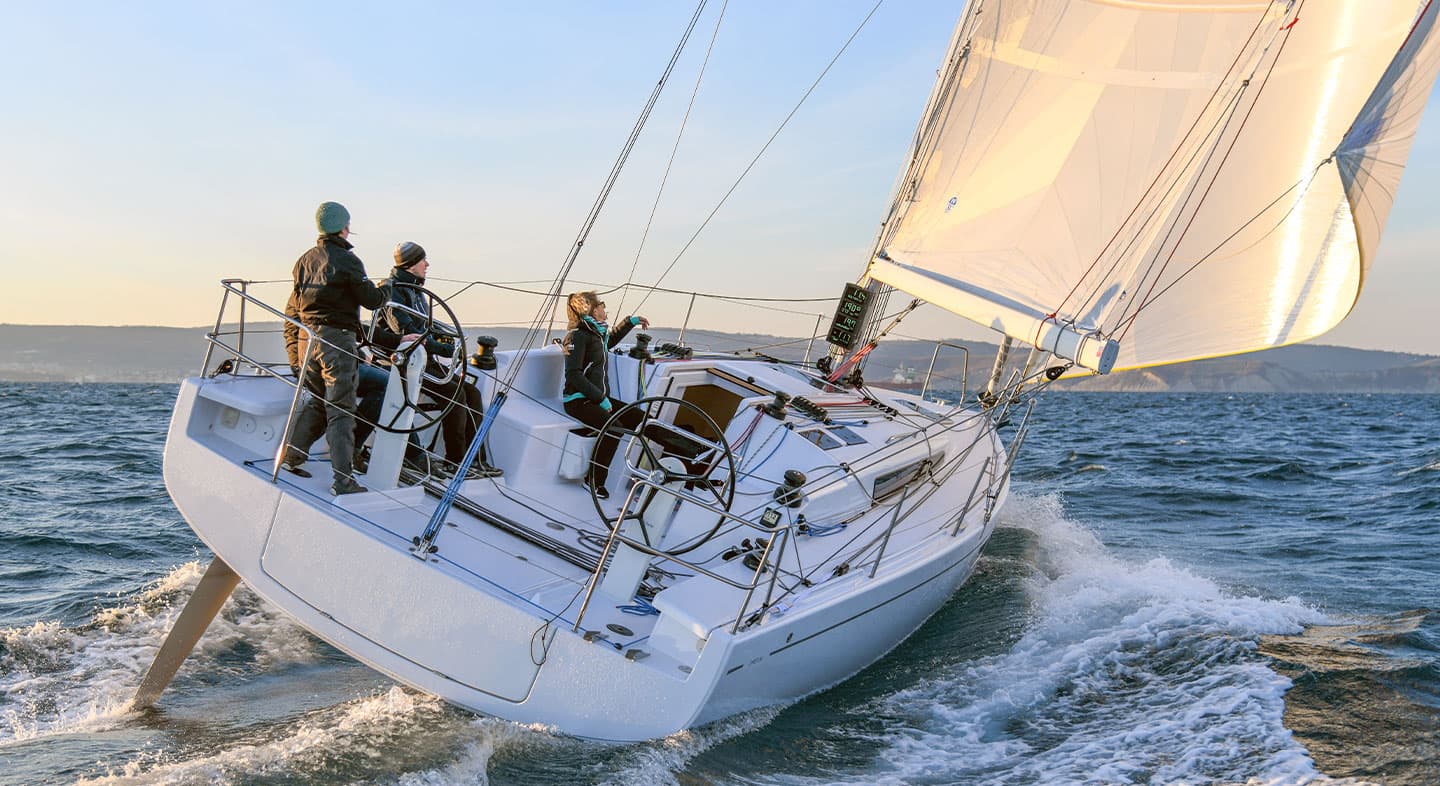
The Beneteau First 36 is arguably the most significant production sailboat of its generation — a 36-footer that can genuinely plane in moderate breeze, built to a standard of structural engineering normally reserved for America’s Cup and IMOCA 60 campaigns, yet priced and equipped for mainstream ownership. Built by Beneteau’s Seascape division in Slovenia, the First 36 was born from a collaboration between naval architect Sam Manuard — dominant in Class 40 and Mini Transat design — and the Seascape team led by Andraz Mihelin and Kristian Hajnsek. The result swept every major sailing award in 2022 and 2023, winning European Yacht of the Year, Sailing World Boat of the Year, British Yachting Awards Performance Yacht of the Year, and the French Voilier de l’Année, all by unanimous or near-unanimous jury votes.
What makes the First 36 genuinely revolutionary rather than merely good is its displacement. At 4,800 kg (10,582 lbs) light, the First 36 weighs roughly 30–40% less than conventional 36-foot cruiser-racers — a figure achieved not through exotic carbon construction but through vacuum-infused GRP with Corecell foam core throughout the entire structure: hull, deck, bulkheads, and even the furniture modules. Everything is structural; nothing is dead weight. The hull scantlings were calculated by Pure Design & Engineering of New Zealand, the same firm that performs structural analysis for America’s Cup teams and TP52 campaigns. This construction philosophy — race-boat engineering applied to a production build process — is the First 36’s defining innovation.
The First 36 is the spiritual successor to the Beneteau First 36.7, one of the most commercially successful racer-cruisers in history. Designed by Farr Yacht Design and built in Marion, South Carolina, the 36.7 produced approximately 800 hulls over a 20-year production run from 2001 to 2021 and established a strong one-design class in North America. The new First 36 is a fundamentally different boat — where the 36.7 was a conventional displacement racer-cruiser, the First 36 breaks out of displacement mode entirely. As Sailing World’s judges observed during sea trials at Annapolis: “Three days and ten boats later, nothing came close to usurping the Beneteau First 36 as the obvious and unanimous Boat of the Year.”
Hulls.io currently tracks 0 active listings for the Beneteau First 36, drawn from brokerages worldwide.
Beneteau First 36 Specifications
| Specification | Detail |
|---|---|
| LOA | 11.98 m (39 ft 4 in) |
| Hull length (LOD) | 11.00 m (36 ft 1 in) |
| LWL | 10.25 m (33 ft 8 in) |
| Beam | 3.80 m (12 ft 6 in) |
| Draft (standard keel) | 2.25 m (7 ft 5 in) |
| Draft (shallow keel) | 1.95 m (6 ft 5 in) |
| Displacement (light) | 4,800 kg (10,582 lbs) |
| Ballast (standard keel) | 1,550 kg (3,417 lbs) |
| Ballast (shallow keel) | 1,690 kg (3,726 lbs) |
| Ballast ratio | ≈32% |
| D/L ratio | 99.6 |
| SA/D ratio | 28.6 |
| Capsize screening factor | 2.25 |
| Mainsail area | 42 m² (452 sq ft) |
| Jib area | 38 m² (409 sq ft) |
| Total upwind sail area | 80 m² (861 sq ft) |
| Masthead gennaker | 141 m² (1,518 sq ft) |
| Fractional furling gennaker | 58 m² (624 sq ft) |
| Total downwind sail area | ≈180 m² (1,938 sq ft) |
| Mast | Deck-stepped Z Spars aluminium (carbon option available) |
| Rigging | Dyform wire standing rigging with Dyneema backstay (no backstay on SE variant) |
| Engine | Yanmar 3YM30, 29 HP diesel |
| Drive | SD25 saildrive with Flexofold folding propeller |
| Fuel capacity | 70 litres (18.5 US gal) |
| Water capacity | 200 litres (53 US gal) |
| Holding tank | 80 litres (21 US gal) |
| Cabins | 3 (1 forward V-berth, 2 aft quarter berths) |
| Berths | 6 (plus 2 saloon settees usable as sea berths) |
| Heads | 1 (forward, with shower and fold-up sink) |
| Naval architecture | Sam Manuard (Manuard YD) |
| Structural engineering | Pure Design & Engineering (New Zealand) |
| Exterior design | Lorenzo Argento |
| Interior design | SITO (Slovenia) |
| Concept & R&D | Beneteau & Seascape |
| Builder | Seascape (Groupe Beneteau) |
| Build location | Slovenia |
| Construction | Vacuum-infused GRP with Corecell foam core throughout — hull, deck, bulkheads, and furniture |
| CE category | A (Ocean) |
| Year introduced | 2022 |
The hull shape is pure Sam Manuard — drawn directly from his experience designing Class 40 offshore racing yachts. The beam is carried well aft to provide a wide, flat planing surface, with hard chines that deliver immense secondary stability when heeled. The D/L ratio of 99.6 places the First 36 firmly in ultralight territory, while the L/B ratio of 2.88 reflects the wide, powerful hull form. The fine entry forward provides comfortable motion in a seaway, while the flat sections aft allow the boat to rise onto the plane once wind speed exceeds 12 knots. There is no backstay — the square-top mainsail is supported by the rig geometry alone, simplifying downwind sailing and allowing an unobstructed sweep of the boom.
Two keel options are available. The standard keel draws 2.25 m (7 ft 5 in) with a cast-iron fin and T-bulb weighing 1,550 kg. A shallow-draft option reduces draft to 1.95 m (6 ft 5 in) with a slightly heavier keel at 1,690 kg to compensate for the reduced righting moment. Both keels are externally bolted through a structural grid system that distributes loads throughout the hull laminate. Twin rudders on stainless steel stocks with Jefa steering provide precise, responsive helm feel even at high speeds — Manuard has stated that a single rudder would be insufficient to control the hull form when pressed in a blow.
The vacuum-infused construction is the key to the First 36’s extraordinary light weight. Every component — hull shell, deck, bulkheads, interior modules — is built using closed-mould infusion with Corecell foam core and vinyl ester resin. This technique, previously reserved for bespoke racing yachts and high-end boutique builders like Baltic or Wally, produces a laminate with consistent fibre-to-resin ratios, maximum stiffness, and minimum weight. The result is a production boat that weighs 4,800 kg fully cored — roughly 2,000 kg less than a conventionally built cruiser-racer of the same length.
Performance & Sailing
The planing threshold: The First 36 begins planing in approximately 12 knots of true wind under gennaker — a threshold that no other mainstream production cruiser can match. In displacement mode, the theoretical hull speed is 7.3 knots. Once the boat transitions to planing, that speed limit vanishes. During Sailing World’s Boat of the Year testing at Annapolis in October 2022, judges recorded a top speed of 18.3 knots in 20-knot gusts. With 12 knots of breeze and moderate chop, testers hoisted the full main and kite and immediately pegged 10 knots SOG on a broad reach. At 14 knots of boat speed on jib alone, the First 36 fundamentally changes what “going sailing” means on a production yacht.
Upwind performance: The First 36 is not merely a downwind flyer. Hard on the wind in 12 knots of true wind, the boat makes a solid 6.3 knots at 40 degrees to the true wind, producing a VMG of approximately 4.83 knots — a figure confirmed by ORC polar diagram data. The fine entry, twin rudders, and balanced rig produce fingertip-light helm feel on the wind, with minimal weather helm even when pressed. The 80 m² upwind sail area, combined with the 4,800 kg displacement, yields an SA/D ratio of 28.6 — higher than virtually every competitor except the pure-racing Pogo 36.
Reaching and downwind: This is where the First 36 is truly untouchable in its class. The 141 m² masthead gennaker drives the boat to planing speed in moderate breeze, and the twin rudders maintain control at speeds that would overwhelm a single rudder on a conventional hull. In European Yacht of the Year testing at 4–5 Beaufort, the First 36 was visibly faster than all competitors, hitting 15 knots in gusts. The judges described the downwind performance as “a real explosion of pleasure.” The 180 m² of downwind sail area on a 4,800 kg platform produces a power-to-weight ratio that simply cannot be matched by any boat carrying an additional 2,000 kg of conventional construction.
Racing credentials: The First 36 has already proven itself at the highest level of offshore racing. At the 2024 Rolex Middle Sea Race, a First 36 named “Marina 21,” sailed by Milan Kolacek and Milan Tomek, won the IRC Double-Handed Class — one of the toughest categories in the event. In the 2025 Transpac race from Los Angeles to Honolulu, a First 36 SE named “Rahan” finished second across the line on elapsed time, beaten only by the 88-foot maxi yacht “Lucky,” and won her class on ORR corrected time — making her by far the smallest boat in the fleet, sailed double-handed.
PHRF and handicap racing: The First 36’s PHRF rating is still being established across regions, but early assessments place it in the 60–72 range with spinnaker — comparable to the Jeanneau Sun Fast 3600 (rated around 60) and competitive with boats like the J/111 and J/112E. Under ORC, the boat rates around GPH 586. The First 36 is designed primarily as a handicap racer rather than a one-design class boat — production volumes are too modest for large one-design fleets, and the wide options list creates significant variation between individual boats. For club racing under PHRF or IRC, the First 36 is a formidable weapon.
Under power: The Yanmar 3YM30 (29 HP) with SD25 saildrive and Flexofold folding propeller is adequate for harbour manoeuvres and calm-conditions motoring. Cruising speed under power is approximately 5.5–6 knots. The 70-litre fuel tank is deliberately small — a weight-saving measure consistent with the boat’s performance philosophy. Powered range in calm conditions is approximately 150–180 nautical miles, sufficient for coastal sailing but requiring careful fuel planning on longer passages.
Interior Layout & Design
The First 36 offers a single interior layout with three double cabins — a forward V-berth and two aft quarter berths under the cockpit. Despite the performance focus, the interior volume is comparable to the significantly larger First 40.7 — a testament to the wide beam (3.80 m) carried well aft. The interior was designed by Slovenian studio SITO and styled by Lorenzo Argento, with every element engineered to contribute to the boat’s structural stiffness while maintaining genuine cruising functionality.
Forward cabin: The V-berth measures 2.01 m by 2.00 m — a genuine double with adequate room for two adults. Two portlights provide natural light and ventilation, supplemented by efficient LED lighting with a red-light option for night watches. Stowage is available in lockers outboard and beneath the berth.
Aft cabins: The two quarter berths beneath the cockpit are large enough for comfortable sleeping but are designed with dual-purpose versatility. The cushion and backing board on each berth can be stacked to convert the space into gear stowage — ideal for storing kites, wings, foilboards, and other water toys. This convertibility is a hallmark of the performance-cruiser philosophy: when racing, you want empty lockers; when cruising, you want comfortable berths.
Saloon: Two outboard settees flank a drop-leaf table, creating a comfortable dining area for four. Both settees double as sea berths, and a corridor created by the foldable and removable table allows safe movement through the saloon at sea. Indirect sectional lighting with a red racing mode illuminates the space at night.
Galley: The L-shaped galley to port at the foot of the companionway is the largest in the class. It includes a two-burner gas stove with oven, a tall central fridge that connects to the galley via a removable cutting board, two overhead lockers for plates and glasses, dedicated stowage beneath the stove for pots and pans, and three drawers for cutlery. This is a proper, functional galley — a notable achievement given the boat’s performance orientation.
Navigation station: Opposite the galley to starboard is a full-sized chart table — an increasingly rare feature on modern production yachts. The nav station doubles as a home office and provides a proper workspace for passage planning, a detail that reflects the First 36’s dual identity as both a coastal racer and an offshore cruiser.
Head: A single head compartment is located forward, between the V-berth and the saloon. It includes a marine toilet, a shower, and a clever fold-up sink positioned over the toilet to maximise usable floor space. The forward placement means crew must traverse the full saloon to reach the head when underway — an acknowledged compromise driven by the performance-first design philosophy. The head compartment has been described in reviews as “small and fiddly” — it is the most obvious area where performance has taken priority over cruising comfort.
Design & Engineering
The First 36’s design team reads like a who’s who of international yacht design. Naval architect Sam Manuard drew the hull lines, bringing his Class 40 expertise to a production platform. Manuard has noted the direct parallels between the First 36 and Class 40 racing yachts: “They are monohull, fixed keel, two rudders, and a rig that is not so dissimilar. My experience designing and sailing different Class 40s helped me draw the hull shape and general equilibrium.” Pure Design & Engineering of New Zealand — the firm that performs structural calculations for America’s Cup and IMOCA 60 programmes — engineered the hull scantlings and structural grid. Lorenzo Argento handled exterior styling, while Slovenian industrial design studio SITO created the interior layout.
The hull form features a fine entry forward for comfortable motion in waves, transitioning to flat, beamy sections aft that provide the planing surface. Reverse sheer gives the hull a low, aggressive profile. Maximum beam is carried all the way to the transom, creating the wide, stable platform necessary for sustained planing. The hard chines aft serve a dual purpose: they provide form stability at high angles of heel and they create a defined separation point for water flow when the hull rises onto the plane. When asked whether a scow bow might improve performance, Manuard confirmed that “the boat already has quite a lot of volume forward, but a scow bow would not be appropriate — we wanted a fast all-rounder, but not a design that would be extreme in any way.”
The First 36 SE (Seascape Edition): Beneteau has introduced a race-focused variant that pushes the platform further toward pure competition. The SE trims 400 kg from the standard displacement (bringing total weight to approximately 4,400 kg), shortens wetted surface by nearly 3 m² through a redesigned bow knuckle, and replaces the aluminium rig with a carbon fibre mast from Axxon Composites with Dyform shrouds and Dyneema running rigging. Twin steering wheels are replaced by a single tiller with an integrated E-bar system for fine-tuning tiller angle. Flush racing valves, carbon companionway stairs, carbon fiddles replacing traditional wood, and removable crew bags instead of wooden lockers complete the transformation. Italian rating specialist Maurizio Cossutti was engaged to optimise the SE’s ORC handicap position, shortening the keel slightly to compensate for the lighter carbon mast. The SE lists at approximately €351,490 (excluding sails) — roughly €56,000 more than the standard boat.
Carbon options on the standard boat: The standard First 36 is equipped with a deck-stepped Z Spars aluminium mast and boom, but a carbon rig option is available as a factory upgrade. Four halyards are standard: one for a masthead gennaker, a 2-to-1 for a code sail, a fractional gennaker halyard, and a 2-to-1 staysail halyard. The sail plan is designed around the North Sails inventory, with 3Di RAW mainsail and medium furling jib with battens as the performance sail package. The absence of a backstay simplifies the rig and allows the square-top mainsail to develop maximum projected area.
Awards & Recognition
The Beneteau First 36 accumulated more awards in its first 18 months of production than any performance sailboat in recent memory. The boat’s sweep of international awards in 2022 and 2023 was remarkable in both its breadth and the unanimity of jury decisions:
- European Yacht of the Year 2023 — Performance Category winner, with unanimous votes from the 12-member international jury. Awarded at Boot Düsseldorf in January 2023.
- Sailing World Boat of the Year 2023 — Overall winner. The jury described it as “the obvious and unanimous Boat of the Year” after three days of testing ten boats at Annapolis. Top speed during testing: 18.3 knots.
- British Yachting Awards 2022 — Performance Yacht of the Year. Awarded by Sailing Today with Yachts & Yachting magazine based on community voting.
- Voilier de l’Année 2023 — Winner of the prestigious French sailboat of the year award from Voile Magazine. The first model from the Beneteau-Seascape partnership to receive this honour.
- Cruising World Boat of the Year 2023 — Best Sportboat (Special Recognition). Judge Herb McCormick noted the First 36 was “conceived working backward from the goal of a pure, unfettered sailing experience, and it fully delivers on that score.”
- SAIL Magazine Best Boats 2023 — Named to the annual Top 10 Best Boats list.
Yachting World summarised the critical consensus: “You might not appreciate it at first glance, but this could well be the best performance production yacht we’ll see for some time. This realisation creeps up on you slowly, and is further confirmed the more time you spend aboard.”
First 36 Pricing & Ownership
- New-build base price: Approximately €238,800–248,000 (ex-VAT) in Europe, or approximately USD $260,000 base in the US market. The original design target was under €150,000 to compete directly with the Dehler 34, but the advanced construction methods pushed the final price significantly higher. A fully equipped, sail-ready First 36 typically lists at €280,000–305,000 in Europe or USD $336,000–400,000 in the US, depending on sail inventory, electronics, and options.
- First 36 SE pricing: The SE (Seascape Edition) lists at approximately €351,490 (excluding sails and VAT) — roughly €56,000 more than the standard boat. The premium covers the carbon rig, tiller conversion, flush racing hardware, reduced wetted surface hull modifications, and ORC-optimised keel.
- Pre-owned market: As a model launched in 2022 with modest production numbers, pre-owned First 36s are scarce. Early 2023–2024 examples that do appear on the market list at €248,000–340,000 depending on specification and condition. The limited supply and strong demand mean that used First 36s hold their value exceptionally well — depreciation in the first two years has been minimal compared to volume production yachts. Note that older listings for “Beneteau First 36” in the €55,000–78,000 range are the original First 36 (2001–2008), an entirely different boat.
- Production and availability: The First 36 is built at Seascape’s facility in Slovenia, where approximately 150 boats per year are produced across all Seascape/First models with around 120 employees. First 36 production began at approximately 25 boats in the first year, with a target ramp-up to 32 boats per year. This deliberately modest production rate reflects both the specialised build process and the niche market for high-performance production cruiser-racers. For context, Tit Plevnik (head of First & First SE marketing at Seascape) confirmed the target as 32 boats per year for the first two years following initial production.
The First 36’s pricing positions it above the Dehler 34 (€168,900 ex-VAT) and the Pogo 36 (€172,473 ex-VAT), and very close to dedicated racing platforms like the Jeanneau Sun Fast 3600 and JPK 10.80. This is higher than the original design intent, but the construction quality and performance capability justify the premium for buyers who prioritise sailing dynamics over interior amenity or value-per-square-metre.
Beneteau First 36 vs Competitors
The First 36 occupies a unique position in the market — faster than conventional cruiser-racers but more liveable than dedicated racing machines. Beneteau and the Seascape team have described it as a “high-performance cruiser,” a category shared primarily with the JPK 39 and Pogo 36. Understanding its competitive position requires comparing it across several dimensions.
First 36 vs Pogo 36
The Pogo 36 is the closest competitor in pure performance terms. At 3,600–3,800 kg (depending on source), the Pogo is 1,000–1,200 kg lighter than the First 36 and demonstrably faster in most conditions. However, the Pogo achieves this weight through a more stripped-out interior that prioritises racing over cruising comfort. The First 36 offers three proper double cabins, a full galley, and a dedicated nav station — amenities the Pogo largely sacrifices. The Pogo 36 lists at approximately €172,473 ex-VAT, making it roughly €25,000–30,000 cheaper than the First 36. For dedicated racers, the Pogo is the better tool; for those who want to race hard and then cook dinner in harbour, the First 36 is the more versatile platform.
First 36 vs Dehler 34
The Dehler 34 was the original price target for the First 36 project, and the two boats appeal to overlapping buyers. The Dehler offers exceptional build quality and a superior cruising interior, with better below-decks finishing and a more comfortable heads compartment. Under sail, the Dehler is a fine boat in moderate breeze but lacks the light-displacement planing ability that defines the First 36. The Dehler weighs significantly more, which makes it sticky in light air and locks it into displacement sailing in all conditions. At approximately €168,900 ex-VAT, the Dehler represents better value if cruising comfort and build quality are priorities. If sailing performance is the primary criterion, the First 36 is in a different league entirely.
First 36 vs J/99
The J/99 is a 32-footer positioned as a performance shorthander with strong J/Boats racing pedigree. It is a smaller, lighter, more race-oriented platform with minimal cruising accommodation. Where the First 36 bridges the gap between racing and cruising, the J/99 leans heavily toward racing. The J/99 benefits from J/Boats’ established one-design and handicap racing infrastructure. The First 36 is a bigger, more powerful boat with significantly more interior volume and genuine offshore cruising capability — but it weighs more, costs more, and lacks the J/99’s established class racing community.
First 36 vs Jeanneau Sun Fast 3600
The Sun Fast 3600 is a more dedicated offshore racer with an established track record in events like the Fastnet and the RORC calendar. It rates similarly to the First 36 under ORC (GPH around 535 vs 586 for the First 36) and is priced in the same range. The Sun Fast has a better heads compartment but a less developed galley. For pure IRC/ORC racing, the Sun Fast has a deeper pedigree; for the dual-purpose buyer who wants to race seriously and cruise comfortably, the First 36 offers a more balanced package with its three cabins, full galley, and dedicated nav station.
The First 36’s key differentiator across all comparisons is its planing ability. No other production cruiser-racer at this price point and size can genuinely plane in 12 knots of true wind. The competitors either achieve similar speed through stripped-out racing interiors (Pogo) or accept displacement sailing as the performance ceiling (Dehler, J/99). The First 36 occupies a unique middle ground that no other production boat has successfully claimed.
Known Issues & Survey Points
The Beneteau First 36 is a young model with limited long-term ownership data. Production volumes are modest — approximately 25–32 boats per year — which means the fleet experience base is smaller than for high-volume Beneteau production models. That said, several points have emerged from early owner feedback and professional reviews:
- Head compartment: Multiple reviewers have flagged the single forward head as small and fiddly. The fold-up sink over the toilet is clever but requires stowing before the toilet can be used. Crew must traverse the full saloon to reach the head when underway. This is the most commonly cited compromise in a boat that otherwise delivers excellent cruising functionality.
- Fuel range: The 70-litre fuel tank provides approximately 150–180 nm of powered range. For coastal day-sailing and weekend racing this is adequate, but it requires careful fuel management on longer passages. Owners planning offshore work should budget for supplementary fuel stowage.
- Early production teething: The Seascape team’s obsessive approach to getting Hull No. 1 perfect caused initial delivery delays, but this perfectionism has also meant that early production boats have been well-received without the common litany of warranty claims that plagues some first-year production runs. Reviewers have praised the fit and finish as closer to a boutique racing yacht than a mass-produced cruiser.
- Construction integrity: The vacuum-infused, fully-cored construction is structurally superior to hand-laid conventional builds, but it does mean that any hardware penetration through the deck or hull must be properly sealed to prevent moisture ingress into the core material. Surveyors should pay particular attention to moisture readings around deck hardware, stanchion bases, and any owner-added fittings. Core delamination from poorly sealed penetrations is a concern on any cored composite boat.
- Keel attachment: As with all externally bolted fin keels, the keel-to-hull joint is a critical survey point. The structural grid system distributes loads well, but keel bolt torque and bilge condition should be checked at every haul-out. The broader Beneteau First range (including the older 36.7 and 40.7) has historically required attention to keel bolt maintenance — the new First 36’s engineered structural grid is designed to address this, but vigilance remains appropriate.
- Twin rudder bearings: Twin rudder configurations require monitoring of bearing condition on both rudder stocks. Check for lateral play at each haul-out. The Jefa steering system is well-regarded but, like all mechanical steering, requires regular inspection of cables, sheaves, and linkages.
Overall, the First 36 has been received as a remarkably well-executed first-generation production boat. The involvement of Pure Design & Engineering in the structural design and the Seascape team’s composites expertise have produced a boat that reviewers consistently describe as closer in build quality to a custom racing yacht than a volume-production cruiser. The limited production volume and high demand suggest that early boats will hold their value well, reducing the financial risk of early adoption.
Beneteau First 36 Value Retention
Newest vintage = 100%. Older vintages shown as % of that price.
Based on median asking prices by model year. The newest model year in our dataset is used as the 100% reference point. The curve is smoothed so retention never increases as age increases — hover over data points to see raw values. Shaded band shows the 25th–75th percentile price range. Figures reflect asking prices from tracked listings, not final sale prices.