


Beneteau Oceanis 40.1 Buyer’s Guide
Cruising MonohullThe sweet-spot size for couples and families, and the second most-listed Beneteau model with strong resale values. The Oceanis 40.1 offers a perfect balance of performance, comfort, and manageable size for shorthanded sailing.
Show 5 key features
Updated 10 June 2026 · By Hulls.io Editorial
The Beneteau Oceanis 40.1: A Complete Guide
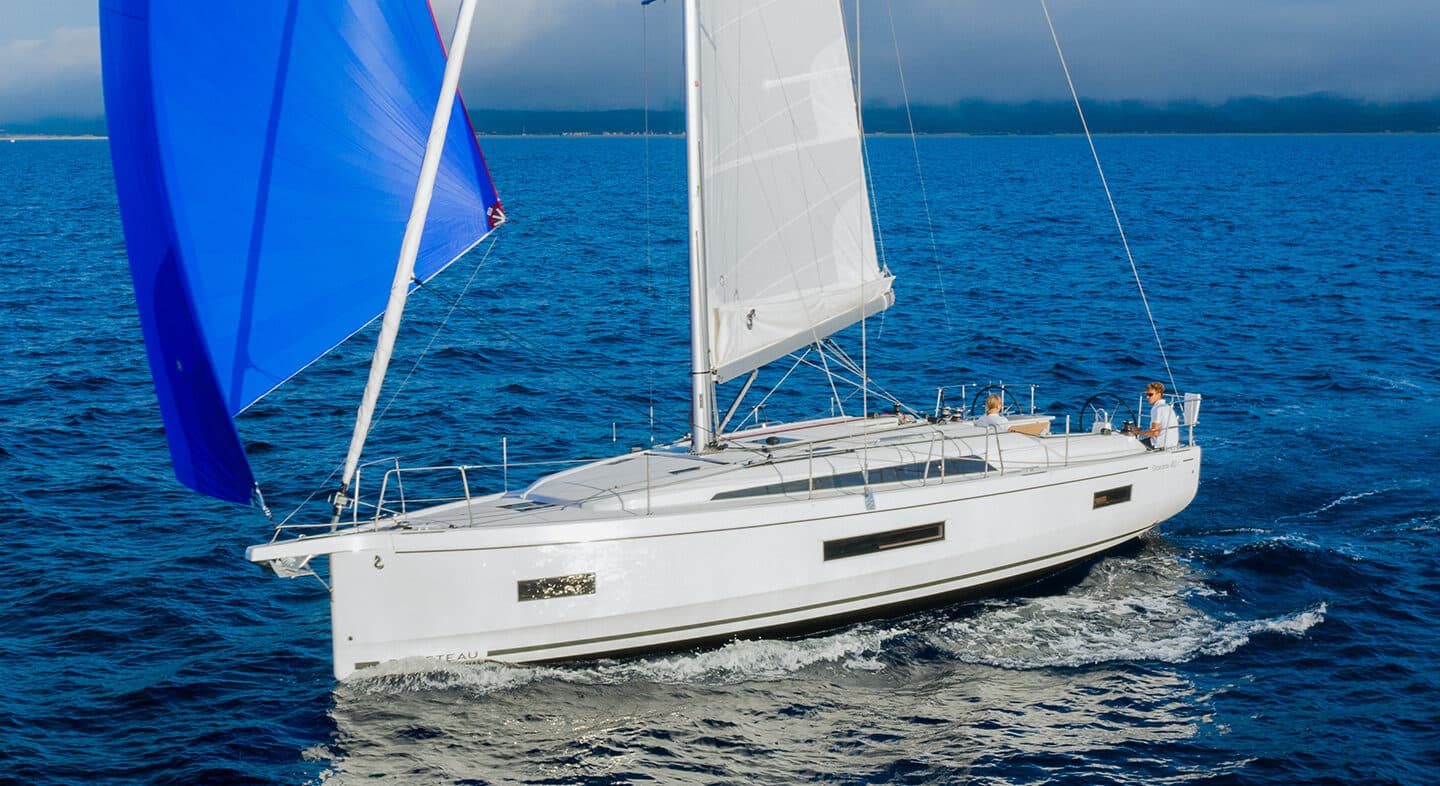
The Beneteau Oceanis 40.1 is one of the highest-volume production monohulls ever built — a 40-foot cruising yacht that distils four decades of Oceanis development into what may be the most carefully optimised boat in its class. Built by Beneteau, the flagship brand of Groupe Beneteau — the world’s largest sailing yacht manufacturer — the Oceanis 40.1 pairs a Marc Lombard hard-chine hull with a Nauta Design interior, creating a platform that works equally well as a private cruiser, a charter fleet workhorse, or a first serious bluewater boat for couples and families stepping up from smaller yachts.
The “.1” suffix marks the current generation of the Oceanis range, which brought two transformative changes: interior styling by Milan’s Nauta Design studio and hard chine hull forms that maximise interior volume and provide form stability at wider angles of heel. While earlier “.1” models (including the Oceanis 41.1, 46.1, and 51.1) were drawn by Finot-Conq, the Oceanis 40.1 introduced a new hull by Marc Lombard — a double-chine design with a pronounced chine aft and flared topsides that increase beam and interior volume without compromising underwater efficiency. The Oceanis 40.1, introduced in 2022 as a successor to the Oceanis 41.1, refines these principles into a platform that balances genuine sailing performance with the liveability and ease of handling that defines the Oceanis philosophy.
Groupe Beneteau was founded in 1884 by Benjamin Beneteau in Croix-de-Vie (now Saint-Gilles-Croix-de-Vie), France, initially building wooden fishing trawlers for the Vendée fleet. Under the leadership of Annette Beneteau-Roux from the 1960s onward, the company transformed into a leisure boat manufacturer, and today Groupe Beneteau encompasses the Beneteau, Jeanneau, Lagoon, Excess, and Prestige brands — producing approximately 7,000 boats per year across factories in France, the United States, Brazil, Poland, Italy, and Portugal. The Oceanis line alone has delivered tens of thousands of hulls over four decades, making it the most commercially successful production cruising yacht range in history.
The Oceanis 40.1’s market dominance extends well beyond private ownership. It is a mainstay of the world’s largest charter fleets — Sunsail, Dream Yacht Charter, Navigare Yachting, and The Moorings all operate the model extensively in the Mediterranean, Caribbean, and Indian Ocean. This charter penetration matters for buyers: it ensures deep parts availability, a global network of technicians familiar with the model, and an unusually liquid resale market with transparent pricing data.
Hulls.io currently tracks 0 active listings for the Beneteau Oceanis 40.1, drawn from brokerages worldwide. With 31 tracked listings in our market intelligence database, comprehensive pricing and depreciation data is available for this high-volume model.
Beneteau Oceanis 40.1 Specifications
| Specification | Detail |
|---|---|
| LOA | 12.87 m (42 ft 3 in) |
| Hull length | 12.18 m (39 ft 11 in) |
| LWL | 11.78 m (38 ft 8 in) |
| Beam | 4.18 m (13 ft 8 in) |
| Draft (standard keel) | 2.08 m (6 ft 10 in) |
| Draft (shoal keel) | 1.65 m (5 ft 5 in) |
| Displacement | ≈8,300 kg (18,298 lbs) |
| Ballast (cast iron) | ≈2,500 kg (5,512 lbs) |
| Ballast ratio | ≈30% |
| Hull type | Hard chine (double-chine hull with pronounced chine aft) |
| Mainsail area | ≈38 m² (409 sq ft) |
| Genoa area | ≈43 m² (463 sq ft) |
| Total upwind sail area | ≈81 m² (872 sq ft) |
| Self-tacking jib (option) | ≈30 m² (323 sq ft) |
| Mast | Deck-stepped aluminium (Sparcraft or similar) |
| Engine | Yanmar 4JH45, 45 HP diesel |
| Drive | Saildrive |
| Fuel capacity | 200 litres (53 US gal) |
| Water capacity | 330 litres (87 US gal) |
| Holding tank | 100 litres (26 US gal) |
| Cabin layouts | 2-cabin / 3-cabin |
| Heads | 1 or 2 |
| Naval architecture | Marc Lombard (ML Yacht Design Group) |
| Interior design | Nauta Design (Milan, Italy) |
| Builder | Beneteau (Groupe Beneteau, France) |
| Build locations | France (Les Sables-d’Olonne / Saint-Hilaire-de-Riez), Brazil (Arapiraca), USA (Marion, SC) |
| Construction | Hand-laid fibreglass hull, balsa/PVC core sandwich deck |
| CE category | A (Ocean) |
| Year introduced | 2022 |
The Marc Lombard hull shape is the foundation of the Oceanis 40.1’s sailing character. The design employs a double-chine form — angular transitions between the hull bottom and topsides — with a pronounced chine aft and flared sections forward that reduce wetted surface and improve hydrodynamic efficiency. The chines serve a dual purpose: they maximise interior volume by pushing usable beam further outboard, and they provide form stability at wider angles of heel, reducing the tendency to round up in gusts. The result is a hull that carries its beam well aft, creating a wide, stable stern platform while maintaining a relatively fine entry forward for comfortable motion in a seaway.
Construction is hand-laid fibreglass with a balsa and PVC core sandwich deck — the industry-standard approach for high-volume production sailboats that balances structural rigidity, thermal insulation, and weight. The hull laminate is solid GRP below the waterline with an infused structural grid bonded to the hull interior, distributing keel and rig loads across a broad area rather than concentrating stress at point attachments. The cast-iron fin keel is externally bolted with stainless steel studs accessible from inside the bilge — standard practice for production yachts and straightforward to inspect during a pre-purchase survey.
The deck-stepped aluminium mast (typically Sparcraft) simplifies the interior layout — no mast compression post penetrates the saloon — and is standard for charter-specification boats where durability and low maintenance take priority over the marginal stiffness advantage of a keel-stepped spar. A stainless steel mast step pad on the coachroof transfers compression loads into the deck and hull structure.
Hard-Chine Hull & Deck Layout
The hard-chine hull: The Oceanis 40.1’s most distinctive design feature is its double-chine hull form — a Marc Lombard design that uses angular hull sections running from bow to stern to maximise beam and interior volume while improving hydrodynamic efficiency. The pronounced chine aft widens the waterplane at rest and provides form stability, while the flared sections forward create a drier ride and reduce pitching in a seaway. The chined hull submerges as a V shape when heeled, resulting in straight tracking and reduced wetted surface at sailing angles. The practical benefit is measurable: the 40.1 reaches hull speed more efficiently than conventionally shaped competitors of similar displacement, and its performance under power is notably improved — the Yanmar 45 HP saildrive pushes the boat to 7+ knots at moderate RPM, where a traditional hull form of the same weight might struggle to achieve the same speed without higher fuel consumption.
Marc Lombard pedigree: The hard-chine hull is not a marketing gimmick — it comes from Marc Lombard (ML Yacht Design Group), a La Rochelle-based naval architect whose portfolio spans over 250 designs and more than 3,500 boats built, including multiple Jeanneau Sun Odyssey models and racing yachts. Lombard draws heavily on race-boat hydrodynamics, and his approach to the Oceanis 40.1 brings performance-derived thinking to a production cruising platform. The double-chine hull form is the most visible expression of that philosophy.
Deck layout: The Oceanis 40.1’s deck arrangement reflects Beneteau’s decades of feedback from charter fleets and private owners. The cockpit is wide and uncluttered, with twin helm stations positioned outboard to provide clear sightlines forward when heeled. The mainsheet is led to a traveller on the coachroof rather than across the cockpit, keeping the central seating area completely free for dining and socialising. A fold-down transom swim platform extends the cockpit living space aft and provides easy boarding from a tender or pontoon. Side decks are adequate for moving forward safely, with substantial handrails running the length of the coachroof. The optional bowsprit improves downwind sail handling and provides a secure anchor roller position clear of the hull.
Ergonomics: Beneteau has iterated the Oceanis cockpit layout across thousands of hulls, and the 40.1 reflects this experience. All primary sail controls are accessible from the helm positions, with halyard and sheet winches positioned within reach of a singlehanded sailor. The companionway provides easy below-deck access with a secure two-part washboard system. An optional cockpit table with integrated icebox seats six comfortably, and the bimini framework (standard on most specifications) accepts a full cockpit enclosure for all-weather sailing.
Sailing Performance
Upwind performance: The Oceanis 40.1 is not a racer, but Marc Lombard’s racing-derived design pedigree means the hull shape is more refined than many competitors in the class. With the standard keel (2.08 m draft) and a genoa, expect 5.5–6.5 knots of boat speed in 12–15 knots of true wind at 35–40 degrees apparent. The shoal keel version (1.65 m) sacrifices approximately 0.3–0.5 knots of pointing ability but opens up shallower cruising grounds in the Bahamas, the ICW, and the Chesapeake. The hard-chine hull contributes to upwind efficiency by reducing form drag at higher speeds, though the primary benefit is felt on reaching courses and under power.
Reaching and downwind: The beamy stern comes alive off the wind. In 15–18 knots of true wind on a broad reach, 7–8 knots of boat speed is achievable with the genoa poled out or with an asymmetric spinnaker. The wide transom provides excellent form stability at deeper angles of heel, and the twin-rudder configuration maintains responsive helm feel even when heeled. The hard-chine hull form pays its greatest dividend here — the boat accelerates more readily than its displacement would suggest, resists the rhythmic rolling that plagues narrower designs on a dead run, and sustains speed through gusts without the bow burying.
Self-tacking jib: The optional self-tacking jib is one of the Oceanis 40.1’s most compelling features for shorthanded or couple sailing. A curved track forward of the mast allows the jib to cross from side to side without touching a sheet winch, transforming tacking into a single-action manoeuvre at the helm. The trade-off is reduced sail area compared to the overlapping genoa (∼30 m² versus ∼43 m²), which costs approximately 0.5–1 knot in light air. Many experienced owners opt for a furling genoa for Mediterranean summer sailing and a self-tacking jib for Atlantic passages or coastal cruising where frequent tacks are required.
Under power: The Yanmar 4JH45 (45 HP) saildrive is well-matched to the 40.1’s displacement. Cruising speed under power is approximately 6.5–7 knots at 2,400 RPM, with a fuel consumption of roughly 4–5 litres per hour. The hard-chine hull form contributes meaningfully here — the reduced wetted surface at cruising speed allows the 45 HP engine to push the 8,300 kg hull more efficiently than a conventional hull form of equivalent displacement. The 200-litre fuel tank provides a powered range of approximately 250–300 nautical miles in calm conditions — sufficient for most coastal passages but modest for extended offshore motoring. Owners planning bluewater work frequently add portable jerry can stowage on the stern rail for an additional 40–80 litres of reserve capacity.
Handling and manoeuvrability: The twin rudders, relatively low wetted surface area, and saildrive configuration make the Oceanis 40.1 responsive in close quarters. The optional bow thruster significantly eases marina manoeuvres, particularly in Mediterranean-style stern-to berthing. The helm stations provide excellent visibility forward, and the mainsheet led to the coachroof traveller keeps the cockpit unobstructed for easy crew movement.
Interior Layout & Design
The Nauta Design interior is the most immediately visible upgrade that distinguishes the “.1” generation from its predecessors. Milan-based Nauta — best known for superyacht interior work with Perini Navi, Sanlorenzo, and Baltic Yachts — brought a contemporary aesthetic to the Oceanis range that elevated the brand’s perceived value without significantly increasing production cost. The Oceanis 40.1 interior features light oak woodwork, clean horizontal lines, and integrated LED ambient lighting that creates a sense of space disproportionate to the hull’s 4.18 m beam.
The saloon is arranged around a central companionway with an L-shaped galley to port and a settee with folding dining table to starboard. Headroom throughout the saloon is approximately 1.98 m (6 ft 6 in) — generous for a 40-footer. The galley includes a two-burner gas stove with oven, a top- and front-loading refrigerator (approximately 130 litres), a stainless steel sink, and Corian-style countertops. It is a functional but compact galley — adequate for coastal cruising and charter use, though serious passage-making cooks will find it limiting compared to centre-cockpit designs with dedicated galley compartments.
The Oceanis 40.1 is offered in two- and three-cabin configurations. The two-cabin “owner’s version” is the preferred layout for private cruising: the forward cabin occupies the full beam of the bow with a large island double berth, an en-suite head with separate shower, and genuinely generous stowage. The aft cabin to starboard provides a double berth with its own access. In this layout, the port aft quarter houses a dedicated utility and stowage space. The three-cabin layout — standard for charter specification — adds a second aft cabin to port, yielding six berths but at the cost of reduced stowage and a more cramped feel in the aft cabins.
Natural light is excellent throughout. The coachroof features full-length windows on both sides, supplemented by two large opening deck hatches and a forward-facing windscreen above the companionway. The forward cabin benefits from a hull window on each side and an overhead hatch. This attention to light penetration is a hallmark of the Nauta Design approach and distinguishes the Oceanis 40.1 from competitors that rely heavily on artificial lighting below.
Systems & Construction
Electrical system: The Oceanis 40.1 ships with a 12V DC electrical system and a standard domestic battery bank (typically 2× 100 Ah AGM batteries) plus a dedicated engine start battery. For extended cruising, most owners upgrade to a lithium battery bank (200–400 Ah), add solar panels on the bimini (200–400 W), and install an inverter/charger for 230V or 110V shore power appliances. An optional diesel generator provides shore-power-independent 230V supply for air conditioning, watermaker, and galley appliances — essential for Caribbean or tropical cruising. The factory wiring harness is well-routed and labelled, a benefit of Beneteau’s production engineering that simplifies post-purchase electrical modifications.
Plumbing: The standard water capacity is 330 litres (87 US gallons) in two tanks, sufficient for 5–7 days of coastal cruising for two people with careful management. A pressurised hot water system with engine heat exchanger provides hot water at anchor after motoring. The 100-litre holding tank is mandatory in many European waters and connected to a deck pump-out fitting and an overboard discharge (for use offshore where permitted). A watermaker is not standard but is strongly recommended for any offshore or extended cruising programme — a 40–60 litres/hour unit fits comfortably in the available utility space.
Electronics: The standard electronics package is basic — a compass, depth sounder, and VHF radio. Most buyers specify a Garmin, Raymarine, or B&G multifunction display (MFD) package with chartplotter, radar, AIS transceiver, and autopilot at the twin helm stations. Beneteau pre-wires for these systems, and the helm pod accommodates displays up to 12 inches. The factory autopilot is a tiller-drive unit that is adequate for coastal use but should be upgraded to a hydraulic or linear drive for offshore passage-making.
Build quality: Beneteau’s construction quality reflects a high-volume production philosophy — consistent, well-engineered, and cost-effective rather than bespoke. The structural laminate, keel attachment, and hull-to-deck joint are robust and well-proven across thousands of hulls. Interior joinery is modular and CNC-cut for precision fit, though the lightweight panels and click-together assembly do not match the solid teak joinery of premium builders. For the price point, the Oceanis 40.1 offers excellent construction quality backed by the most extensive warranty and service network in the industry.
Oceanis 40.1 Ownership: What to Expect
The Oceanis 40.1 sits in the volume segment of the cruising yacht market, and its ownership economics benefit enormously from Beneteau’s production scale and global service infrastructure:
- New-build pricing: Approximately €220,000–310,000 (USD 240,000–340,000) depending on specification, options, and delivery location. The base price covers a well-equipped sailing boat, but most buyers add €30,000–60,000 in options including bow thruster, electric winches, generator, watermaker, cockpit bimini/enclosure, and electronics upgrades. Charter-specification boats ordered through management programmes may be priced differently, often with VAT advantages for EU-registered vessels entering charter service.
- Used market: A 2022–2023 Oceanis 40.1 in private condition typically lists at €200,000–260,000 depending on specification and hours. Ex-charter examples from 2022–2023 vintages list 15–25% below equivalent privately owned boats — a significant discount for a mechanically identical boat that carries higher engine hours and more cosmetic wear. The high production volume ensures strong liquidity: Oceanis 40.1s sell within 60–120 days of listing in most European markets.
- Annual operating costs: For a privately owned Oceanis 40.1 based in the Mediterranean, expect €12,000–22,000 annually. This includes: marina berth (€4,000–10,000 depending on location), insurance at 0.8–1.2% of hull value (€2,000–3,500), annual haul-out with antifouling and anode replacement (€2,000–3,000), Yanmar engine service (€500–800), and safety equipment recertification (€300–500). These figures are modest compared to larger or more complex yachts — a direct benefit of the 45 HP single-engine, aluminium-rigged, production-standardised platform.
- Charter potential: The Oceanis 40.1 is one of the most sought-after models in the bareboat charter market. Charter management programmes in Croatia, Greece, and the Caribbean offer 6–10% net returns on hull value, with the charter company handling maintenance, insurance, and berth fees. A well-managed charter programme can cover 60–80% of annual ownership costs. The three-cabin layout is preferred for charter; the two-cabin owner’s version is harder to place but commands higher private resale value when exiting the programme.
Depreciation on the Oceanis 40.1 follows a well-established curve for high-volume production Beneteau models: approximately 8–12% in the first year, 5–8% per year through years two to five, and 3–5% per year thereafter. Ex-charter boats experience a steeper initial depreciation but tend to stabilise faster once they enter the private resale market. The sheer volume of comparable sales data — a direct consequence of the model’s popularity — makes the Oceanis 40.1 one of the most transparently priced yachts on the market.
How to Buy a Beneteau Oceanis 40.1
New build vs used: The Oceanis 40.1 is available new through Beneteau’s global dealer network spanning over 80 countries. Lead times vary by region and specification — standard configurations from French production lines typically deliver in 4–8 months; US-built examples from the Marion, South Carolina factory may have shorter lead times for North American buyers. Buying used is straightforward given the model’s high production volume and excellent market liquidity.
The Oceanis range: The Oceanis 40.1 sits within a broader Oceanis line spanning from the Oceanis 30.1 to the Oceanis 60. All current “.1” generation models share the Nauta Design interior aesthetic (though naval architecture varies — the 40.1 and 34.1 are Marc Lombard designs, while the 30.1, 46.1, and 51.1 are by Finot-Conq). Buyers who find the 40.1 slightly small should evaluate the Oceanis 46.1, which adds meaningful interior volume and a third cabin without a dramatic increase in operating complexity. Those seeking a smaller, more easily singlehanded boat should consider the Oceanis 34.1.
Key Considerations for Buyers
- Keel choice: The standard keel (2.08 m) is the correct choice for Mediterranean sailing, Atlantic crossings, and any programme where upwind performance matters. The shoal keel (1.65 m) suits the Bahamas, Florida, the Chesapeake, and shallow-water charter grounds in the Adriatic. This decision is permanent and significantly affects resale — deep-keel boats are more liquid in European markets; shoal-keel boats sell faster in North America and the Caribbean.
- Two-cabin vs three-cabin: For private cruising, the two-cabin owner’s version is clearly superior — it provides more stowage, a larger forward cabin, and a dedicated utility space. The three-cabin layout is designed for charter revenue. Buying a three-cabin boat for private use is the most common regret reported by Oceanis 40.1 owners in sailing forums.
- Ex-charter inspection points: Key areas to survey on an ex-charter Oceanis 40.1 include: saildrive seal condition and hours, standing rigging terminals (swage fittings on aluminium rigs should be replaced at 10 years), keel bolt torque and bilge condition, gel coat crazing around stanchion bases and mooring cleats, and the condition of the fold-down transom hinge mechanism — a high-wear item on charter boats. Upholstery and soft furnishings are typically the most visibly worn components but are inexpensive to replace.
- Essential options: Bow thruster (essential for Mediterranean stern-to berthing), electric primary winches (particularly for shorthanded sailing), a rigid bimini with solar panels, and a holding tank (mandatory in many European waters) are options that should be considered near-essential. A watermaker is strongly recommended for any offshore or Caribbean programme.
The Oceanis 40.1 is a yacht that rewards pragmatic ownership. It is not a bespoke platform — it is a well-engineered, well-proven production boat backed by the largest sailboat manufacturer in the world. Its strengths are reliability, low operating costs, excellent resale liquidity, and a global parts and service network that no boutique builder can match. For buyers seeking a 40-foot cruising yacht that simply works, the Oceanis 40.1 is the benchmark against which every competitor is measured.
Who Is the Beneteau Oceanis 40.1 For?
Couples and small families stepping up: The Oceanis 40.1 is an ideal graduation from a 30–35-foot yacht. It offers genuinely comfortable two-person liveaboard space in the owner’s version, enough performance to make sailing engaging rather than merely functional, and a manageable size that a competent couple can handle without crew. The 45 HP saildrive, furling headsail, and optional electric winches make the boat accessible to sailors who prioritise ease of handling over racing credentials.
Charter investors: The Oceanis 40.1’s charter fleet penetration is unmatched in the monohull segment. Buyers entering a charter management programme benefit from the model’s proven rental demand, transparent operating cost data, and strong resale values when exiting the programme after 3–5 years. The three-cabin layout maximises charter revenue potential.
First-time bluewater cruisers: With CE Category A certification, a proven Marc Lombard hull shape, and a global parts network, the Oceanis 40.1 is a sensible choice for couples planning their first Atlantic crossing or extended Caribbean cruise. It is not the ultimate bluewater yacht — a centre-cockpit design with larger tankage and heavier construction would be more capable in sustained heavy weather — but it is a proven, well-supported platform for the majority of offshore passages that cruising sailors actually undertake.
Value-conscious buyers: The Oceanis 40.1’s combination of Beneteau’s production scale, transparent pricing, and low operating costs makes it the rational choice in the 40-foot cruiser segment. Buyers who want more personality or performance can look to boutique builders or racing-derived designs — but they will pay significantly more for acquisition, maintenance, and parts, and they will wait longer to sell when the time comes. The Oceanis 40.1 is the 40-foot cruiser that makes the most financial sense.
Beneteau Oceanis 40.1 vs Competitors
The 40-foot production cruiser segment is the most competitive class in sailing — every major European builder offers a direct rival to the Oceanis 40.1, and the buyer’s decision ultimately comes down to priorities: sailing performance, interior design, build quality, dealer support, and price. The Oceanis 40.1’s advantage is that it delivers the most balanced combination of all five factors at this size.
Oceanis 40.1 vs Jeanneau Sun Odyssey 410
The Jeanneau Sun Odyssey 410 is the Oceanis 40.1’s closest sibling rival — both are built by Groupe Beneteau brands and share many suppliers and subcontractors. The Sun Odyssey 410, designed by Marc Lombard, differentiates itself with an innovative walk-around deck concept that eliminates the traditional coachroof-to-gunwale step, creating flush side decks for easier movement forward. The cockpit features fold-down transom seats and a convertible lounge layout. In sailing terms, the two boats are closely matched — the Sun Odyssey 410 is marginally lighter, giving it a fractional edge in light air. The Oceanis 40.1 counters with the Marc Lombard hard-chine hull’s superior efficiency under power and at speed, a wider stern platform, a more conventional and arguably more practical interior layout, and significantly higher production volume that translates directly into better resale liquidity. The choice between them often comes down to deck design preference and dealer proximity.
Oceanis 40.1 vs Hanse 418
The Hanse 418 is the Oceanis 40.1’s most direct German competitor — similar LOA, similar beam, and a comparable price bracket. Designed by judel/vrolijk, the Hanse 418 features the signature Hanse self-tacking jib system refined over two decades, a spacious interior with multiple layout options, and solid German engineering. Built in Greifswald, Germany, the Hanse offers a functional, if somewhat austere, interior detailing style that prioritises durability over aesthetic refinement. The Oceanis 40.1 is more compact and easier to handle shorthanded, has a more refined Nauta Design interior, and benefits from Beneteau’s wider global dealer network. The hard-chine hull also gives the Beneteau an edge in motoring efficiency. Buyers who prioritise a self-tacking rig as standard and Germanic build solidity may prefer the Hanse; those who prioritise aesthetics, brand support, and resale liquidity tend toward the Beneteau.
Oceanis 40.1 vs Bavaria C42
The Bavaria C42 competes head-to-head with the Oceanis 40.1 on price. Bavaria, based in Giebelstadt, has historically offered more standard equipment per euro than any French rival, and the C42 continues this tradition with a spacious interior offering up to three cabins and a competitive sail plan. However, Bavaria’s corporate restructuring in recent years has created uncertainty around long-term parts support and warranty coverage. The Oceanis 40.1 distinguishes itself through Nauta Design’s interior refinement, the Marc Lombard hard-chine hull’s superior hydrodynamic efficiency, and significantly stronger resale values in most markets. The Bavaria is compelling for buyers who prioritise upfront value; the Beneteau is the safer long-term investment.
Oceanis 40.1 vs Dufour 41
The Dufour 41 is the performance-oriented French alternative in the same size class. Designed by Umberto Felci, the Dufour emphasises sailing dynamics with a taller rig, deeper draft options, and a more aggressive hull form that rewards active sailing. The Dufour also features a distinctive full-beam owner’s suite amidships — a layout that maximises privacy and comfort at the cost of saloon volume. For buyers who prioritise sailing performance and an innovative interior layout, the Dufour is compelling. The Oceanis 40.1 counters with the hard-chine hull’s efficiency advantage under power, lower operating costs, easier handling for shorthanded crews, a wider dealer network, and substantially better resale liquidity driven by higher production volume.
Oceanis 40.1 vs Dehler 42
The Dehler 42 occupies a different niche — it is a performance cruiser with genuine racing credentials, designed for owners who want to compete in club racing and cruise comfortably with the same boat. Designed by judel/vrolijk with a focus on sailing dynamics, the Dehler 42 features a deeper keel, taller rig, and more powerful sail plan than the Oceanis 40.1. The interior is functional but secondary to the sailing experience. The Dehler commands a premium over the Beneteau and appeals to a distinctly different buyer — one who prioritises performance under sail above all else. The Oceanis 40.1 is the better choice for buyers who want a comfortable cruising yacht with competent but not race-oriented sailing characteristics, lower ownership costs, and stronger resale in the mainstream market.
For a full interactive comparison between the Beneteau Oceanis 40.1 and other models, visit the Hulls.io Market Intelligence tool.
Value & Market Insight
Based on analysis of 31 tracked listings across 4 model years, the Beneteau Oceanis 40.1 retains around 79% of its value after two years.
The newest qualifying model year in our dataset (2024) has a median asking price of £348K.
Market insight based on asking prices from 31 tracked listings analysed by Hulls.io (April 2026 data). Figures reflect asking prices, not final sale prices.
Beneteau Oceanis 40.1 Value Retention
Newest vintage = 100%. Older vintages shown as % of that price.
Based on median asking prices by model year. The newest model year in our dataset is used as the 100% reference point. The curve is smoothed so retention never increases as age increases — hover over data points to see raw values. Shaded band shows the 25th–75th percentile price range. Figures reflect asking prices from tracked listings, not final sale prices.