


Privilege 585 for Sale
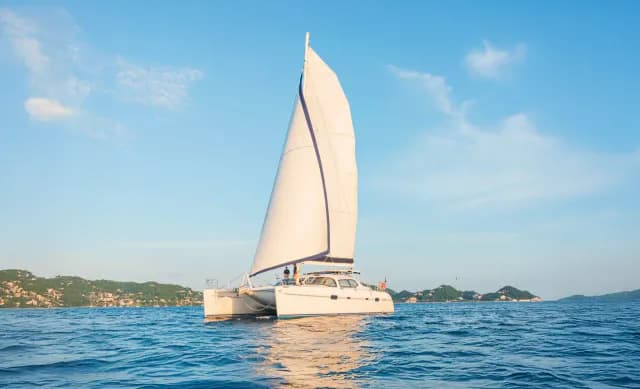
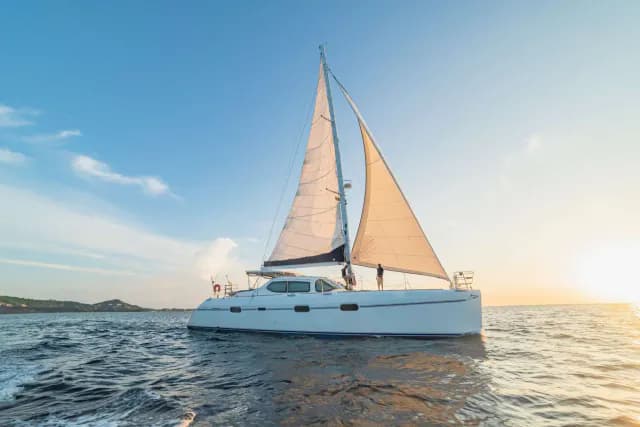
Bluewater Cruising CatamaranThe Privilege 585 is a large bluewater cruising catamaran distinguished by its signature elevated salon design — the salon sits above deck level, providing panoramic 360° views while underway that no other production catamaran can match. Built in France by Alliaura Marine (later Privilege Marine), the 585 was designed for serious long-range cruising and liveaboard comfort. At nearly 58 feet, the 585 offers enormous interior volume with a full-beam salon, up to six cabins, and extensive storage for extended voyaging. Several 585s have completed circumnavigations, and the design is particularly popular among experienced cruising couples planning multi-year voyages.
Show 2 awards
Show 6 key features
Related models
Updated 10 June 2026 · By Hulls.io Editorial
The Privilege 585: A Complete Guide
The Privilege 585 is a 58-foot bluewater cruising catamaran designed by the late Marc Lombard and built by Alliaura Marine in France between 2002 and 2006. With only 24 hulls ever produced, the 585 is one of the rarest and most sought-after cruising catamarans on the brokerage market — a semi-custom yacht distinguished by its signature elevated salon, panoramic round windshields, and the kind of interior volume and finish quality that reviewers consistently describe as apartment-like. The 585 was the largest model in the Privilege range of its era and represented the pinnacle of the brand’s elevated salon design philosophy.
The Privilege brand was born from solo ocean racing. Philippe Jeantot — a two-time winner of the BOC Challenge (the predecessor to the Vendée Globe) — founded Jeantot Marine in 1985 at Les Sables d’Olonne on the French Atlantic coast, the very port from which the Vendée Globe fleet departs. Having raced alone around the world twice, Jeantot wanted to take his family on the same oceans with the safety, comfort, and space that no existing catamaran could provide. When he couldn’t find such a yacht, he built it. Jeantot also founded the Vendée Globe race itself in 1989, forever linking the Privilege name to the most extreme test of yacht and sailor.
Marc Lombard (1958–2023) was one of France’s most respected naval architects, with over 250 boat designs to his credit. Born in Brittany, he graduated from the British School of Naval Architecture in Southampton in 1981 and established his own design firm in 1982. He joined the Privilege brand in 1987 and designed Privilege catamarans for 37 consecutive years — including the 585, which was the first Privilege to be built using vacuum infusion rather than hand lamination. Lombard also designed the Figaro Bénéteau 2 (98 units) and collaborated with RM, Neel Trimarans, and the Beneteau Group. He retired in April 2022 and passed away in September 2023 at age 64.
The 585’s bluewater credentials are proven beyond doubt. The most famous example is SV Zatara (Sailing Zatara on YouTube), a 2006 hull that has completed a full circumnavigation and logged over 50,000 nautical miles since 2016, carrying the Whitaker family of six through the Caribbean, South Pacific, Indian Ocean, and Mediterranean. Their YouTube channel has brought enormous visibility to the Privilege 585 and confirmed the platform’s ocean-crossing capability conclusively.
Hulls.io currently tracks 1 active listing for the Privilege 585, drawn from brokerages worldwide.
Showing 1–1 of 1 results
Privilege 585 Specifications
| Specification | Detail |
|---|---|
| LOA | 17.80 m (58 ft 5 in) |
| LWL | 16.76 m (55 ft 1 in) |
| Beam | 9.12 m (30 ft 5 in) |
| Draft | 1.75 m (5 ft 9 in) |
| Displacement | ~20,000 kg (44,000 lbs) cruising trim |
| Light displacement | 17,800 kg (39,200 lbs) |
| Mainsail area | 120 m² (1,292 sq ft) |
| Genoa area | 85 m² (915 sq ft) |
| Gennaker (optional) | 280 m² (3,014 sq ft) |
| Rig | Fractional sloop |
| Mast height | 24.2 m (~79 ft) |
| Engines | 2× Yanmar diesel (100–150 HP options) |
| Fuel capacity | 1,400 litres (370 US gal) |
| Water capacity | 1,200 litres (317 US gal) |
| Cabins (owner version) | 4 double + 3 single crew |
| Cabins (charter version) | 5 double + 1 single crew |
| Heads | 4–5 en suite + 1 crew |
| Construction | Divinycell PVC foam/vinylester sandwich, vacuum infusion |
| Naval architecture | Marc Lombard (1958–2023) |
| Builder | Alliaura Marine, France |
| CE category | A (Ocean) |
| Production years | 2002–2006 |
| Hulls built | 24 |
The 585 was groundbreaking for the Privilege brand — the first model built using vacuum infusion rather than hand lamination. The construction uses Divinycell closed-cell PVC foam as the sandwich core material with vinylester resin applied via vacuum infusion and directional glass cloth. This produces a hull that is lightweight yet exceptionally rigid, with superior osmosis resistance compared to earlier polyester layups. All bulkheads are glassed into the hull and deck to form a single monocoque structure, adding tremendous rigidity. Important caveat: some early 2002–2003 hulls may have used polyester resin rather than vinylester — a critical survey point for prospective buyers.
The tankage numbers tell the bluewater story. With 1,400 litres of fuel, 1,200 litres of water, and standard watermaker capability, the 585 is genuinely self-sufficient for extended offshore passages. The twin Yanmar diesels (100–150 HP options across the production run) deliver a cruising speed of 10 knots under power with a range of approximately 1,000 nautical miles. This is a yacht built for crossing oceans, not just coastal hopping.
Performance & Sailing
Under sail: The Privilege 585 achieves 7–9 knots in moderate conditions, with a maximum speed of 12 knots. Professional reviewers described the 585 as “a light sailboat which is a very high performer” — though owner feedback is more nuanced. The yacht excels reaching and running, particularly with the large 280 m² gennaker deployed. Upwind, some owners report the boat is “a bit slower than expected from a beam reach to close-hauled” — a common trait of voluminous cruising catamarans where interior volume was prioritised over hydrodynamic optimisation.
Passage-making: The 585 is rated CE Category A (Ocean) and has been proven as a bluewater passage-maker through tens of thousands of miles of real-world cruising. SV Zatara’s 50,000+ NM circumnavigation is the definitive proof point, but multiple 585s have completed transatlantic crossings and extended Caribbean and Pacific circuits. The rounded bridgedeck shape — a Privilege design hallmark — is considered superior to flat-bottomed designs for wave interaction, reducing bridgedeck slamming in confused seas.
Under power: Twin Yanmar diesels deliver a cruising speed of 10 knots. With the 1,400-litre fuel capacity, the 585 has a motorised range of approximately 1,000 nautical miles. Twin engines provide excellent close-quarters manoeuvrability through differential thrust.
Shorthanded sailing: Electric winches handle all sailing loads, making the yacht genuinely manageable for a couple. The helm is positioned on the port side at an elevated station with an oversized double pilot chair, providing excellent all-around visibility. All halyards and sheets are led to the helm area. The Sailing Zatara family has demonstrated that the 585 can be sailed by a family with children — a testament to the thoughtful ergonomic design.
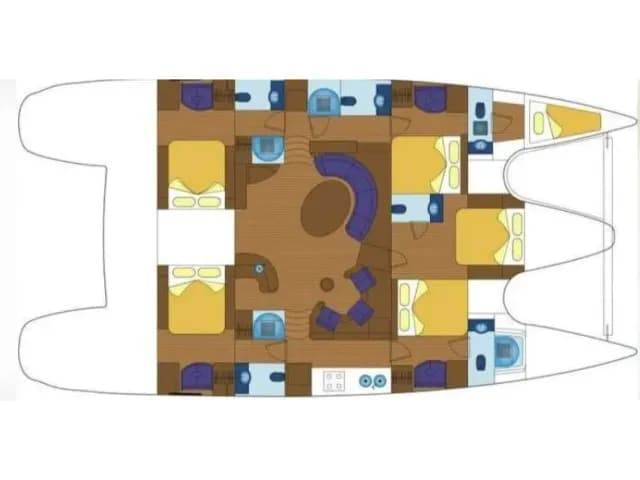
Interior Layout & The Elevated Salon
The defining design feature of the Privilege 585 is its raised salon and galley, positioned high on the bridgedeck. This creates the panoramic 360-degree visibility that no other production catamaran of the era could match — the distinctive round-shaped windshields are the 585’s visual signature. The main living area sits significantly higher than on competing catamarans, giving a sense of being “above the water” rather than enclosed at waterline level. Reviewers frequently describe the arrangement as a “Pullman” (luxury railway car) in spaciousness.
Salon: Finished in beech timber (some boats in cherrywood), the salon provides a warm, light-filled environment with original builds featuring leather seating and a telescopic dining table. A bar area is integrated into the upper bridgedeck space. The salon opens aft to the cockpit, creating a continuous living space that flows from the raised interior through to the outdoor seating.
Galley: Raised and open to the salon, the galley was described by reviewers as “quasi-professional standard.” Generous Corian countertops, a four-burner range with oven, dishwasher, microwave, double stainless steel sink under a large opening hatch, and both positive and negative cold storage provide the equipment and workspace for extended liveaboard cruising. The galley’s elevated position means the cook shares the same panoramic views as the salon occupants.
Owner’s suite: The master cabin occupies the forward nacelle — the structural pod on the bridgedeck between the two hulls that is a Privilege trademark. The nacelle provides three simultaneous benefits: structural stiffness for the entire platform, reserve buoyancy forward to improve heavy-weather behaviour, and a uniquely private full-beam master cabin with en-suite head and dressing area, accessed via a private companionway from the saloon.
Guest cabins: The owner’s version provides three additional double guest cabins, each with king or queen berths and private en-suite heads with separate dry showers. Three single crew berths are located aft. The charter version offers five double cabins plus one single crew cabin. Every configuration provides the separation and privacy expected of a yacht at this level.
Cockpit and deck: The spacious cockpit features a teak table on stainless steel supports seating six, three large cushioned benches, and a generous bimini providing shade and solar panel mounting. The foredeck is vast, with two trampolines, pulpits, and four teak seats forward. Large sugar-scoop transoms with swim ladders on both hulls provide water access, with a bottom transom platform for tender and water sports equipment storage.
Privilege 585 Ownership: What to Expect
Owning a Privilege 585 is a different proposition from owning a mass-produced catamaran. The yacht’s rarity (24 hulls), the builder’s demise (Alliaura Marine liquidated in 2012), and the age of the fleet (all hulls now 20+ years old) create both opportunities and responsibilities:
- Used pricing: Privilege 585s on the brokerage market range from approximately USD 500,000–600,000 for boats needing work, USD 600,000–750,000 for well-maintained examples, and USD 750,000–800,000+ for extensively refitted boats. Original new price was approximately USD 1,500,000. The yacht has retained value remarkably well — a testament to build quality and the extreme scarcity of only 24 hulls.
- Annual costs: Insurance at 1.0–1.5% of hull value, marina berth fees for a 58-foot catamaran (30 ft beam), twin Yanmar engine servicing, generator maintenance, watermaker upkeep, and general systems maintenance. At this age, budget for ongoing refit investment rather than simple maintenance.
- Parts and service: With Alliaura Marine defunct, sourcing specific OEM parts requires resourcefulness. The successor company, Privilege Marine (under Gilles Wagner), builds the Signature 580 as the spiritual successor and may provide some guidance. The broader Privilege owner community and specialist multihull yards are the primary support resources.
- Refit considerations: At 20+ years old, comprehensive refits are common. SV Zatara has invested significantly in their 2006 hull, including lithium battery upgrades, new electronics, generator overhaul, and rudder rebuild. Budget for continuous investment rather than one-off maintenance.
The Privilege 585 rewards owners who appreciate its unique qualities — the elevated salon, the build quality, the rarity — and who are prepared to maintain a 20-year-old yacht to the standard its construction deserves. This is not a yacht for passive ownership; it is a platform for active, engaged sailors planning serious voyages.
How to Buy a Privilege 585: What to Look For
With only 24 hulls built, purchasing opportunities are rare. When a suitable boat becomes available, buyers should be prepared to act decisively while conducting thorough due diligence:
Key Inspection Areas
- Hull laminate and osmosis: Early 2002–2003 hulls may have used polyester resin rather than vinylester, creating susceptibility to osmotic blistering. Later hulls (2004+) with vinylester infusion are more resistant. Full hull moisture survey with professional moisture meter readings is essential regardless of build year.
- Standing rigging: At 20+ years old, complete rig replacement (shrouds, stays, chainplates, turnbuckles, toggles) should be expected. If the rigging has not been replaced, budget for immediate renewal.
- Rudders: SV Zatara experienced a damaged port rudder requiring a full rebuild. Rudder bearings, blade condition, and shaft integrity should be carefully inspected.
- Engines and generators: Engine hours, service records, and oil analysis. The twin Yanmar diesels are robust but at this age require diligent maintenance. Verify generator condition —Zatara experienced a mid-ocean generator failure. Dual generators are common on the 585 and both should be thoroughly surveyed.
- Teak deck and cockpit: Teak in the cockpit and on deck requires regular maintenance and at 20 years may need partial or full replacement. Check for soft spots, delamination, and caulking condition.
- Electric systems: At this age, rewiring or significant electrical work may be needed. Many boats have had lithium battery upgrades. Verify the condition of electric furlers, winches, and navigation electronics. Request full documentation of any refits.
Engage a surveyor with specific experience in French-built composite catamarans. The vacuum-infused sandwich construction, monocoque bulkhead bonding, and nacelle structure all require specialist knowledge to assess properly. Cross-reference findings with the Privilege owner community — with only 24 hulls, the history and condition of each boat is well-known within the community.
Privilege 585 vs Competitors
The Privilege 585 occupies a unique niche: it combines the interior volume and luxury finishing of yachts 10+ feet larger with genuine bluewater capability, built in a semi-custom run of only 24 hulls. Competitors tend to fall into either the “mass-produced comfort” camp or the “performance at the expense of volume” camp. The 585 bridges these worlds but leans firmly toward luxury and comfort.
Privilege 585 vs Lagoon 560
The Lagoon 560 (2013–2020) is a much newer design with higher production volume, stronger resale values, and the Groupe Beneteau global service network. The Lagoon offers more readily available parts and service. The Privilege 585 counters with semi-custom build quality, the signature elevated salon with panoramic round windshields, a more robust construction (vacuum-infused sandwich versus hand-laid), and the proven bluewater heritage — including a documented circumnavigation. The Lagoon is the practical, well-supported choice. The Privilege is the connoisseur’s choice for buyers who prioritise build quality and design distinction over convenience.
Privilege 585 vs Catana 55 Carbon Infusion
The Catana 55 Carbon Infusion (2012–2013, only 5 built) is the performance counterpoint — lighter, with carbon construction and deeper-draft daggerboards (2.95 m) for superior upwind sailing. The Catana is sportier and faster but offers less interior volume and luxury finishing. Both are equally rare (5 Catana hulls vs 24 Privilege hulls) and occupy different ends of the 55–60 ft catamaran spectrum: performance (Catana) versus luxury cruising capability (Privilege).
Privilege 585 vs Privilege Signature 580
The Signature 580 is the spiritual successor to the 585, designed under the revived Privilege Marine brand with a new Marc Lombard hull and Darnet Design interior. The 580 offers modern construction, current systems and electronics, and active factory support. The 585 counters with proven ocean-crossing credentials (50,000+ NM logged on one hull), lower acquisition cost, and the character of a yacht designed by Lombard at the height of his career. For buyers who want a new Privilege at this size, the 580 is the natural choice. For buyers who value proven capability and are prepared to maintain a 20-year-old yacht, the 585 offers extraordinary value.
Privilege 585 vs Fountaine Pajot Saba 50
The Fountaine Pajot Saba 50 is a smaller, lighter yacht at approximately 15,700 kg — more of a “next size down” competitor with better upwind performance and a strong dealer network. The Privilege 585 offers significantly greater interior volume, the elevated salon concept, more comprehensive tankage for extended cruising, and the gravitas of a 58-foot platform. The Saba appeals to buyers who prioritise sailing performance and modern production support. The 585 appeals to buyers who need the space and capability of a larger yacht.
For a full interactive comparison between the Privilege 585 and competing models, visit the Hulls.io Market Intelligence tool.