


Prout 45 for Sale
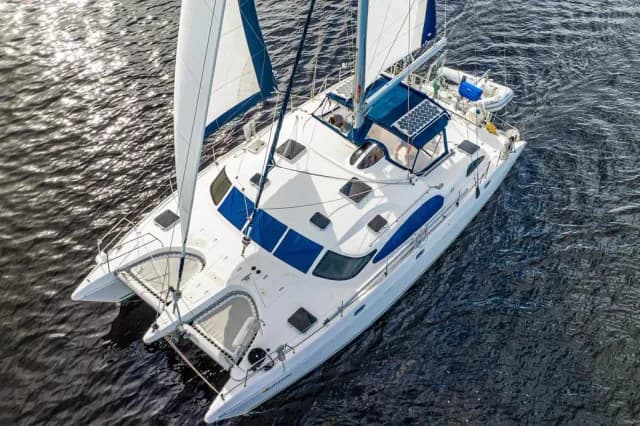
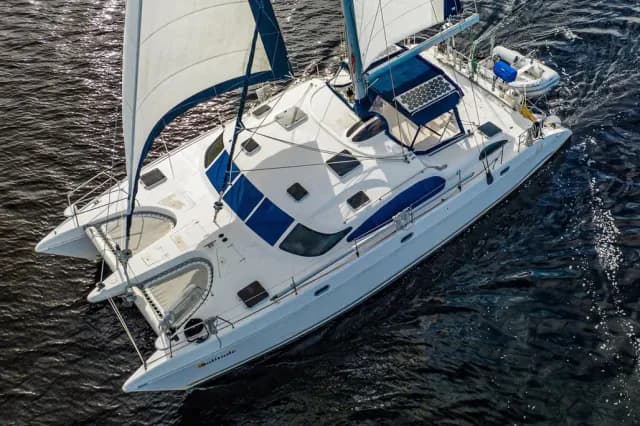
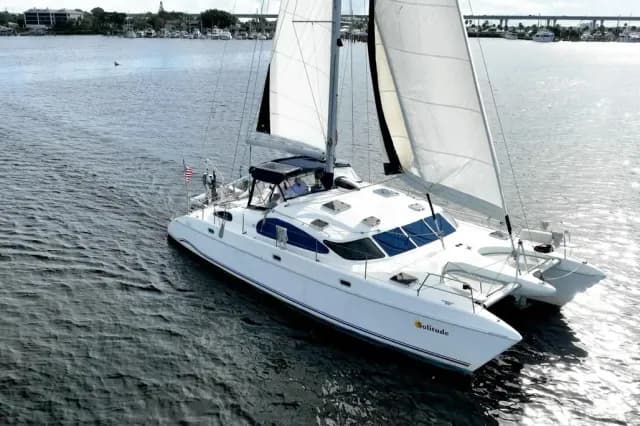
Sailing CatamaranThe Prout 45 is the flagship cruising catamaran from Prout Catamarans, the pioneering British multihull builder founded in 1935. Designed with the signature Prout full-length central nacelle — essentially a semi-submerged third hull providing exceptional interior volume and sleeping comfort at the centre of pitch and roll — the 45 was built for serious bluewater passage-making. UK-built examples (1995–2001) feature heavy-duty GRP construction with Kevlar reinforcement, a conservative cutter rig for short-handed sailing, and full skegs protecting the rudders. The moulds were later acquired by Prout International, who produced the redesigned 45S in Thailand and China until approximately 2013.
Show 2 awards
Show 6 key features
Updated 10 June 2026 · By Hulls.io Editorial
The Prout 45: A Complete Guide
The Prout 45 is a bluewater cruising catamaran built by Prout Catamarans at their Canvey Island, Essex yard — the birthplace of the modern cruising catamaran. Launched in 1995 as the successor to the Quasar 50, the Prout 45 is widely regarded as the high-water mark of the Prout range: a heavy-duty, ocean-proven platform designed by the brothers who effectively invented the production cruising catamaran in the 1950s. Where French multihull builders of the same era prioritised light displacement and racing-influenced hull shapes, the Prout 45 took an unapologetically British approach — robust GRP construction, a conservative aft-mast cutter rig, the trademark full-length nacelle, and an interior built with traditional wood joinery.
Prout Catamarans traces its roots to 1935, when Geoffrey Prout founded G. Prout & Sons on Canvey Island, initially building folding dinghies and kayaks. It was Geoffrey’s sons, Roland and Francis Prout, who transformed the company. The brothers were accomplished canoeists — British Champions in K2 Kayaks and Great Britain Olympic representatives at the 1952 Helsinki Games. In 1947, they lashed two K1 racing kayaks together with a bamboo platform, added a mast, and reached 15 knots. The cruising catamaran was born. Their first production design, the Shearwater III, became the world’s first production catamaran, with over 2,000 units built. In 1956, the Shearwater beat the legendary Uffa Fox by over one hour in the Cross Channel dinghy race from Folkestone to Boulogne — the performance that brought catamarans to the attention of the wider sailing world.
The Prout heritage runs deeper than most sailors realise. In 1964, Dr David Lewis sailed a 42-foot Prout named Rehu Moana in the OSTAR singlehanded transatlantic race, finishing seventh. He then continued on a three-year circumnavigation via the Strait of Magellan, the South Pacific, and the Cape of Good Hope — completing the world’s first circumnavigation by a multihull. Both brothers were granted the Freedom of the City of London and made Liverymen of the Worshipful Company of Shipwrights. By the time the Prout 45 launched in 1995, the yard had over 3,000 catamarans behind it, including the Snowgoose 37 — a 37-footer of which approximately 500 were built and nearly 100 have completed circumnavigations.
Hulls.io currently tracks 1 active listing for the Prout 45, drawn from brokerages worldwide.
Showing 1–1 of 1 results
Prout 45 Specifications
| Specification | Detail |
|---|---|
| LOA | 13.72 m (45 ft 0 in) |
| LWL | 12.80 m (42 ft 0 in) |
| Beam | 6.35 m (20 ft 10 in) |
| Draft | 1.04 m (3 ft 5 in) |
| Displacement | 9,750 kg (21,450 lbs) |
| D/L ratio | 129 |
| Mast height above waterline | 18.44 m (60 ft 6 in) |
| Mainsail area | 33.5 m² (360 sq ft) |
| Genoa area | 54.0 m² (582 sq ft) |
| Staysail area | 10.7 m² (115 sq ft) |
| Spinnaker area | 158 m² (1,700 sq ft) |
| SA/D ratio | 19.5 |
| Rig | Cutter — mast set well aft |
| Hull construction | GRP with Kevlar reinforcement below waterline |
| Deck construction | GRP sandwich with balsa core |
| Keel type | Low-aspect-ratio fixed keels with full skegs |
| Engines | 2× Volvo Penta 30 HP diesel (55 HP upgrade common) |
| Fuel capacity | 380 litres (85 Imp gal) |
| Water capacity | 726 litres (160 Imp gal) |
| Cabins | 3 or 4 (layout dependent) |
| Heads | 2 or 3 (layout dependent) |
| Designer | Prout Brothers (in-house) |
| Builder | Prout Catamarans Ltd, Canvey Island, Essex |
| CE category | A (Ocean) |
The defining structural feature of the Prout 45 is the full-length central nacelle — a semi-submerged “third hull” running fore and aft between the main hulls. This signature Prout innovation, first introduced on the Snowgoose 34 in 1969, provides exceptional interior volume and headroom without requiring high bridgedeck clearance. The nacelle houses the forward master cabin — a unique accommodation space positioned at the centre of pitch and roll, giving the owners the most comfortable berth on the boat. The trade-off is modest additional drag and potential bridgedeck slamming in steep seas, though the anti-slam profile and generous displacement mitigate this.
Hull construction uses isophthalic gelcoat over hand-laid GRP with isophthalic resin, 600/300g biaxial material, 9 mm end-grain balsa core, and Kevlar reinforcement in critical areas below the waterline and around the keels. The rudders are mounted on full protective skegs — a deliberate choice for a yacht designed to be beached, dried out, and maintained without a crane. UK-built Prout 45s came with a five-year osmosis guarantee.
The cutter rig with the mast set well aft is quintessentially Prout. It produces a smaller, more manageable mainsail with a larger genoa and staysail as the primary working sails — ideal for short-handed ocean passages. All halyards and sheets are led aft to the cockpit. The cutter configuration allows progressive reefing from full sail down to staysail alone, maintaining balance throughout the wind range. An SA/D ratio of 19.5 is conservative by French catamaran standards but matches the heavy-displacement hull’s requirements.
Performance & Sailing
Cruising speed: The Prout 45 averages 6 knots under sail in moderate conditions, increasing to 7–8+ knots downwind in trade-wind conditions. This is not a boat that will win races against lighter French contemporaries, and it was never designed to. As one long-term owner put it: “You won’t be beating any speed records, but she is a comfortable boat that will take you anywhere safely.” The heavy displacement absorbs sea state rather than bouncing across it — a genuine comfort advantage on long passages.
Windward ability: Optimal close-hauled angle is approximately 60 degrees apparent, tightening to 55 degrees in favourable conditions. This is wider than daggerboard-equipped French competitors such as the Catana 471 or Outremer 45, but consistent with the Prout design philosophy of prioritising comfort and safety over pointing angle. The aft-positioned mast and balanced cutter rig make the boat remarkably well-behaved on all points of sail.
Heavy-weather performance: The Prout 45 comes into her own when the wind builds. Owners consistently report that the boat gets better as conditions worsen — “the more wind, the more she seems to like it.” The cutter rig allows systematic reduction: roll away the genoa and sail under staysail and main, then reef the main, then sail under staysail alone. At every stage the boat remains balanced and controllable. The full skegs protect the rudders from floating debris and lobster pots, and the low-aspect keels allow the boat to be beached for antifouling in remote anchorages.
Under power: The standard twin Volvo Penta 30 HP diesels deliver approximately 6 knots at 1,300 RPM in flat seas, rising to 8 knots at full throttle. Many long-term owners recommend upgrading to 55 HP engines for better performance in headwinds and adverse currents. Fuel consumption at cruising speed is modest, and the 380-litre tank capacity provides reasonable range under power.
Ocean pedigree: Multiple Prout 45s have completed Atlantic crossings, and the broader Prout fleet — including the Snowgoose 37 with nearly 100 circumnavigations — holds the record for more ocean crossings in the 20th century than any other multihull brand. The Prout 45 was designed from the outset as a genuine bluewater yacht, not a coastal cruiser pressed into offshore service.
Interior Layout & Design
The Prout 45 was offered in four distinct interior layouts — Owner’s, Open Plan, Family, and Charter — all sharing the same hull, deck, and rig but configured for different cruising programmes. This flexibility was a significant selling point: the same platform could serve a retired couple on a circumnavigation or a charter operator in the Caribbean.
Owner’s version: The signature layout places a large forward master cabin in the nacelle — arguably the most comfortable sleeping position on any catamaran, positioned at the centre of pitch and roll rather than in the bow or stern. The port hull forward houses the master head with separate shower room and dressing area. The galley is located down in the starboard hull, providing excellent counter space and a cooler working environment in the tropics. The starboard hull aft contains a guest cabin with en-suite. The saloon features a large wraparound sofa around the dining table with a navigation station to port.
Construction quality: UK-built Prout 45s feature all-wood interior joinery — a British boatbuilding tradition that distinguishes them from the moulded interiors found on many production French catamarans of the same era. The full-length nacelle provides exceptional headroom throughout the saloon and cabins. Storage is generous throughout, reflecting the yard’s understanding that a bluewater cruising yacht needs to carry everything a crew requires for months at sea.
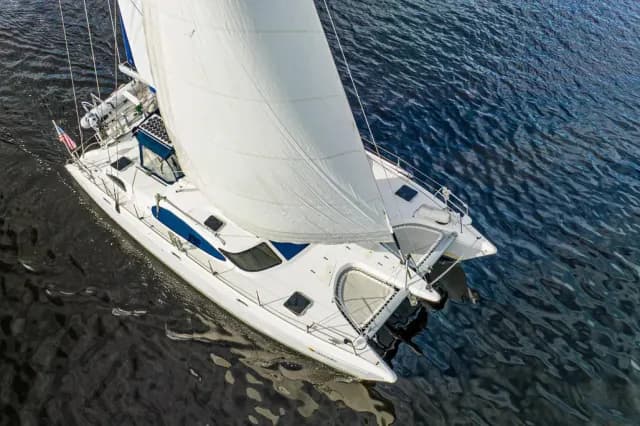
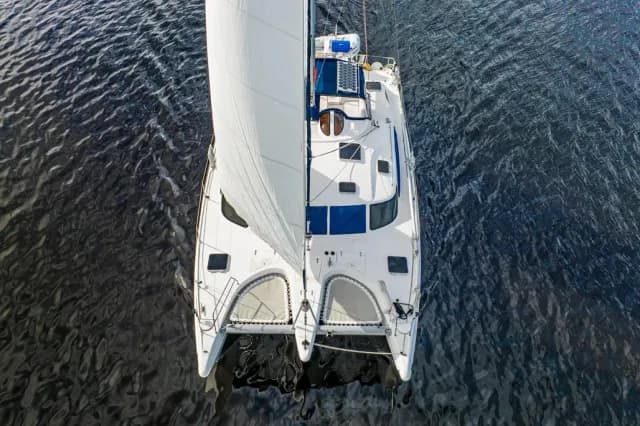
Cockpit and deck: The solid GRP bridgedeck extends to the bows — unlike French designs with open trampolines forward. This provides a safe, secure working platform in all weather conditions and contributes to the enclosed, all-weather character of the boat. The cockpit is well protected and positioned directly ahead of the twin helms, with all sail controls led aft. The solid foredeck is a significant safety advantage over trampoline-equipped designs when working with the anchor or handling sails in heavy weather.
Charter and four-cabin version: The charter layout provides four double cabins (two forward of the saloon, two aft athwartships) with two heads, maximising accommodation capacity. The family version prioritises a queen-size forward cabin in the nacelle with a practical layout for sailing with children.
Prout 45 Ownership: What to Expect
The Prout 45 represents outstanding value in the bluewater catamaran market. UK-built examples from 1995–2001 typically trade between GBP 120,000 and 250,000 (USD 150,000–300,000), while later Asian-built 45S models (2003–2013) range from USD 200,000 to 375,000. These boats are rarely available on the secondhand market and tend to sell quickly when listed.
- Insurance: GBP 1,500–3,500 per annum (0.7–1.5% of insured value). Most UK marine insurers are familiar with Prout catamarans given the brand’s British heritage.
- Berthing: GBP 8,000–20,000+ annually in the UK (multihull surcharge of 1.25× LOA is standard at most UK marinas). Mediterranean berthing ranges from EUR 10,000 in Greece or Croatia to EUR 20,000+ on the French Riviera.
- Annual maintenance: Budget 5–10% of purchase price for comprehensive upkeep. On a 25+ year old boat, allow extra for standing rigging replacement (every 10–15 years), sail replacement, deck fitting resealing, and rudder bearing renewal.
- Haul-out and antifouling: GBP 2,000–4,000 annually. The low fixed keels and protective skegs allow the boat to be dried out on firm ground without a crane — a significant advantage for maintenance in remote locations.
- Engine servicing: GBP 1,000–2,000 per annum for twin-engine service. Parts for Volvo Penta diesels are widely available worldwide.
- Estimated annual total: GBP 18,500–48,000 depending on location, usage pattern, and the age-related maintenance requirements of the individual boat.
As one owner summarised: the Prout 45 is “a lot of boat for the current market price.” The combination of genuine bluewater capability, proven construction, and moderate purchase price makes it one of the strongest value propositions in the 40–50-foot cruising catamaran market — particularly for buyers who prioritise seaworthiness and passage-making comfort over outright speed or charter-fleet cosmetics.
How to Buy a Prout 45
UK-built vs Asian-built: The most important distinction in the Prout 45 market is provenance. UK-built boats (1995–2001) from the Canvey Island yard carry the full Prout Brothers heritage, all-wood joinery, and the original cutter rig. After Prout Catamarans entered receivership in 2001, the 45 moulds were acquired by Prout International (a Chinese-Canadian consortium), and the significantly redesigned 45S was built in Thailand and China. The 45S features a wider 7.00 m beam (vs 6.35 m), heavier displacement, repositioned mast, and revised sail plan. Both are capable bluewater boats, but they are materially different yachts. UK-built examples command a premium for their construction quality and historical significance.
Pre-purchase survey focus: On any Prout 45 over 20 years old, a surveyor should pay particular attention to water ingress through deck fittings, rudder tie rods and bearings, standing rigging condition (especially if original), and the balsa core in the deck sandwich construction. The GRP hulls themselves are generally robust, and the five-year osmosis guarantee on UK-built boats reflected Prout’s confidence in their hull layup.
Key Considerations for Buyers
- Engine upgrades: The standard 30 HP Volvo Penta diesels are adequate for coastal work but long-term owners consistently recommend upgrading to 55 HP engines for better performance in headwinds, strong currents, and marina manoeuvring. Check whether the previous owner has already completed this common upgrade.
- Rig and sails: On a 25+ year old boat, standing rigging will likely need replacement if not already done. The cutter rig is simple and strong, but all wire, swages, and turnbuckles should be carefully inspected. Budget for new sails if the existing inventory has done significant ocean miles.
- Spares availability: Prout Catamarans ceased trading in 2001 (UK) and Prout International around 2013. There is no factory support, but the boat uses standard marine components (Volvo Penta engines, Lewmar winches, standard GRP construction) that any competent boatyard can service. An active owner community provides technical knowledge and sourcing advice.
- Market scarcity: Prout 45s appear on the brokerage market infrequently and tend to sell quickly. Buyers should be prepared to move decisively when a well-maintained example becomes available, and should consider engaging a yacht broker to monitor new listings.
The Prout 45 is a yacht for sailors who value substance over style, who plan to cross oceans rather than sail between marinas, and who appreciate that genuine bluewater capability was built into this design by two brothers who spent their entire careers proving that catamarans could go anywhere.
Prout 45 vs Competitors
The Prout 45 competed in the 40–50-foot cruising catamaran market of the mid-1990s to early 2000s, a period when French builders were establishing dominance in multihull production. The competitive landscape was defined by a fundamental philosophical split: the British heavy-displacement, safety-first approach versus the French performance-oriented, light-displacement school.
Prout 45 vs Catana 471
The Catana 471 is widely considered the high-water mark of the French performance cruising catamaran school of the same era. With daggerboards for superior windward ability, lighter displacement, and finer hull entries, the Catana is the faster boat on every point of sail. However, the daggerboard trunks penetrate the hull — a structural complexity that the Prout avoids entirely with its fixed keels and full skegs. The Catana demands more of its crew; the Prout is more forgiving. For extended bluewater cruising by a short-handed couple, the Prout’s aft-mast cutter rig and nacelle-centred master cabin offer practical advantages that the Catana’s speed cannot replicate.
Prout 45 vs Fountaine Pajot Bahia 46
The Fountaine Pajot Bahia 46 represents the balanced French approach: lighter than the Prout, faster upwind, and designed with the charter market in mind. The Bahia offers a more modern, open-plan interior with superior ventilation for tropical cruising. The Prout counters with heavier construction, the enclosed nacelle for North Atlantic and higher-latitude sailing, the cutter rig for progressive reefing, and all-wood joinery that ages more gracefully than moulded interiors. The Bahia suits the Mediterranean and Caribbean charter circuit; the Prout suits the sailor heading west from the Canaries or south from the Solent.
Prout 45 vs Privilege 45
The Privilege 45 was another French contender positioned at the premium end of the market. With superior interior finish, better sailing performance, and a more modern aesthetic, the Privilege was the more refined yacht. The Prout 45’s advantages lie in its lower purchase price, the proven durability of British GRP construction, and the nacelle layout that provides unmatched interior volume for its length. The Privilege commands higher prices on the brokerage market; the Prout offers more boat per pound.
Prout 45 vs Lagoon 47
The Lagoon 47 prioritised interior volume and charter appeal above all else. It is the more spacious boat with better ventilation and a more contemporary layout. However, the Lagoon’s build quality of the era did not match the Prout’s heavy-duty construction, and the Lagoon’s trampolined foredeck offers less security than the Prout’s solid bridgedeck when working forward in heavy weather. For a sailing couple planning an extended circumnavigation, the Prout’s combination of structural robustness, self-sufficiency (the ability to beach for maintenance), and the conservative cutter rig offers a stronger package than the charter-optimised Lagoon.
For a full interactive comparison between the Prout 45 and other models, visit the Hulls.io Market Intelligence tool.