


Fountaine Pajot Saba 50 for Sale
Sail CatamaranThe Fountaine Pajot Saba 50 is available on Hulls.io with 1 listing currently for sale. This model is categorised as a Sail Catamaran.
Updated 3 October 2026 · By Hulls.io Editorial
The Fountaine Pajot Saba 50: A Complete Guide
Announced in December 2013 as the successor to the Salina 48, Fountaine Pajot’s Saba 50 took the yard’s cruising catamaran range into the 50-foot class. The Salina 48 had been a success — first launched in 2009, it passed 100 boats in five years — and the Saba replaced it with a bigger boat rather than a refreshed one: 68 cm longer and 29 cm wider, on hulls and a bridgedeck nacelle that are both broader and taller. Multihulls World, which sailed the boat for its launch review, reported that 15 had been sold before it was shown to the public.
The design team was the one behind the Salina: naval architects Berret-Racoupeau drew the hulls, with near-vertical bows, shallow aft steps and U-shaped sections to keep the waterline long and the wetted area small, and Isabelle Racoupeau designed the interior. The boat was offered in two versions from the start — the four-cabin Maestro for private owners and the six-cabin Quintet for charter — which is why the Saba 50 is as common in charter fleets as it is in private hands.
Recognition followed in its first US season. Judged at the autumn 2014 Annapolis show, the Saba 50 won SAIL magazine’s Best Boats 2015 award in the Multihull 41–50 ft category, and it was one of three nominees in Cruising World’s 2015 Boat of the Year Multihull Cruiser class (the Gunboat 55 took that title). The Saba 50 has since been succeeded by the Aura 51. Accounts of how many were built differ: Yachting World put the number launched at more than 150 when it tested the Aura 51 at the end of 2022, while Cruising World later wrote that some 300 hulls had been sold.
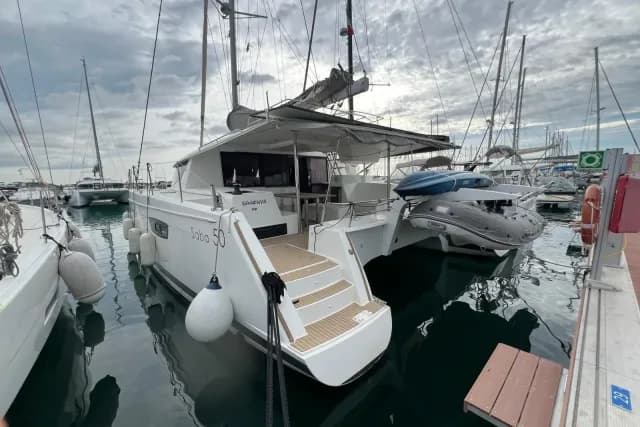
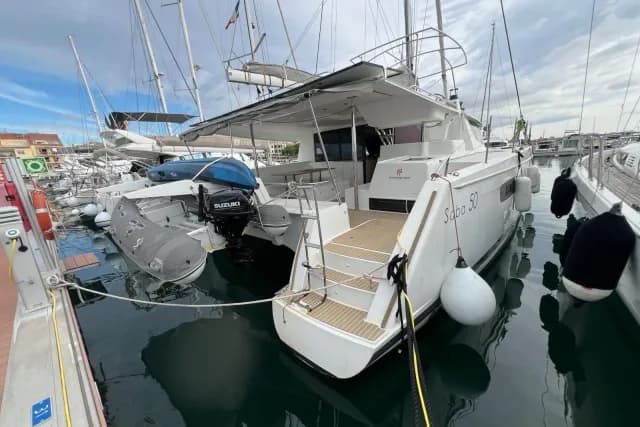
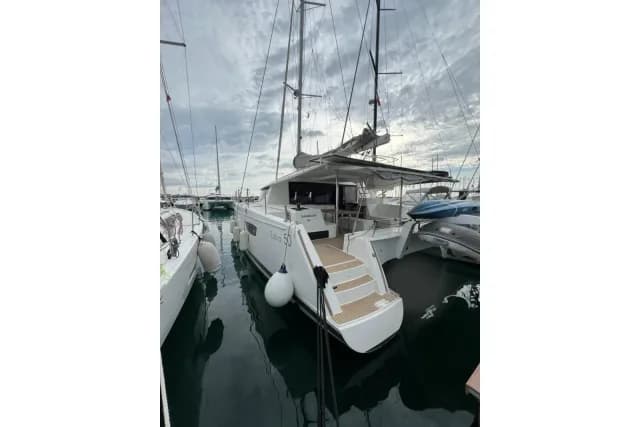
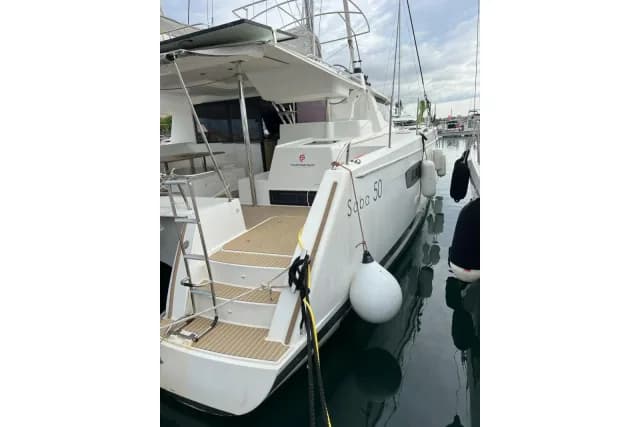
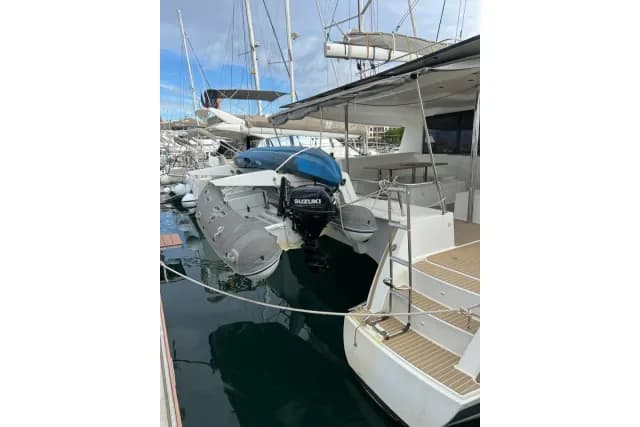
Hulls.io currently tracks 1 active listing for the Saba 50. Among them is a 2019 Saba 50 listed in Cambrils, Spain.
Showing 1–1 of 1 results
Saba 50 Specifications
Figures from Fountaine Pajot’s own specification for production boats. Some pre-launch announcements quoted smaller sails (a 74 m² main and 52.6 m² genoa), a 1.15 m draft and 50 hp engines; the builder’s production sheet and the boats tested at launch carry the figures below.
| LOA | 14.98 m (49 ft 2 in) |
|---|---|
| Beam | 7.99 m (26 ft 3 in) |
| Draft | 1.25 m (4 ft 1 in), fixed keels |
| Light displacement | approx. 15,700 kg (34,600 lbs) |
| Mainsail | 83.5 m² (899 sq ft) |
| Genoa | 57.5 m² (619 sq ft) |
| Upwind sail area | 141 m² (1,518 sq ft) |
| Engines (standard) | 2× Volvo Penta D2-55, 55 hp, saildrives |
| Engines (option) | 2× 75 hp |
| Fuel capacity | 940 litres (2 × 470 L; 248 US gal) |
| Water capacity | 700 litres (185 US gal) |
| Layouts | Maestro: owner’s suite + 3 guest cabins, 4 heads · Quintet: 5 doubles + crew cabin, 6 heads |
| CE category | A (14 people) |
| Naval architecture | Berret-Racoupeau Yacht Design |
| Interior design | Isabelle Racoupeau |
| Builder | Fountaine Pajot, France |
| Predecessor | Salina 48 |
| Successor | Aura 51 |
Design and Accommodation
Three outdoor spaces
Fountaine Pajot built the Saba 50 around three areas given over to relaxation: the aft cockpit, a forward deck salon at the foot of the mast, and a 12 m² lounge deck on top of the hard bimini, next to the helm. The cockpit sits under the hardtop with a table of 1.72 × 1.21 m offset to port that seats ten — twelve with the extension offered on the Quintet — and a 3.75 m bench across the stern. Forward, rather than a full second cockpit, the yard fitted slightly recessed seating with adjustable cushions and an optional awning on carbon posts. The yard’s signature overhanging coachroof shades the saloon windows.
Helm and sail handling
The helm station is to starboard at half coachroof height, with a three-seat bench and a separate sail-handling area alongside: three winches and the clutches, with lines from the port side routed so they do not cross the roof. Everything is handled there except the second and third reefs, which are taken at the mast as standard — leading them aft was an option. Multihulls World noted good visibility from the helm, interrupted only by a genoa or gennaker eased right out.
Interior
There is no step between the cockpit and the saloon, and headroom reaches 2.25 m. The galley is to port, with an L-shaped worktop and a central island, close to the cockpit; the chart table is set at an angle. In the hulls, the yard kept its “cat’s eye” portlights but made them much larger than on the Salina. The Maestro version gives the owner a private suite with its own bathroom plus three guest cabins with their own bathrooms; the Quintet has five double cabins and a crew cabin, with six bathrooms, for up to twelve berths.
Under Sail and Power
The Saba is a heavier boat than the Salina it replaced — about 15.7 tonnes against 11 — while upwind sail area rose more modestly, from 131 m² to 141 m². Multihulls World calculated a sail-area-to-weight ratio of 8.98 m² per tonne for the Saba, against 11.9 for the Salina 48 and 6.81 for the Lagoon 52, and expected the extra weight to show in light air. On its test day, in just 5–6 knots of wind, the boat surprised it: under gennaker the speed rose from 4 to 6 knots, the helm stayed light, and the boat did not miss a tack all day, even under mainsail alone. With the slightly overlapping solent it pointed to about 60 degrees off the wind, which the magazine judged fairly good for a cruising catamaran on fixed keels.
The keels are fixed, as on every Fountaine Pajot of the period, giving a 1.25 m draft — 15 cm more than the Salina 48. Standard power is a pair of 55 hp Volvo Penta saildrives, which the testers found well matched to a 50-foot catamaran in a tight marina; 75 hp engines were offered for owners wanting more in reserve. Fuel is carried in two 470-litre tanks.
How It Compares
On the used market the Saba 50’s closest rival is the Lagoon 50, launched in 2017. The Lagoon is slightly shorter (14.75 m) and a little wider (8.10 m), and is a flybridge design where the Saba keeps its helm at half coachroof height beside a lounge deck. Lagoon quotes a CE light displacement of 19,956 kg against Fountaine Pajot’s light weight of about 15,700 kg; the two builders measure differently, so treat that gap as indicative rather than exact.
Within Fountaine Pajot’s own range, buyers looking a size down will also meet the Saona 47, another Berret-Racoupeau design. For the boat that replaced the Saba 50, see the Aura 51.
Buying a Used Saba 50
The first question is the version. A four-cabin Maestro was bought to be lived on by its owner; a six-cabin Quintet was usually built for charter, and its history will show it. Neither is better in itself — but the layout decides who the boat suits, and the service record decides what it will cost to put right.
What to check
- Engine hours and saildrive service history on both Volvo units, including the saildrive seals.
- Whether the boat has the standard 55 hp engines or the 75 hp option.
- The hard bimini and lounge deck: Multihulls World found the aft end of the bimini, where the solar panels sit, less stiff than it would have liked.
- Reefing arrangement — whether the second and third reefs were led back to the cockpit or are still taken at the mast.
- Equipment fitted as options at build (air-conditioning, watermaker, generator), and its condition.
- For an ex-charter boat, the fleet’s maintenance records and a full out-of-water survey.
Asking prices depend heavily on version, year and charter history. The listings on this page show what sellers are asking today. Browse every Fountaine Pajot catamaran for sale.
Fountaine Pajot Saba 50 Value Retention
Newest vintage = 100%. Older vintages shown as % of that price.
Based on median asking prices by model year. The newest model year in our dataset is used as the 100% reference point. The curve is smoothed so retention never increases as age increases — hover over data points to see raw values. Shaded band shows the 25th–75th percentile price range. Figures reflect asking prices from tracked listings, not final sale prices.