


Lagoon 50 for Sale
Sail CatamaranThe Lagoon 50 is available on Hulls.io with 2 listings currently for sale. This model is categorised as a Sail Catamaran.
Updated 10 June 2026 · By Hulls.io Editorial
The Lagoon 50: A Complete Guide
Unveiled at the Cannes Yachting Festival in September 2017, the Lagoon 50 extended the new-generation vertical bow and aft-positioned mast — first introduced on the Lagoon 52 in 2011 and rolled out to the Lagoon 42 in 2016 — into the 50-foot segment. Developed by VPLP Design in collaboration with industrial designer Patrick le Quément (who led Renault design for more than two decades, from 1987 to 2009), this design language broke with the swept-bow, mid-mast conventions that had defined the brand’s earlier generation. Positioned between the 46 and the 52 in Lagoon’s lineup, the 50 filled a gap that charter operators and private owners had requested for years — a flybridge catamaran large enough for six-cabin charter service yet refined enough for private three-cabin owner cruising.
The market responded quickly. The Lagoon 50 won the British Yachting Awards Multihull of the Year in 2018 and SAIL Magazine’s Best Boats award for 2019 in the 40–50 ft cruising multihull category. Production ran from 2018 to 2021 before the Lagoon 51 superseded it — a relatively short production window. Contrary to what a higher model number might suggest, the 51 is not a smaller boat: it is in fact slightly longer (15.35 m LOA vs 14.76 m) on a near-identical light displacement. The real changes are a revised sail plan with a larger mainsail, the mast repositioned further forward, and a redesigned deck with a forward cockpit and lounge — an evolution of the layout rather than the dimensions.
Lagoon is one of Groupe Bénéteau’s catamaran brands; the group is the world’s largest recreational boatbuilder by volume. The marque dates to 1984 and the Lagoon 55, its first catamaran. Since then Lagoon has delivered over 6,000 catamarans across sail and power models, making it the world’s largest production catamaran builder by unit volume. Larger Lagoon models (50 ft and above) are built at the group’s CNB shipyard in Bordeaux, France, while smaller models are assembled at Belleville-sur-Vie in the Vendée and at international partner facilities. The design team — VPLP for naval architecture, Nauta Design of Milan for interiors, and Patrick le Quément for exterior styling — has been consistent across the entire new-generation range.
Hulls.io currently tracks 2 active listings for the Lagoon 50, drawn from brokerages worldwide. With 71 tracked listings in our market intelligence database, comprehensive pricing data is available for this popular charter and cruising platform.
Showing 1–2 of 2 results
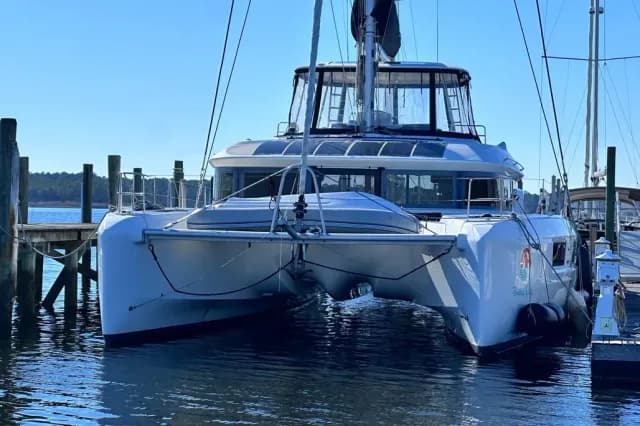
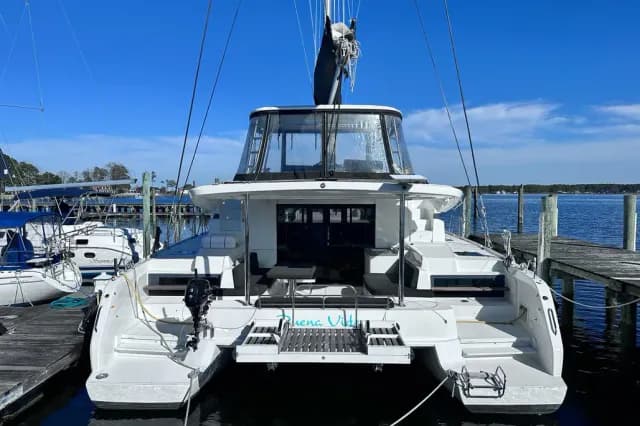
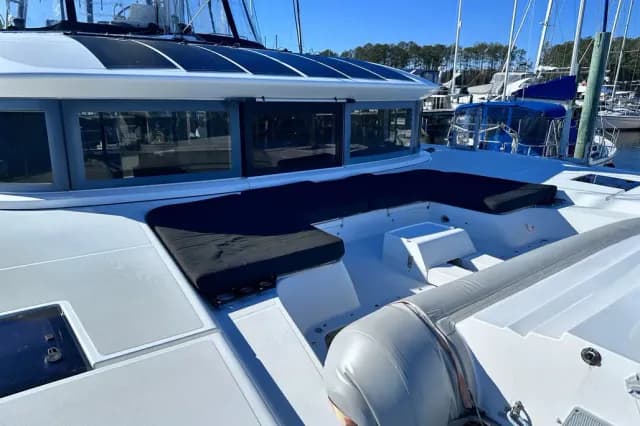
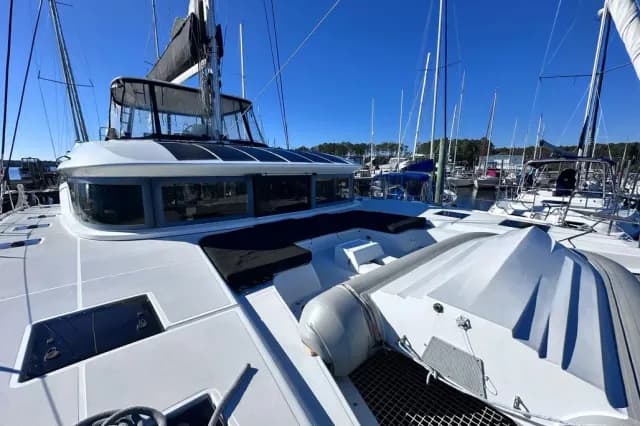
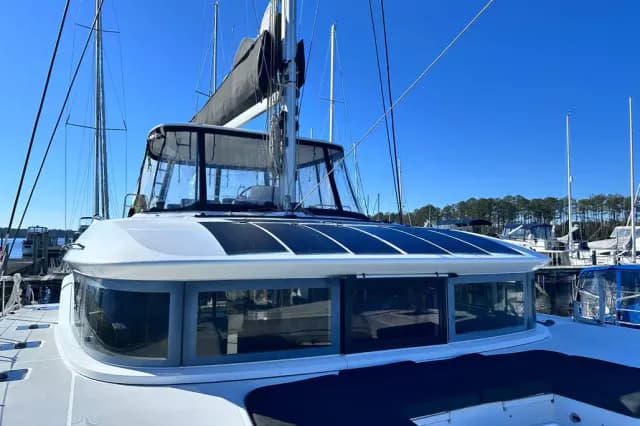
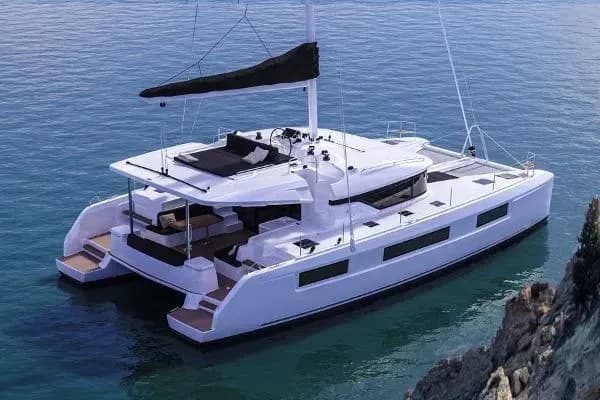
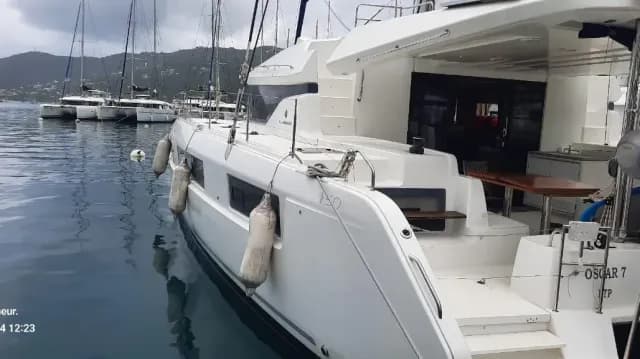
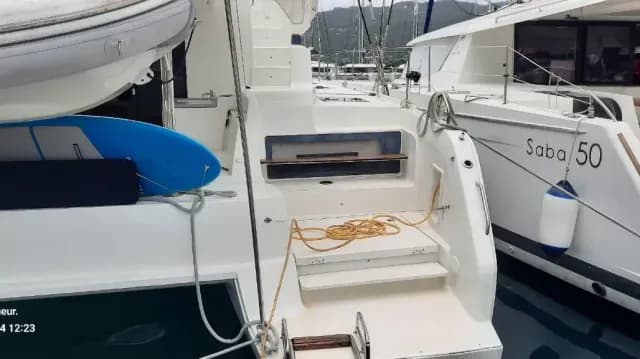
2019 Lagoon 50 | Six-Cabin Charter-Ready Catamaran
Lagoon 50 Specifications
| Specification | Detail |
|---|---|
| LOA | 14.76 m (48 ft 5 in) |
| LWL | 14.30 m (46 ft 11 in) |
| Beam | 8.10 m (26 ft 7 in) |
| Draft | 1.40 m (4 ft 7 in) |
| Light displacement (CE) | 19,956 kg (43,990 lbs) |
| Air draft | 26.51 m (87 ft) |
| Mainsail area | 87 m² (937 sq ft) |
| Self-tacking jib | 57 m² (614 sq ft) |
| Total upwind sail area | 144 m² (1,549 sq ft) |
| Code 0 (optional) | ~117 m² (1,259 sq ft) |
| Engines (standard) | 2× Yanmar 4JH57, 57 HP |
| Engines (option) | 2× Yanmar 4JH80, 80 HP |
| Fuel capacity | 1,040 litres (275 US gal) |
| Water capacity | 480 litres (127 US gal) |
| Cabin layouts | 3 / 4 / 6-cabin configurations |
| Naval architecture | VPLP Design |
| Interior design | Nauta Design |
| Exterior design | Patrick le Quément |
| Builder | Lagoon (Groupe Bénéteau), Bordeaux, France |
| CE category | A (Ocean) |
| Production years | 2018–2021 |
| Successor | Lagoon 51 |
The defining specification is the mast position. VPLP moved the mast step significantly aft compared to the previous-generation Lagoon 450 and 500, a direct application of the office’s competitive sailing experience (VPLP designed the foils and hulls for multiple America’s Cup and Vendée Globe campaigns). The aft mast shifts the centre of effort rearward, which reduces weather helm and improves upwind balance — a meaningful gain for a 20-tonne catamaran. The self-tacking jib on a curved track forward of the mast crosses the boat without sheet handling, making tacking a single-person operation.
Construction is vacuum-infused polyester GRP with a solid laminate below the waterline and a balsa-cored sandwich above. This is standard production catamaran construction — cost-effective, well-proven, and repairable at any yard with GRP experience. The vertical bow, borrowed from VPLP’s racing designs, lengthens the waterline by approximately 0.5 metres compared to a conventional raked bow of the same LOA, increasing hull speed and improving the motion in head seas.
The engine range starts with twin Yanmar 4JH57 diesels producing 57 HP per side, sufficient for marina manoeuvring and motoring in light airs at approximately 7.5 knots. The optional 80 HP Yanmar 4JH80 upgrade delivers 9.5 knots at 3,000 RPM and is the specification of choice for owners who plan extended motoring passages in light-wind areas such as the Mediterranean in summer. The 1,040-litre fuel capacity provides a motoring range of approximately 300–400 nautical miles at 7-knot cruise depending on conditions.
Performance & Sailing
Upwind: SAIL Magazine tested the Lagoon 50 off Miami’s South Beach in 12–16 knots of true breeze and lumpy seas, recording 5.1 knots at 60 degrees off the wind. This is representative of production catamaran upwind performance at this displacement — not exciting, but functional. The self-tacking jib makes short-tacking through a channel or harbour entrance straightforward without crew coordination, which is where the aft mast position pays its greatest practical dividend.
Reaching & downwind: The boat accelerated to 7.4 knots at 140 degrees apparent in the same conditions, and the optional Code 0 produced 11.4 knots on a beam reach — a genuine sailing speed that transforms passage-making from a motoring exercise into a sailing one. The 144 m² upwind sail area is well-matched to the 20-tonne displacement; the boat begins to move reliably in 8–10 knots of true wind.
Under power: With the optional twin 80 HP Yanmars, the Lagoon 50 motors at 9.5 knots at 3,000 RPM. The more efficient cruising speed of 7.5 knots at 2,200 RPM is where most owners settle for long-distance motoring. Twin engines with saildrives provide excellent close-quarters manoeuvrability through differential thrust, and the shallow 1.40-metre draft permits anchorage in waters that deeper-keeled monohulls cannot access.
Sea-keeping: CE Category A (Ocean) certifies the Lagoon 50 for unrestricted offshore sailing. The wide 8.10-metre beam provides stability that eliminates heeling — the primary comfort advantage of any catamaran over a monohull. The vertical bow improves the motion in head seas by preventing the bow from slamming into wave faces, though the flat bridgedeck underside will slap in steep short chop at speed, which is a characteristic of all bridgedeck catamarans regardless of builder.
Handling: The flybridge helm position provides 360-degree visibility, and all sail controls are led to the flybridge via electric winches. A single person can sail the Lagoon 50 in moderate conditions without leaving the flybridge, which is a meaningful practical advantage for short-handed cruising couples.
Interior Layout & Design
The interior was designed by Nauta Design of Milan, the same studio responsible for the interiors of the Lagoon 46, the Lagoon 42 and the entire new-generation range. Nauta’s approach centres on natural light, clean lines and a material palette of light oak woodwork, white laminate and neutral-toned soft furnishings. The saloon is a single open-plan space connecting galley, dining and lounge areas with full-height glazing on both sides and a forward-facing panoramic window.
The Lagoon 50 is offered in an unusually wide range of cabin configurations — three, four and six cabins — reflecting its dual role as both a private cruiser and a charter platform. The three-cabin owner’s version places a full-beam master suite in the starboard hull with a separate shower and heads, a guest double forward in the port hull, and a third double aft in the port hull. This layout maximises private space and storage for long-range cruising. The six-cabin charter version fits six double cabins across both hulls with four heads, accommodating up to twelve guests — the configuration most commonly found in Mediterranean and Caribbean charter fleets.
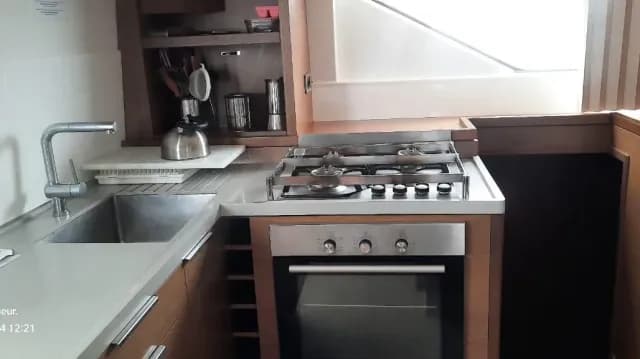
The galley is positioned on the main deck level at the aft end of the saloon, opening directly to the cockpit through a large sliding door. This galley-up arrangement keeps the cook integrated with the social spaces and provides natural ventilation at anchor — a significant quality-of-life feature in tropical cruising. Counter space, refrigeration volume and stowage are all dimensioned for provisioning a week’s charter or a multi-week passage.
The flybridge is the Lagoon 50’s primary living space in fair weather. It accommodates the helm station forward with seating for two, a U-shaped settee with dining table amidships, and a sunpad aft. A rigid bimini provides permanent shade. The total flybridge area is approximately 20 m² — larger than many 50-foot monohull cockpits — and is connected to the cockpit below via an internal staircase.
The cockpit itself features a dining table for eight, a wet bar, and direct access to both the saloon and the swim platform via the transom steps. The aft platform includes a hydraulic tender lift on some specifications, facilitating deployment and recovery of a 3-metre tender without davits or a crane.
Lagoon 50 Ownership: What to Expect
The Lagoon 50’s ownership profile splits into two distinct markets: private owners who cruise independently and charter-programme owners who place the boat in a fleet to offset costs. Both are well-served by the platform:
- New-build pricing: The Lagoon 50 is no longer in production (replaced by the Lagoon 51 in 2021). New-build pricing during production ranged from approximately €600,000 to €750,000 depending on cabin layout and equipment level. The successor Lagoon 51 launched at roughly €800,000 and has risen well beyond that with options.
- Used market: Ex-charter six-cabin examples from 2019–2020 can be found from approximately €200,000–€350,000, reflecting heavy use and charter depreciation. Private-owner three- or four-cabin examples from 2020–2021 command €600,000–€870,000 depending on specification and condition. The price gap between ex-charter and private boats is the widest in the production catamaran market.
- Annual operating costs: Insurance at 1.0–1.5% of hull value, marina berthing for an 8-metre-beam catamaran (charged at beam × 2 at most Mediterranean marinas), twin Yanmar engine servicing, saildrive maintenance, antifoul, and annual rigging inspection. Expect €25,000–€50,000 annually in the Mediterranean, excluding berthing fees which vary dramatically by location.
- Charter income: A six-cabin Lagoon 50 in a BVI, Greek or Croatian charter fleet generates €60,000–€120,000 in annual gross charter revenue depending on utilisation, season and management company. Net income after management fees, maintenance and insurance is typically 30–50% of gross. Charter-leaseback programmes are the primary acquisition route for buyers seeking to offset ownership costs.
- Resale curve: The Lagoon 50’s short production run (2018–2021) limits used supply, which supports residuals for private-owner boats. Ex-charter boats depreciate steeply once they exit the fleet at 5–7 years, typically losing 50–70% of the original new-build price.
The key decision for any Lagoon 50 buyer is charter history. A private-owner three-cabin boat with 500 engine hours and full service records is a fundamentally different proposition from an ex-charter six-cabin boat with 3,000 hours and charter wear. Price the boat accordingly.
How to Buy a Lagoon 50
New vs used: The Lagoon 50 is out of production. All transactions are used-boat sales. The replacement Lagoon 51 is available new through the Lagoon dealer network. Buyers choosing between a used 50 and a new 51 should note that the 51 is, despite the name, slightly longer (15.35 m vs 14.76 m) on a near-identical displacement, with a larger mainsail and the mast moved forward to open up a forward cockpit and lounge. The two are closely matched on size and interior volume; the 51 is the newer design with the updated deck layout, while the 50 offers better value on the used market.
The Lagoon range: The Lagoon 50 sits within a comprehensive sailing catamaran lineup that currently spans the Lagoon 40 to the Lagoon 65. Buyers considering the 50 for private cruising should evaluate the Lagoon 46 (smaller, simpler, lower operating costs) and the Lagoon 55 (larger, more luxury-oriented) to identify the right platform for their cruising programme.
Key Considerations for Buyers
- Charter history: The single most important factor in a used Lagoon 50 purchase. Request full engine hours, charter booking records, and maintenance logs. Ex-charter boats at 5+ years with 2,000+ engine hours require thorough osmosis checks, saildrive seal inspection, standing rigging assessment, and interior condition review.
- Saildrive seals: The Yanmar saildrives use rubber lip seals that degrade over time regardless of use. Budget for saildrive seal replacement every 5–7 years (€2,000–€3,000 per side). A failed saildrive seal allows water ingress into the engine compartment and is the most common emergency on Lagoon catamarans of this era.
- Beam-related berthing: At 8.10 m beam, the Lagoon 50 requires a catamaran-width berth at every marina. In the Mediterranean, catamaran berths are scarce and priced at 1.5–2× the cost of a monohull berth of equivalent LOA. Factor this into annual operating costs before committing.
- Survey requirements: A multihull-experienced surveyor is essential. Standard monohull survey techniques miss critical catamaran areas: bridgedeck laminate, hull-to-crossbeam joints, daggerboard trunk seals (if fitted), and mast step compression loading. Request core sampling in the bridgedeck and foredeck to check for moisture ingress in the balsa core.
The Lagoon 50 is an excellent platform for both charter operation and private cruising, with the cabin-layout flexibility to serve either role. The buying decision turns almost entirely on charter history, engine hours and saildrive condition.
Lagoon 50 vs Competitors
The Lagoon 50 competes in the 45–52 ft production sailing catamaran segment — the largest and most competitive size class in the catamaran market, dominated by charter fleet demand. Every major production catamaran builder offers a model in this range.
Lagoon 50 vs Fountaine Pajot Saona 47
The Fountaine Pajot Saona 47 (13.94 m LOA, 7.70 m beam, ~14,350 kg light displacement, 2× Volvo Penta D2-50 at 50 HP standard / D2-60 at 60 HP optional, built 2017–2021) is the closest direct competitor from Lagoon’s principal French rival. The Saona 47 is shorter, lighter and narrower than the Lagoon 50 — differences that translate into lower berthing costs, better upwind sailing angles and lower fuel consumption. The Lagoon 50 counters with greater interior volume (the 8.10 m beam provides meaningfully wider cabins and saloon), a larger fuel tank (1,040 L vs 940 L) and the flybridge helm station that the Saona 47 does not offer. For charter operators, the Lagoon 50’s six-cabin layout accommodates more guests than the Saona 47’s maximum of five cabins. The Saona has been replaced by the Tanna 47, and used pricing for both is comparable.
Lagoon 50 vs Bali 5.4
The Bali 5.4 (16.78 m LOA, 8.74 m beam, approximately 22,000 kg displacement, 2× Yanmar 80 HP) is Catana Group’s entry in this segment and is a substantially larger and heavier boat. At 16.78 m LOA and 8.74 m beam, the Bali 5.4 dwarfs the Lagoon 50 on paper and in interior volume. The Bali’s signature features — the solid foredeck (no trampoline), the opening forward cockpit and the tilting saloon door — create a usable living space that is simply larger than anything the Lagoon 50 can offer. The trade-off is weight, windage and sailing performance: the Bali 5.4 is not a boat that sails particularly well in light airs, and its 8.74-metre beam limits marina options further. The Lagoon 50 is the better sailor; the Bali 5.4 is the better floating apartment.
Lagoon 50 vs Leopard 50
The Leopard 50 (15.42 m LOA, 8.04 m beam, approximately 20,600 kg displacement, 2× Yanmar 57 HP, built by Robertson & Caine in Cape Town, South Africa) is the Lagoon 50’s most direct competitor in the charter market. The Leopard is longer (15.42 m vs 14.76 m), marginally narrower (8.04 m vs 8.10 m) and priced comparably on the used market. The Leopard 50’s strengths are the Simonis Voogd hull design (regarded by many as a better-sailing hull than the VPLP shape in this size class), the South African build cost advantage, and the Moorings/Sunsail charter fleet integration. The Lagoon 50 counters with the Nauta Design interior (more refined than the Leopard’s), the flybridge helm, and the galley-up saloon. Both offer up to six-cabin charter layouts, and both are excellent charter platforms.
For a full interactive comparison between the Lagoon 50 and other models, visit the Hulls.io Market Intelligence tool.
Value & Market Insight
Based on analysis of 71 tracked listings across 6 model years, with five-year value retention around 83%.
The newest qualifying model year in our dataset (2016) has a median asking price of £412K.
Market insight based on asking prices from 71 tracked listings analysed by Hulls.io (April 2026 data). Figures reflect asking prices, not final sale prices.
Lagoon 50 Value Retention
Newest vintage = 100%. Older vintages shown as % of that price.
Based on median asking prices by model year. The newest model year in our dataset is used as the 100% reference point. The curve is smoothed so retention never increases as age increases — hover over data points to see raw values. Shaded band shows the 25th–75th percentile price range. Figures reflect asking prices from tracked listings, not final sale prices.