


Lagoon 43 Buyer’s Guide
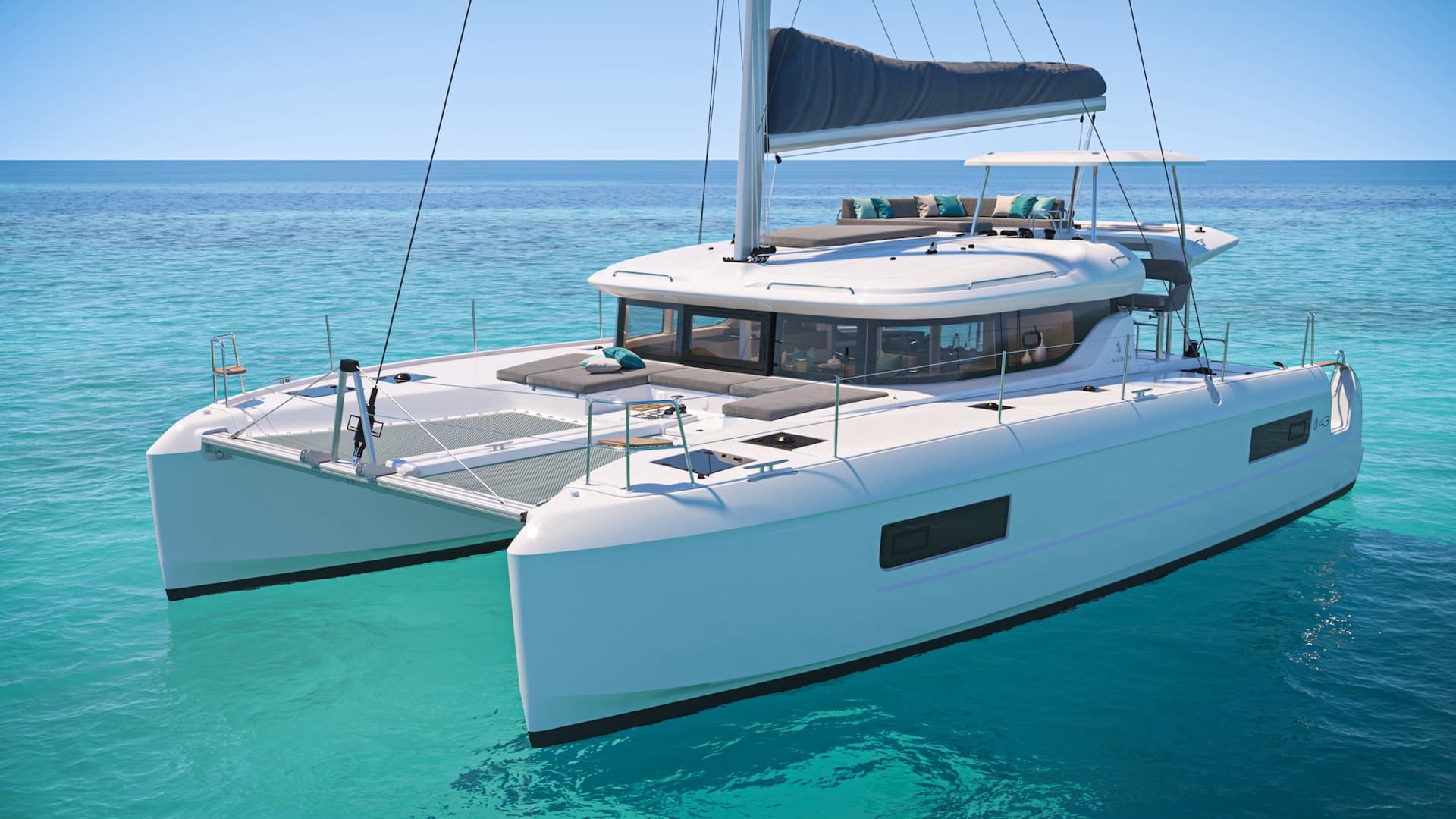
Cruising CatamaranThe Lagoon 43 succeeds the world's best-selling cruising catamaran, the Lagoon 42, introducing a semi-flybridge concept, forward cockpit, and innovative aft hull entries. Revealed at Cannes in September 2024, the 43 builds on the 42's proven VPLP hull design with more interior volume, a larger sail plan, and 57 HP engines as standard.
Show 2 awards
Show 5 key features
Updated 10 June 2026 · By Hulls.io Editorial
The Lagoon 43: A Complete Guide
The Lagoon 43 is the successor to the Lagoon 42, the best-selling cruising catamaran ever built. Announced in March 2024 and given its world premiere at the Cannes Yachting Festival in September 2024, the 43 represents a significant rethinking of Lagoon’s sub-50 ft offering rather than a simple refresh. The headline innovations — a semi-flybridge, a forward cockpit, and aft hull entries — are features previously reserved for Lagoon’s larger models. The design team is equally ambitious: VPLP Design returns for the naval architecture, Nauta Design handles the interiors, and Patrick le Quement (former head of Renault Design) shaped the exterior styling.
The 42 it replaces was produced from 2016 to 2024, with over 1,100 units launched — a production volume unmatched by any other model in the 40–45 ft catamaran segment. Lagoon stated that the 43 would be offered “at the same price as the outgoing 42” and backed this with a €52,000 early-order discount. The market responded: 70 units were sold within the first three months of availability, and Lagoon is targeting production of approximately 100 units per year at the Belleville-sur-Vie factory in France. First deliveries began in early-to-mid 2025.
A note on data: The Lagoon 43 is a very new model. As of early 2026, there is limited real-world ownership data, no meaningful used market history, and only a handful of independent sea trials from which to draw conclusions. The information in this guide draws on confirmed specifications from Lagoon, early press and boat-test data, and comparisons against the well-documented Lagoon 42. We have been careful to distinguish between verified facts and early impressions.
Hulls.io currently tracks 0 active listings for the Lagoon 43. As the fleet grows and used boats begin to appear on the brokerage market, our market intelligence database will build a comprehensive picture of value retention, pricing trends, and demand patterns — as it already does for the Lagoon 42.
Lagoon 43 Specifications
| Specification | Detail |
|---|---|
| LOA | 13.85 m (45 ft 5 in) |
| Hull length | 12.82 m (42 ft 1 in) |
| Beam | 7.69 m (25 ft 3 in) |
| Draft | 1.31 m (4 ft 4 in) |
| Light displacement (EEC) | 13,900 kg (30,644 lbs) |
| Mast clearance | 19.94 m (65 ft 5 in) |
| Mainsail area (high roach) | 60 m² |
| Mainsail area (square-top) | 68 m² (732 sq ft) |
| Furling genoa | 37 m² (398 sq ft) |
| Total upwind sail area | 105 m² (with square-top) |
| Code 0 (optional) | 73 m² (785 sq ft) |
| Engines | 2× Yanmar 4JH57, 57 HP |
| Fuel capacity | 1,140 litres (2× 570L) |
| Water capacity | 600 litres (2× 300L) |
| Cabin layouts | 3-cabin owner / 4-cabin charter |
| Heads | 3 (owner) / 4 (charter) |
| Naval architecture | VPLP Design |
| Interior design | Nauta Design |
| Exterior design | Patrick le Quement |
| Builder | Lagoon (Groupe Beneteau) |
| Build location | Belleville-sur-Vie, France |
| Construction | GRP sandwich, balsa core, carbon fibre reinforcement |
| CE category | A (Ocean) |
| Production start | Late 2024 |
The numbers reveal a boat that has grown meaningfully from its predecessor. The 43 is 1.05 m longer overall, 1,800 kg (15%) heavier, and carries double the fuel and water capacity of the Lagoon 42. The 57 HP Yanmar 4JH57 engines are the only option — there is no lower-powered alternative as there was on the 42. Construction uses GRP sandwich with balsa core, carbon fibre reinforcement in structural areas, and flax fibre in select non-structural panels. The CE Category A rating permits ocean passages in winds up to Beaufort 9 and seas to 10 metres.
How Does the Lagoon 43 Sail?
Important caveat: The sailing performance data below is drawn from a small number of early press sea trials. These tests were conducted in specific conditions and may not be representative of the boat’s behaviour across the full range of wind and sea states. Treat the following as early impressions rather than definitive benchmarks.
Upwind: In 18–19 knots of true wind speed, early test data shows the Lagoon 43 achieving approximately 7.5 knots upwind, tacking through roughly 100 degrees. At 65 degrees apparent wind angle in 16 knots TWS, 7.7 knots was recorded. At a tighter 50 degrees AWA, boat speed dropped to 6.3 knots. These are respectable figures for a 13,900 kg cruising catamaran, and the total upwind sail area of 105 m² (with square-top main and genoa) is a meaningful increase over the 42’s 90–94 m².
Reaching: On a beam reach in 19 knots of true wind, 8.5 knots was recorded. With the optional Code 0 deployed at 100 degrees true wind angle in 12–15 knots, 7–7.5 knots was achievable. As with the 42, the reaching angles are where the boat is most comfortable and most rewarding.
Light air: This is the area where early reviewers have flagged concerns. In 10–12 knots of true wind, the Lagoon 43 struggles to exceed 5 knots of boat speed. The 1,800 kg weight increase over the 42 is noticeable in lighter conditions. A Code 0 or asymmetric spinnaker appears even more essential than it was on the 42, which itself was no light-air flyer.
Under power: The twin 57 HP Yanmars deliver 7.1 knots at 2,200 RPM and 8.7 knots at 3,200 RPM. These are strong figures, and the doubled fuel capacity of 1,140 litres gives the 43 significantly greater range under power than the 42.
Key design change — genoa vs self-tacking jib: The Lagoon 42 used an aft-positioned mast and a self-tacking jib, which made short-handed sailing straightforward but limited pointing ability. The 43 moves the mast forward and replaces the self-tacking jib with a furling genoa. This provides more sail area and potentially better upwind performance, but at the cost of requiring active sheet management when tacking. The mast is also shorter (19.94 m vs 20.65 m), yet the overall sail plan is larger.
Honest assessment: It is too early to make definitive statements about the Lagoon 43’s sailing character. The early data suggests a boat that performs well in moderate-to-strong conditions but pays a price in light air for its additional weight and volume. Whether the shift from self-tacking jib to genoa proves to be a net positive for real-world cruising will become clearer as more owners report their experiences.
Interior Layout & Living Aboard
The Lagoon 43 is offered in two layouts: a 3-cabin owner’s version with three heads, and a 4-cabin charter version with four heads. The 4-cabin version is notable for having four truly equal-sized cabins, each with peninsula berths — a departure from the typical compromise of smaller aft cabins seen in most 40–45 ft catamarans. In the owner’s version, the master cabin layout has been reversed from the 42: the berth is now forward and the bathroom aft, which Lagoon claims improves the sense of space and access to natural light through forward-facing windows.
The saloon continues the Nauta Design interior language, with the galley-up configuration retained for direct cockpit serving. The most striking interior change is the triple-section sliding saloon door with carbon fibre reinforcement, which opens up significantly more of the saloon width to the cockpit than the 42’s arrangement.
Semi-flybridge: This is the Lagoon 43’s most talked-about innovation. The semi-flybridge — a first for any Lagoon under 50 ft — features an integrated U-shaped seating area for six, creating an elevated social zone that sits between a traditional hardtop and a full flybridge. The helm station sits on this level, offering panoramic visibility for navigation.
Forward cockpit: A dedicated forward seating area creates a third outdoor social zone — aft cockpit, semi-flybridge, and now a forward cockpit. This is a feature borrowed from larger Lagoon models (notably the 55 and 60) and gives the 43 three distinct living areas outdoors, each with a different character.
Aft hull entries: The 43 introduces step-through gates at the aft of each hull for pontoon boarding. This replaces the transom-only access of the 42 and makes the boat significantly easier to board from a marina pontoon or dinghy dock — a practical improvement for daily use.
What’s New: Lagoon 43 vs Lagoon 42
The Lagoon 43 is not a facelift of the 42 — it is a fundamentally different boat that happens to occupy the same market position. Below is a detailed comparison of the key differences for buyers weighing a new 43 against a used Lagoon 42.
- Length: 13.85 m vs 12.80 m — the 43 is 1.05 m longer overall.
- Beam: Virtually identical at 7.69 m vs 7.70 m. The “cat tax” for berthing remains the same.
- Displacement: 13,900 kg vs 12,100 kg — the 43 is 1,800 kg (15%) heavier. This is the single most significant change for sailing performance, particularly in light air.
- Fuel capacity: 1,140 litres vs 570 litres — doubled. A major improvement for extended cruising range under power.
- Water capacity: 600 litres vs 300 litres — doubled. The 42’s 300-litre tanks were a frequent criticism.
- Engines: 57 HP standard (only option) vs 45 HP standard with 57 HP optional on the 42. This simplifies the purchase decision.
- Sail plan: Furling genoa (37 m²) replaces self-tacking jib (35 m²). The mast moves forward (opposite to the 42’s aft position). Total upwind sail area increases from 90–94 m² to 105 m², despite a shorter mast (19.94 m vs 20.65 m).
- Semi-flybridge: New to the 43, replacing the 42’s simple hardtop. Adds an elevated social zone and improved helm visibility.
- Forward cockpit: New to the 43. Creates a third outdoor living area not present on the 42.
- Aft hull entries: New to the 43. Pontoon boarding access not available on the 42.
- Owner’s cabin: Reversed layout — berth forward, bathroom aft (opposite to the 42).
- 4-cabin version: Four equal-sized cabins with peninsula berths, versus the 42’s more conventional layout with compromised aft cabins.
The 43 is, by most measures, a more capable cruising platform than the 42. The doubled tankage alone transforms the boat’s self-sufficiency. However, the 15% weight increase is not trivial, and buyers who prioritise light-air sailing performance may find the 42 remains the better boat in that specific regard. For those considering a used Lagoon 42 versus ordering a new 43, the decision ultimately comes down to whether the additional features justify the price premium — and whether the 42’s 1,100-unit track record and well-understood maintenance profile outweigh the appeal of a newer design.
Buying a Lagoon 43: What to Know
New boat pricing: The Lagoon 43 has a base price of approximately €594,000–660,000 depending on configuration and market. Lagoon offered a €52,000 early-order discount during the initial sales period. As with all Lagoon models, options and commissioning can add 20–40% to the base price — a fully specified boat with electronics, air conditioning, watermaker, solar, and other cruising essentials will be significantly more expensive than the headline figure.
When will used boats appear? Based on the Lagoon 42’s history, the first used Lagoon 43s will likely appear on the brokerage market in 2027–2028 as early charter boats complete their initial management programmes. Private-owner resales may appear slightly earlier if circumstances change. Until then, the new-boat market is the only option.
Production and delivery: Series production runs at Belleville-sur-Vie, with a target of approximately 100 boats per year. Given the strong initial order book (70 units in three months), delivery wait times should be factored into any purchase decision. Lagoon has significant production capacity from the 42’s assembly line, which helps manage the transition.
Awards and recognition: The Lagoon 43 was nominated for European Yacht of the Year 2025, SAIL Magazine Top 10 Best Boats 2025, Cruising World Boat of the Year 2025 (Midsize Multihull), and Multihull of the Year 2025. It did not win any of these awards, though the breadth of nominations reflects the industry’s recognition of the model’s ambition.
First-generation considerations: As a new model in its first year of production, the Lagoon 43 carries the inherent risks of any first-generation boat. The Lagoon 42 itself had several early-production issues that were resolved in later build years (including a mast step recall on pre-2019 boats). Buyers ordering early 43s should be aware that minor fit-and-finish refinements are normal during the first 12–18 months of any production run.
3-cabin vs 4-cabin: As with the 42, the 3-cabin owner’s version is expected to command a premium on the eventual used market due to the larger master suite and additional storage. However, the 43’s 4-cabin version — with its four equal-sized cabins — may narrow this gap, as it offers a more compelling layout than the 42’s 4-cabin arrangement.
Lagoon 43 vs Competitors
The Lagoon 43 enters a competitive segment that has evolved considerably since the 42 launched in 2016. The following models represent the most direct alternatives, each with a distinct philosophy and set of trade-offs.
Lagoon 43 vs Fountaine Pajot FP 41
Fountaine Pajot’s newer entry in the 40–42 ft range offers a lower entry price from approximately €404,400 ex VAT — significantly undercutting the Lagoon 43. The FP 41 is a more conventional design without the semi-flybridge or forward cockpit, but offers Fountaine Pajot’s characteristically high build quality and efficient use of space. For buyers where budget is a primary concern, the FP 41 delivers a strong cruising package at a considerably lower price point.
Lagoon 43 vs Bali 4.2
The Catana Group’s offering takes a fundamentally different approach to catamaran design. The solid foredeck (no trampoline) provides more usable deck area, and the open-plan living concept maximises indoor-outdoor integration. At 11,400 kg, the Bali 4.2 is 2,500 kg lighter than the Lagoon 43 — a significant difference that should translate to better light-air performance. The Bali philosophy maximises living space at the expense of a more traditional sailing feel.
Lagoon 43 vs Leopard 42
Built by Robertson & Caine in South Africa, the Leopard 42 has a strong reputation for build quality — laminated cabinetry with properly finished edges, robust structural construction, and a cockpit-level helm that keeps the skipper closer to the action. The Leopard is a proven platform with an extensive track record in both the charter and private markets. For buyers who value construction quality above innovation, the Leopard remains a strong contender.
Lagoon 43 vs Excess 14
From the same parent company (Groupe Beneteau) but positioned as the performance-first alternative. The Excess 14 is lighter, sportier, and designed for sailors who want an engaged sailing experience over maximum living space. It targets a fundamentally different buyer — but its existence within the Beneteau stable highlights the Lagoon 43’s positioning as a comfort-and-volume-first cruiser. The two boats share some supply chain and dealer network, which may simplify servicing for owners in certain regions.
Lagoon 43 vs Lagoon 42 (Used)
Perhaps the most interesting competitor to the Lagoon 43 is the boat it replaces. With over 1,100 units on the water, the used Lagoon 42 offers a known quantity: a well-documented maintenance profile, extensive parts availability, a deep pool of comparable sales data, and a price point significantly below a new 43. The 42 is lighter, has a self-tacking jib for easier short-handed sailing, and has had eight years of production refinement. For buyers who do not need the 43’s additional tankage, semi-flybridge, or forward cockpit, a well-maintained used 42 may represent the better value proposition.
For value retention comparisons across all these models, visit the Hulls.io Market Intelligence tool.
Lagoon 43 Value Retention
Newest vintage = 100%. Older vintages shown as % of that price.
Based on median asking prices by model year. The newest model year in our dataset is used as the 100% reference point. The curve is smoothed so retention never increases as age increases — hover over data points to see raw values. Shaded band shows the 25th–75th percentile price range. Figures reflect asking prices from tracked listings, not final sale prices.