


Lagoon 620 for Sale
Sail CatamaranThe Lagoon 620 is available on Hulls.io with 1 listing currently for sale. This model is categorised as a Sail Catamaran.
Updated 10 June 2026 · By Hulls.io Editorial
The Lagoon 620: A Complete Guide
The Lagoon 620 is the 62-foot sailing catamaran that anchored the top of Lagoon’s production range for a decade. Launched at the Cannes Boat Show in September 2009, it was the largest series-production sailing catamaran in the world at introduction — a 32-tonne, 10-metre-beam platform that blurred the line between production cruiser and custom superyacht catamaran. Approximately 169 hulls were built between 2009 and 2019, a modest production volume that reflects both the price point (€2–3 million new) and the specialised nature of the buyer.
VPLP Design — the same naval architecture office that designed the Lagoon 42, 46 and 50 — was responsible for the hull forms. Marc Van Peteghem and Vincent Lauriot-Prévost applied their offshore racing pedigree (multiple Vendée Globe and America’s Cup campaigns) to produce a hull shape with fine entries, moderate beam-to-length ratio and a relatively deep draft of 1.55 metres for a catamaran of this size. Nauta Design of Milan handled the interior, applying the same light-oak, white-laminate design language that later became standard across the entire Lagoon range. The result is a catamaran that sails substantially better than its 32 tonnes suggest, while providing an interior volume that rivals 70-foot monohulls.
Lagoon is part of the CNB division of Groupe Bénéteau, the world’s largest recreational boatbuilder by volume. The brand was founded in 1984 and has since delivered over 6,000 catamarans across sail and power models — the largest production catamaran builder in the world by unit volume. The 620 was built at the Groupe Bénéteau facility in Bordeaux, France, alongside the Lagoon 52, 560 and other large-platform models. Production ceased in 2019 when the Lagoon 60 superseded it — a successor that is shorter (18.28 m vs 18.90 m), lighter, and carries the new-generation vertical bow and aft-positioned mast that now defines the Lagoon range.
Hulls.io currently tracks 1 active listing for the Lagoon 620, drawn from brokerages worldwide.
Showing 1–1 of 1 results
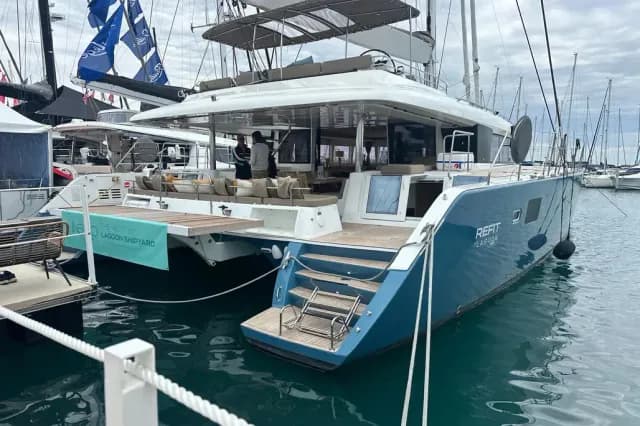
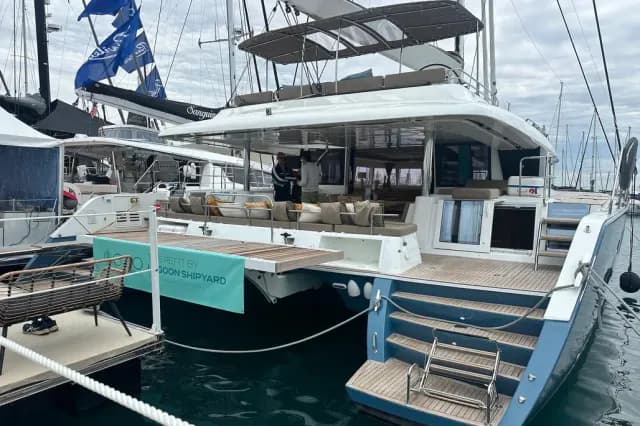
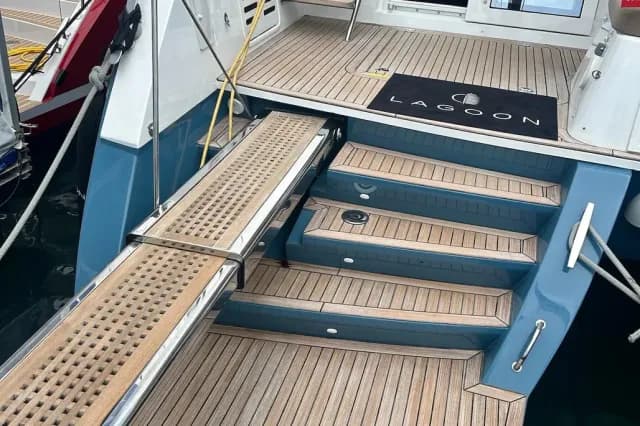
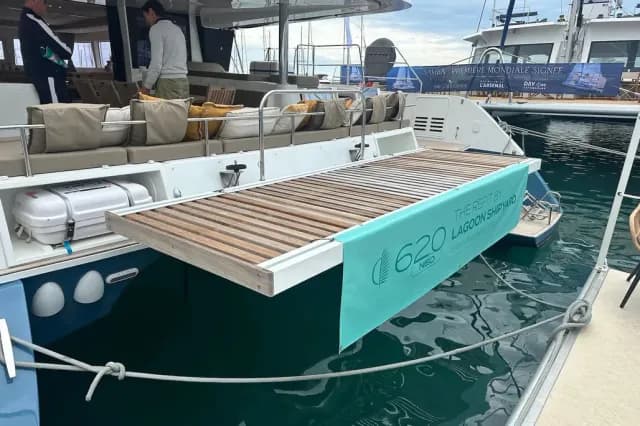
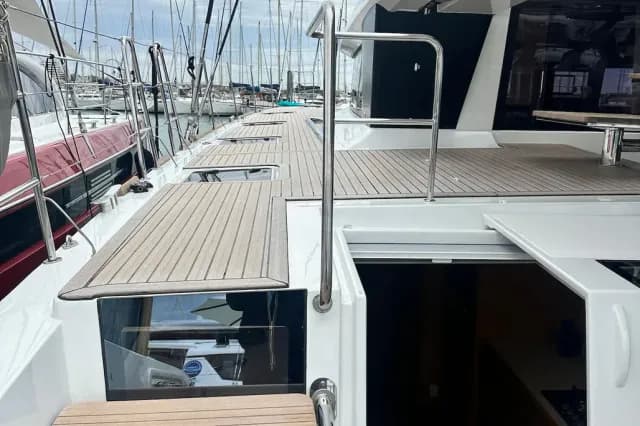
Lagoon 620 Specifications
| Specification | Detail |
|---|---|
| LOA | 18.90 m (62 ft) |
| Beam | 10.00 m (32 ft 10 in) |
| Draft | 1.55 m (5 ft 1 in) |
| Light displacement | 32,240 kg (71,079 lbs) |
| Mainsail area | 146 m² (1,572 sq ft) |
| Genoa | 91 m² (980 sq ft) |
| Gennaker (optional) | 190 m² (2,045 sq ft) |
| Total upwind sail area | 237 m² (2,551 sq ft) |
| Engines (standard) | 2× 110 HP diesel |
| Engines (option) | 2× Volvo Penta D3-150, 150 HP |
| Fuel capacity | 1,300 litres (343 US gal) |
| Water capacity | 960 litres (254 US gal) |
| Cabin layouts | 4 / 5 / 6-cabin configurations |
| Naval architecture | VPLP Design |
| Interior design | Nauta Design |
| Builder | Lagoon (Groupe Bénéteau), Bordeaux, France |
| CE category | A (Ocean) |
| Production years | 2009–2019 |
| Successor | Lagoon 60 |
| Estimated hulls built | ≈169 |
The defining numbers are the 10-metre beam and 32-tonne displacement. This is a genuinely large vessel — wider than many 80-foot monohulls and heavier than most 50-foot production catamarans by a factor of 1.6. The 10-metre beam creates hulls wide enough to accommodate full-width double cabins with standing headroom, walk-in wardrobes and en-suite heads that would not disgrace a shore-side apartment. The beam also generates enormous form stability, making the 620 an exceptionally steady platform at anchor and in a seaway.
Construction is vacuum-infused polyester GRP with a balsa-cored sandwich above the waterline and solid laminate below — standard production catamaran construction, proven across thousands of Lagoon hulls. The 1.55-metre draft is deeper than many competitors in this size class, which VPLP specified deliberately to improve windward performance and directional stability. The trade-off is a reduced ability to access the shallowest anchorages.
The standard twin 110 HP diesels are adequate for marina manoeuvring and light-air motoring at 8–9 knots. The optional 150 HP Volvo Penta D3 upgrade delivers approximately 10 knots at cruise and is the specification of choice for owners who plan extended motoring passages. The 1,300-litre fuel capacity provides a motoring range of approximately 400–500 nautical miles at 8-knot cruise, and the 960-litre water tanks support genuine offshore self-sufficiency.
Performance & Sailing
Upwind: The Lagoon 620 carries 237 m² of upwind sail area (146 m² mainsail, 91 m² genoa), producing a sail-area-to-displacement ratio that is respectable for a 32-tonne catamaran. In 15 knots of true wind, expect 6–7 knots upwind at approximately 50–55 degrees apparent. The 1.55-metre draft and VPLP’s fine hull entries keep leeway manageable. Tacking angles are wide at 100–110 degrees — characteristic of all large cruising catamarans — but the 620 tracks well between tacks and carries its way through the eye of the wind reliably.
Reaching & downwind: This is where the 620 transforms. With the optional 190 m² gennaker deployed in 15–20 knots of true wind, the boat accelerates to 10–12 knots on a broad reach. In sustained trade wind conditions (15–20 knots, 120–150 degrees apparent), 9–10 knots is a realistic cruising speed under sail alone. At these speeds, the 32-tonne hull develops its own momentum, and the ride becomes remarkably stable and quiet — one of the signature advantages of a heavy-displacement catamaran.
Under power: With the optional twin 150 HP Volvos, the 620 motors at approximately 10 knots at cruise and 11 knots at wide-open throttle. The standard 110 HP engines deliver 8–9 knots at comfortable RPM. Fuel consumption at 8-knot cruise is approximately 20–25 litres per hour combined, giving a theoretical motoring range of approximately 400–500 nautical miles from the 1,300-litre tanks. Twin engines with saildrives provide excellent close-quarters manoeuvrability through differential thrust, though the 10-metre beam demands careful planning in marina berths and turning basins.
Sea-keeping: CE Category A (Ocean) certifies the 620 for unrestricted offshore sailing. The 10-metre beam provides exceptional stability — heeling is virtually non-existent, and the motion in a seaway is the slow, gentle roll of a stable platform rather than the snap roll of a lighter catamaran. The flat bridgedeck underside will slap in steep short chop at speed, which is characteristic of all bridgedeck catamarans, but the 620’s weight dampens this better than lighter boats.
Passage-making: Multiple Lagoon 620s have completed transatlantic crossings and circumnavigations. The combination of 1,300-litre fuel tanks, 960-litre water tanks, CE Category A certification, and the VPLP hull design makes the 620 a genuinely capable bluewater yacht. Its passage-making credentials are not theoretical — they are demonstrated by a decade of owners crossing oceans.
Interior Layout & Design
The interior was designed by Nauta Design of Milan, the same studio responsible for interiors across the Lagoon range. At 10 metres of beam, the 620 provides interior spaces that are unprecedented for a sailing catamaran. Each hull is wide enough for full-beam cabins with island double berths, standing headroom throughout, walk-in wardrobes, and en-suite heads with separate shower stalls. The overall volume approaches that of a 70-foot monohull — without the monohull’s heel angle.
The Lagoon 620 was offered in four, five and six-cabin configurations. The four-cabin owner’s version places a full-beam master suite in the starboard hull with a dedicated office, dressing area, and en-suite head with separate shower — a genuine owner’s stateroom by any standard. The port hull accommodates two guest cabins with shared or en-suite heads. A crew cabin with separate access is standard on the four-cabin version. The six-cabin charter version fits three doubles per hull with six heads, accommodating up to twelve guests for professional charter operation.
The saloon is a single open-plan space stretching across the full 10-metre beam of the bridgedeck. Floor-to-ceiling glazing on both sides floods the space with natural light and provides panoramic views at anchor. The galley is positioned on the main deck level, opening to the cockpit through a large sliding door — the galley-up arrangement that has become standard across all Lagoon models. At this size, the galley is fully professional: a four-burner hob, full-size oven, large refrigerator and freezer, and counter space adequate for provisioning a multi-week passage or a charter with twelve guests.
The flybridge is the 620’s most distinctive feature. At approximately 35 m², it is larger than the entire cockpit area of most 50-foot catamarans. It accommodates a forward helm station with bench seating, a large U-shaped settee with dining table amidships, a sunpad aft, and a wet bar. A rigid bimini provides permanent shade. The flybridge is the primary living space in fair weather and the primary social space at all times.
The aft cockpit provides a second outdoor dining area with seating for eight to ten, direct access to the saloon, and steps down to the swim platform. A hydraulic tender garage beneath the cockpit sole is standard on most specifications, accommodating a 3.5-metre tender with outboard — eliminating the need for davits and simplifying tender deployment and recovery.
Lagoon 620 Ownership: What to Expect
The Lagoon 620 occupies a distinct ownership niche: too large and expensive for casual cruising, but produced in sufficient volume to avoid the bespoke maintenance costs of a custom-built catamaran. Owners fall into three categories — private long-range cruisers, charter-programme participants, and liveaboards.
- New-build pricing (historical): The Lagoon 620 is no longer in production (replaced by the Lagoon 60 in 2019). New-build pricing ranged from approximately €2,000,000 to €3,000,000 depending on cabin layout, engine specification and equipment level. The successor Lagoon 60 starts at approximately €2,500,000.
- Used market: Used Lagoon 620s currently list between approximately €1,100,000 and €1,900,000 depending on year, hours, configuration and condition. Older 2010–2013 examples at the lower end of the range often require significant refit investment (rigging, electronics, soft furnishings, mechanical systems). Well-maintained 2016–2019 examples in private-owner condition command premiums above €1,500,000.
- Annual operating costs: Insurance at 1.0–1.5% of hull value, catamaran-width berthing for a 10-metre beam (the most expensive category at most marinas), twin diesel engine servicing, saildrive maintenance, antifouling on two hulls, rigging inspection, and professional maintenance. Expect €60,000–€120,000 annually in the Mediterranean, excluding berthing fees.
- Refit economics: A comprehensive refit of a 2010–2014 Lagoon 620 (new rigging, electronics, sails, mechanical overhaul, interior refresh) can cost €400,000–€800,000. This makes the total cost of a used 620 plus refit comparable to a new Lagoon 60 at €2,500,000+. The refit route offers a larger boat with known condition; the new-build route offers warranty, the latest design, and no legacy issues.
- Charter income: A six-cabin Lagoon 620 in a Caribbean or Mediterranean charter fleet generates €150,000–€300,000 in annual gross charter revenue depending on utilisation, weekly rate, and management company. Net income after management fees, maintenance and insurance is typically 25–40% of gross. The 620’s size and cabin count make it competitive in the crewed-charter segment.
The critical ownership decision is refit vs new-build. With used 620s available at €1.1–1.9M and the successor Lagoon 60 starting at approximately €2.5M, a used 620 in good condition offers more boat per euro — but only if the refit budget is accurately estimated and the hull and structure are sound.
How to Buy a Lagoon 620
New vs used: The Lagoon 620 is out of production. All transactions are used-boat sales. The replacement Lagoon 60 is available new through the Lagoon dealer network. The 60 is shorter (18.28 m vs 18.90 m), carries the new-generation vertical bow and aft-positioned mast, and benefits from a decade of engineering refinement. Buyers choosing between a used 620 and a new 60 should factor in the cost of bringing a used 620 to equivalent mechanical and electronic condition.
The Lagoon range: The 620 sat at the top of Lagoon’s sailing catamaran lineup during its production years. The current range extends from the Lagoon 40 to the Lagoon 65. Buyers considering a used 620 for private cruising should evaluate whether the Lagoon 50 or the Lagoon 55 would satisfy their space requirements at substantially lower acquisition and operating costs.
Key Considerations for Buyers
- Age and condition variance: With a ten-year production run (2009–2019), the age range of available boats spans 7 to 17 years. A 2010 hull and a 2019 hull are fundamentally different propositions in terms of systems condition, electronics generation, and remaining useful life of mechanical components. Price accordingly.
- Charter history: Many Lagoon 620s spent years in professional charter fleets. Ex-charter boats carry higher engine hours, more cosmetic wear, and require closer scrutiny of structural components. Request full charter booking records, engine hours, and professional maintenance logs.
- Standing rigging: On a catamaran of this size, standing rigging replacement is a €30,000–€50,000 operation. Most rigging manufacturers recommend replacement at 10–12 years regardless of visual condition. Factor rigging age into any pre-2015 purchase.
- Saildrive seals: Twin saildrives with rubber lip seals that degrade over time. Budget for seal replacement every 5–7 years (€3,000–€5,000 per side at this scale). A failed saildrive seal allows water ingress into the engine compartment.
- 10-metre beam berthing: The Lagoon 620 requires catamaran-width berths everywhere. In the Mediterranean, berths for a 10-metre-beam vessel are scarce and priced at a significant premium. Factor berthing availability and cost into your cruising plan before committing to the purchase.
- Survey requirements: A multihull-experienced surveyor is essential. The survey should cover bridgedeck laminate, hull-to-crossbeam joints, all structural bulkheads, mast step compression loading, and core sampling in the bridgedeck and foredeck to check for moisture ingress. At this value, a thorough survey is a small fraction of the total investment.
The Lagoon 620 is a serious bluewater yacht that demands serious due diligence. The reward for thorough inspection is a genuinely ocean-capable catamaran with interior volume and comfort that no monohull under 80 feet can match.
Lagoon 620 vs Competitors
The 60–65 ft sailing catamaran segment is a small, specialised market with limited production volume from each builder. Competitors include the Fountaine Pajot Alegria 67, the Sunreef 60, and the Lagoon’s own successor, the Lagoon 60.
Lagoon 620 vs Lagoon 60
The Lagoon 60 (18.28 m LOA, 9.87 m beam, built from 2020) is the 620’s direct successor. It is shorter by 0.62 m, marginally narrower, and lighter. The 60 carries the new-generation vertical bow, aft-positioned mast, and self-tacking jib that the 620 does not have — changes that improve upwind sailing performance and reduce the crew required for tacking. The 60’s interior benefits from a decade of Nauta Design refinement. New pricing starts at approximately €2,500,000. Against the 60, a used 620 in good condition at €1.3–1.9M offers more length, comparable beam, and proven ocean-crossing credentials at a significantly lower entry price. The 620’s disadvantage is the older-generation rig, higher maintenance burden, and the absence of manufacturer warranty.
Lagoon 620 vs Fountaine Pajot Alegria 67
The Fountaine Pajot Alegria 67 (20.44 m LOA, 10.24 m beam, approximately 35,400 kg displacement, built from 2019) is a newer, larger and more expensive competitor. The Alegria 67 is the current flagship of Fountaine Pajot’s sailing range, offering more length, more modern systems, and a contemporary interior by Berret-Racoupeau. New pricing starts at approximately €3,000,000+. Used examples from early production are scarce. Against the 620, the Alegria 67 is the more modern design with better sailing performance per tonne. The 620 counters with dramatically lower used pricing, a decade-long track record, and a larger pool of available used boats.
Lagoon 620 vs Sunreef 60
The Sunreef 60 (18.29 m LOA, 10.04 m beam, built in Gdansk, Poland) is a semi-custom catamaran where each hull is finished to the owner’s specification. Build quality and interior finish are a class above production-line Lagoons — at a corresponding price premium. New Sunreef 60 pricing starts at approximately €3,500,000 depending on specification. Used examples are rare and hold their value well. The Sunreef is the choice for buyers who prioritise bespoke finish and are willing to pay for it. The Lagoon 620 offers volume production benefits: better parts availability, a wider service network, more comparable sales data, and a lower entry price on the used market.
For a full interactive comparison between the Lagoon 620 and other models, visit the Hulls.io Market Intelligence tool.
Lagoon 620 Value Retention
Newest vintage = 100%. Older vintages shown as % of that price.
Based on median asking prices by model year. The newest model year in our dataset is used as the 100% reference point. The curve is smoothed so retention never increases as age increases — hover over data points to see raw values. Shaded band shows the 25th–75th percentile price range. Figures reflect asking prices from tracked listings, not final sale prices.